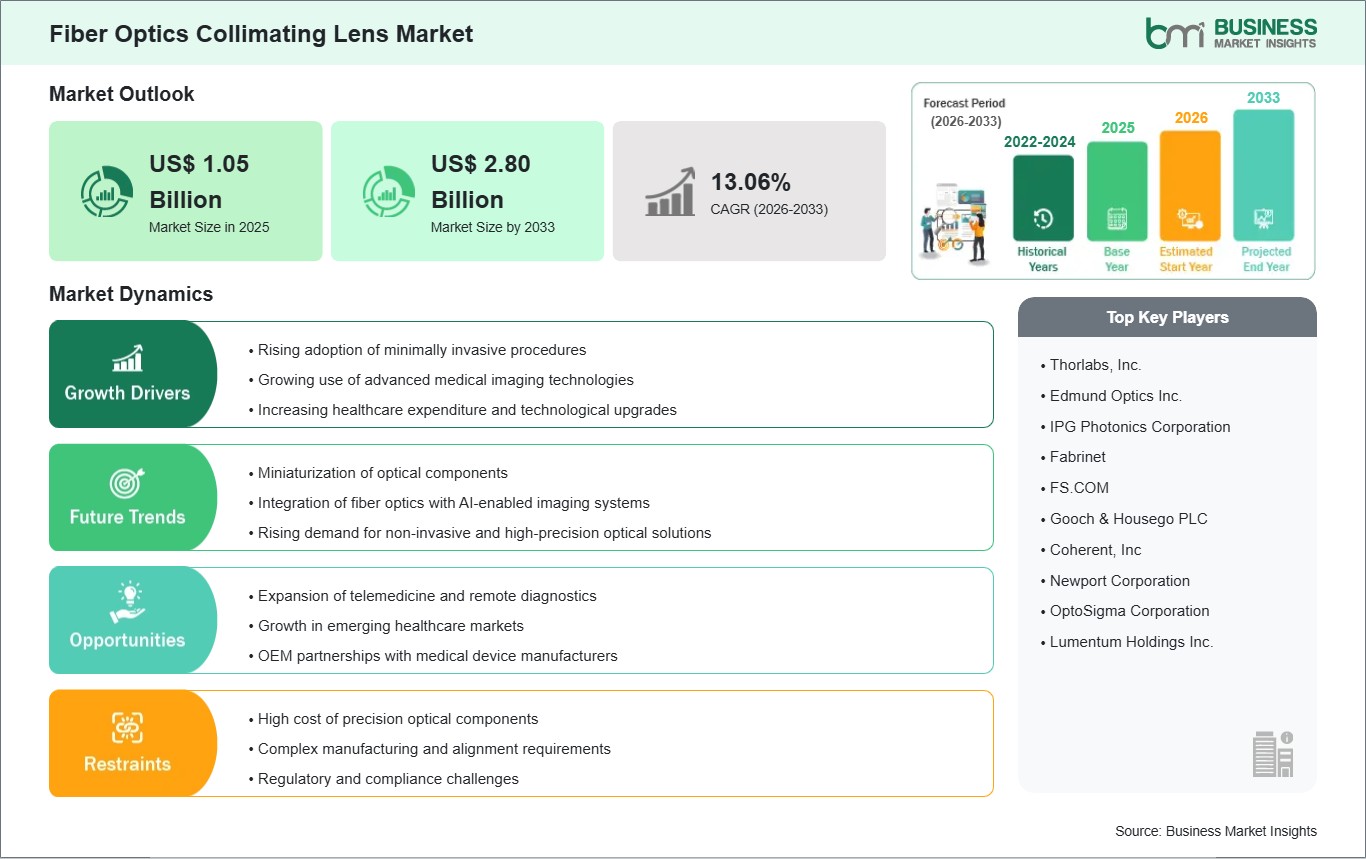
The Fiber Optics Collimating Lens Device market size is expected to reach US$ 2.80 billion by 2033 from US$ 1.05 billion in 2025. The market is estimated to record a CAGR of 13.06% from 2026 to 2033
The global fiber optics collimating lens market is experiencing stable growth due in large part to the acceptance of new advanced optical technology within the fields of Medical Diagnostics, Medical Imaging, and Laser-Based Therapies. The fiber optic collimator lens is key to providing precise light transmission, beam shaping capability, and accuracy of signal all of which are necessary for Optical Coherence Tomography (OCT), Endoscopy, Microscopy, and Minimally Invasive Surgical Procedures. The need for High-Resolution Imaging, increasing prevalence of Chronic Illnesses, and an increased focus on Non-Invasive Diagnostics are driving the growth of the market. The growth of the market is also currently being fueled by a number of innovations in lens design including Aspheric Lenses and GRIN Lenses that improve overall performance within Compact and Portable Medical Devices and thereby contribute to building momentum for the industry.
North America continues to dominate the market due to its superior healthcare systems and the presence of numerous medical device manufacturers and a large number of sophisticated imaging and laser systems on the market in North America. Europe is in close proximity to North America again due to continual merger and acquisition activities, as well as increased investment in the medical and technological fields, resulting in many innovative medical devices in production in the European region. The Asia Pacific region will experience the highest amount of growth in the coming years as a result of an expanding number of hospitals and healthcare facilities, increasing medical tourism from numerous sources, and the introduction of new government programs to modernize health care facilities within the region. Additionally, with the continued growth of fiber optics collimate lenses, along with an increasing number of original-equipment-manufacturer (OEM) partnerships, as well as a movement toward using lower-cost, less invasive digital healthcare technology, the future of the fiber optic collimating lens market will be strong for many years to come.

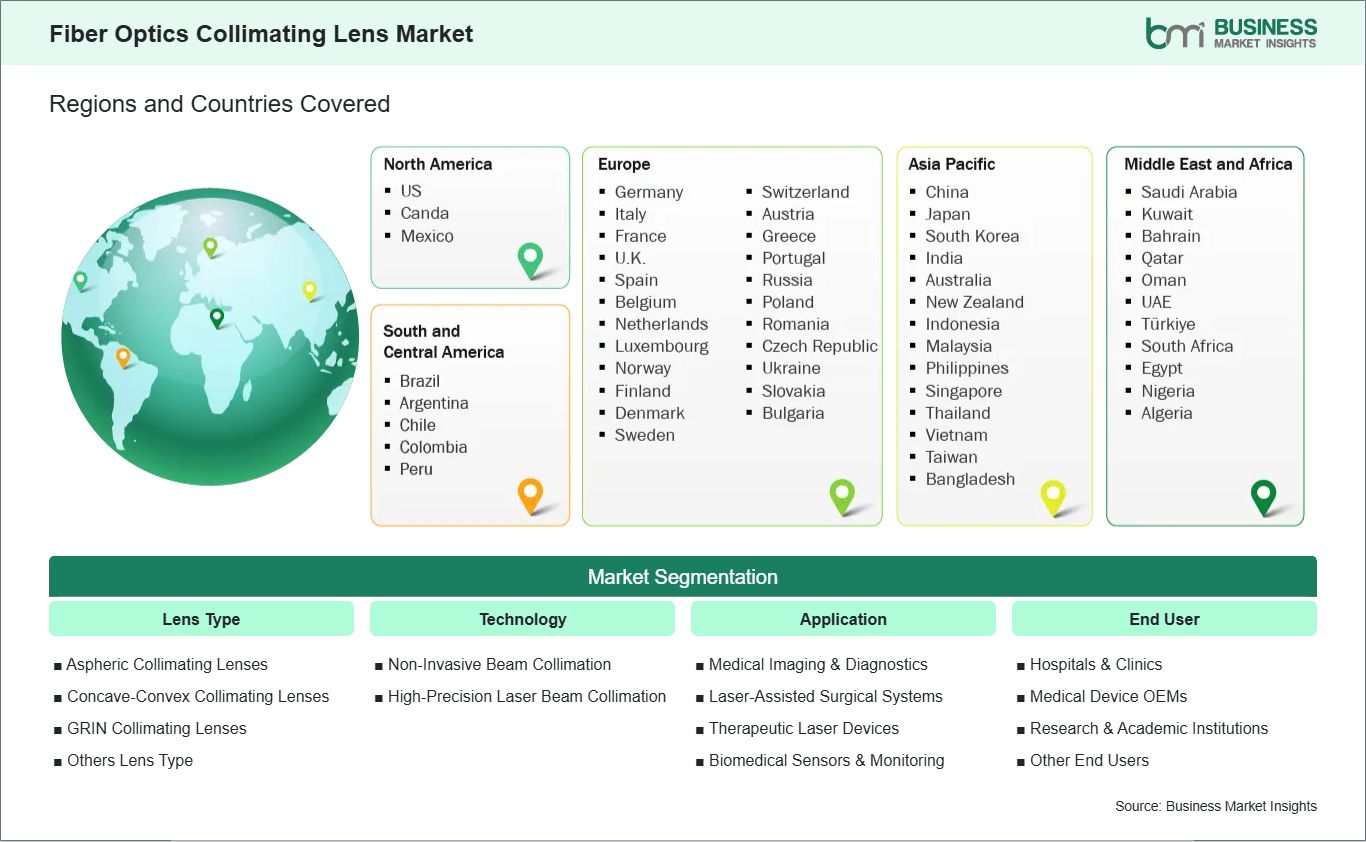
Key segments that contributed to the derivation of the Fiber Optics Collimating Lens Device market analysis are lens type, technology, application, and end user.
The global fiber optics collimating lens industry within healthcare is the increasing application of latest technologies with respect to medical imaging technologies and minimally invasive procedures. Modern diagnostic and therapeutic techniques that use optical coherency tomography (OCT), endoscopies, laser based (assisted) surgeries as well as high resolution microscopes to obtain a precise picture of anatomy depend heavily on the ability of collimated lenses to accurately transmit and control the light beam being directed at the diagnostic or therapeutic site. Fiber optics collimating lenses also offer enhanced image clarity; diagnostic/procedural accuracy; as well as improved patient safety by enabling the accurate collimation of a light beam and allowing it to be accurately aligned with an optical path. In conjunction with their growing responsibilities related to early disease detection, healthcare providers are more frequently looking to provide therapies through the use of minimally invasive technologies, thereby minimizing potential patient recovery time and limiting hospital stays. Consequently, as the prevalence of chronic and age-related diseases such as cardiovascular disorders and cancer are increasing globally, more and more healthcare providers and medical device manufacturers are utilizing the latest advancements in wavelength-specific imaging and laser based therapies as part of their unending quest to enhance the effectiveness, safety and efficiency of the advancement of healthcare delivery. Therefore, as a result of this continued increasing demand for healthcare providers and medical device manufacturers to develop and increase access to the next generation of diagnostic and surgical instruments as well as develop new methods to minimize the risks to patients involved in their surgical procedures, many healthcare providers and medical device manufacturers are now integrating fiber optics collimating lenses into their next generation diagnostic and surgical equipment, which is driving the global market for advanced medical imaging and minimally invasive care.
This shift from traditional care methods to more decentralized health care models will create a strong need for compact, lightweight, high-performance optical components that can integrate seamlessly into portable medical imaging and sensing devices. Fibre optic collimating lenses are ideally suited to facilitate this shift by providing precise control of light in smaller and more energy-efficient medical devices. Emerging markets represent a significant opportunity for both governments and private health care providers to provide affordable diagnostic solutions and increase access to health services in rural and underserved areas. Additionally, increased collaboration between manufacturers of optical components and manufacturers of medical devices allows for the development of customized collimating lens solutions designed specifically for clinical applications. As digital health, telemedicine, remote diagnostics and other innovative medical technologies gain more traction, demand for reliable fibre optic-based optical systems will likely continue to grow rapidly, and thus providing long-term growth opportunities for manufacturers in the fibre optic collimating lens market.
By lens type, the fiber optics collimating lens market is segmented into aspheric collimating lenses, concave-convex collimating lenses, GRIN (gradient-index) collimating lenses, and others. The aspheric collimating lenses segment dominated the market in 2025. Their dominance is largely driven by their ability to minimize optical aberrations and deliver high-resolution performance in medical imaging and laser systems.
By technology, the market is segmented into non-invasive beam collimation, high-precision laser beam collimation. The high-precision laser beam collimation segment held the largest share of the market in 2025. The segment's expansion is attributed to the growing use of laser-based surgical and therapeutic procedures requiring accurate beam control.
By application, the fiber optics collimating lens market is segmented into medical imaging & diagnostics, laser-assisted surgical systems, therapeutic laser devices, biomedical sensors & monitoring. The medical imaging & diagnostics segment dominated the market in 2025. The growth is driven by the rising demand for advanced imaging modalities such as OCT, endoscopy, and microscopy.
By end user, the market is segmented into hospitals & clinics, medical device OEMs, research & academic institutions, others. The hospitals & clinics segment held the largest share of the market in 2025. This growth is supported by the increasing adoption of advanced diagnostic and laser-assisted treatment equipment in clinical settings.
| Report Attribute | Details |
|---|---|
| Market size in 2025 | US$ 1.05 Billion |
| Market Size by 2033 | US$ 2.80 Billion |
| Global CAGR (2026 - 2033) | 13.06% |
| Historical Data | 2022-2024 |
| Forecast period | 2026-2033 |
| Segments Covered | By Lens Type
|
| Regions and Countries Covered | North America
|
| Market leaders and key company profiles |
|
The "Fiber Optics Collimating Lens Device Market Size and Forecast (2022 - 2033)" report provides a detailed analysis of the market covering below areas:
The geographical scope of the Fiber Optics Collimating Lens Device market report is divided into five regions: North America, Asia Pacific, Europe, Middle East & Africa, and South & Central America. The Fiber Optics Collimating Lens Device market in Asia Pacific is expected to grow significantly during the forecast period.
The Asia-Pacific Fiber Optics Collimating Lens Device market is segmented into China, Japan, South Korea, India, Australia, New Zealand, Indonesia, Malaysia, the Philippines, Singapore, Thailand, Vietnam, Taiwan, Bangladesh, and the Rest of Asia. In the Asia Pacific region, strong growth is occurring in the healthcare sector with regard to fiber optics collimating lenses as a result of significant advances made in medical technology and expanding healthcare facilities throughout the region. Some of the major countries that are seeing increasing use of advanced medical imaging systems, laser-assisted surgery equipment, and biomedical sensing technology (which require accurately collimated beams of light from fibre optics) are China, India, Japan, South Korea, and Australia. The increasing population size, an increasing number of patients suffering from chronic illnesses and eye disease, and an increasing need for earlier and more accurate diagnoses all contribute to increased use of optical imaging systems and laser-assisted medical devices within this region. Additionally, government initiatives aimed at increasing access to health care and reducing the number of diagnostic gaps will further create opportunities for growth.
The rapid advances being witnessed in imaging technology and laser efficiency provide a great opportunity for manufacturing and new applications of aspherical (aspheric) and GRIN collimate (collimators) lenses, particularly within a growing range of compact/portable medical instruments. In addition, the Asia-Pacific region continues to benefit from strong manufacturing capabilities and a significant number of medical device Original Equipment Manufacturers (OEMs), allowing these new optical components to be produced economically as well as more readily adopted. Lastly, there is a substantial increase in the use of fibre optic diagnostic/therapeutic tools due to the growing trend towards Minimally Invasive Surgery (MIS) and outpatient care; however, the continued uneven access to healthcare in rural regions and a shortage of trained professionals may restrict some markets. The increasing trend of growing healthcare spending, expanding medical tourism, and the continuous investment into research and development will likely provide the best opportunity for continued growth in the fibre optics collimating lens market throughout the Asia-Pacific region.

The Fiber Optics Collimating Lens Device market is evaluated by gathering qualitative and quantitative data post primary and secondary research, which includes important corporate publications, association data, and databases. A few of the key developments in the fiber optics collimating lens market are:
The Fiber Optics Collimating Lens Market is valued at US$ 1.05 Billion in 2025, it is projected to reach US$ 2.80 Billion by 2033.
As per our report Fiber Optics Collimating Lens Market, the market size is valued at US$ 1.05 Billion in 2025, projecting it to reach US$ 2.80 Billion by 2033. This translates to a CAGR of approximately 13.06% during the forecast period.
The Fiber Optics Collimating Lens Market report typically cover these key segments-
The historic period, base year, and forecast period can vary slightly depending on the specific market research report. However, for the Fiber Optics Collimating Lens Market report:
The Fiber Optics Collimating Lens Market is populated by several key players, each contributing to its growth and innovation. Some of the major players include:
The Fiber Optics Collimating Lens Market report is valuable for diverse stakeholders, including:
Essentially, anyone involved in or considering involvement in the Fiber Optics Collimating Lens Market value chain can benefit from the information contained in a comprehensive market report.
Please tell us your area of interest
(Market Segments/ Regions and Countries/ Companies)