Market Summary
Executive Summary and Global Market Analysis
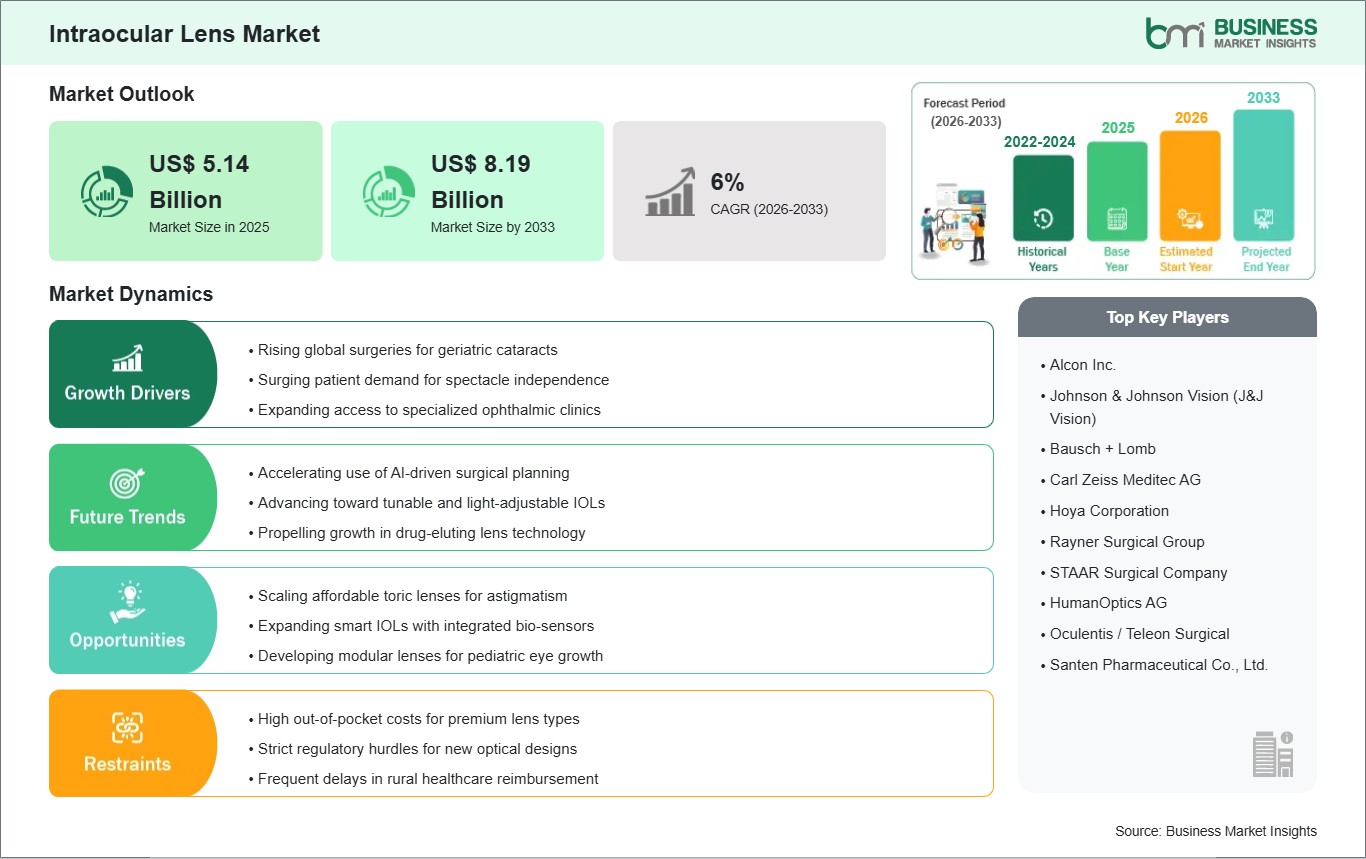
Intraocular Lens (IOL) are pivotal for replacing the natural lens during cataract surgery, effectively restoring clear vision and correcting refractive errors. These devices are essential for core ophthalmology segments: hospitals, eye specialty clinics, and ambulatory surgical centers (ASCs). IOLs offer advantages, including high success rates in treating cataracts, permanent vision correction, and enabling spectacle independence through premium lens technology. The market is fueled by the rapidly increasing global geriatric population susceptible to cataracts, the rising prevalence of diabetes accelerating cataract formation, and growing patient demand for premium IOLs (multifocal, toric). Technological innovation leading to advanced lens designs and injector systems further drives procedural volume.
However, several challenges restrain market growth: the high cost of premium IOLs and advanced surgical procedures creates access barriers, especially in low-income countries. Complex reimbursement policies and varying coverage for premium lenses impact adoption rates. Furthermore, the industry faces constraints due to the potential for post-operative complications (e.g., posterior capsule opacification) and the shortage of skilled ophthalmologists in many developing regions. Despite these hurdles, opportunities arise with the expansion of outpatient cataract surgery centers, reducing overall procedure costs, increasing focus on refractive lens exchange (RLE) for younger patients, and substantial market penetration in the Asia-Pacific region, where the cataract burden is highest.
Segment Analysis
Intraocular Lens Market Segmentation
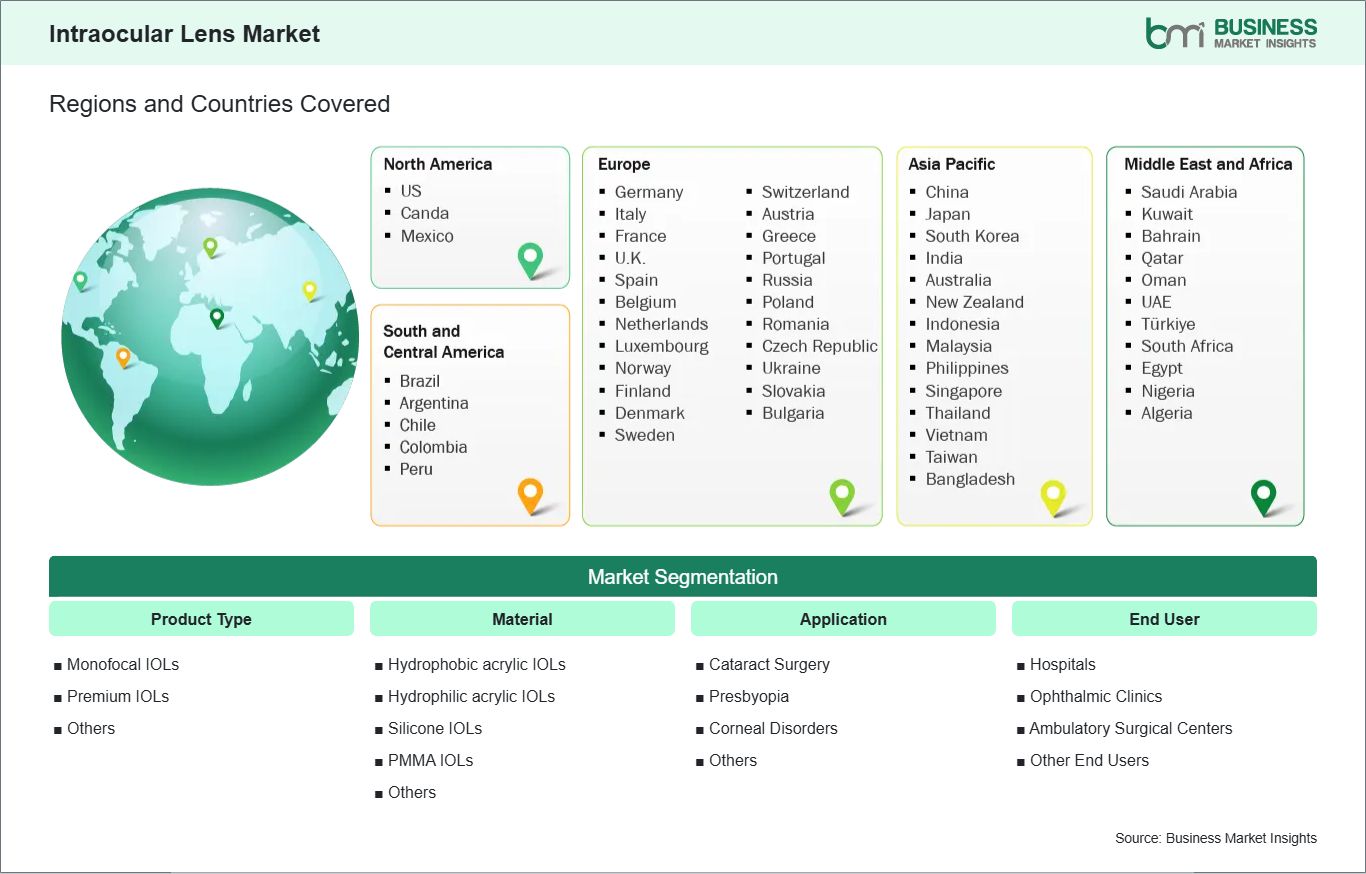
Key segments that contributed to the derivation of the Intraocular Lens Market analysis are product type, material, application, and end user.
- By Product Type, the market is segmented into Monofocal IOLs, Premium IOLs, and Others.
- By Material, the market is segmented into Hydrophobic acrylic IOLs, Hydrophilic acrylic IOLs, Silicone IOLs, PMMA (polymethyl methacrylate) IOLs, and Others.
- By Application, the market is segmented into Cataract Surgery, Presbyopia, Corneal Disorders, and Others.
- By End User, the market is segmented into Hospitals, Ophthalmic Clinics, Ambulatory Surgical Centers, and Other End Users
Market Forces
Intraocular Lens Market Drivers and Opportunities
Increasing Cataract Incidence and Aging Population
Cataracts, the clouding of the eye's natural lens, remain the leading cause of reversible blindness worldwide. Age is the most significant risk factor for cataract development; as global life expectancy rises, the patient pool requiring cataract surgery, and consequently IOL implantation, expands dramatically. This demographic shift provides a perpetual, non-cyclical demand base for IOLs, particularly in developed regions with established healthcare systems. Furthermore, chronic diseases such as diabetes, which accelerate cataract formation, are also growing globally, further ensuring the sustained volume of surgical procedures required for vision correction and restoration.
Growing Adoption of Premium IOLs and Customized Vision Solutions
Traditional monofocal lenses provide clear vision at only one distance (usually far), often requiring reading glasses afterward. Premium IOLs, including Multifocal, Trifocal, Toric (for astigmatism), and Extended Depth of Focus (EDOF) lenses, offer patients the chance for spectacle independence by correcting vision across near, intermediate, and far distances. Despite their higher cost, patient preference for these advanced outcomes is surging, driving the fastest growth segment of the market. Furthermore, innovative concepts like light-adjustable lenses allow surgeons to precisely fine-tune the lens power after it has been implanted, achieving unprecedented levels of visual accuracy and customization, which commands premium pricing and drives significant market value.
Size and Share Analysis
Intraocular Lens Market Size and Share Analysis
The Intraocular Lens Market demonstrates steady growth, with size and share analysis revealing evolving trends and competitive positioning among key players. The report further examines subsegments categorized within product type, material, application, and end user, offering insights into their contribution to overall market performance.
For instance, Monofocal IOLs subsegment holds a significant share of the market. Monofocal IOLs are typically used in routine cataract surgery, providing clear vision at a single focal point, often for distance. This segment, frequently made from hydrophobic acrylic, is driven by its cost-effectiveness and widespread reimbursement coverage.
Hospitals and Ambulatory Surgery Centers (ASCs) utilize IOLs for a high volume of surgical procedures, requiring pre-loaded systems and specialized tools. ASCs are picking up pace, largely driven by their efficiency and lower total episode costs compared to traditional hospital settings.
Report Coverage
Intraocular Lens Market Report Coverage and Deliverables
The "Intraocular Lens Market Size and Forecast (2022 - 2033)" report provides a detailed analysis of the market covering below areas:
- Intraocular Lens Market size and forecast at global, regional, and country levels for all the key market segments covered under the scope
- Intraocular Lens Market trends, as well as market dynamics such as drivers, restraints, and key opportunities
- Intraocular Lens Market analysis covering key market trends, global and regional framework, major players, regulations, and recent market developments
- Industry landscape and competition analysis covering market concentration, heat map analysis, prominent players, and recent developments for the Intraocular Lens Market
- Detailed company profiles, including SWOT analysis
Geographic Insights
Intraocular Lens Market Geographic Insights
The geographical scope of the Intraocular Lens Market report is divided into five regions: North America, Asia Pacific, Europe, the Middle East & Africa, and South & Central America.
For instance, the Asia-Pacific Intraocular Lens Market is segmented into China, Japan, South Korea, India, Australia, New Zealand, Indonesia, Malaysia, the Philippines, Singapore, Thailand, Vietnam, Taiwan, Bangladesh, and the Rest of Asia. The Asia-Pacific IOL market is driven by the rapidly aging demographic and the high prevalence of cataracts, which increases the patient pool for surgery.
The region is witnessing increased adoption of both premium IOLs (multifocal, toric) due to rising income, and cost-effective monofocal IOLs in public health initiatives. Growth is supported by the expansion of medical tourism and continuous advancements in surgical techniques. High patient volume and strategic investment in eye care solidify Asia-Pacific as the global leader for IOL market expansion.
Industry Activity
Recent Developments
The Intraocular Lens Market is evaluated by gathering qualitative and quantitative data post-primary and secondary research, which includes important corporate publications, association data, and databases. A few of the key developments in the Intraocular Lens Market are:
- In October 2025, Bausch + Lomb Corporation (NYSE/TSX: BLCO), a leading global eye health company dedicated to helping people see better to live better, announced that the U.S. Food and Drug Administration has approved the enVista®Envy™ full range of vision intraocular lens (IOL), which offers a continuous range of vision with excellent dysphotopsia tolerance on the widely used enVista IOL platform.
- In January 2025, Rayner announced the full commercial release of RayOne Galaxy and RayOne Galaxy Toric, marking a wider global rollout of its next-generation full range of focus intraocular lenses. In September 2024, Rayner unveiled the world’s first spiral IOL at the ESCRS congress in Barcelona.
Trust & Transparency
Research Methodology
The market analysis combines proprietary research with secondary data from government agencies, company disclosures, regulatory filings, industry databases and expert interviews. Market estimates are validated through data triangulation, cross-market benchmarking and analyst
review.
View Full Research Methodology
Key Sources Referred:
World Bank - Global Trade IndicatorsWorld Trade Organization (WTO)International Monetary Fund (IMF)International Trade Administration (ITA)Company WebsitesCompany Annual ReportsCompany Investor Presentations