
Ferroalloy Market Outlook: Size, Share, Trends, Growth Analysis, Competitive Landscape & Forecast, 2026-2033

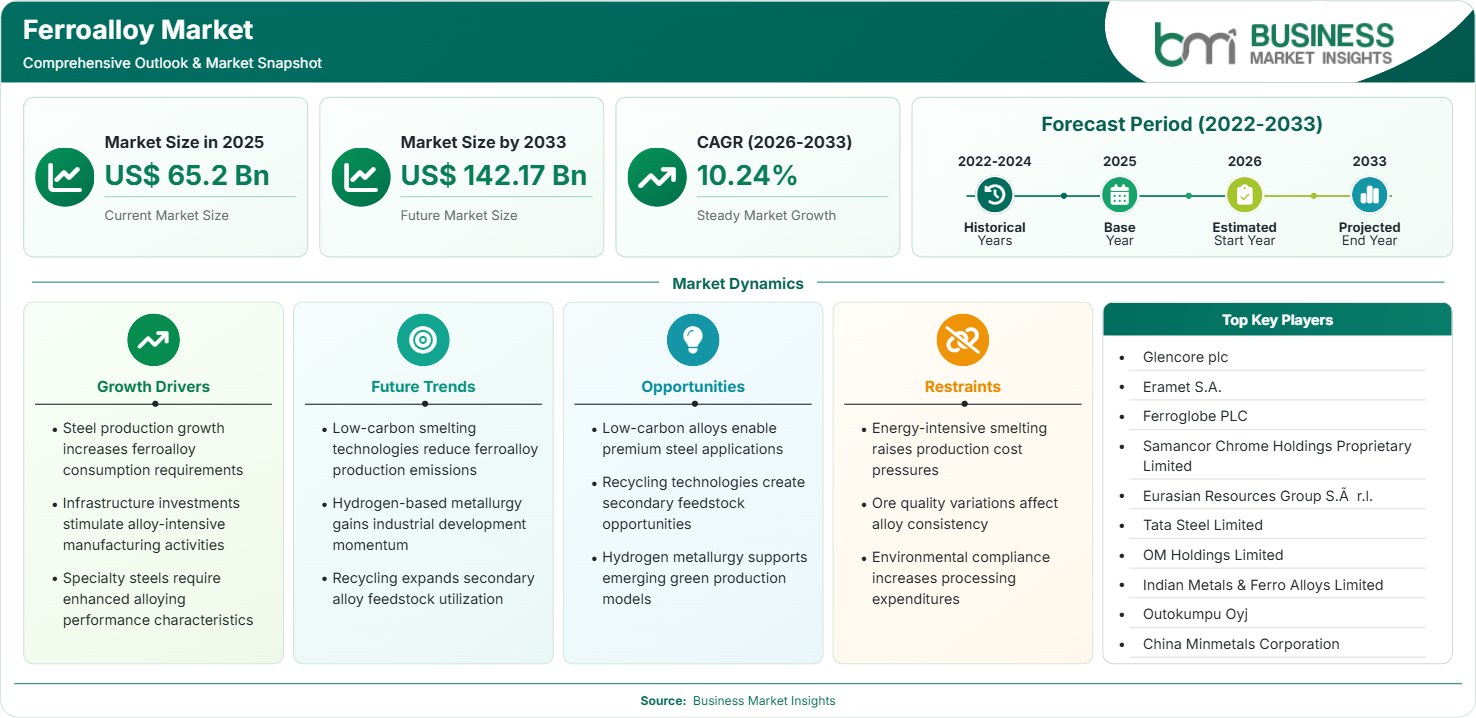
The Ferroalloy Market size was valued at US$ 65.2 Billion in 2025 and is projected to reach US$ 142.17 Billion by 2033, growing at a CAGR of 10.24% during 2026–2033. Rising steel consumption, stainless-steel capacity additions, infrastructure investment, decarbonized smelting technologies, and expanding transportation, energy, and industrial manufacturing activities continue creating strong demand opportunities.

Report Coverage
  • Type: Ferrosilicon, Ferromanganese, Ferrochromium, Others
  • Application: Carbon & Low Alloy Steel, Alloy Steel, Stainless Steel, Cast Iron, Others
US$ 65.2 Bn Market size in 2025
US$ 142.17 Bn Market Size by 2033
10.24% CAGR, 2026 - 2033
2026-2033 Forecast Period

AI Overview

Ferroalloy Market Summary

  • North America Region: Holds 12%–14% share in 2025, growing at 7.5%–8.5% CAGR during 2026–2033. Infrastructure modernization, specialty steel demand, and domestic manufacturing resilience support capacity utilization and strategic sourcing initiatives across regional supply chains. US market benefits from automotive, energy, and aerospace steel demand, advancing at approximately 7.8%–8.8% CAGR through 2033.
  • Fastest Growing Region: Asia Pacific holds 50%–54% share in 2025, growing at 11.5%–12.5% CAGR during 2026–2033. Expanding steelmaking capacity, industrialization, renewable energy construction, and transportation infrastructure development accelerate alloy consumption across major manufacturing economies.
  • Leading Segment: Ferrochromium holds 42%–46% share in 2025 and advances at 10.5%–11.5% CAGR. Stainless steel production growth, corrosion-resistant applications, and industrial equipment manufacturing continue supporting sustained consumption across multiple end-use industries.
  • High Growth Segment: Stainless Steel accounts for 29%–33% share in 2025 and expands at 11.5%–12.5% CAGR. Food processing, medical equipment, urban construction, and energy infrastructure projects maintain strong requirements for premium alloyed steel grades.
  • Key Market Opportunity: Development of low-carbon smelting technologies, renewable-energy-powered furnaces, circular metallurgy initiatives, and localized supply chains creates attractive investment opportunities while supporting sustainability objectives and regulatory compliance requirements.
  • Major Market Players: Glencore plc, Eramet S.A., Ferroglobe PLC, Samancor Chrome Holdings Proprietary Limited, Eurasian Resources Group S.à r.l., Tata Steel Limited, OM Holdings Limited, Indian Metals & Ferro Alloys Limited, Outokumpu Oyj, China Minmetals Corporation.
Strategic Insights

Ferroalloy Market: Strategic Insights

Ferroalloy Market Strategic Framework
FREE PDF
Request your free sample
Request free sample
Stakeholder View

Key Takeaways

  • It is becoming a key source of competitive advantage for companies to pursue vertical integration across mining, smelting, logistics, and alloy production, thereby gaining control over raw material costs and ensuring supply stability.
  • The strongest potential gain comes from using stainless steel, as demand for corrosion-resistant materials is rising due to increased needs for food-processing equipment, healthcare infrastructure, and energy-transition projects.
  • The use of energy-efficient submerged arc furnaces, process automation, and digital monitoring systems is increasing productivity while helping manufacturers reduce their environmental impact.
  • The economies of India and Southeast Asia have strong investment potential due to increased steel capacity, manufacturing expansion, and supportive industrial development programs.
  • Strategic acquisitions and partnerships increasingly focus on securing ore resources, expanding processing capacities, and improving access to regional steelmaking customers.
  • Sustainability-linked financing and decarbonization initiatives are influencing procurement decisions across steel and alloy value chains.
Geographic Outlook

Ferroalloy Market Regional Highlights

North America Ferroalloy Market

North America accounts for approximately 12%–14% of global demand in 2025 and is projected to register a CAGR of 7.5%–8.5% through 2033. Regional consumption is supported by infrastructure renewal, defense manufacturing, transportation equipment production, and specialty steel applications. The Ferroalloy Market share remains concentrated among integrated supply networks serving steel producers. Demand is increasingly shifting toward higher-performance alloy grades supporting energy, aerospace, and industrial modernization projects.

  • The programs aimed at modernizing infrastructure lead to increased demand for steel containing alloys in bridges, transportation corridors, and utility systems.
  • Initiatives aimed at domestic manufacturing promote the localization of supply chains and decrease the extent to which companies are affected by disruptions in overseas sourcing.
  • The use of alloys in the aerospace and defense sectors focuses on premium-grade materials to ensure strength and durability.
  • Investments in electric arc furnace steel production enhance demand visibility for alloy suppliers.

US Ferroalloy Market

The United States represents 74%–78% of the North American Ferroalloy Market demand and is expected to grow at 7.8%–8.8% CAGR through 2033. Demand originates from the automotive, infrastructure, machinery, and energy industries. Trade policy, strategic mineral security concerns, and manufacturing reshoring initiatives continue influencing procurement strategies and supplier diversification efforts.

  • The automotive industry's shift towards using advanced steel parts continues to drive demand for performance-enhancing alloys.
  • The need for corrosion-resistant and high-strength steel products rises as energy infrastructure is upgraded.
  • Investments in domestic steel capacity help meet stable long-term buying needs.
  • The development of manufacturing activities leads to greater consumption of specialized alloy inputs.

Europe Ferroalloy Market

Europe holds 18%–21% Ferroalloy Market share in 2025 and is forecast to expand at 8.0%–9.0% CAGR through 2033. Germany remains the leading country, while Eastern European manufacturing centers exhibit higher growth momentum near 9%–10%. Energy efficiency, sustainability targets, and industrial modernization support demand. Regional producers increasingly prioritize low-emission metallurgical technologies and circular-economy initiatives.

  • Germany's position as the leading country in the region is due to its strong capabilities in automobile and engineering equipment production.
  • In Poland and in other markets in Eastern Europe, expansion is showing greater strength as a result of rising industrial investment.
  • Sustainability regulations promote the use of production technologies that have a lower carbon footprint.
  • The need for specialized steel is driven by renewable-energy infrastructure projects.

Asia Pacific Ferroalloy Market

Asia Pacific dominates with 50%–54% share during 2025 and is projected to achieve 11.5%–12.5% CAGR, the fastest worldwide. China remains the largest consumer, while India records particularly strong expansion above 12%. Rapid urbanization, industrialization, infrastructure development, and manufacturing growth sustain regional leadership. The Ferroalloy Market growth trajectory is strongly influenced by stainless steel production and export-oriented manufacturing.

  • China sustains its position as the leading consumer through its large steel-making cis one ofndia rais one ofhe fastest-as a result of devas a result of developments in its infrastructure and industrial expansion.
  • The fundamentals of demand in the Southeast Asian region are strengthened by manufacturing investments.
  • The demand for alloyed steel rises with renewable energy and transport projects.
  • Expanding production enhances both regional supply security and export competitiveness.

Rest of World Ferroalloy Market

Rest of World contributes 13%–16% Ferroalloy Market share in 2025 and is forecast to grow at 9.0%–10.0% CAGR. South and Central America benefit from mining investments and industrial development. Middle East and Africa growth is supported by infrastructure, metal-processing expansion, and resource-based industrialization strategies. South Africa remains an important production hub, while Gulf economies increasingly invest in downstream manufacturing.

  • South Africa is still supplying the global chrome and ferrochrome supply chains.
  • Brazil meets regional demand by carrying out initiatives aimed at mining and industrial expansion.
  • The economies of the Gulf are encouraging diversification into metals and the development of manufacturing.
  • Infrastructure investment helps drive construction projects that use a lot of steel.
  • The amount of resources available leads to an increase in smelting and processing capacity.
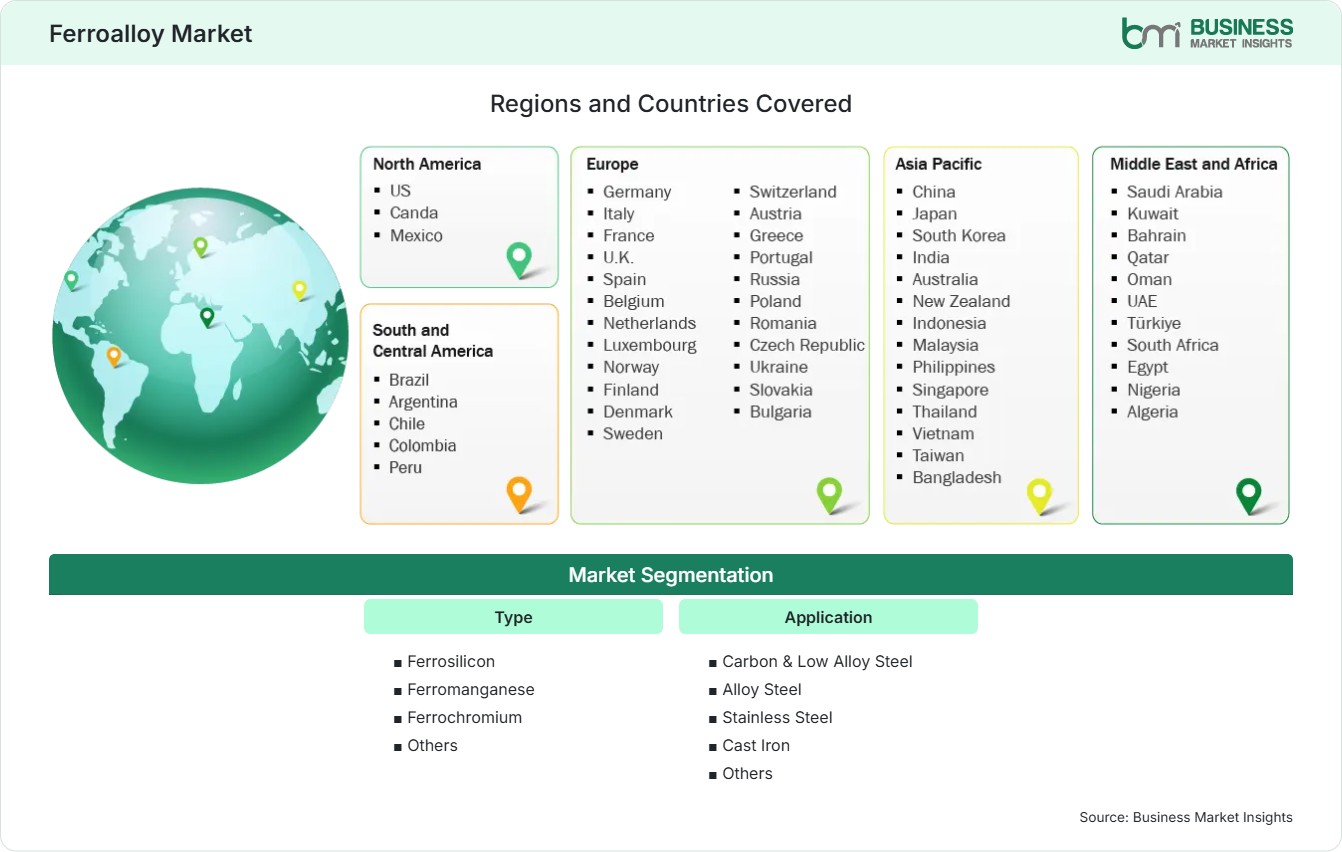
Global Market Geography
FREE PDF
Request your free sample
Request free sample
Segment Analysis

Ferroalloy Market Segmentation

Type

Type segment represents the core production structure, with Ferrochromium leading. This segment accounts for nearly 42%–46% Ferroalloy Market scope in 2025 and is expected to advance at 10.5%–11.5% CAGR through the forecast period. Demand patterns reflect steel-sector requirements, ore availability, energy economics, and evolving industrial applications requiring enhanced performance characteristics.

  • Ferrosilicon: Widely used as a deoxidizer and alloying agent in steelmaking, supported by electrical steel demand, foundry applications, and increasing requirements for improved metallurgical efficiency.
  • Ferromanganese: Essential for strength enhancement and sulfur control in steel production, benefiting from expanding construction, automotive manufacturing, and infrastructure-related steel consumption.
  • Ferrochromium: Primary alloy input for stainless steel manufacturing, driven by corrosion-resistance requirements across industrial equipment, transportation, energy systems, and consumer applications.

Application

Application demand remains closely connected to downstream steel production patterns. Stainless steel leads growth momentum while carbon and low-alloy steel retains the largest consumption base. Ferroalloy Market trends indicate an increasing preference for high-performance materials capable of delivering durability, corrosion resistance, and efficiency improvements. The segment holds steady expansion potential with 10%–12% annual growth across key industries.

  • Carbon & Low Alloy Steel: Remains the largest usage category due to extensive deployment across construction, infrastructure, machinery, and transportation applications requiring cost-effective performance enhancement.
  • Alloy Steel: Growth is supported by engineering, heavy equipment, automotive, and industrial machinery sectors seeking improved strength, wear resistance, and reliability.
  • Stainless Steel: Fastest-growing application category driven by hygiene standards, corrosion resistance requirements, food processing equipment, healthcare facilities, and energy-transition infrastructure.
  • Cast Iron: Continues generating stable demand from automotive components, machinery parts, municipal infrastructure products, and industrial manufacturing operations.
Market Forces

Ferroalloy Market Dynamics

Key Market Drivers

Expansion of Global Steel Manufacturing Capacity

Steel production is still the main driver of ferroalloy consumption. Industry data referenced by the World Steel Association shows that global output of crude steel keeps going above 1.8 billion tonnes each year, which in turn leads to strong demand for ferroalloys used in deoxidation, desulfurization, alloy strengthening, and to provide corrosion resistance. Since governments are still investing in transportation networks, industrial corridors, urban housing, and renewable energy infrastructure, the intensity of steel consumption remains high in both developed and developing economies. To meet the demand downstream, producers are increasing the capacity of their blast furnaces and electric arc furnaces, especially in the Asia Pacific region and in areas rich in resources. The growing production of advanced high-strength steel, weather-resistant steel, and special engineering grades also raises ferroalloy consumption per tonne of steel produced, thus supporting continued growth in the industry.

Growth in Stainless Steel Consumption

The production of stainless steel is still one of the biggest areas of demand for ferrochromium and other alloy additions. The greater use of stainless steel in food processing equipment, pharmaceutical plants, chemical processing facilities, medical devices, transportation infrastructure and renewable energy systems is increasing the global demand for ferroalloys. Today's industrial facilities more and more need materials that provide a longer service life, are resistant to corrosion, have good structural strength and involve lower maintenance expenses. Continued urbanisation and industrial growth in Asia, the Middle East and in some African economies is still contributing to the growth of stainless steel production. Furthermore, the stricter hygiene and durability requirements in the healthcare and food industries are prompting upgrades in materials. These developments are supporting long-term consumption of alloys and are leading to more investment along the entire metallurgical value chain.

Industrialization and Infrastructure Development

Large-scale programs to expand infrastructure are driving sustained demand for alloy-enhanced steel products. Governments in emerging economies are still putting money into railways, airports, industrial parks, energy transmission systems, ports, bridges, and urban development projects. These investments need large amounts of carbon steel, alloy steel, and stainless steel, all of which rely on ferroalloy inputs to meet the required standards for mechanical strength, wear resistance, and durability. In addition to construction, industrialization is driving demand through the use of manufacturing equipment, mining machinery, logistics infrastructure, and heavy engineering applications. Those countries which are pursuing industrial diversification are directing their capital towards steel-intensive sectors, thus creating procurement opportunities for alloy producers. The ongoing modernization of infrastructure and industrial assets is expected to ensure a favorable demand situation for ferroalloy producers in the long term.

Key Market Opportunities

Low-Carbon Smelting Technologies

The global commitment to decarbonization is presenting ferroalloy manufacturers with attractive chances if they invest in cleaner methods of production. Nowadays, energy-efficient furnaces, the use of renewable electricity, digital controls of the production process, waste-heat recovery systems, and measures to reduce emissions are becoming ever more important as distinguishing features. When choosing suppliers, steelmakers carefully review those suppliers' sustainability records as part of their broader carbon-reduction strategies and responsible sourcing initiatives. For producers who are able to reduce the intensity of their greenhouse gas emissions, it is possible to strengthen ties with customers as well as to gain better access to green financing and to sustainability-linked funding options. Improvements in operational efficiency achieved through the modernization of technology also contribute to profitability by cutting down on energy use and production costs. Since environmental performance is now being taken into account in procurement decisions, low-carbon production models are likely to attract greater investment and more strategic partnerships across the entire ferroalloy value chain.

Expansion of Regional Supply Chains

Supply chain resilience has now become a strategic focus for both governments and industrial manufacturers. The presence of geopolitical uncertainty, changes in trade policy, disruptions in the logistics sector, and worries about the availability of critical minerals are all pushing companies to diversify their sourcing strategies. In this situation, opportunities arise for regional smelting capacity, downstream processing plants, and vertically integrated production systems. Countries with substantial reserves of chromite, manganese, quartz, and similar minerals can increase the economic value of these resources by processing them locally rather than exporting the raw materials. Putting money into domestic alloy production infrastructure helps to create jobs, diversify exports, and achieve industrial development goals. Since steel producers are looking to establish secure, geographically varied supply networks, investment in regional investments in ferroalloy manufacturing is expected to speed up in many different markets.

Advanced High-Strength Steel Applications

The demand for advanced high-strength steel is on the rise in the automotive manufacturing sector, in utility infrastructure, in industrial automation, in renewable energy installations, and in transportation systems. In these areas, special alloy compositions are frequently needed to achieve better mechanical performance at the same time as reducing the weight of the material. Automotive manufacturers are still working to design lighter vehicles to boost efficiency and comply with emissions targets, which in turn promotes the use of higher-grade steel. Likewise, wind energy structures, electric transmission equipment, and sophisticated machinery are becoming increasingly dependent on high-performance alloyed materials. Companies that create custom ferroalloy formulations, have metallurgical expertise, and can provide technical support are able to enter higher-value market segments. The increasing technological complexity of the industries using these products is likely to generate significant opportunities for differentiated alloy products and for specialized manufacturing capabilities.

Market Restraints and Challenges

Energy Cost Volatility and Smelting Economics

Factor: Ferroalloy production relies heavily on electricity-intensive smelting processes, particularly within submerged arc furnace operations. Impact: Variations in electricity tariffs, fuel prices, and energy availability directly influence production economics and operating margins. Unexpected increases in power costs may reduce competitiveness, limit capacity utilization, and delay expansion plans. Producers operating in regions with unstable power infrastructure face additional challenges related to operational continuity and production scheduling. While renewable energy procurement agreements and process-efficiency investments can reduce exposure to energy volatility, implementation often requires significant capital expenditure. Smaller producers may encounter financial constraints when upgrading facilities, potentially widening competitiveness gaps between large integrated operators and smaller independent manufacturers.

Raw Material Supply and Environmental Compliance Risks

Factor: Ferroalloy production depends on reliable access to chromite ore, manganese ore, quartz, reductants, and other critical raw materials while operating within increasingly stringent environmental frameworks. Impact: Supply disruptions, transportation bottlenecks, permitting delays, emissions compliance costs, and mining-related regulatory restrictions can affect production planning and profitability. Companies may face rising expenditures associated with environmental monitoring, waste management, and emissions-control technologies. Furthermore, regulatory uncertainty can extend project development timelines and increase investment risk. These factors influence long-term capital allocation decisions, limit production flexibility, and contribute to supply-side volatility across regional and global ferroalloy markets, particularly during periods of elevated industrial demand.

Company Analysis

Competitive Landscape

The competitive environment reflects ongoing consolidation, resource integration, and technology investment. Ferroalloy Market analysis shows producers prioritizing secure raw-material access, energy efficiency, and strategic steel-industry relationships.

Company Name

Overview

Products and Services relevant to this market

Glencore plc

Global mining and commodities company with diversified metals operations and extensive supply-chain capabilities.

Ferrochrome, manganese products, mining, trading, logistics, and metallurgical solutions.

Eramet S.A.

Major mining and metallurgy group serving global steel and specialty-alloy markets.

Manganese alloys, ferroalloys, mining operations, processing, and technology solutions.

Ferroglobe PLC

International producer focused on silicon and specialty metallurgical products.

Ferrosilicon, silicon metal, specialty alloys, and industrial materials.

Samancor Chrome Holdings Proprietary Limited

Leading chrome producer with substantial ferrochrome production capabilities.

Ferrochrome products, chrome ore processing, and metallurgical services.

Eurasian Resources Group S.à r.l.

Integrated natural resources group with mining and metals operations.

Ferroalloys, raw materials, mining, processing, and export solutions.

Tata Steel Limited

Major steel producer with alloy and raw-material integration strengths.

Ferrochrome, steelmaking materials, mining assets, and metallurgical products.

OM Holdings Limited

Established manganese and ferroalloy producer serving regional steel industries.

Silicomanganese, ferromanganese, alloy processing, and smelting services.

Indian Metals & Ferro Alloys Limited

Integrated ferrochrome company with mining and processing operations.

Ferrochrome production, ore mining, and related metallurgical activities.

Outokumpu Oyj

Stainless steel specialist with integrated alloy sourcing capabilities.

Stainless steel products, ferrochrome production, and metallurgical technologies.

China Minmetals Corporation

Diversified metals and minerals enterprise with global trading presence.

Ferroalloys, minerals trading, processing, logistics, and supply-chain services.

Trust & Transparency

Research Methodology

The market analysis combines proprietary research with secondary data from government agencies, company disclosures, regulatory filings, industry databases and expert interviews. Market estimates are validated through data triangulation, cross-market benchmarking and analyst review.

View Full Research Methodology

Questions Answered

Frequently Asked Questions

What does a Ferroalloy Market Report typically evaluate?

The Ferroalloy Market Report commonly evaluates market size, competitive positioning, regional demand patterns, technology developments, production economics, regulatory influences, supply chains, and forecast growth opportunities.

How are sustainability initiatives affecting producers?

Manufacturers are investing in energy-efficient furnaces, renewable electricity sourcing, emissions reduction programs, and circular-metallurgy practices to meet customer and regulatory expectations.

Why is Asia Pacific the leading regional market?

The region combines large-scale steelmaking capacity, industrialization, infrastructure development, urbanization, and manufacturing growth, creating the world's largest concentration of alloy consumption.

Which alloy type dominates industry revenue?

Ferrochromium remains the leading product category because stainless steel manufacturing relies heavily on chromium-containing alloys to achieve corrosion resistance and durability.

What factors are creating long-term demand for ferroalloys?

Demand is supported by steel production, stainless-steel consumption, infrastructure investment, renewable-energy projects, and expansion of advanced manufacturing industries requiring stronger and more durable materials.

Access the Full Ferroalloy Market Report

Get segment-level forecasts, regional estimates, competitive benchmarking, company profiles and downloadable Excel datasets.

Access the full Ferroalloy Market Report
350 pages PDF & Excel | 2026-09-16
Similar Research

Related Market Reports