
Enzyme Linked Immunosorbent Assays Market Outlook: Size, Share, Trends, Growth Analysis, Competitive Landscape & Forecast, 2026-2033

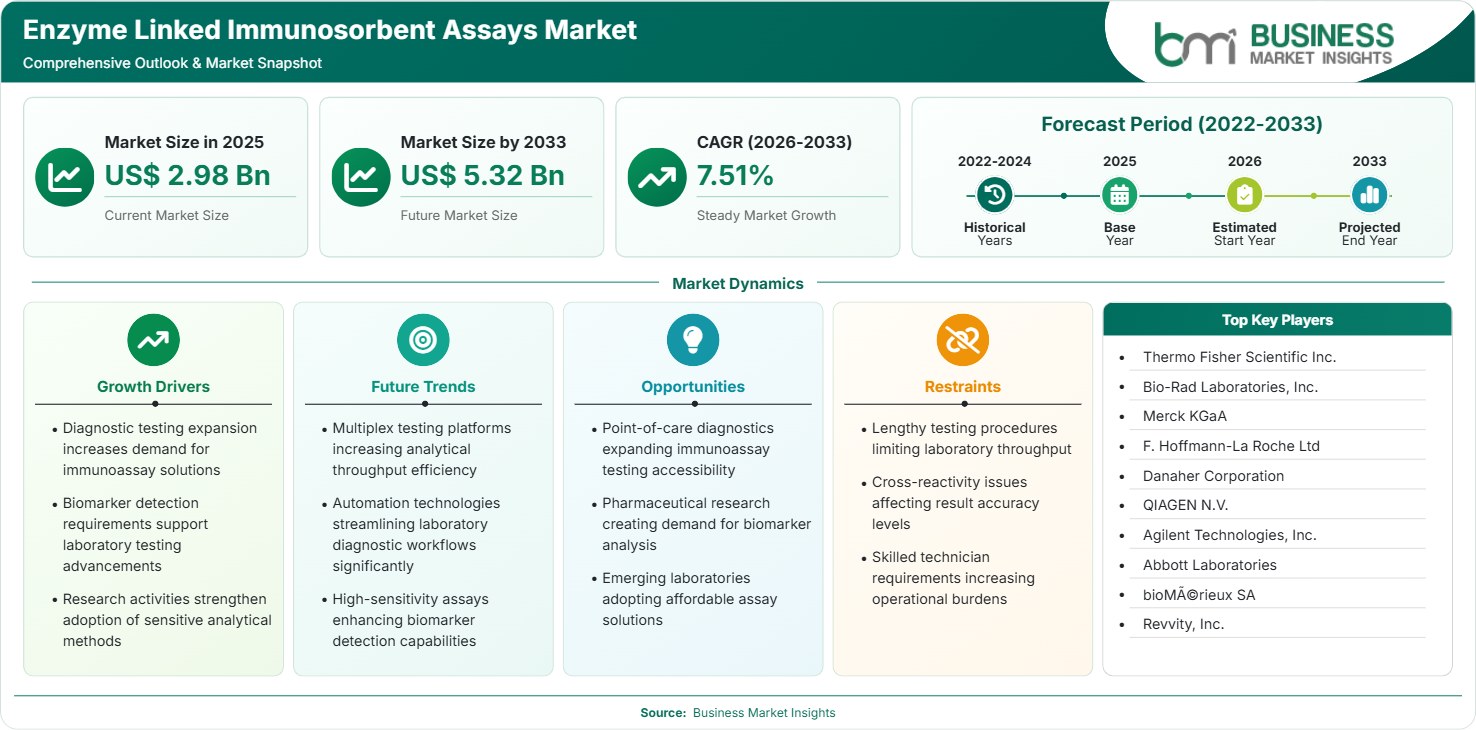
The Enzyme Linked Immunosorbent Assays Market size was valued at US$ 2.98 Billion in 2025 and is projected to reach US$ 5.32 Billion by 2033, growing at a CAGR of 7.51% during 2026–2033, driven by biomarker research, infectious disease testing, cancer diagnostics, automation, multiplexing, and expanding pharmaceutical R&D.

Report Coverage
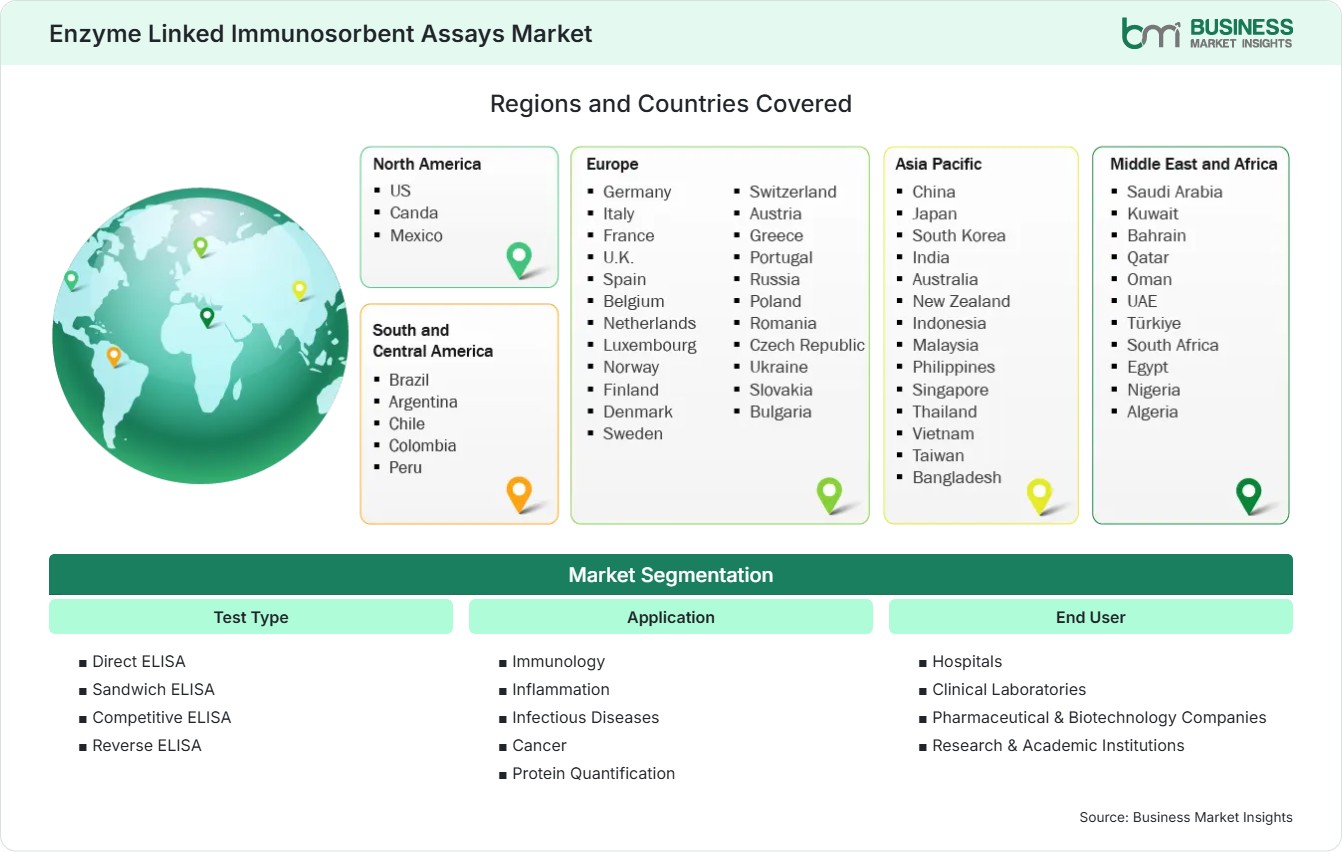
  • Test Type: Direct ELISA, Sandwich ELISA, Competitive ELISA, Reverse ELISA
  • Application: Immunology, Inflammation, Infectious Diseases, Cancer, Protein Quantification
  • End User: Hospitals, Clinical Laboratories, Pharmaceutical & Biotechnology Companies, Research & Academic Institutions
US$ 2.98 Bn Market size in 2025
US$ 5.32 Bn Market Size by 2033
7.51% CAGR, 2026 - 2033
2026-2033 Forecast Period

AI Overview

Enzyme Linked Immunosorbent Assays Market Summary

  • North America Region: North America holds a 35%–38% Enzyme Linked Immunosorbent Assays Market share in 2025, growing at a 6.9%–7.6% CAGR, influenced by advanced laboratories, pharmaceutical R&D, clinical testing, automation adoption, and strong demand for validated biomarker assays. The US market benefits from extensive laboratory infrastructure, pharmaceutical research, and automated immunoassay adoption, with a 6.8%–7.5% CAGR through 2033.
  • Fastest Growing Region: Asia Pacific holds a 25%–29% share in 2025, expanding at a 8.4%–9.3% CAGR, supported by diagnostic infrastructure expansion, infectious disease surveillance, biotechnology investment, growing clinical laboratories, and increasing research expenditure.
  • Leading Segment: Sandwich ELISA holds a 42%–46% share in 2025, expanding at a 7.4%–8.1% CAGR, supported by superior specificity, quantitative biomarker detection, pharmaceutical research, complex biological samples, and increasing demand for reproducible analytical workflows.
  • High Growth Segment: Infectious Diseases holds a 24%–28% share in 2025, advancing at a 8.1%–8.9% CAGR, driven by surveillance, serology, antimicrobial resistance programs, outbreak preparedness, population screening, and demand for scalable laboratory diagnostics.
  • Key Market Opportunity: Expanding decentralized testing, dried-blood-spot workflows, multiplex biomarker panels, and automated laboratory systems creates opportunities for suppliers to improve accessibility, throughput, analytical sensitivity, and recurring reagent revenues.
  • Major Market Players: Thermo Fisher Scientific Inc.; Bio-Rad Laboratories, Inc.; Merck KGaA; F. Hoffmann-La Roche Ltd; Danaher Corporation; QIAGEN N.V.; Agilent Technologies, Inc.; Abbott Laboratories; bioMérieux SA; Revvity, Inc.
Strategic Insights

Enzyme Linked Immunosorbent Assays Market: Strategic Insights

Enzyme Linked Immunosorbent Assays Market Strategic Framework
FREE PDF
Request your free sample
Request free sample
Stakeholder View

Key Takeaways

  • The value chain spans antibody and enzyme suppliers, assay developers, plate manufacturers, instrument providers, distributors, clinical laboratories, pharmaceutical researchers, and academic institutions. Recurring reagent consumption remains strategically important because installed laboratory workflows generate continuing demand after initial platform adoption.
  • Sandwich ELISA and infectious disease applications provide attractive expansion areas because they combine high analytical specificity with broad laboratory applicability. Cancer biomarker research and protein quantification also create demand for sensitive, reproducible assays.
  • Product development is moving toward ready-to-use reagents, reduced wash requirements, automated sample handling, broader dynamic ranges, multiplexing, and improved validation. Research suppliers increasingly position ELISA alongside complementary immunoassay technologies rather than as an isolated workflow.
  • Asia Pacific provides a substantial investment opportunity as diagnostic capacity, pharmaceutical research, biotechnology manufacturing, and laboratory automation expand. India, China, Japan, and South Korea provide differentiated demand profiles across clinical and research settings.
  • Competitive activity increasingly centers on portfolio breadth, assay menus, automation, specialty antibodies, and adjacent immunodiagnostic technologies. Broader immunoassay portfolios allow suppliers to serve research and clinical customers across multiple testing environments.
  • Manufacturers that combine validated assay content with dependable supply, technical support, automation compatibility, and regulatory documentation can strengthen customer retention while reducing switching incentives within laboratory workflows.
Geographic Outlook

Enzyme Linked Immunosorbent Assays Market Regional Highlights

North America Enzyme Linked Immunosorbent Assays Market

North America Enzyme Linked Immunosorbent Assays Market represents 35%–38% of 2025 revenue and is projected to expand at a 6.9%–7.6% CAGR through 2033. Mature laboratory infrastructure, biotechnology investment, clinical research, and automated testing support adoption. The United States remains the principal contributor, while Canada adds demand through research institutions and diagnostic laboratories. The region benefits from established reagent distribution, extensive pharmaceutical development, and high laboratory utilization. Strong validation requirements favor suppliers offering standardized kits, quality documentation, reproducible antibodies, and compatibility with automated plate readers across research and diagnostic environments.

  • Pharmaceutical and biotechnology R&D sustains recurring demand for validated immunoassays, particularly during biomarker discovery, translational research, preclinical development, and therapeutic monitoring programs.
  • Automated liquid handling and microplate instrumentation support higher sample throughput, reducing manual intervention and improving consistency across laboratories processing large research or diagnostic sample volumes.
  • Cancer and inflammation research continue to create demand for quantitative cytokine, protein, and biomarker assays that support experimental validation and translational research workflows.
  • Established distributors and technical-support networks improve reagent availability, application support, troubleshooting, and laboratory adoption across academic, pharmaceutical, and clinical research environments.

US Enzyme Linked Immunosorbent Assays Market

The US Enzyme Linked Immunosorbent Assays Market comprises around 29%-32% of total worldwide demand in 2025 and is forecast to expand at a CAGR of 6.8%-7.5% through 2033. Well-developed infrastructure in pharmaceutical research, academia, and clinical laboratories, along with purchasing channels for diagnostics, drives market growth. There is an increased demand for standardized and automated assays. The research demand is significant; however, the clinical demand depends on validation and economic factors in labs. Growth in specialized biomarker testing and surveillance for infectious diseases offers another opportunity.

  • Pharmaceutical laboratories increasingly integrate immunoassay workflows into biomarker development, drug discovery, pharmacodynamic studies, and translational research, supporting recurring reagent consumption and assay customization requirements.
  • Academic institutions generate diversified demand for cytokine, antibody, protein, and signaling assays, particularly within immunology, oncology, inflammation, infectious disease, and molecular biology research programs.
  • Clinical laboratories prioritize reproducibility, automation compatibility, quality control, and supply reliability when selecting immunoassay products for standardized testing workflows.

Europe Enzyme Linked Immunosorbent Assays Market

Europe market had 27% - 30% share of the Enzyme Linked Immunosorbent Assays Market in 2025 and is estimated to grow at a CAGR of 6.7% - 7.4% by 2033. Germany, the UK, France, Italy, and Spain make up the key demand hubs. Germany is estimated to grow at a CAGR of 6.9%-7.5%, whereas Spain and Italy are projected to grow at 7.2%-8.0%. The demand is underpinned by quality needs, biomedical research, diagnostics labs, and pharmaceutical developments.

  • Germany combines pharmaceutical research, industrial biotechnology, and advanced laboratory infrastructure, supporting demand for quantitative protein assays, infectious disease testing, and standardized research reagents.
  • The United Kingdom benefits from university research, biotechnology development, and translational medicine programs requiring validated antibodies, biomarker assays, and reproducible laboratory workflows.
  • France maintains strong diagnostic and life-science capabilities, while Italy and Spain provide expanding demand through hospital laboratories and research institutions.
  • Regulatory emphasis on analytical performance and documentation encourages suppliers to strengthen validation packages, quality systems, traceability, and technical support for European laboratories.

Asia Pacific Enzyme Linked Immunosorbent Assays Market

Asia Pacific Enzyme Linked Immunosorbent Assays Market accounted for 25%–29% of demand in 2025 and is expected to expand at an 8.4%–9.3% CAGR until 2033. Major countries that consume within the region are China, Japan, India, and South Korea. India and China have high growth potential. The forecasted CAGR for China is 8.7%–9.5% and for India 9.0%–9.8%. Growth in diagnostic infrastructure, pharmaceutical production, investment in biotechnology, and infection monitoring is driving the adoption of enzyme-linked immunosorbent assays.

  • China benefits from expanding biotechnology manufacturing, clinical laboratory networks, pharmaceutical research, and domestic diagnostic development, supporting broad demand across research and clinical applications.
  • India combines growing hospital laboratories, pharmaceutical R&D, biotechnology investment, and diagnostic infrastructure expansion, creating opportunities for affordable and scalable assay platforms.
  • Japan provides mature demand through pharmaceutical research, advanced clinical laboratories, academic institutions, and quality-focused diagnostic workflows requiring reproducible analytical performance.
  • South Korea is strengthening biotechnology and precision-medicine capabilities, supporting demand for biomarker assays, cancer research tools, and high-throughput laboratory technologies.

Rest of World Enzyme Linked Immunosorbent Assays Market

The Rest of World accounts for 9% - 12% of market demand in 2025 for the Enzyme Linked Immunosorbent Assays Market and is expected to grow at a 7.0% - 8.1% CAGR. South and Central America include Brazil and Mexico; both countries have growing diagnostic services and infectious disease surveillance, which increases demand for assays. Brazil has a 7.3%- 8.2% CAGR, driven by hospitals and government testing labs. Mexico has private labs and pharmaceutical companies driving its growth. The Middle East & Africa includes Saudi Arabia, the UAE, and South Africa as the top markets, with Saudi Arabia at about 8.0%-8.8% CAGR.

  • Brazil provides the largest South American opportunity through clinical laboratory expansion, infectious disease testing, pharmaceutical research, and increasing demand for dependable laboratory reagents.
  • Mexico benefits from private diagnostics, hospital networks, biotechnology activity, and laboratory modernization, creating opportunities for standardized assay kits and automated testing workflows.
  • Saudi Arabia and the UAE are strengthening healthcare infrastructure, laboratory capabilities, and specialized diagnostics, supporting demand for higher-quality immunoassay technologies.
  • South Africa remains an important African testing market, particularly for infectious disease surveillance, academic research, clinical laboratories, and public-health-oriented diagnostic programs.
Global Market Geography
FREE PDF
Request your free sample
Request free sample
Segment Analysis

Enzyme Linked Immunosorbent Assays Market Segmentation

Test Type

The Test Type category is led by Sandwich ELISA, capturing a 42% - 46% share of the Enzyme Linked Immunosorbent Assays Market in 2025 and growing at a 7.4% - 8.1% CAGR until 2034. Specificity, quantification capability, and wide-range biomarker applications help drive usage in research, diagnostic, and drug discovery processes where accurate target identification is needed.

  • Direct ELISA: Direct ELISA supports streamlined workflows through direct antigen detection, reducing procedural complexity. Its simplicity benefits routine research, screening, and applications where rapid processing and straightforward signal generation are priorities.
  • Sandwich ELISA: Sandwich ELISA uses paired antibodies for target capture and detection, providing strong specificity and sensitivity. Its suitability for cytokines, biomarkers, and complex samples supports broad laboratory adoption.
  • Competitive ELISA: Competitive ELISA is useful for smaller analytes and targets requiring competition-based quantification. Its flexible antibody configuration supports measurements across pharmaceutical, biochemical, environmental, and research applications.
  • Reverse ELISA: Reverse ELISA supports antibody-focused analytical workflows and specialized detection requirements. Its application value increases where conventional antigen-capture formats provide limited compatibility with particular analytes or experimental designs.

Application

The Applications section is headed by the Infectious Diseases domain, accounting for 24%-28% of the Enzyme Linked Immunosorbent Assays Market share in 2025, growing at an 8.1%-8.9% CAGR until 2033. The need for surveillance, serology tests, outbreak preparedness, and improved access to laboratories will ensure ongoing demand.

  • Immunology: Immunology applications rely on antibody, cytokine, and immune-marker quantification. Research into immune pathways, autoimmune disorders, vaccines, and cellular responses creates recurring demand for sensitive and reproducible assays.
  • Inflammation: Inflammation testing uses ELISA extensively for cytokine and inflammatory mediator quantification. Increasing interest in chronic inflammatory conditions and therapeutic biomarker development supports assay utilization.
  • Infectious Diseases: Infectious disease applications use antigen and antibody detection for surveillance, diagnosis, epidemiology, and research. Global diagnostic gaps and antimicrobial-resistance priorities reinforce demand for accessible testing technologies.
  • Cancer: Cancer research requires quantitative measurement of tumor markers, cytokines, growth factors, and signaling proteins. Expanding precision oncology and biomarker discovery programs create demand for validated immunoassay reagents.
  • Protein Quantification: Protein quantification supports cell biology, bioprocess development, biomarker studies, and pharmaceutical research. Assay reproducibility and dynamic range remain central selection criteria for laboratories.

End User

The End User segment is anchored by Pharmaceutical & Biotechnology Companies, with broad recurring demand generated by drug discovery, biomarker development, quality assessment, and translational research. Enzyme Linked Immunosorbent Assays Market Growth is supported by expanding biological research and increased use of validated assay workflows.

  • Hospitals: Hospitals use immunoassays within diagnostic and research laboratories, particularly for infectious disease, endocrine, immune, inflammatory, and selected oncology testing workflows requiring established analytical procedures.
  • Clinical Laboratories: Clinical laboratories prioritize standardized reagents, automation compatibility, throughput, reproducibility, and supply continuity. Expansion of specialized testing supports demand for application-specific assay menus and validated workflows.
  • Pharmaceutical & Biotechnology Companies: Pharmaceutical and biotechnology companies apply ELISA across discovery, preclinical research, pharmacodynamic evaluation, biomarker validation, and process development, generating recurring demand for high-quality assay components.
  • Research & Academic Institutions: Universities and research institutions use ELISA for diverse biological investigations, including protein expression, immune response, inflammation, cancer biology, infectious disease research, and experimental validation.
Market Forces

Enzyme Linked Immunosorbent Assays Market Dynamics

Key Market Drivers

Expansion of Biomarker Research and Translational Medicine

Biomarker discovery remains a fundamental demand driver because ELISA converts antibody-antigen recognition into measurable signals suitable for protein and cytokine quantification. As more pharmaceutical pipelines need analytical tools that link molecular information to pharmacodynamic and disease-response data, so too do academic laboratories that employ validated immunoassays to confirm experimental results in biological matrices. Thus, the market expansion can be attributed to increased translational research in areas such as oncology, inflammation, immunology, and infections. Advancements such as increased antibody specificity, recombinant antibodies, controls, and prepackaged kits reduce assay development time. These advancements, coupled with the Enzyme Linked Immunosorbent Assays Market trends toward reproducibility and validation for specific applications, allow suppliers with content and processes to capitalize on high-usage laboratory settings.

Automation and Higher Laboratory Throughput

Staffing issues in laboratory settings, along with an increase in sample numbers, are driving the demand for automation of liquid handling, plate washing, incubation, and optical measurements. Automation helps minimize manual errors and enables the processing of larger sample sizes while adhering to standard procedures. Readily available test kits and simplified protocols help in reducing manual labor. Immunoassay product lineups from commercial players have begun to focus on integration with automated, high-throughput screening platforms. Some modern ELISA products offer shortened workflows, whereas other immunoassay platforms compete on no-wash workflows and high-throughput capabilities. These developments influence Enzyme Linked Immunosorbent Assays Market growth by improving laboratory productivity without requiring complete replacement of established plate-based infrastructure.

Increasing Infectious Disease Surveillance Requirements

There is an ongoing need for serology and antigen-based testing due to infectious disease surveillance in clinical laboratories, public health services, research organizations, and epidemiological studies. The 2025 diagnostic landscape assessment conducted by the WHO found ongoing needs in pathogen detection, identification, and antimicrobial resistance testing, highlighting the importance of portable, easily deployed diagnostics. ELISA remains relevant wherever plate-based tests are required to process large sample volumes. Revvity's 2025 release of a measles antibody ELISA for use on dried blood spots demonstrates ongoing product development.

Key Market Opportunities

Expansion of Dried-Blood-Spot and Decentralized Sample Workflows

Dried-blood-spot testing creates an opportunity to extend immunoassay access beyond conventional serum and plasma collection. It can simplify transportation, sample handling, and collection requirements in surveillance programs where centralized venous sampling is difficult. The development of the measles test by Revvity is an example of commercial interest in validating dried blood spots alongside existing specimen types. The same process could be employed to extend research and public health testing across geographically distributed samples. Value can be captured by manufacturers through validated extraction methods, controls, calibrators, and plate-based workflows. Thus, Enzyme Linked Immunosorbent Assays Market Forecasts become increasingly dependent on suppliers' ability to adapt existing assay chemistry to new collection processes.

Growth of Multiplex and High-Content Biomarker Testing

Multiplexing offers laboratories an opportunity to obtain broader biological information from limited sample volumes. Cancer research, immunology, inflammation studies, and therapeutic development increasingly require simultaneous assessment of multiple biomarkers rather than isolated measurements. Reagent systems compatible with ELISA can be placed side by side with multi-array systems, microplate readers, and liquid handlers. Danaher's immunoassay product line, for instance, includes matched antibody pairs, multi-array kits, and various detection technologies. This presents opportunities for firms to add value to their account relationships through reagent portfolios that complement existing lab equipment.

Expansion of Assay Development for Emerging Therapeutics

Biological drug substances, vaccines, cell therapies, and precision medicine programs all need methods to quantify their protein, antibody, biomarker, and process attributes. ELISA offers a well-known format for many research and development quantitation experiments and represents an exciting area for assay customization. There are many opportunities for differentiation for vendors through the development of improved antibodies, matrices, reference standards, sensitivity enhancements, and technical expertise for specific applications. Increased demand is also driven by stricter regulatory requirements to demonstrate the performance of such assays.

Market Restraints and Challenges

Analytical Interference and Cross-Reactivity

Factors: Effects of matrix and non-specific binding, cross-reactivity, differences among antibodies, and insufficient blocking may affect test performance, particularly when few targets are present or when sample matrices are complex. Impact: Laboratories need to do more validation, carry out controls, repeat the test several times, and sometimes even develop alternative methods, thus increasing the cost of testing and slow adoption of the test. Sandwich tests reduce specificity issues through utilization of two antibodies per one test; however, they still strongly depend on the type of antibodies, calibration, sample preparation, and reagents. Alternative tests will face one more challenge – the difficulty of signal interpretation.

Regulatory Complexity and Quality-Control Requirements

Factor: Clinically regulated applications demand more rigorous evidence regarding the analytical performance, manufacturing processes, traceability, documentation, and quality control than many research applications. Impact: Timeframes and costs associated with development and regulation will increase, particularly when suppliers change research assays for clinical use or supply to several jurisdictions. Requirements may include standards on accuracy, specificity, sensitivity, linearity, stability, interference studies, and manufacturing process control. Laboratories have to bear the cost of validation, proficiency testing, instrument qualification, and quality assurance. Such requirements can prevent the commercialization of new tests, but may help established suppliers with regulatory knowledge.

Company Analysis

Competitive Landscape

The competitive environment combines large diagnostics companies, life-science suppliers, specialty immunoassay developers, and diversified laboratory technology providers. Enzyme Linked Immunosorbent Assays Market analysis indicates that competitive differentiation increasingly depends on assay breadth, antibody quality, automation compatibility, validation support, geographic distribution, and recurring reagent availability. Industry evidence identifies major immunoassay participation from companies including Roche, Abbott, Siemens Healthineers, Danaher, Bio-Rad, bioMérieux, and specialized suppliers.

Company Name

Overview

Products and Services relevant to this market

Thermo Fisher Scientific Inc.

Global life-science supplier serving research, diagnostics, biotechnology, and pharmaceutical laboratories through extensive laboratory technology portfolios.

ELISA kits, antibodies, reagents, microplate technologies, laboratory instruments, assay development support, and research workflow solutions.

Bio-Rad Laboratories, Inc.

Life-science and diagnostics company with established capabilities in immunoassays, quality controls, laboratory systems, and research reagents.

ELISA kits, immunoassay controls, antibodies, reagents, microplate systems, diagnostic products, and laboratory quality solutions.

Merck KGaA

Diversified science and technology company supplying research, bioprocessing, and analytical products to global laboratories.

Antibodies, immunoassay reagents, analytical materials, assay-development components, and laboratory workflow technologies.

F. Hoffmann-La Roche Ltd

Global healthcare company with substantial diagnostics and laboratory testing capabilities supporting clinical and research environments.

Immunoassay systems, reagents, diagnostic assays, laboratory automation, calibration materials, and analytical workflow solutions.

Danaher Corporation

Diversified life-science and diagnostics group with broad immunoassay, antibody, reagent, and laboratory technology capabilities.

ELISA kits, sandwich and competitive assays, matched antibody pairs, immunoassays, multiplex products, and research reagents.

QIAGEN N.V.

Molecular diagnostics and life-science company supporting sample preparation, assay development, molecular research, and laboratory workflows.

Immunoassay-related research reagents, sample technologies, assay components, molecular workflows, and laboratory automation solutions.

Agilent Technologies, Inc.

Analytical technology provider serving pharmaceutical, clinical research, biotechnology, and laboratory customers globally.

Laboratory instruments, microplate-related technologies, reagents, analytical solutions, and research workflow support relevant to immunoassay applications.

Abbott Laboratories

Healthcare company with broad diagnostic platforms spanning laboratory immunoassays, point-of-care systems, and clinical testing.

Immunoassay analyzers, diagnostic reagents, automated laboratory systems, infectious disease testing, and specialized clinical assays.

bioMérieux SA

In vitro diagnostics specialist focused on infectious diseases, microbiology, molecular diagnostics, and clinical laboratory applications.

Infectious disease diagnostics, immunological testing, laboratory systems, reagents, and integrated diagnostic workflow solutions.

Revvity, Inc.

Life-science and diagnostics company focused on precision health, research tools, immunoassays, and specialized diagnostic technologies.

ELISA and immunoassay technologies, EUROIMMUN products, AlphaLISA, HTRF, reagents, microplate readers, and diagnostic assays.

Trust & Transparency

Research Methodology

The market analysis combines proprietary research with secondary data from government agencies, company disclosures, regulatory filings, industry databases and expert interviews. Market estimates are validated through data triangulation, cross-market benchmarking and analyst review.

View Full Research Methodology

Questions Answered

Frequently Asked Questions

How are pharmaceutical companies using immunoassays beyond conventional biomarker research?

As per the Enzyme Linked Immunosorbent Assays Market report, pharmaceutical companies use immunoassays for pharmacodynamic measurements, therapeutic monitoring, immunogenicity-related investigations, protein characterization, process development, preclinical studies, and assay validation. This broad usage creates recurring demand because programs may require repeated testing across discovery, development, clinical research, and manufacturing-support activities.

What makes dried-blood-spot ELISA workflows commercially relevant?

Dried-blood-spot workflows can simplify sample collection, storage, transportation, and field deployment. Their commercial value is strongest where conventional venous sampling is difficult. Successful adoption requires validated extraction procedures, stability data, controls, calibration, and demonstrated equivalence or suitability for the intended analytical application.

Why are antibodies important to ELISA performance?

Antibody affinity, specificity, epitope recognition, cross-reactivity, and lot consistency directly influence analytical performance. Poor antibody selection can increase background signal or reduce sensitivity. Recombinant and well-characterized antibodies can improve reproducibility, particularly when assays are used across multiple laboratories or production lots.

How does automation affect ELISA laboratory economics?

Automation can reduce manual handling, improve workflow consistency, increase sample throughput, and reduce operator-dependent variation. The economic benefit depends on utilization, labor costs, instrument capacity, reagent consumption, maintenance requirements, and whether automated equipment can support multiple assay types across the laboratory.

What factors determine the suitability of an ELISA format for a specific laboratory application?

Sandwich formats generally suit larger protein targets requiring high specificity, while competitive formats can accommodate smaller molecules. Selection also depends on sample matrix, target concentration, sensitivity requirements, throughput, available instrumentation, validation needs, and whether the assay is intended for research or regulated clinical use.

Access the Full Enzyme Linked Immunosorbent Assays Market Report

Get segment-level forecasts, regional estimates, competitive benchmarking, company profiles and downloadable Excel datasets.

Access the full Enzyme Linked Immunosorbent Assays Market Report
350 pages PDF & Excel | 2026-11-03
Similar Research

Related Market Reports