
Computer Aided Facility Management (CAFM) Market Outlook: Size, Share, Trends, Growth Analysis, Competitive Landscape & Forecast, 2026-2033

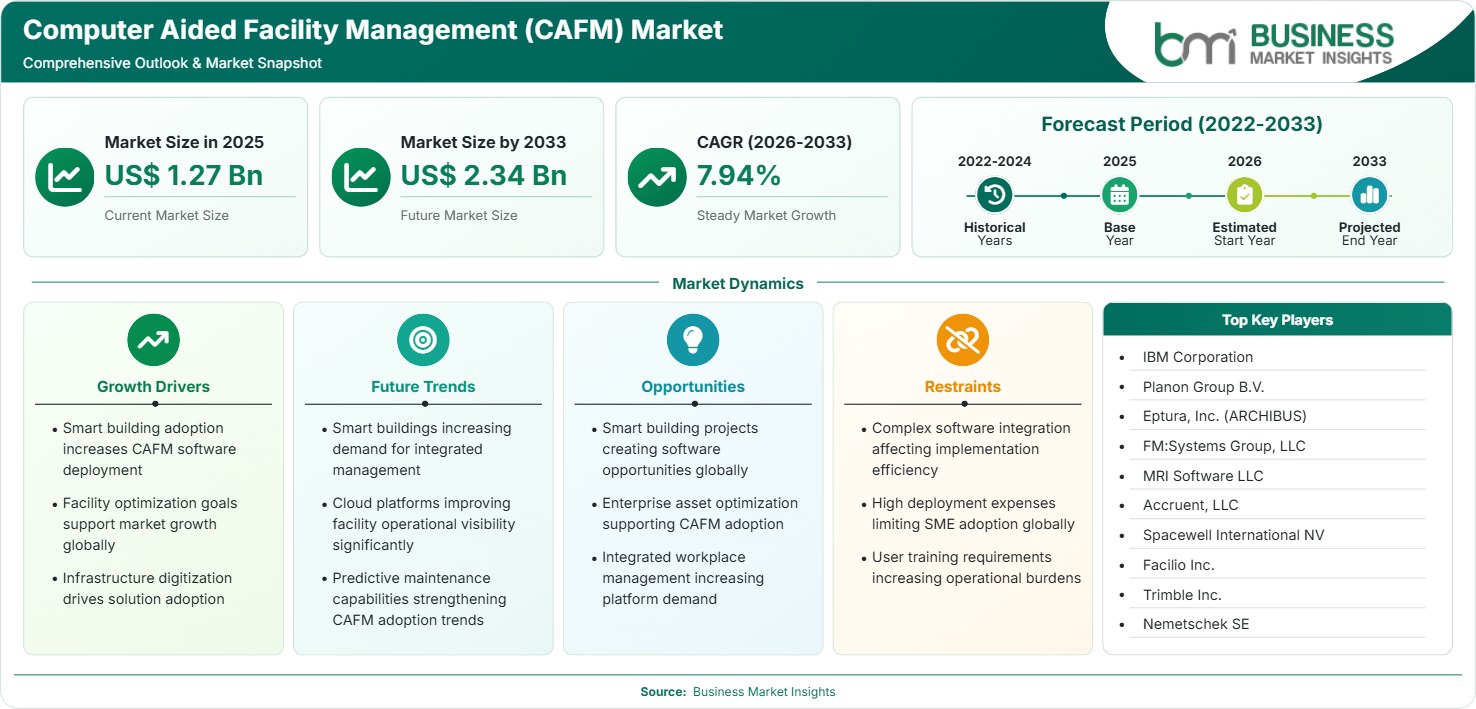
The Computer Aided Facility Management (CAFM) Market size was valued at US$ 1.27 Billion in 2025 and is projected to reach US$ 2.34 Billion by 2033, growing at a CAGR of 7.94% during 2026–2033, driven by workplace digitalization, smart building investments, predictive maintenance adoption, cloud deployment expansion, and rising demand for operational efficiency across commercial, industrial, healthcare, and government facilities.

Report Coverage
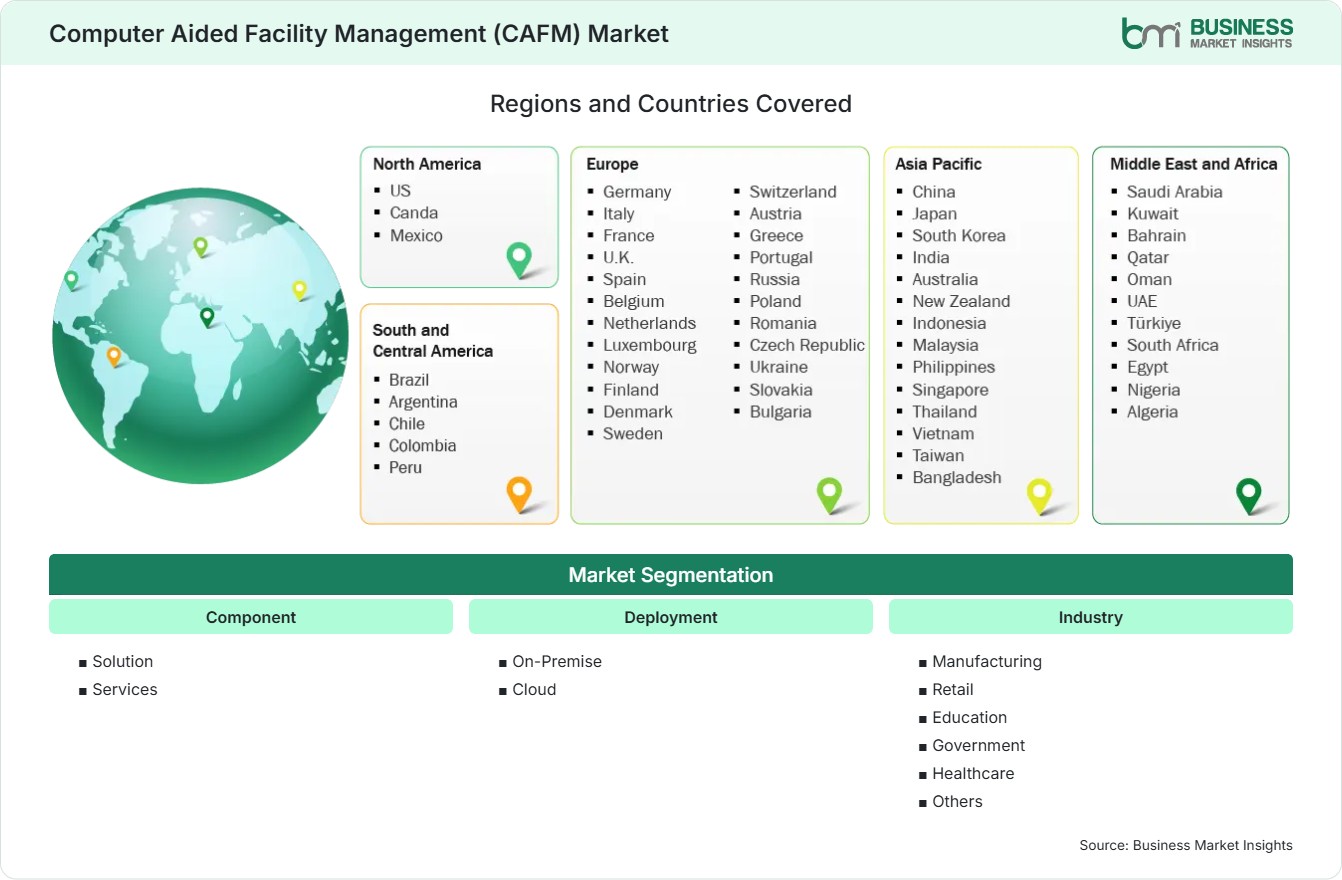
  • Component: Solution, Services
  • Deployment: On-Premise, Cloud
  • Industry: Manufacturing, Retail, Education, Government, Healthcare, Others
US$ 1.27 Bn Market size in 2025
US$ 2.34 Bn Market Size by 2033
7.94% CAGR, 2026 - 2033
2026-2033 Forecast Period

AI Overview

Computer Aided Facility Management (CAFM) Market Summary

  • North America Region: North America holds a market share of 34%–37% in 2025, growing at a CAGR of 7.1%–7.8% during 2026–2033, supported by mature smart-building ecosystems, enterprise software investments, regulatory compliance requirements, workplace modernization initiatives, predictive maintenance adoption, cloud-based facility management expansion, and rising sustainability-driven operational efficiency programs across sectors. U.S. demand remains strongest, expanding at 7.2%–7.9% CAGR through workplace analytics integration and digital asset management deployment.
  • Fastest Growing Region: Asia Pacific accounts for 24%–27% CAFM market share in 2025 and is projected to grow at 9.1%–9.8% CAGR during 2026–2033, fueled by commercial infrastructure development, smart city investments, enterprise digitization strategies, expanding industrial facilities, cloud technology adoption, workforce management modernization, and increasing operational transparency requirements.
  • Leading Segment: Solution represents 65%–68% Computer Aided Facility Management Market share in 2025 and advances at a 7.7%–8.3% CAGR during 2026–2033, benefiting from integrated workplace management requirements, centralized asset visibility, workflow automation capabilities, maintenance scheduling optimization, digital twin integration, compliance monitoring, and enhanced facility performance analytics.
  • High Growth Segment: Cloud deployment captures 42%–46% market share in 2025 and expands at 9.3%–10.1% CAGR during 2026–2033, driven by scalable implementation models, lower ownership costs, remote accessibility, cybersecurity enhancements, rapid software updates, multi-site facility management requirements, and growing subscription-based technology preferences.
  • Key Market Opportunity: Growing convergence of IoT sensors, artificial intelligence, digital twins, and energy-management platforms creates opportunities for advanced predictive facility management, automated maintenance workflows, sustainability reporting, and enterprise-wide operational optimization capabilities.
  • Major Market Players: IBM Corporation, Planon Group B.V., Eptura, Inc. (ARCHIBUS), FM: Systems Group, LLC, MRI Software LLC, Accruent, LLC, Spacewell International NV, Facilio Inc., Trimble Inc., Nemetschek SE.
Strategic Insights

Computer Aided Facility Management (CAFM) Market: Strategic Insights

Computer Aided Facility Management (CAFM) Market Strategic Framework
FREE PDF
Request your free sample
Request free sample
Stakeholder View

Key Takeaways

  • The value chain is getting ever more integrated, with software vendors working alongside IoT platform providers, building automation specialists, cloud infrastructure providers, and workplace technology providers to deliver the full range of facility intelligence solutions.
  • The best upside potential is in the cloud deployments for healthcare networks, educational campuses, government sites, and multi-site retail where you have the need for centralized oversight and compliance.
  • Innovation is increasingly being focused on digital twins, AI-assisted asset diagnostics, predictive maintenance engines, and occupancy analytics, which are all aimed at improving utilization and reducing maintenance costs.
  • Asia Pacific is a very attractive investment destination given the pace of commercial construction, the number of smart city projects being rolled out, and the increasing demand for enterprise digitalization in India and SE Asia.
  • Industry consolidation is still going on, with workplace management (IWMS), CAFM, asset management, and the like all actively pursuing acquisitions to extend their software suites, improve their analytics, and grow their international customer base.
  • Sustainability reporting requirements are driving the integration of energy management systems with facility platforms to enable organizations to track their emissions, optimize their resource usage, and improve their compliance performance.
Geographic Outlook

Computer Aided Facility Management (CAFM) Market Regional Highlights

North America Computer Aided Facility Management Market

North America accounted for approximately 34%–37% of global revenue in 2025 and is projected to expand at a 7.1%–7.8% CAGR through 2033. The Computer Aided Facility Management Market share remains supported by mature cloud infrastructure, advanced workplace technologies, and strong investment in predictive maintenance solutions.

  • Large companies are still moving away from their disparate maintenance applications and towards a single integrated workplace and asset management platform. The benefits in terms of operational visibility, compliance management and workforce productivity across a range of sites are well documented.
  • Growing use of AI-enabled maintenance analytics is helping organizations to reduce equipment failures, improve the accuracy of their lifecycle planning and make better capital expenditure decisions on their critical infrastructure assets.
  • Healthcare providers are increasingly using digital facility management systems to support compliance, improve building performance and enhance the responsiveness of maintenance across their hospital networks.
  • Demand for sustainability dashboards and energy reporting tools is still going up as companies continue to pursue their environmental objectives and meet the ever-increasing requirements around disclosure and efficiency.
  • Government modernization initiatives are all about promoting wider use of digital infrastructure platforms, which in turn will enable the more efficient running of facilities, the more effective management of budgets, and the better planning of long-term assets.

US Computer Aided Facility Management Market

The United States represents approximately 72%–76% of North American Computer Aided Facility Management Market revenue in 2025 and is anticipated to grow at a 7.2%–7.9% CAGR during 2026–2033. Demand remains concentrated among healthcare networks, federal facilities, manufacturing plants, universities, and corporate campuses.

  • Large companies are increasingly integrating their building management systems with their facility platforms to improve their maintenance planning, their occupancy tracking, their energy monitoring, and their long-term capital asset management decisions.
  • Healthcare facility operators are still investing in compliance-focused management software to help with maintenance documentation, equipment tracking, and service response across a multi-site environment.
  • Growing uptake of hybrid working models is driving demand for space management capabilities that will enable optimal utilization rates, improved employee experience and better real estate planning.
  • Federal and state infrastructure modernization programs are underpinning the roll-out of more sophisticated operational technologies aimed at improving facility reliability, lifecycle visibility and sustainability outcomes.

Europe Computer Aided Facility Management Market

Europe accounted for approximately 27%–30% of global Computer Aided Facility Management Market revenue in 2025 and is expected to expand at a 7.4%–8.1% CAGR through 2033. Strong adoption across commercial real estate, public infrastructure, healthcare, and industrial facilities supports demand.

  • Germany is number one in the region with growth estimated at 7.2%-7.8% CAGR. This is underpinned by a range of industrial digitalization initiatives, a very strong base of advanced manufacturing, and significant investment in smart building.
  • Spain is one of the fastest-growing markets (8.4%-9.0% CAGR), with growth being driven by commercial infrastructure upgrades and digital workplace programs.
  • Energy efficiency regulations are driving the roll-out of monitoring and reporting functions, which in turn will support both sustainability compliance and operational optimization objectives.
  • Real estate operators are increasingly using cloud-based facility technologies to manage their dispersed assets and to improve the standardization of their maintenance processes.
  • Public sector modernization programs are still in the process of supporting the digitization of facilities across schools, government buildings, and transport infrastructure.

Asia Pacific Computer Aided Facility Management Market

Asia Pacific represented approximately 24%–27% of global Computer Aided Facility Management Market revenue in 2025 and is projected to register the fastest regional expansion at a 9.1%–9.8% CAGR through 2033. Rapid urbanization, industrial development, and smart-city investments create substantial demand for digital facility-management solutions.

  • China is still the biggest market in the region with an estimated CAGR of 8.7%-9.3%, driven by smart building deployments and significant investment in commercial infrastructure.
  • India is the fastest-growing national market at 10.2% to 10.9% CAGR as a result of enterprise digitization and the ongoing infrastructure expansion programs.
  • Smart city projects throughout SE Asia are continuing to create opportunities for the integrated workplace, maintenance and asset management software providers.
  • Manufacturers are increasingly using digital platforms to improve equipment availability, maintenance visibility and operational efficiency across their sites.
  • Cloud adoption is accelerating as organizations look for a deployment model that can scale to support multiple sites and a distributed operational environment.

Rest of World Computer Aided Facility Management Market

Rest of World accounted for approximately 9%–12% of global Computer Aided Facility Management Market revenue in 2025 and is expected to grow at an 8.0%–8.7% CAGR during 2026–2033. South and Central America continue benefiting from commercial infrastructure modernization and expanding corporate real estate investments.

  • Brazil is ahead of the rest of South and Central America with an estimated CAGR of 8.1%-8.7%. This is being driven by the growing uptake among commercial real estate and industrial operators.
  • Saudi Arabia is a high-growth Middle East market (9.4%-10.0% CAGR) driven by smart city initiatives and significant infrastructure investment.
  • Facility digitization projects ongoing at airports, in healthcare, and on campuses continue to generate software implementation opportunities.
  • Energy management integration is becoming increasingly important as organizations look to achieve cost efficiency and improvements in sustainability across their facility operations.
  • Demand for the cloud deployment model is continuing to grow as a result of the flexibility of implementation, the reduced need for infrastructure, and the improved accessibility.
Global Market Geography
FREE PDF
Request your free sample
Request free sample
Segment Analysis

Computer Aided Facility Management (CAFM) Market Segmentation

Component

The Component segment accounted for the largest share of industry revenue in 2025. Solutions represented approximately a 65%–68% share, while the segment is projected to expand at a 7.7%–8.3% CAGR during 2026–2033. The Computer Aided Facility Management Market scope continues expanding as enterprises prioritize operational visibility, automation, predictive maintenance, and centralized facility-control systems.

  • Solution: Software platforms increasingly integrate maintenance scheduling, asset tracking, space utilization, workflow automation, and analytics functions, helping organizations improve operational efficiency while reducing facility-management complexity.
  • Services: Consulting, implementation, training, and managed services support successful deployment strategies, system integration requirements, and long-term optimization initiatives across complex enterprise facility environments.

Deployment

Deployment preferences continue shifting toward flexible and scalable technology architectures. Cloud deployment held approximately 42%–46% Computer Aided Facility Management Market share in 2025 and is projected to achieve the highest growth rate of 9.3%–10.1% CAGR through 2033.

  • On-Premise: On-premise implementations remain important among organizations requiring extensive customization, strict data-control policies, and integration with legacy enterprise systems supporting mission-critical operations.
  • Cloud: Cloud solutions offer deployment flexibility, lower upfront costs, continuous software updates, scalable functionality, and improved access to analytics, mobility, and collaborative facility-management capabilities.

Industry

The Industry segment demonstrates growing adoption across operationally intensive sectors. Manufacturing accounts for an estimated 23%–27% share in 2025 and advances at a 7.9%–8.5% CAGR through 2033, supported by increasing digitalization and asset-performance requirements. Computer Aided Facility Management Market trends indicate broader adoption across healthcare, government, retail, and educational institutions seeking improved operational efficiency and compliance management capabilities.

  • Manufacturing: Manufacturers leverage facility-management platforms to optimize maintenance operations, improve equipment reliability, manage industrial assets, and support production continuity initiatives.
  • Retail: Retail organizations utilize centralized facility oversight tools to manage distributed stores, streamline maintenance requests, and maintain consistent operational standards across locations.
  • Education: Educational institutions increasingly adopt digital solutions for campus maintenance, classroom utilization, infrastructure planning, and regulatory compliance management.
  • Government: Government agencies implement facility-management systems to improve asset accountability, operational efficiency, maintenance planning, and public infrastructure stewardship.
  • Healthcare: Healthcare providers depend on integrated management platforms to maintain regulatory compliance, monitor critical equipment, and ensure facility performance across clinical environments.
Market Forces

Computer Aided Facility Management (CAFM) Market Dynamics

Key Market Drivers

Expansion of Smart Buildings and Connected Infrastructure

The rapid deployment of smart buildings is creating sustained demand for advanced facility management platforms. Modern commercial properties increasingly integrate IoT sensors, building automation systems, occupancy monitoring tools, and energy-management solutions, generating large volumes of operational data. Facility teams require centralized platforms capable of transforming this information into actionable maintenance and performance insights. Computer Aided Facility Management Market growth is being supported by organizations seeking real-time asset visibility, predictive maintenance capabilities, and automated workflow management.

Growing Focus on Asset Lifecycle Optimization

Organizations are facing increasing pressure to maximize returns from facility and infrastructure investments. Asset-intensive sectors such as manufacturing, healthcare, and government are adopting digital facility-management solutions to improve maintenance planning and asset utilization. Computer Aided Facility Management Market trends indicate stronger adoption of predictive and condition-based maintenance approaches that reduce unplanned downtime and extend equipment lifespan.

Regulatory Compliance and Sustainability Requirements

Operators are responding to the increasingly prescriptive regulations around safety, energy efficiency, environmental performance and workplace compliance. Facility management systems can help organizations by providing a central repository for documentation, automating inspection schedules, and making pre-audit tasks easier. The ability to monitor energy usage and produce sustainability reports is increasingly important as both government and corporate bodies set emissions reduction targets. Digital FM solutions allow for the ongoing monitoring of energy consumption, maintenance, and compliance.

Key Market Opportunities

AI-Driven Predictive Facility Management Platforms

Artificial intelligence is creating new opportunities to transform facility operations from reactive maintenance to predictive and prescriptive management. Advanced algorithms can analyze equipment performance data, detect anomalies, forecast maintenance requirements, and optimize workforce scheduling. The Computer Aided Facility Management Market Forecasts increasingly reflect growing demand for platforms capable of delivering measurable operational intelligence. Enterprises are seeking solutions that improve resource allocation, reduce maintenance costs, and support continuous asset availability.

Expansion Across Emerging Economies

Emerging markets are a massive growth opportunity given the pace of urbanization, the level of commercial construction, and the ongoing digital transformation. In Asia Pacific, the Middle East, and Latin America, governments and private sector organizations are pouring money into smart infrastructure projects, which in turn require a high level of operational management capability. New airports, new hospitals, new industrial parks and new mixed-use developments are all being built with digital facility management systems from the very beginning.

Integration with ESG and Energy Management Programs

Strategies for sustainability in organizations are now emerging as major growth drivers for next-generation facility management systems. Visibility of data relating to energy consumption, carbon emissions, maintenance effectiveness, and resource utilization is a necessity today. These facility management tools can help meet environmental reporting requirements as well as gain efficiencies. The Computer Aided Facility Management Market opportunity extends beyond compliance, enabling real-time optimization of energy-intensive assets and building systems.

Market Restraints and Challenges

High Implementation Complexity and Integration Costs

Factor: Large-scale deployments invariably involve some form of integration with ERP, building management, HR, and legacy systems. Impact: The cost of implementation, the level of customization required, and the sheer scale of the project can all act as a barrier to adoption for SMEs. The integration issues can often require a significant amount of consultancy, training and process re-engineering before any real value is achieved.

Cybersecurity and Data Privacy Concerns

Factor: Modern facility management platforms are increasingly based on cloud infrastructure, connected devices and remote access, which all represent potential avenues for increased cyber exposure. Impact: The potential for unauthorized access, operational disruption, and the protection of sensitive facility data can all be a barrier to adoption in highly regulated sectors.

Company Analysis

Competitive Landscape

Computer Aided Facility Management Market analysis reflects a competitive environment characterized by software innovation, cloud migration, integrated workplace management capabilities, asset lifecycle optimization tools, and increasing adoption of AI-enabled facility intelligence solutions.

Company Name

Overview

Products and Services relevant to this market

IBM Corporation

Global technology leader providing enterprise software, analytics, AI, and infrastructure solutions supporting digital operations and intelligent asset management.

IBM Maximo, enterprise asset management, predictive maintenance, operational analytics, facility optimization, monitoring, and lifecycle management solutions.

Planon Group B.V.

Specialist provider of integrated workplace and facility management software serving corporate, healthcare, education, and public-sector customers.

CAFM, IWMS, workplace management, asset tracking, maintenance automation, space optimization, and sustainability management solutions.

Eptura, Inc. (ARCHIBUS)

Major workplace and facility management software provider supporting real estate, maintenance, and operational efficiency initiatives.

ARCHIBUS platform, asset management, workplace planning, maintenance management, space management, and reporting capabilities.

FM: Systems Group, LLC

Technology provider focused on workplace experience, occupancy intelligence, and facility performance optimization.

Space management, occupancy analytics, workplace applications, asset visibility, maintenance planning, and utilization monitoring tools.

MRI Software LLC

Enterprise software company serving real estate and facility operators across commercial and public sectors.

Facility management, maintenance management, lease administration, asset tracking, and workplace management solutions.

Accruent, LLC

Provider of facility, engineering, and asset lifecycle software solutions for complex operational environments.

Maintenance management, asset lifecycle management, compliance tracking, facility operations, and capital planning solutions.

Spacewell International NV

Smart-building technology specialist focused on workplace efficiency and energy optimization.

Workplace applications, maintenance management, IoT integration, occupancy analytics, and energy-performance solutions.

Facilio Inc.

Cloud-native facilities operations platform provider emphasizing automation and connected asset intelligence.

Predictive maintenance, building operations, asset monitoring, workflow automation, and performance analytics solutions.

Trimble Inc.

Technology company delivering digital construction, infrastructure, and facility management capabilities.

Asset management, facility operations, BIM integration, maintenance planning, and workplace optimization solutions.

Nemetschek SE

Software provider supporting the building lifecycle through design, construction, and operational management technologies.

Digital building management, BIM-enabled facility operations, maintenance coordination, and asset lifecycle solutions.

Trust & Transparency

Research Methodology

The market analysis combines proprietary research with secondary data from government agencies, company disclosures, regulatory filings, industry databases and expert interviews. Market estimates are validated through data triangulation, cross-market benchmarking and analyst review.

View Full Research Methodology

Questions Answered

Frequently Asked Questions

What does the Computer Aided Facility Management Market Report help organizations understand?

The report provides insights into technology adoption patterns, competitive positioning, growth opportunities, deployment preferences, investment trends, regional dynamics, and operational strategies influencing future industry development.

How does AI improve facility-management performance?

AI enables predictive maintenance, anomaly detection, automated scheduling, asset-performance forecasting, and data-driven operational decision-making that help reduce downtime and optimize resource utilization.

Which industries generate the strongest demand for CAFM platforms?

Manufacturing, healthcare, government, education, and retail sectors represent major adopters due to significant maintenance requirements, compliance obligations, asset-management needs, and operational efficiency objectives.

How does cloud deployment benefit facility-management operations?

Cloud deployment reduces infrastructure requirements, enables remote accessibility, accelerates software updates, supports multi-site management, and improves scalability for organizations managing complex facility portfolios.

What factors are accelerating adoption of digital facility-management solutions?

Organizations are prioritizing operational efficiency, predictive maintenance, smart-building integration, sustainability tracking, and centralized control of distributed facilities. These requirements are increasing investments in modern facility-management technologies across multiple industries.

Access the Full Computer Aided Facility Management (CAFM) Market Report

Get segment-level forecasts, regional estimates, competitive benchmarking, company profiles and downloadable Excel datasets.

Access the full Computer Aided Facility Management (CAFM) Market Report
350 pages PDF & Excel | 2026-11-03
Similar Research

Related Market Reports