
Chocolate Syrup Market Size, Share, Trends & Forecast Report, 2026–2033

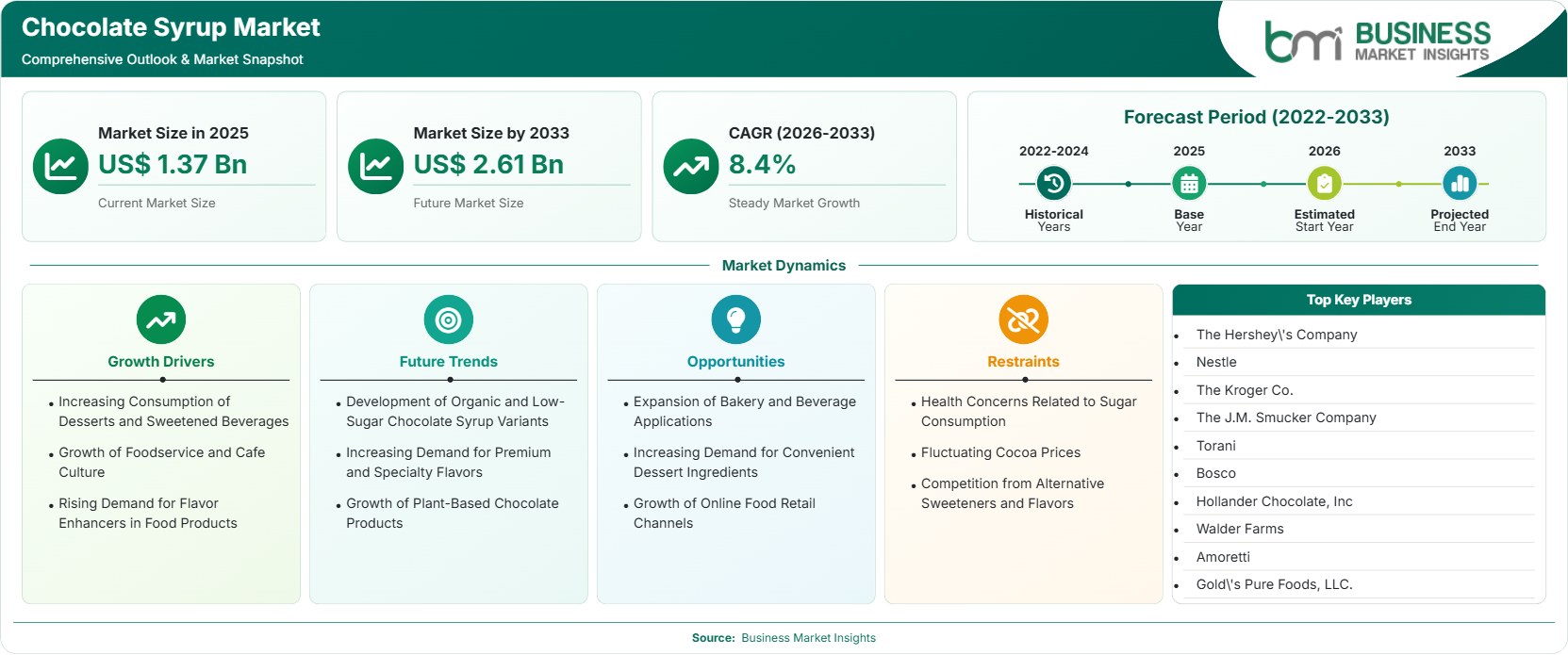
The Chocolate Syrup Market size was valued at US$ 1.37 Billion in 2025 and is projected to reach US$ 2.61 Billion by 2033, growing at a CAGR of US$ 8.4% during 2026–2033, driven by rising dessert consumption, café expansion, product innovation, premium flavor demand, and increasing applications across bakery, beverage, and foodservice sectors.

Report Coverage
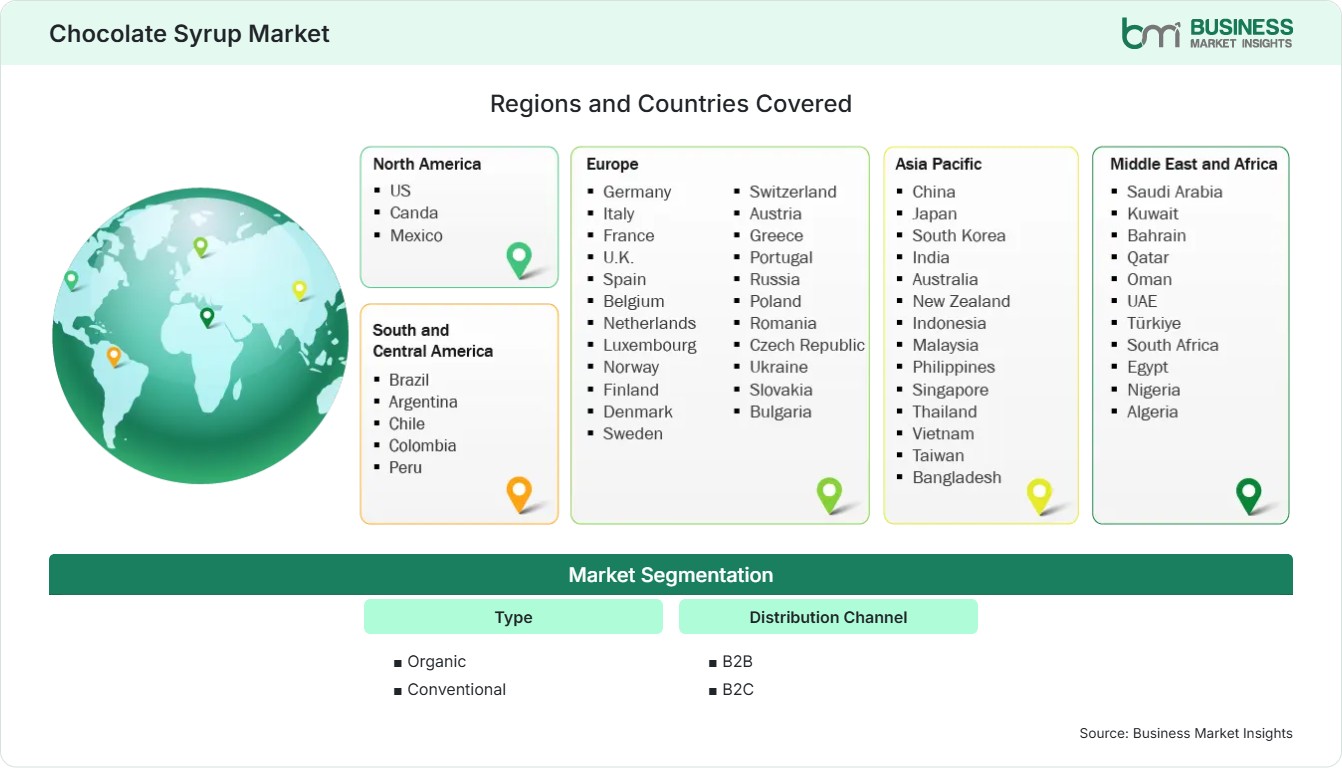
  • Type: Organic, Conventional
  • Distribution Channel: B2B, B2C
US$ 1.37 Bn Market size in 2025
US$ 2.61 Bn Market Size by 2033
8.4% CAGR, 2026 - 2033
2026-2033 Forecast Period

AI Overview

Chocolate Syrup Market Summary

  • North America Region: North America holds market share of 34%–37% in 2025, growing with a CAGR of 7.8%–8.8% influenced by established dessert culture, foodservice expansion, premium product launches, and strong retail distribution networks. The US market demonstrates steady adoption through specialty beverages and convenience products, with a CAGR of 8.0%–9.0% during 2026–2033.
  • Fastest Growing Region: Asia Pacific holds market share of 25%–28% in 2025, growing with a CAGR of 9.0%–10.0% supported by expanding café chains, rising disposable income, westernized desserts, e-commerce grocery adoption, and increasing consumer interest in flavored food products.
  • Leading Segment: Conventional chocolate syrup holds market share of 78%–81% in 2025, growing with a CAGR of 7.8%–8.8% driven by broad consumer acceptance, affordability, established manufacturing capabilities, and extensive applications across retail and foodservice channels.
  • High Growth Segment: Organic chocolate syrup represents a high-growth segment with increasing demand from health-conscious consumers, clean-label preferences, premium food trends, and manufacturers introducing natural ingredient-based alternatives.
  • Key Market Opportunity: Growth opportunities are emerging through premium formulations, organic ingredients, online retail expansion, innovative beverage applications, and partnerships with cafés, bakeries, and foodservice operators seeking differentiated flavor solutions.
  • Major Market Players: The Hershey Company, Nestlé, The Kroger Co., The J.M. Smucker Company, Torani, Bosco, Hollander Chocolate, Inc., Walden Farms, Amoretti, Gold’s Pure Foods, LLC.
Strategic Insights

Chocolate Syrup Market: Strategic Insights

Chocolate Syrup Market Strategic Framework
FREE PDF
Request your free sample
Request free sample
Stakeholder View

Key Takeaways

  • The market ecosystem is shaped by ingredient suppliers, syrup manufacturers, retailers, foodservice operators, and online distribution platforms, creating an interconnected value chain focused on product availability and consumer accessibility.
  • Premium and organic formulations represent attractive growth opportunities as consumers increasingly seek differentiated dessert experiences, clean-label products, and reduced-impact alternatives without compromising flavor quality.
  • Product innovation is shifting toward healthier formulations, customized flavors, sustainable packaging, and versatile applications across beverages, bakery products, frozen desserts, and culinary preparations.
  • Asia Pacific provides a compelling investment opportunity due to expanding café culture, urbanization, rising middle-class spending, and rapid development of modern retail and digital commerce channels.
  • Strategic collaborations among food manufacturers, retailers, and specialty ingredient companies are increasing as businesses seek broader market reach and stronger product differentiation.
Geographic Outlook

Chocolate Syrup Market Regional Highlights

North America Chocolate Syrup Market

North America accounted for a market share of 34%–37% in 2025 and is projected to expand at a CAGR of 7.8%–8.8% during 2026–2033. Chocolate Syrup Market share in the region is supported by strong dessert consumption patterns, mature retail networks, established brands, and extensive foodservice applications. The United States remains the leading contributor due to widespread consumer familiarity and product innovation.

  • Premium chocolate beverages and dessert offerings are increasing demand among consumers seeking café-style experiences and customized foodservice menu options.
  • Retail brands are introducing diverse formulations including organic, low-sugar, and specialty chocolate syrups to capture evolving consumer preferences.
  • Foodservice operators are expanding chocolate-based menu items, supporting consistent demand from restaurants, cafés, and dessert-focused businesses.
  • Established distribution infrastructure enables manufacturers to maintain broad product availability across supermarkets, convenience stores, and online platforms.

US Chocolate Syrup Market

The US accounted for a market share of 29%–32% in 2025 and is expected to register a CAGR of 8.0%–9.0% between 2026–2033. Chocolate Syrup Market growth in the country is influenced by strong household consumption, café expansion, and innovation in dessert applications. Manufacturers are targeting consumers through premiumization and convenient retail formats.

  • Foodservice chains are increasing chocolate syrup usage across beverages, desserts, and seasonal product offerings to enhance menu variety.
  • Consumer interest in specialty coffee and blended beverages is supporting demand for chocolate-flavored ingredients.
  • Online grocery platforms are improving accessibility of branded and specialty chocolate syrup products nationwide.

Europe Chocolate Syrup Market

Europe represented a market share of 22%–25% in 2025 and is projected to grow at a CAGR of 7.0%–8.0% during 2026–2033. Chocolate Syrup Market share in Europe is influenced by premium confectionery preferences, bakery traditions, and demand for high-quality ingredients. Germany, the United Kingdom, and France remain significant contributors, while Nordic markets show increasing interest in premium and organic offerings.

  • Germany supports market expansion through strong bakery consumption, food innovation capabilities, and demand for premium dessert ingredients.
  • The United Kingdom demonstrates growth through café culture, specialty beverages, and increasing adoption of convenient dessert solutions.
  • France contributes through established confectionery preferences and demand for high-quality chocolate-based culinary products.
  • Nordic countries are expanding premium product adoption through clean-label and sustainability-focused consumer preferences.

Asia Pacific Chocolate Syrup Market

Asia Pacific held a market share of 25%–28% in 2025 and is anticipated to expand at a CAGR of 9.0%–10.0% through 2033. Chocolate Syrup Market share in the region is supported by urbanization, expanding foodservice channels, rising disposable incomes, and increasing acceptance of Western-style desserts. China, India, Japan, and Southeast Asian economies are contributing to regional growth.

  • China is experiencing increasing demand through café expansion, online food retail growth, and evolving consumer dessert preferences.
  • India is gaining opportunities through bakery growth, restaurant expansion, and rising interest in chocolate-based beverages.
  • Japan supports premium chocolate product adoption through established confectionery culture and innovative food applications.
  • Southeast Asian markets are adopting chocolate syrups through modern retail expansion and growing café networks.
  • Regional manufacturers are investing in localized flavors and packaging formats to attract diverse consumers.

Rest of World Chocolate Syrup Market

Rest of World accounted for a market share of 12%–15% in 2025 and is projected to grow at a CAGR of 6.5%–7.5% during 2026–2033. Chocolate Syrup Market share across Latin America, Middle East, and Africa is supported by expanding foodservice sectors, urban consumer markets, and increasing availability of international food brands. Brazil, Mexico, and Gulf countries demonstrate rising product adoption.

  • Latin American markets benefit from strong beverage consumption patterns and increasing demand for dessert-based food products.
  • Brazil demonstrates growth through expanding retail availability, café development, and chocolate product consumption.
  • Mexico supports adoption through bakery applications, foodservice expansion, and increasing modern retail penetration.
  • Middle Eastern markets are adopting premium chocolate products through hospitality and restaurant sector development.
  • African urban markets present opportunities through growing retail infrastructure and changing consumer food preferences.
Global Market Geography
FREE PDF
Request your free sample
Request free sample
Segment Analysis

Chocolate Syrup Market Segmentation

Type

The type segment accounted for a significant portion of the market in 2025, with conventional products maintaining broader adoption due to affordability and availability. The segment held a market share of 78%–81% in 2025 and is projected to expand at a CAGR of 7.8%–8.8% between 2026–2033. Organic alternatives are gaining attention as consumers prioritize ingredient transparency, natural formulations, and premium food choices.

  • Organic: Organic chocolate syrup products are gaining traction among health-focused consumers seeking cleaner formulations, natural ingredients, and sustainably sourced options across premium retail and specialty food channels.
  • Conventional: Conventional chocolate syrup remains dominant due to established consumer preferences, cost efficiency, large-scale production capabilities, and extensive usage in households, restaurants, cafés, and commercial food preparation.

Distribution Channel

The distribution channel segment plays a crucial role in determining product accessibility, brand visibility, and consumer purchasing behavior. The market scope is expanding through diversified sales channels, including retail stores, foodservice networks, and digital platforms. This segment represented a market share of 100% in 2025 and is expected to grow at a CAGR of 8.4% between 2026–2033 as manufacturers strengthen omnichannel strategies.

  • B2B: B2B distribution supports large-volume consumption through restaurants, cafés, bakeries, hotels, and institutional food operators requiring consistent supply and customized product solutions.
  • B2C: B2C channels are expanding through household consumption, retail branding, and direct consumer access enabled by supermarkets, convenience stores, and digital commerce platforms.
  • Supermarket/Hypermarket: Supermarkets and hypermarkets remain important retail channels by providing broad product visibility, promotional opportunities, competitive pricing, and convenient access for household consumers.
  • Convenience Stores: Convenience stores support impulse purchases and quick-access consumption by offering smaller packaging formats suitable for beverages, snacks, and immediate dessert preparation.
  • Online Stores: Online stores are gaining importance through subscription models, wider product selection, digital marketing, and improved accessibility for premium and specialty chocolate syrup brands.
Market Forces

Chocolate Syrup Market Dynamics

Key Market Drivers

Increasing Consumption of Desserts and Sweetened Beverages

The increase in the consumption of desserts, beverages, and other food products is helping the market grow through the retail and food services applications segments. Consumers around the world are looking for flavors to add value to their beverages, ice creams, bakery products, and home-made desserts. As per the Food and Agriculture Organization, the demand for cocoa continues to be related to the increase in consumption of confectionery around the world. Chocolate Syrup Market trends show that producers have begun to adapt their formulas and flavor ranges.

Growth of Foodservice and Cafe Culture

The rise in the number of coffee shops, dessert shops, restaurants, and fast food places is resulting in a steady increase in demand for chocolate syrup as a flexible and versatile ingredient. There is an increasing trend among food service providers in making use of chocolate syrups in drinks, toppings, and unique desserts so as to help them distinguish themselves. Consumers in urban areas are embracing the café culture as a part of their lifestyle, especially in developing countries where food service networks are growing in a planned manner.

Rising Demand for Flavor Enhancers in Food Products

The rising demand for improved taste sensations in packaged foods is contributing to increased usage of chocolate syrup in foods other than sweets. The incorporation of chocolate taste in beverages, baked foods, frozen foods, and other specialty snacks is helping food companies attract customers who are looking for indulgent products. The market will receive an advantage due to the flexibility of its products since the syrups add texture, sweetness, and appearance to many different food products. Manufacturers are focusing on the development of better formulations of syrups.

Key Market Opportunities

Expansion of Bakery and Beverage Applications

The expansion in bakery and beverage uses presents great prospects for the industry to create opportunities for increased penetration among varied consumption instances. There is increasing use of chocolate syrups as ingredients in coffee beverages, milkshakes, bakery fillings, dessert toppings, and specialty dishes. Chocolate Syrup Market Forecasts present future possibilities by creating linkages with cafés, bakeries, and beverages that are looking for new flavors. Opportunities can be captured by manufacturers by creating customised recipes, sustainable packaging, and professional kitchen products. Growth in the organised food services sector within the developing world is another possibility.

Increasing Demand for Convenient Dessert Ingredients

Consumer adoption of innovative products for the preparation of desserts that save time while delivering a high taste experience is becoming more common. Chocolate syrups are readily available for use at home to make desserts, drinks, and snacks without involving complicated ingredients. The opportunity is driven by changing lifestyle patterns, urbanization, and growing trends towards food preparation at home. Products can capitalize on the market through smaller pack sizes, ready-to-use products, and distinctive flavors. Premiumization of products through organic ingredients, low sugar content, and clean label products can boost consumer engagement.

Growth of Online Food Retail Channels

Expansion of digital commerce presents new business opportunities for chocolate syrup manufacturers as they enhance their customer reach and interact directly with their customers. The online space will enable the manufacturers to offer specialty items, market to targeted demographics, and overcome their previous restrictions in brick-and-mortar stores. The growth of grocery delivery businesses and digital marketplaces will facilitate the widespread availability of higher-end and imported chocolate syrups. The online marketing space will be used by manufacturers via subscriptions, marketing campaigns, and packaging efforts.

Market Restraints and Challenges

Health Concerns Related to Sugar Consumption

Factor: Rising awareness regarding excessive sugar intake and associated health concerns is influencing consumer preferences toward reduced-sugar and alternative sweetener products. Impact: Reformulation of the chocolate syrup formulation by manufacturers becomes imperative owing to health considerations without sacrificing its taste and quality, besides ensuring affordable pricing. Growing interest from various health bodies in reducing sugar content in food consumption has prompted manufacturers to produce healthier products. All these developments lead to increased work and effort in terms of research, raw material availability, and product testing. Brands that fail to address changing nutritional expectations may experience reduced consumer acceptance, particularly among health-conscious demographics seeking balanced indulgence options.

Fluctuating Cocoa Prices

Factor: Volatility in cocoa prices caused by supply constraints, weather conditions, and agricultural challenges affects raw material costs for chocolate syrup manufacturers. Impact: Increased costs of inputs may affect profitability as well as place pressure on pricing methods used. Areas that produce cocoa experience uncertainties in production that impact global supply. The firms need to create effective purchasing systems for raw materials that will reduce cost disturbances. Price volatility is among the key challenges since companies producing chocolate syrups have to consider pricing competitiveness and quality of their products at the same time.

Company Analysis

Competitive Landscape

The Chocolate Syrup Market analysis highlights competition among global food manufacturers, specialty syrup producers, and ingredient-focused companies. Market participants are emphasizing product innovation, distribution expansion, premium formulations, and partnerships with foodservice operators to strengthen their competitive positions.

Company Name

Overview

Products and Services relevant to this market

The Hershey Company

Global confectionery leader with strong chocolate brand recognition and extensive consumer reach.

Chocolate syrups, dessert toppings, confectionery ingredients, and branded chocolate products.

Nestlé

Multinational food company offering diverse nutrition and confectionery product portfolios worldwide.

Chocolate ingredients, beverage solutions, dessert products, and foodservice applications.

The Kroger Co.

Major US retailer supporting private-label and branded food product distribution.

Retail chocolate syrups, grocery distribution, and consumer food solutions.

The J.M. Smucker Company

Food manufacturer known for consumer brands and packaged food products.

Dessert toppings, syrups, spreads, and specialty food products.

Torani

Specialty beverage syrup company serving cafés, restaurants, and consumers globally.

Chocolate syrups, beverage flavors, cafe ingredients, and customization solutions.

Bosco

Established chocolate syrup brand recognized for beverage and dessert applications.

Chocolate syrups, dessert toppings, and foodservice products.

Hollander Chocolate, Inc.

Specialty chocolate ingredient supplier serving beverage and culinary markets.

Chocolate sauces, syrups, beverage ingredients, and café solutions.

Walden Farms

Food company focused on calorie-conscious and specialty food products.

Reduced-calorie chocolate syrups and alternative food products.

Amoretti

Specialty ingredient provider offering flavor solutions for professional applications.

Chocolate syrups, culinary flavors, beverage ingredients, and bakery solutions.

Gold’s Pure Foods, LLC.

Food producer offering specialty sauces and consumer packaged products.

Chocolate syrups, dessert toppings, and specialty food offerings.

Industry Activity

Recent Developments

May 2026

Barry Callebaut Group introduced new chocolate innovation solutions, including Cacao Max, a premium cacao coating range, and expanded commercialization of ChoViva, a cocoa-free chocolate alternative developed with Planet A Foods. The developments strengthen Barry Callebaut’s portfolio of chocolate ingredients and coatings used by food manufacturers, including applications related to dessert toppings, sauces, and chocolate-flavored products.

November 2025

Barry Callebaut Group announced a strategic partnership with NotCo AI to explore the use of artificial intelligence in chocolate recipe development. The collaboration aims to speed up formulation innovation and create customized chocolate solutions for evolving consumer preferences.

August 2025

Monin India (MONIN) launched PURE by MONIN, a no-added-sugar flavor range in India targeting beverage and dessert creators. While focused on broader flavor applications, the launch supports MONIN’s expansion in premium beverage ingredients and café solutions, a key channel for chocolate syrup and flavored syrup consumption.

July 2025

Barry Callebaut Group entered a strategic partnership with Zurich University of Applied Sciences (ZHAW) to explore cocoa cell culture technology. The initiative supports long-term sustainability and alternative cocoa innovation strategies for the chocolate ingredient industry.

Trust & Transparency

Research Methodology

The market analysis combines proprietary research with secondary data from government agencies, company disclosures, regulatory filings, industry databases and expert interviews. Market estimates are validated through data triangulation, cross-market benchmarking and analyst review.

View Full Research Methodology

Questions Answered

Frequently Asked Questions

Which regions provide future investment opportunities for chocolate syrup producers?

Asia Pacific offers strong opportunities due to expanding foodservice infrastructure, urbanization, rising disposable incomes, and increasing adoption of Western-style desserts. Emerging markets in Latin America and the Middle East also provide growth potential.

What role does sustainability play in the Chocolate Syrup Market Report?

Sustainability influences sourcing strategies, packaging decisions, and supplier relationships. Companies are increasingly focusing on responsible cocoa procurement, transparent ingredient practices, and environmentally conscious production methods to improve brand value.

How are manufacturers addressing changing consumer health preferences?

Manufacturers are developing reduced-sugar, organic, and clean-label formulations to respond to changing dietary preferences. Product reformulation efforts focus on maintaining chocolate flavor, texture, and consumer satisfaction while improving nutritional profiles.

Which distribution channels are gaining importance for chocolate syrup sales?

Online stores and organized retail channels are gaining importance due to improved accessibility, wider product availability, digital promotions, and consumer convenience. Foodservice distribution remains essential because cafés and restaurants represent significant volume users.

What factors are influencing Chocolate Syrup Market expansion through 2033?

Growth is driven by increasing dessert consumption, café culture expansion, product innovation, online retail growth, and rising applications across beverages, bakery products, and foodservice operations. Premium and organic formulations are also supporting market diversification.

Access the Full Chocolate Syrup Market Report

Get segment-level forecasts, regional estimates, competitive benchmarking, company profiles and downloadable Excel datasets.

Access the full Chocolate Syrup Market Report
350 pages PDF & Excel | 2026-07-31