
Automotive HMI Market Outlook: Size, Share, Trends, Growth Analysis, Competitive Landscape & Forecast, 2026-2033

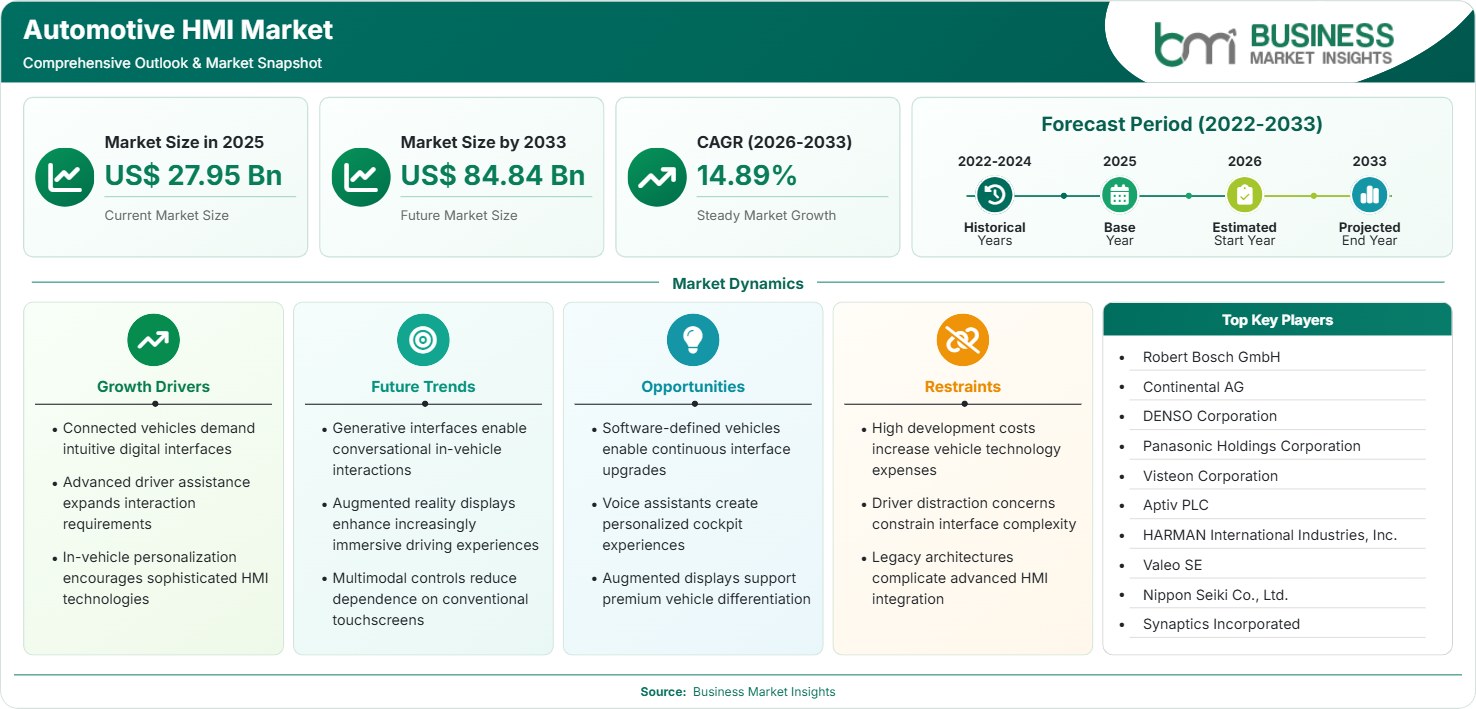
The Automotive HMI Market size was valued at US$ 27.95 Billion in 2025 and is projected to reach US$ 84.84 Billion by 2033, growing at a CAGR of 14.89% during 2026–2033. Key growth drivers include connected vehicles, digital cockpit adoption, AI-enabled voice interfaces, EV penetration, and advanced safety systems, while opportunities emerge from software-defined vehicles, multimodal interaction platforms, and augmented reality displays.

Report Coverage
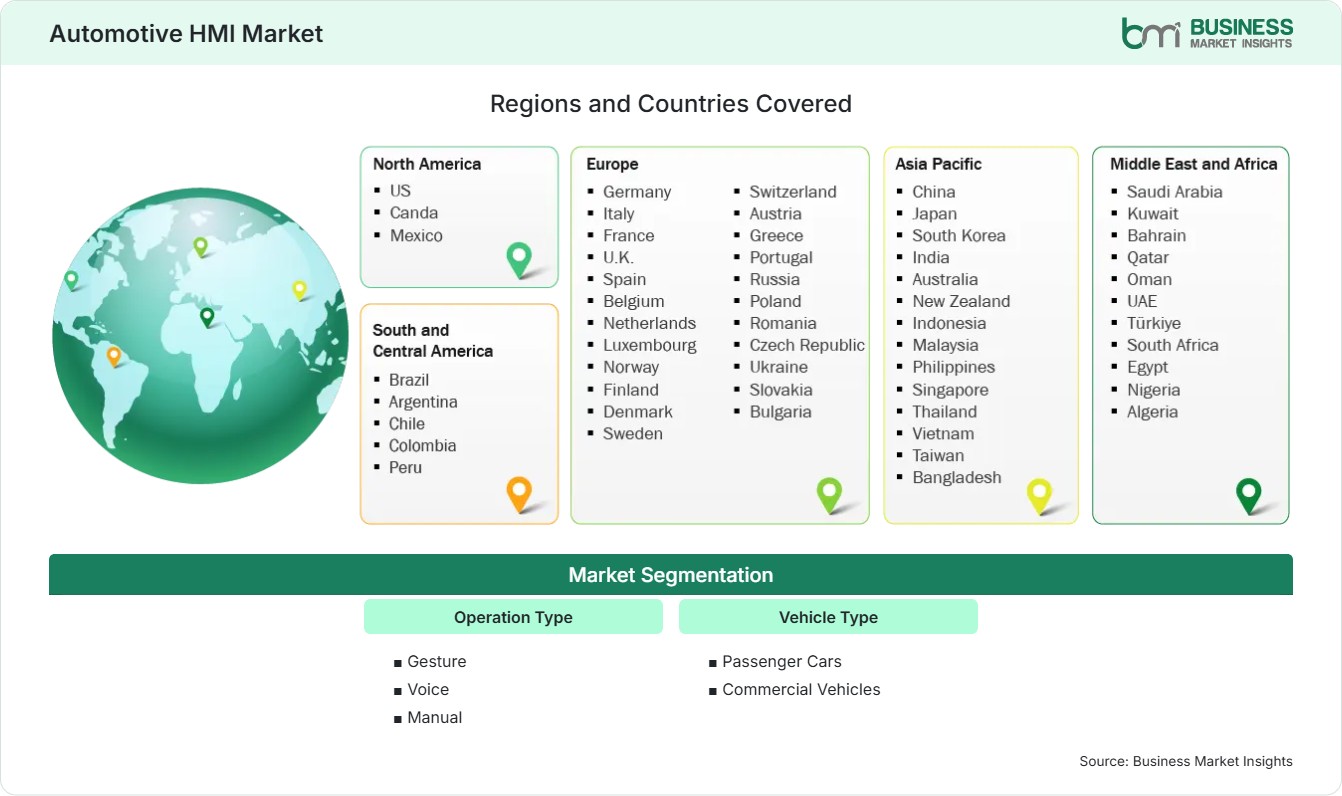
  • Operation Type: Gesture, Voice, Manual
  • Vehicle Type: Passenger Cars, Commercial Vehicles
US$ 27.95 Bn Market size in 2025
US$ 84.84 Bn Market Size by 2033
14.89% CAGR, 2026 - 2033
2026-2033 Forecast Period

AI Overview

Automotive HMI Market Summary

  • North America Region: Holds a market share of 32%–35% in 2025, growing at a CAGR of 13.5%–14.5% during 2026–2033. Demand is supported by premium vehicle penetration, digital cockpit upgrades, software-defined vehicle architectures, connected mobility ecosystems, advanced safety requirements, fleet digitalization, increasing EV deployments, voice assistants, and immersive display investments. US market benefits from strong OEM innovation and is estimated to advance at a CAGR of 13.8%–14.8%.
  • Fastest Growing Region: Asia Pacific holds 28%–31% share in 2025 and grows at 16.5%–17.5% CAGR. Growth stems from expanding EV production, rising vehicle electrification, smart cockpit adoption, increasing premium features in mid-range vehicles, government manufacturing incentives, semiconductor investments, connected vehicle demand, and local innovation ecosystems.
  • Leading Segment: Passenger Cars account for a 72%–75% share in 2025 with a CAGR of 14.0%–15.0%. Growth is supported by larger infotainment displays, digital instrument clusters, voice recognition integration, ADAS expansion, consumer demand for intuitive interfaces, and premium user-experience differentiation strategies.
  • High Growth Segment: Voice operation represents 30%–33% share in 2025 and expands at 17.0%–18.0% CAGR. Growth is driven by AI assistants, distraction reduction requirements, connected services integration, multilingual interaction capabilities, cloud processing advances, and increasing acceptance of hands-free vehicle control systems.
  • Key Market Opportunity: Expansion of multimodal human-machine interfaces combining voice, gesture, touch, haptic feedback, and augmented reality creates new revenue streams while improving safety, personalization, software monetization, and driver engagement.
  • Major Market Players: Robert Bosch GmbH, Continental AG, DENSO Corporation, Panasonic Holdings Corporation, Visteon Corporation, Aptiv PLC, HARMAN International Industries, Inc., Valeo SE, Nippon Seiki Co., Ltd., Synaptics Incorporated.
Strategic Insights

Automotive HMI Market: Strategic Insights

Automotive HMI Market Strategic Framework
FREE PDF
Request your free sample
Request free sample
Stakeholder View

Key Takeaways

  • The value chain is increasingly centered on software integration, display technologies, sensors, semiconductors, and cloud-connected services, creating deeper collaboration between automakers, Tier-1 suppliers, and technology providers.
  • Voice-based interaction presents the strongest upside as automakers seek hands-free control mechanisms that improve safety while supporting increasingly sophisticated vehicle functions.
  • Innovation is shifting toward multimodal digital cockpits combining AI assistants, augmented reality displays, haptic feedback, and personalized user experiences.
  • Asia Pacific offers the strongest investment case due to expanding EV manufacturing, government support programs, and rapid adoption of connected vehicle technologies.
  • Strategic partnerships between automotive suppliers and software companies are accelerating product development and enabling recurring revenue models through software updates.
  • Semiconductor optimization and edge-computing capabilities are becoming critical competitive differentiators across next-generation vehicle interface platforms.
Geographic Outlook

Automotive HMI Market Regional Highlights

North America Automotive HMI Market

North America accounts for 32%–35% of the Automotive HMI Market share in 2025 and is projected to grow at 13.5%–14.5% CAGR through 2033. Strong adoption of premium vehicles, connected mobility technologies, and advanced digital cockpit systems sustains regional leadership. Major OEM investments in software-defined architectures are increasing HMI content per vehicle. Regulatory focus on driver safety and user-interface effectiveness also supports investments in voice, haptic, and augmented-reality solutions.

  • Premium SUVs and EVs are adopting larger displays, AI assistants, and integrated cockpit platforms, supporting interface revenue expansion.
  • Software-defined vehicle development is increasing demand for upgradable and personalized interaction systems.
  • Fleet operators are investing in connected dashboards and productivity-focused driver interfaces.
  • Advanced safety regulations encourage innovation in distraction reduction technologies and intuitive controls.

US Automotive HMI Market

The United States represents 78%–82% of North American share and records a 13.8%–14.8% CAGR. Strong consumer demand for technology-rich vehicles and leadership in automotive software innovation support the deployment of intelligent cockpit systems. EV manufacturers and premium vehicle brands continue expanding investments in digital experience platforms.

  • AI-enabled voice systems are gaining widespread integration across new vehicle launches.
  • EV-focused manufacturers increasingly adopt centralized touchscreen architectures.
  • Connected services ecosystems are expanding monetization opportunities through software updates.
  • Strong R&D capabilities support development of next-generation cockpit technologies.

Europe Automotive HMI Market

Europe captures a 25%–28% share in 2025 and advances at a 14.0%–15.0% CAGR. Germany remains the leading market, while Eastern European manufacturing locations strengthen production capabilities. Growth is supported by premium vehicle demand, electrification targets, and technology leadership among regional automakers.

  • Germany remains the largest market with strong luxury vehicle production and interface innovation.
  • The UK and France continue expanding connected mobility deployment.
  • Central and Eastern Europe benefit from automotive manufacturing investments.
  • Regulatory focus on safety and emissions supports cockpit digitization.
  • Premium EV launches increase demand for advanced display systems.

Asia Pacific Automotive HMI Market

Asia Pacific holds 28%–31% share and records the highest growth at 16.5%–17.5% CAGR. China leads regional demand through EV production dominance, while India emerges as a fast-growing opportunity. Rising disposable incomes and digital-feature adoption accelerate deployment of advanced interfaces.

  • China dominates production of connected and electric vehicles requiring sophisticated interfaces.
  • India experiences strong adoption of digital instrument clusters and infotainment platforms.
  • Japan and South Korea remain technology leaders in cockpit innovation.
  • Regional semiconductor investments strengthen supply chain resilience.
  • Mid-range vehicle digitization expands addressable demand.

Rest of World Automotive HMI Market

Rest of World accounts for 10%–12% share and grows at 14.5%–15.5% CAGR. South and Central America benefit from increasing vehicle modernization initiatives, while the Middle East and Africa witness growing premium vehicle adoption. Market development remains linked to infrastructure expansion and technology transfer.

  • Brazil remains the leading South American market with growing vehicle production.
  • Mexico benefits from automotive manufacturing integration and exports.
  • GCC countries drive premium vehicle demand and infotainment adoption.
  • South Africa serves as a regional automotive manufacturing hub.
  • Connected mobility investments gradually expand interface deployment.
Global Market Geography
FREE PDF
Request your free sample
Request free sample
Segment Analysis

Automotive HMI Market Segmentation

Operation Type

The Operation Type segment describes the layer that includes the primary interactions between vehicles and users. It also takes into account users' changing preferences and safety concerns. The Automotive HMI Market scope has been steadily increasing as interfaces expand from touchscreens to intelligent interaction systems. Voice-controlled interfaces demonstrate the highest growth rates. Together, manual interfaces account for more than 50% of the segment, while advanced interaction technologies deliver higher future CAGR potential.

  • Gesture: Gesture recognition improves convenience through touchless interaction, supporting safety objectives and premium cabin experiences. Adoption increases across luxury vehicles integrating sensors, cameras, and AI processing capabilities.
  • Voice: Voice-controlled interfaces enable hands-free operation of infotainment, navigation, climate, and communication functions. AI improvements, multilingual support, and natural-language processing continue accelerating market penetration.
  • Manual: Manual controls remain essential for critical vehicle functions, offering reliability, familiarity, and regulatory acceptance despite increasing digitalization across modern cockpit environments.

Vehicle Type

Passenger and commercial vehicles are increasingly integrating high-end interface technologies to enhance ease of use, safety, and efficiency. The Automotive HMI Market trends suggest increased usage in passenger cars, driven by consumers' demand for digital experiences. Commercial vehicles are seeing growing use of connectivity dashboards and productivity interfaces. The share of Passenger Cars remains at 72%-75% and is growing at 14.0%-15.0% CAGR, maintaining segment leadership.

  • Passenger Cars: Strong demand for infotainment, digital clusters, and personalized cockpit environments supports widespread integration of sophisticated interaction technologies in both premium and mass-market models.
  • Commercial Vehicles: Fleet management requirements, telematics integration, navigation efficiency, and safety monitoring systems drive deployment of increasingly advanced interface platforms.
Market Forces

Automotive HMI Market Dynamics

Key Market Drivers

Expansion of Software-Defined Vehicle Architectures

Automobile manufacturers are shifting towards software-based platforms rather than hardware-based ones, with digital interfaces being an essential part of the latter. Systems in the cockpit have become the key interface between users and the vehicle's functionality. There is an increasing need for integration and updates via air, connectivity, and cloud platforms, necessitating flexible interface environments to accommodate software changes. The Automotive HMI market growth is thus linked to this trend, as software becomes the differentiating factor in the user experience and branding. Both premium and volume carmakers implement centralized computing platforms, generating demand for visualization, control, and interaction solutions.

Growing Adoption of Electric Vehicles and Connected Mobility

The electric car needs high-quality displays that can convey information about battery behavior, the charging process, routes, and energy management. Connected mobility systems also require seamless interaction among smartphones, cloud services, navigation solutions, and vehicle interfaces. The Automotive HMI Market trends show an increasing amount of interface content per vehicle, with more connected features. Digital cockpits are becoming more popular among EV manufacturers as a competitive factor. As electrification plans worldwide continue to expand in the automotive industry, interface complexity keeps increasing, supporting long-term investments in touchscreens, digital clusters, head-up displays, and AI-powered assistance technologies.

Rising Focus on Driver Safety and Human-Centric Design

The combination of safety regulations and consumer preferences will drive the development of interfaces that provide an intuitive, distraction-free experience while giving access to important information. The use of voice control, haptic feedback systems, and a personalized user interface will decrease users' cognitive load. Automakers will integrate systems that enable drivers to use a suitable communication method to access various functions. A human-centered design approach will become common practice in cockpit design projects due to the connectivity and automation of automobiles. These factors continue to reinforce demand for advanced interaction platforms that balance usability, safety, functionality, and regulatory compliance.

Key Market Opportunities

Augmented Reality Head-Up Display Commercialization

Augmented reality head-up displays present a tremendous potential for value creation. The automotive industry is incorporating navigation support, warning alerts, and driver-assistance information into the driver's field of vision. Such solutions provide increased situational awareness while improving the user experience. Automotive HMI Market Forecasts now view AR interfaces as a premium solution with the potential to become mainstream. Cheaper hardware, improved optical solutions, and a software ecosystem make the business case more attractive. Suppliers capable of producing such solutions on a scale and establishing relationships with car manufacturers will gain long-term growth prospects.AI-Based Personalized Vehicle Experiences

The use of artificial intelligence is driving the creation of interactive platforms that cater to users' individual needs, behaviors, and context-specific requirements. Intelligent agents will be able to control navigation, entertainment, air conditioning systems, and other car systems using a natural language interface. Profiles synced across digital platforms will lead to greater convenience and continuity. As manufacturers look for ways to distinguish themselves outside their conventional performance features, personalization becomes an increasingly critical element. Suppliers offering scalable AI integration frameworks stand to benefit from the growing demand for intelligent cockpit experiences.

Growth Potential in Emerging Automotive Markets

The emerging nations are seeing an increase in vehicle production, utilization of digital technology, and electric-vehicle production capabilities. There is growing consumer spending power among the middle class that will drive demand for connected, technologically advanced vehicles. Advanced interfaces are also being used by local manufacturers to differentiate themselves. Investments in semiconductor ecosystems, manufacturing localization, and automotive innovation hubs will further enhance prospects. Suppliers that strike a balance between affordability and functionality will be able to capture market share in rapidly expanding vehicle markets across Asia, Latin America, and selected Middle Eastern economies.

Market Restraints and Challenges

High Development and Integration Costs

Factor: High-end digital cockpits demand displays, processors, sensors, software platform capabilities, and cybersecurity capabilities. Impact: Integration costs may become too high for cost-conscious vehicle programs, making it difficult for manufacturers and suppliers to generate profit. Seamless multimodal interactions will require substantial investment in development and testing. Managing costs will be especially difficult during times of volatile, rising component costs. Manufacturers need to constantly balance high-end features with affordable price points, making commercialization strategies increasingly complex across competitive vehicle categories.

Cybersecurity and Data Privacy Risks

Factor: Increased connectivity expands the attack surface of the vehicle software ecosystem. Impact: Security breaches could erode consumer trust, create compliance issues, and increase development costs. Connected interfaces handle navigation information, user settings, communication services, and cloud-based services; therefore, it is imperative to protect these digital assets. A lot needs to be done by automotive companies in encryption, secure software development, threat management, and compliance. As interface ecosystems become more integrated with external platforms, maintaining robust cybersecurity frameworks remains an ongoing strategic and operational challenge.

Company Analysis

Competitive Landscape

Automotive HMI Market analysis indicates competition is driven by software capability, display innovation, sensor integration, and strategic OEM relationships.

Company Name

Overview

Products and Services relevant to this market

Robert Bosch GmbH

Global automotive technology supplier with broad digital cockpit expertise and strong OEM partnerships.

Instrument clusters, displays, cockpit electronics, connectivity solutions, driver-interface technologies.

Continental AG

Leading Tier-1 supplier focused on intelligent mobility and human-centric vehicle experiences.

Digital cockpits, HMI software, displays, HUDs, control systems.

DENSO Corporation

Major automotive supplier investing heavily in connected and intelligent vehicle technologies.

Instrument panels, electronics, integrated cockpit systems, interface solutions.

Panasonic Holdings Corporation

Electronics leader supporting connected mobility and infotainment innovation.

Displays, infotainment platforms, connectivity and vehicle electronics.

Visteon Corporation

Specialized automotive cockpit technology provider with global OEM relationships.

Digital clusters, cockpit controllers, infotainment and HMI platforms.

Aptiv PLC

Mobility technology company emphasizing advanced software and vehicle architectures.

Connected vehicle systems, software platforms, user-interface technologies.

HARMAN International Industries, Inc.

Automotive connectivity and digital experience specialist.

Infotainment systems, voice solutions, connected cockpit technologies.

Valeo SE

Automotive technology provider focused on electrification and intelligent mobility.

HMI components, displays, sensors, driver-information systems.

Nippon Seiki Co., Ltd.

Long-established specialist in vehicle instrumentation technologies.

Instrument clusters, head-up displays, cockpit visualization systems.

Synaptics Incorporated

Human-interface technology developer expanding automotive applications.

Touch, display, sensing, and interaction technologies.

Trust & Transparency

Research Methodology

The market analysis combines proprietary research with secondary data from government agencies, company disclosures, regulatory filings, industry databases and expert interviews. Market estimates are validated through data triangulation, cross-market benchmarking and analyst review.

View Full Research Methodology

Questions Answered

Frequently Asked Questions

What does an Automotive HMI Market Report typically evaluate?

It evaluates market size, technology trends, competitive positioning, regional dynamics, growth drivers, opportunity areas, segmentation developments, and future demand outlook.

What distinguishes premium cockpit platforms from traditional systems?

Premium platforms integrate large displays, AI assistants, augmented reality features, personalization capabilities, and cloud connectivity within a unified software environment.

How are voice interfaces changing vehicle interaction models?

Voice systems reduce driver distraction, improve accessibility, and enable natural-language control of navigation, entertainment, climate, and connected services.

Which region offers the strongest growth potential through 2033?

Asia Pacific presents the highest growth potential due to EV manufacturing expansion, increasing digital feature adoption, government incentives, and growing automotive production capacity.

What factors are accelerating adoption of advanced in-vehicle interfaces?

Connected vehicles, electrification, AI integration, digital cockpits, and safety-focused interaction systems are increasing demand for advanced user-interface technologies across passenger and commercial vehicles.

Access the Full Automotive HMI Market Report

Get segment-level forecasts, regional estimates, competitive benchmarking, company profiles and downloadable Excel datasets.

Access the full Automotive HMI Market Report
350 pages PDF & Excel | 2026-09-17
Similar Research

Related Market Reports