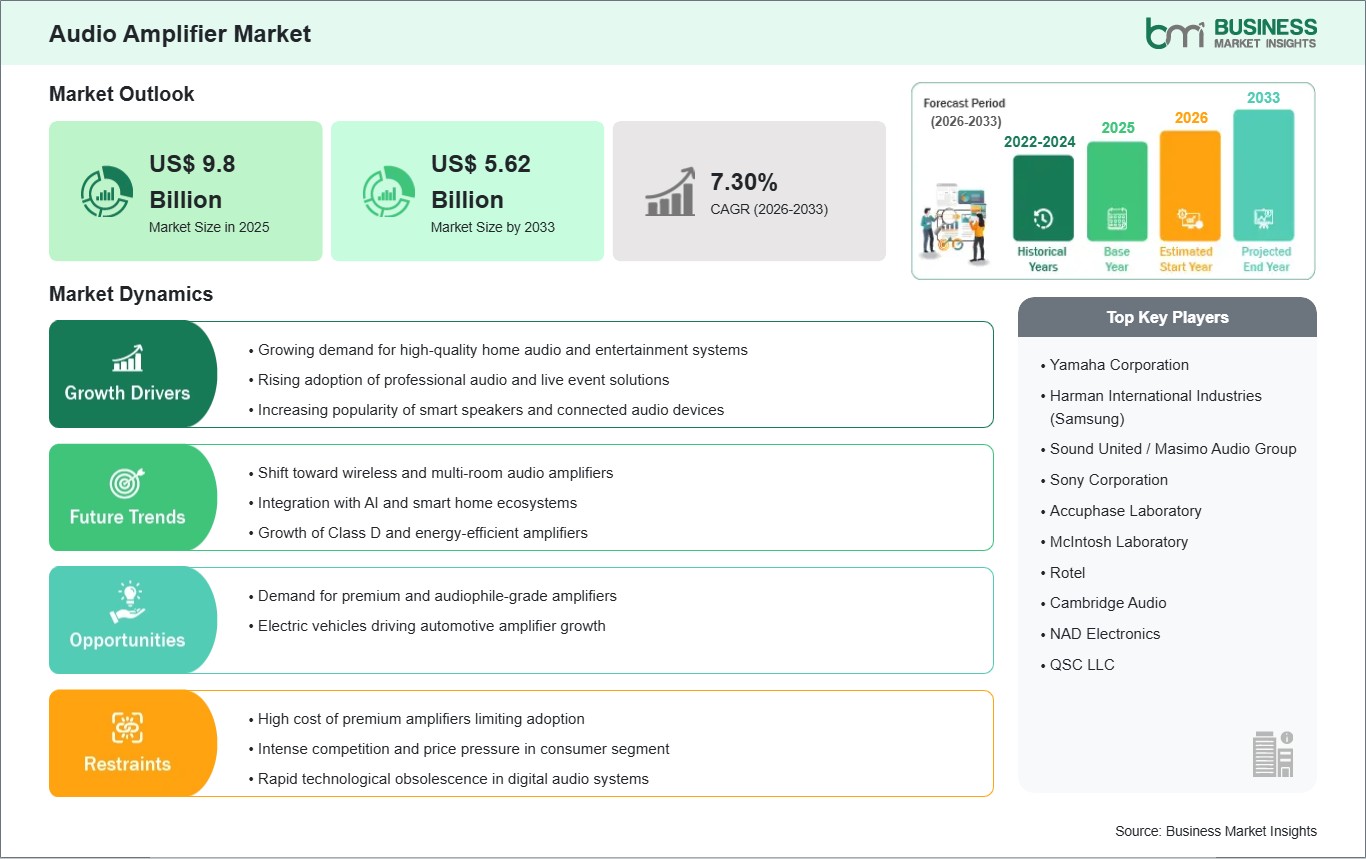
The Audio Amplifier size is expected to reach US$ 9.88 billion by 2033 from US$ 5.62 billion in 2025. The market is estimated to record a CAGR of 7.30% from 2026 to 2033.
The Audio Amplifier market is a critical segment of the global consumer, electronics, and professional, audio, ecosystem. Functions of audio amplifier electronics can be summarized as boosting the power of an audio signal for the purpose of room, filling sound through speakers, headphones, home theaters, musical instruments, and public address systems. Due to their excellent functions, these electronic devices are considered essential parts of loudspeakers, hi, fi, car audio, professional audio equipment, live events, and broadcasting, where they mainly serve to deliver the best sonic qualities, and precise signal control.
The global audio amplifier market is experiencing gradual expansion along with the rise of the consumer preference for luxurious sound experience and the rapid development of digital audio technologies. More and more people are buying smart gadgets equipped with voice assistants and wireless audio systems, and usually at the same time, they want to listen to the highest quality tracks through online streaming services that support playback in high resolution, which results in the need for audio amplifiers to be compatible with highly complex audio signals to still provide the original sound in a clean and very efficient way. The automotive industry is another sector that is heavily reliant on the usage of audio amplifiers in cars nowadays as they have long been integrated with entertainment systems, where the car audio is an active noise detector and thus utilizes advanced car audio solutions that are connected with the outside world and also need small yet very powerful audio amplifiers to provide exceptional sound quality.

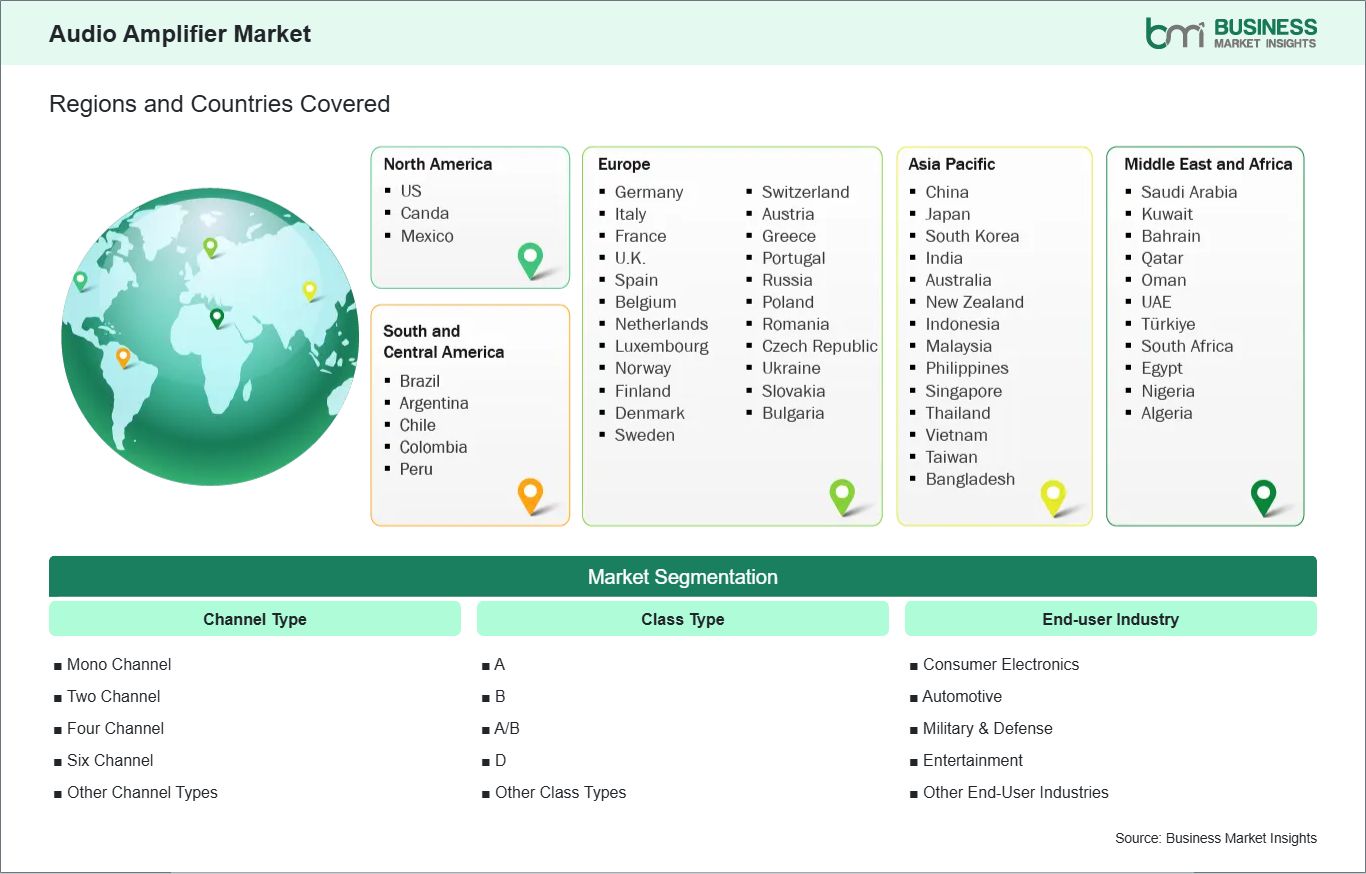
Key segments that contributed to the derivation of the Audio Amplifier analysis are channel type, class, and end-user industry.
The Audio Amplifier market is being strongly driven by the increasing consumer preference for high, fidelity and immersive audio experiences. The spread of smart devices, wireless speakers, and home entertainment systems has greatly raised the public's expectations for sound quality. Nowadays, consumers want stereo and multi, channel amplifier systems that can provide them with accurate, distortion, free music, movie, and gaming sounds. Moreover, the automotive industry is experiencing a rapid upgrade of premium car entertainment systems, which are highly dependent on multi, channel amplifiers for stereo, surround sound, and subwoofer control.
The growth of streaming services and high, resolution audio formats is another factor that keeps the demand for amplifiers that can process complicated audio signals while still preserving sound quality at a high level. Consequently, manufacturers have been motivated to come up with compact, energy, efficient, and high, performance solutions that are not only suitable for consumer but also professional use, thus greatly contributing to the growth of the global audio amplifier market.
The increased use of sophisticated audio technologies in automotive and smart home sectors is a major driving factor for the Audio Amplifier market. Automakers are equipping vehicles with multi, channel audio systems, active noise cancellation, and connected infotainment platforms which are all technologies that require highly advanced amplifier solutions. In the same way, the rise of smart homes and IoT, based gadgets, such as smart speakers, home theaters, and wireless audio systems, is leading to a requirement for amplifiers that are small, use less power, and produce high, quality sound.
New amplifier technologies such as Class D and Class H lead to greater efficiency, less heat emission, and suitability to portable and wireless devices, hence opening up even more opportunities for the market. Moreover, the popularity of immersive audio experiences, such as Dolby Atmos and DTS:X is increasing the demand for multi, channel and high, performance amplifiers which is a way for manufacturers to access new consumer segments and increase their presence in the world market.

By Channel Type, the Audio Amplifier (AMI) market is segmented into Mono Channel, Two Channel, Four Channel, Six Channel, and Others. Two, Channel segment is atop the market, mainly due to its continued dominance in delivering high quality stereo sound to consumer electronics, automotive audio and professional audio applications. Two, channel amplifiers offer a perfect compromise between performance, price and versatility, which is why they are the favorite choice in home stereo systems, small home theaters and multi, room audio arrangements. On the contrary, Four, Channel segment is rapidly expanding its share as more and more people are embracing multi, speaker configurations in cars, professional audio and home theaters for better channel separation and surround sound experiences.
By Class, the Audio Amplifier (AMI) market is segmented into A, B, A/B, D, and Others. The Class D segment leads the market. Class D amplifiers find applications in a wide range of products such as portable devices, smart speakers, automotive audio systems, and home theaters, mainly due to their ability to deliver a powerful output while generating little heat and consuming less energy. However, the Class A/B segment still retains a considerable share as it offers a balance between sound fidelity and efficiency, thus, it is still widely used in high, fidelity audio systems and professional studio equipment. Class A amplifiers are used in high, end audio applications where the main goal is to keep distortion levels at a minimum whereas Class B and other classes of amplifiers are used for niche or specialized audio needs.
By End-user Industry, the Audio Amplifier (AMI) market is segmented into Consumer Electronics, Automotive, Military & Defense, Entertainment, and Others. The Consumer Electronics segment leads the market. There is an increasing demand among consumers for immersive sound experiences. At the same time, they want compact and energy-efficient amplifiers that can be easily integrated with smart and wireless technologies. The Automotive segment is experiencing rapid growth, which can be attributed to the increasing installation of premium car audio systems, multi-channel speaker setups, and connected infotainment that necessitate advanced amplifier technologies. Military & Defense sectors, such as communication systems, surveillance, and mission-critical audio systems, consistently generate demand for high-performance and reliable amplifiers.
| Report Attribute | Details |
|---|---|
| Market size in 2025 | US$ 9.8 Billion |
| Market Size by 2033 | US$ 5.62 Billion |
| Global CAGR (2026 - 2033) | 7.30% |
| Historical Data | 2022-2024 |
| Forecast period | 2026-2033 |
| Segments Covered | By Channel Type
|
|
Regions and Countries Covered
| |
| North America | US, Canada, Mexico |
| Europe | Belgium, Austria, Finland, Denmark, Greece, Poland, Romania, Russia, Ukraine, Czech Republic, Slovakia, Bulgaria, Italy, Luxembourg, Germany, Switzerland, France, Netherlands, Norway, Portugal, Spain, Sweden, United Kingdom |
| Asia-Pacific | Australia, China, India, Japan, South Korea, Indonesia, Malaysia, Philippines, Singapore, Thailand, Vietnam, Bangladesh, New Zealand, Taiwan |
| South and Central America | Brazil, Argentina, Peru, Chile, Colombia |
| Middle East and Africa | Bahrain, Kuwait, Oman, Qatar, Saudi Arabia, United Arab Emirates, Turkiye, South Africa, Egypt, Algeria, Nigeria |
| Market leaders and key company profiles |
|
The "Audio Amplifier Size and Forecast (2022-2033)" report provides a detailed analysis of the market covering below areas:
The geographical scope of the Audio Amplifier report is divided into five regions: North America, Asia Pacific, Europe, the Middle East & Africa, and South & Central America. The Audio Amplifier in the Asia Pacific is expected to grow significantly during the forecast period.
The audio amplifier market is characterized by quite marked regional variations. These differences are largely attributed to consumer electronics penetration, automotive and smart home growth, entertainment infra as well as industrial development across regions. The U.S. and Canada primarily drive the large share held by North America as the demand for home audio systems, premium headphones, automotive infotainment, and professional audio equipment is fueled by high consumer spending.
The region is thus well, positioned for success due to its being at the forefront of extensive R&D, rapid embracement of smart and wireless audio technologies and having a mature entertainment and music industry ecosystem. Europe likewise represents a significant market, with Germany, the UK, and France at the forefront of growth. This is mainly due to the strong consumer preference for high, fidelity audio systems, the implementation of strict product quality and safety standards as well as the growing use of smart home and connected car audio solutions. Moreover, the professional audio, live events, and broadcasting sectors deepen the market potential.

The Audio Amplifier is evaluated by gathering qualitative and quantitative data post primary and secondary research, which includes important corporate publications, association data, and databases. A few of the key developments in the Audio Amplifier are:
The Audio Amplifier Market is valued at US$ 9.8 Billion in 2025, it is projected to reach US$ 5.62 Billion by 2033.
As per our report Audio Amplifier Market, the market size is valued at US$ 9.8 Billion in 2025, projecting it to reach US$ 5.62 Billion by 2033. This translates to a CAGR of approximately 7.30% during the forecast period.
The Audio Amplifier Market report typically cover these key segments-
The historic period, base year, and forecast period can vary slightly depending on the specific market research report. However, for the Audio Amplifier Market report:
The Audio Amplifier Market is populated by several key players, each contributing to its growth and innovation. Some of the major players include:
The Audio Amplifier Market report is valuable for diverse stakeholders, including:
Essentially, anyone involved in or considering involvement in the Audio Amplifier Market value chain can benefit from the information contained in a comprehensive market report.
Please tell us your area of interest
(Market Segments/ Regions and Countries/ Companies)