Market Summary
Executive Summary and Global Market Analysis
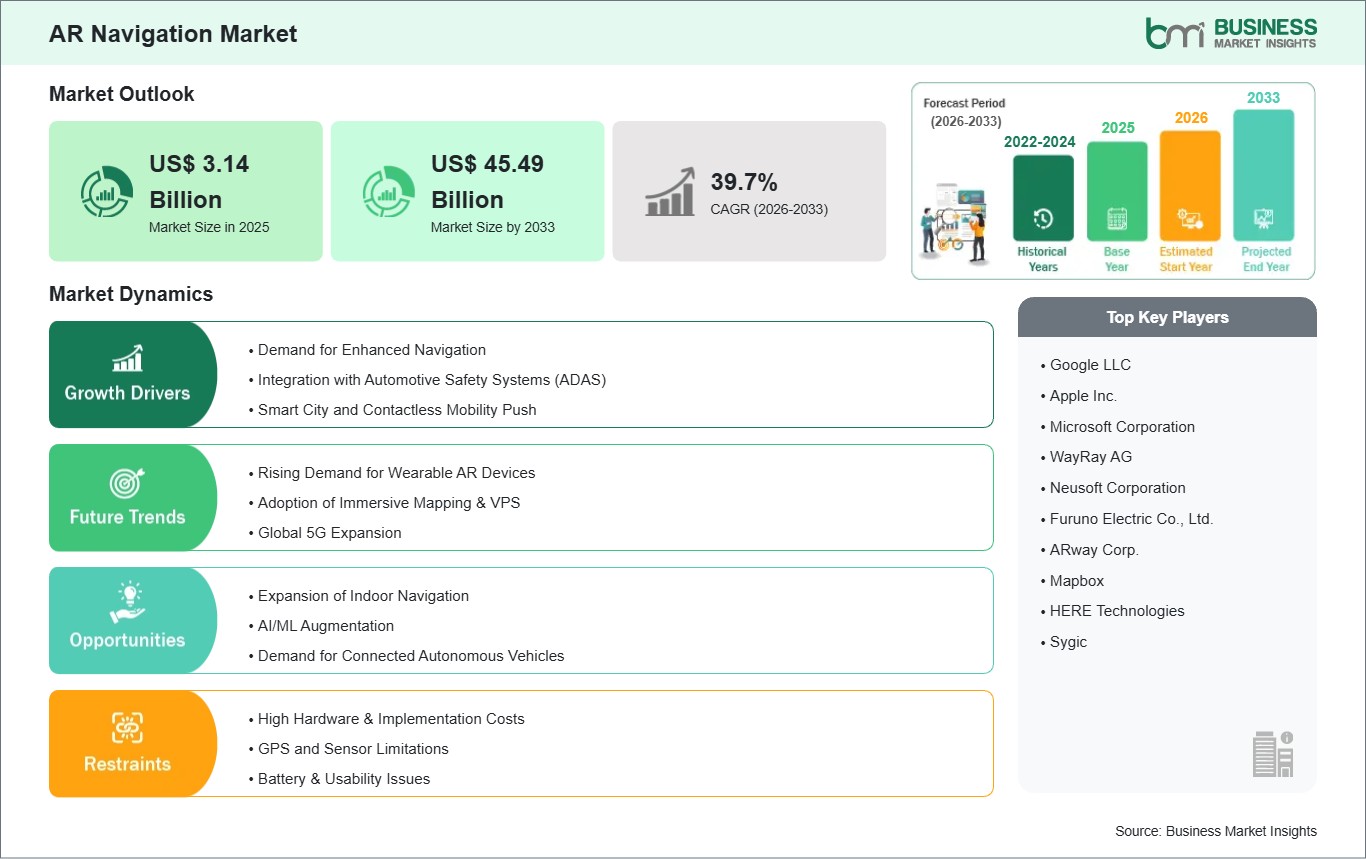
Augmented Reality (AR) navigation refers to technology that overlays digital information—such as directions, points of interest, or traffic alerts—onto the real-world environment, typically through smartphones, AR glasses, or head-up displays in vehicles. Unlike traditional GPS-based navigation, AR navigation provides users with an interactive and intuitive experience, guiding them with visual cues directly integrated into their surroundings. The usage of AR navigation spans multiple sectors: in automotive, it enhances driver safety by displaying turn-by-turn directions without diverting attention from the road; in retail and tourism, it assists users in locating stores, exhibits, or attractions efficiently; and in logistics and warehousing, it optimizes route planning and inventory management. Several demand factors drive the global AR navigation market. The rapid adoption of smartphones and wearable devices, growing consumer preference for immersive digital experiences, and increasing investments in smart city and connected vehicle initiatives all contribute to market growth. Additionally, advancements in AR software, high-precision GPS, and computer vision technologies have enhanced usability and accuracy, further stimulating adoption. Urbanization, rising traffic congestion, and the need for real-time, context-aware navigation solutions also create strong demand, positioning AR navigation as a transformative tool in both everyday life and enterprise applications.
Segment Analysis
AR Navigation Market Segmentation
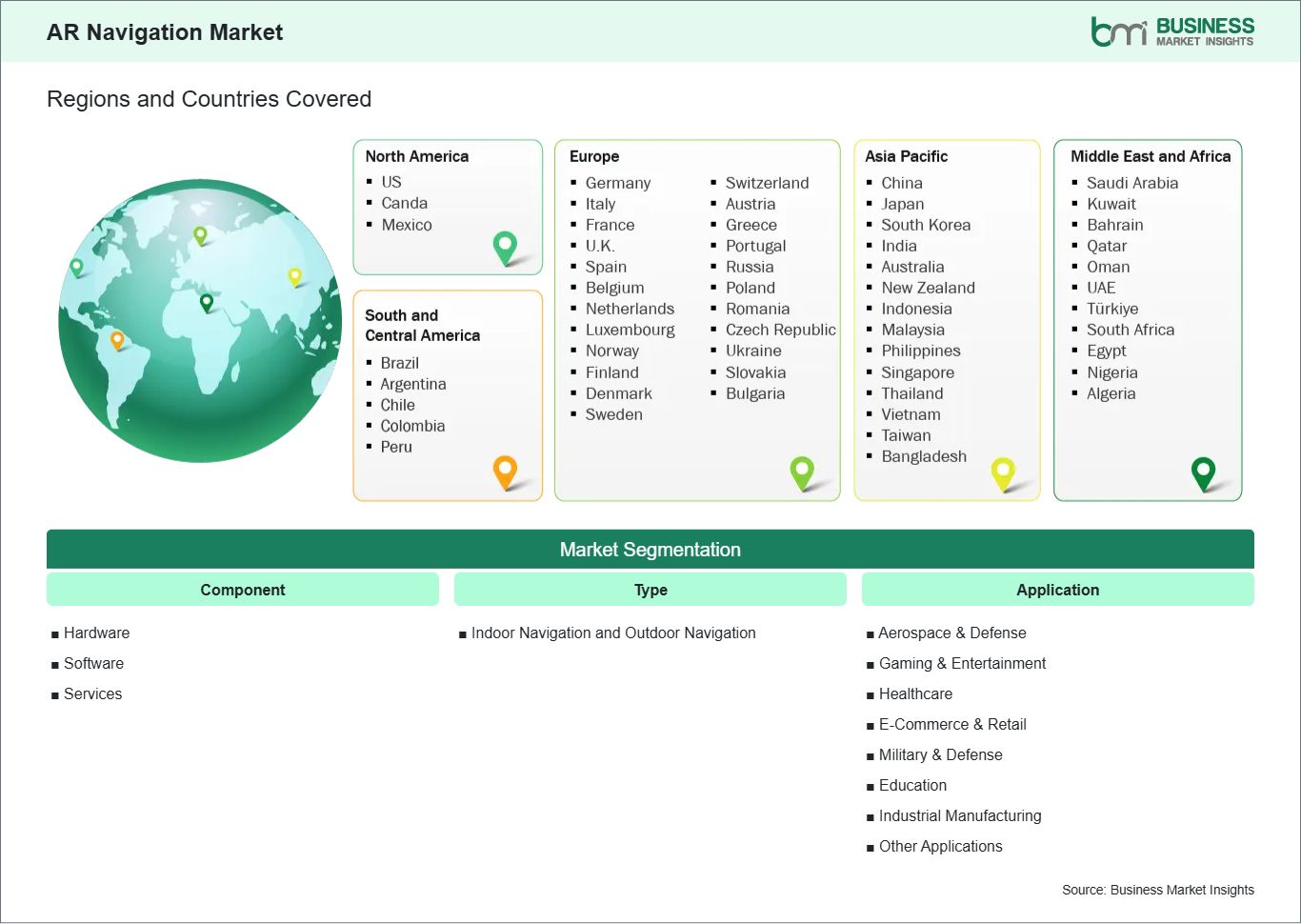
Key segments that contributed to the derivation of the AR navigation market analysis are component, type, and application.
- By component, the market is segmented into hardware, software, and services. The hardware segment held the largest share of the market in 2025.
- By type, the market is divided into indoor navigation and outdoor navigation. The outdoor navigation segment held the largest share of the market in 2025.
- By application, the market is segmented into aerospace & defense, gaming & entertainment, healthcare, e-commerce & retail, military & defense, education, industrial manufacturing, and others. The industrial manufacturing segment held the largest share of the market in 2025.
Market Forces
AR Navigation Market Drivers and Opportunities
Demand for Enhanced Navigation
The growing demand for enhanced navigation is a major driver of the augmented reality (AR) navigation market. As urban environments become increasingly complex and congested, traditional navigation tools like maps or GPS apps often fall short in providing real-time, intuitive guidance. Consumers and businesses alike are seeking solutions that offer more immersive, context-aware navigation experiences. AR navigation overlays digital directions directly onto the real-world environment, making it easier for users to find routes, recognize landmarks, and avoid obstacles without constantly switching attention between a map and their surroundings. This demand is particularly strong in sectors such as automotive, retail, tourism, and logistics, where efficiency, safety, and user experience are paramount. Furthermore, the rise of smart devices, connected vehicles, and location-based services has amplified expectations for seamless, interactive navigation. Consequently, companies are investing heavily in AR navigation technologies to meet user demand, fueling the growth of this innovative market segment.
Expansion of Indoor Navigation
The expansion of indoor navigation presents a significant growth driver for the AR navigation market, as traditional GPS solutions struggle to function accurately within enclosed spaces. Airports, hospitals, shopping malls, and warehouses represent environments where visitors and employees often face challenges in efficiently finding specific locations, services, or products. Augmented reality (AR) wayfinding solutions bridge this gap by overlaying digital directions onto real-world indoor settings, providing intuitive guidance and reducing time spent navigating complex layouts. In airports, AR can help passengers locate gates, lounges, or baggage claim areas, enhancing the travel experience. Hospitals benefit from AR-assisted navigation by helping patients and visitors find clinics, labs, or emergency exits quickly, improving safety and satisfaction. Similarly, retail malls and warehouses can leverage AR to streamline customer journeys or optimize operational workflows. This untapped indoor potential significantly expands AR navigation applications, driving market adoption and investment.
Size and Share Analysis
AR Navigation Market Size and Share Analysis
By component, the market is segmented into hardware, software, and services. The hardware segment held the largest share of the market in 2025. The hardware segment drives the AR navigation market due to the demand for advanced devices such as AR glasses, smartphones, and sensors. High-performance processors, cameras, and GPS modules enable precise, real-time navigation, enhancing user experience and supporting widespread AR adoption globally.
By type, the market is divided into indoor navigation and outdoor navigation. The outdoor navigation segment held the largest share of the market in 2025. The rising demand for outdoor navigation, fueled by urbanization, tourism growth, and the popularity of outdoor activities, drives the AR navigation market. Users seek real-time, immersive directions, enhanced safety, and interactive experiences, boosting adoption of AR-enabled navigation solutions globally.
By application, the market is segmented into aerospace & defense, gaming & entertainment, healthcare, e-commerce & retail, military & defense, education, industrial manufacturing, and others. The industrial manufacturing segment held the largest share of the market in 2025. The demand for AR navigation in industrial manufacturing is rising due to its ability to streamline complex workflows, reduce errors, enhance worker safety, provide real-time guidance, improve training efficiency, and optimize maintenance, ultimately boosting productivity and operational accuracy.
Report Coverage
AR Navigation Market Report Coverage and Deliverables
The "AR Navigation Market Size and Forecast (2022–2033)" report provides a detailed analysis of the market covering below areas:
- AR navigation market size and forecast at global, regional, and country levels for all the key market segments covered under the scope
- AR navigation market trends, as well as market dynamics such as drivers, restraints, and key opportunities
- AR navigation market analysis covering key market trends, global and regional framework, major players, regulations, and recent market developments
- Industry landscape and competition analysis covering market concentration, heat map analysis, prominent players, and recent developments for the air circuit breaker market
- Detailed company profiles, including SWOT analysis
Geographic Insights
AR Navigation Market Geographic Insights
The geographical scope of the AR navigation market report is divided into five regions: North America, Asia Pacific, Europe, Middle East & Africa, and South & Central America. The AR navigation market in North America is expected to grow significantly during the forecast period.
The North America AR navigation market is segmented into United States, Canada, and Mexico. The demand for AR navigation in North America has been steadily increasing due to several interrelated factors. Rapid technological advancements in smartphones, AR-enabled devices, and vehicle infotainment systems have made AR navigation more accessible and user-friendly. Consumers are increasingly seeking intuitive, real-time, and interactive navigation experiences that traditional GPS systems cannot provide, such as overlaying directions directly onto the real-world environment. Urbanization and growing traffic congestion in major North American cities have also driven the need for more precise, context-aware navigation solutions to enhance efficiency and safety. Additionally, the rise of autonomous vehicles, smart transportation infrastructure, and connected devices has created a supportive ecosystem for AR adoption. The demand is further fueled by the popularity of AR in retail, tourism, and gaming, which familiarizes users with AR technology and encourages its integration into everyday navigation tasks. Overall, convenience, safety, and technological innovation are key drivers.
Industry Activity
Recent Developments
The AR navigation market is evaluated by gathering qualitative and quantitative data post primary and secondary research, which includes important corporate publications, association data, and databases. A few of the key developments in the AR navigation market are:
- In October 2025, NAVER Corporation announced on October 23 that it has officially launched the “Indoor AR Navigation” service, which enables users to receive accurate directions via NAVER Map, even in indoor spaces without Global Positioning System (GPS). The company also introduced “Flying View 3D,” a feature that renders major landmarks across Korea in 3D.
- In September 2025, Meta unveiled a new range of smart glasses powered by its artificial intelligence (AI) tech, as it expands its bet that they will be a must-have accessory for users around the world. The firm also introduced a neural wristband that pairs with its Meta Ray-Ban Display glasses to allow users to carry out tasks like sending messages with small hand gestures.
Trust & Transparency
Research Methodology
The market analysis combines proprietary research with secondary data from government agencies, company disclosures, regulatory filings, industry databases and expert interviews. Market estimates are validated through data triangulation, cross-market benchmarking and analyst
review.
View Full Research Methodology
Key Sources Referred:
World Bank – Global Trade Indicators World Trade Organization (WTO) International Monetary Fund (IMF) International Trade Administration (ITA) Company website Company annual reports Company investor presentations