Navigation System Market Outlook (2022-2033)

Historic Data: 2022-2024   |   Base Year: 2025   |   Forecast Period: 2026-2033
Report Content: Market Scope, Market Segmentation, Market Dynamics, and Competitive Analysis

Report Coverage:
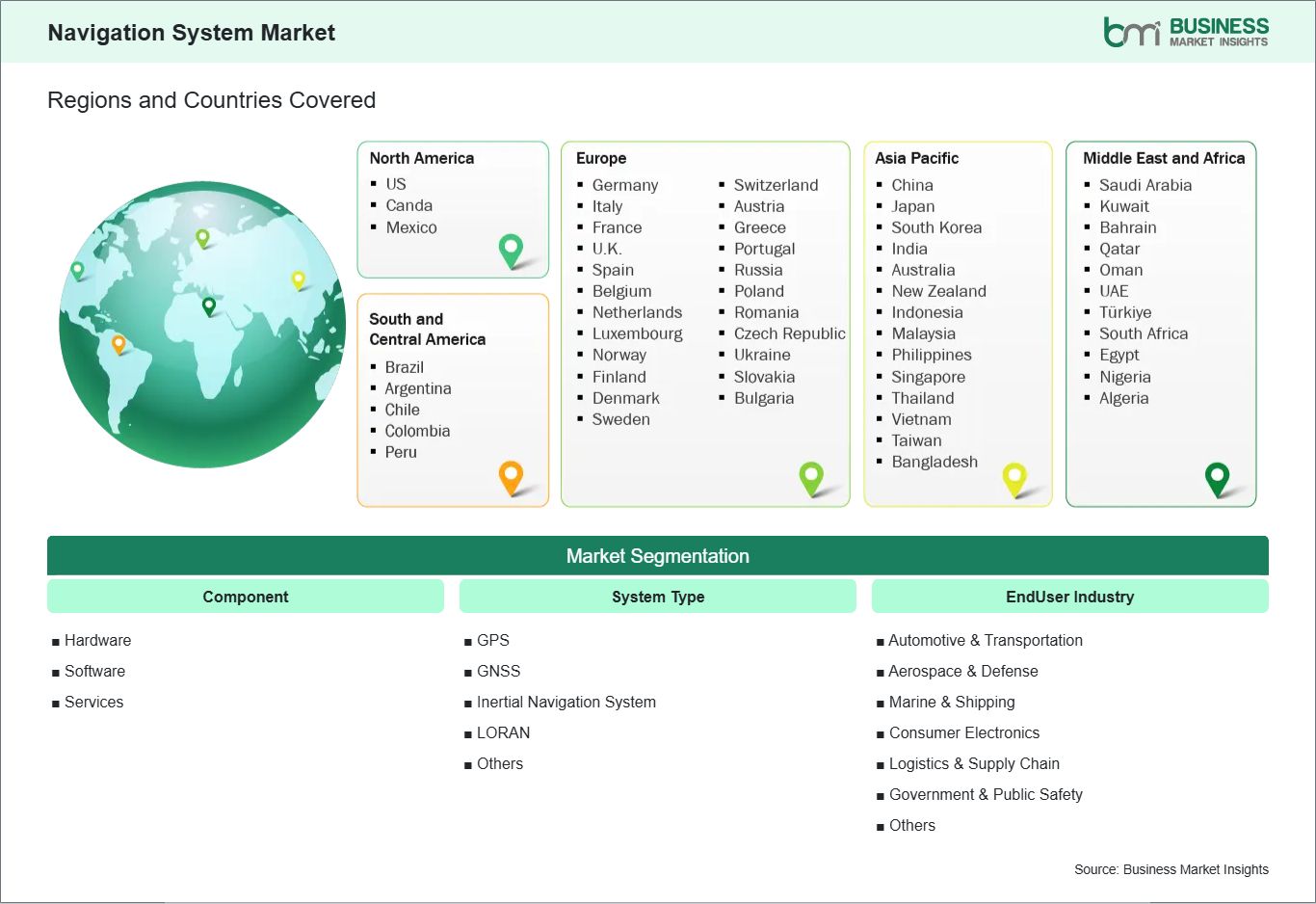
  • Component (Hardware, Software, Services)
  • System Type (GPS, GNSS, Inertial Navigation System (INS), LORAN, Others)
  • EndUser Industry (Automotive & Transportation, Aerospace & Defense, Marine & Shipping, Consumer Electronics, Logistics & Supply Chain, Government & Public Safety, Others)

No. of Pages: 400
Report Code: BMIPUB00032691
Category: Electronics and Semiconductor
Navigation System Market

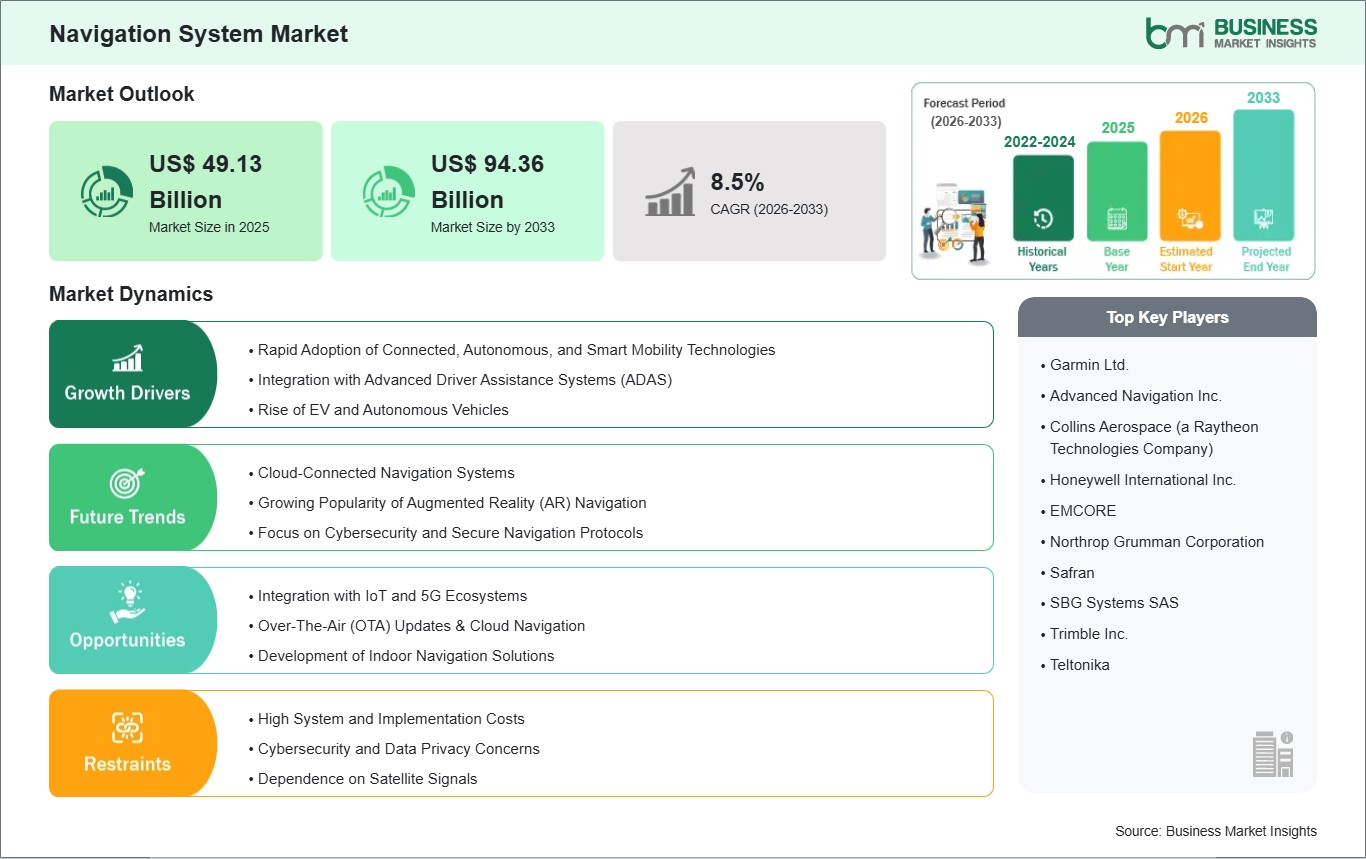
The navigation system market size is expected to reach US$ 94.36 billion by 2033 from US$ 49.13 billion in 2025. The market is estimated to record a CAGR of 8.5% from 2026 to 2033.

Executive Summary and Global Market Analysis:

A navigation system refers to a technological solution that enables users to determine their current position, plan routes, and receive guidance to a destination using maps, satellite positioning (such as GPS), and real-time data. These systems have become integral in personal vehicles, smartphones, aviation, maritime, and logistics, helping users optimize travel time, reduce fuel consumption, and enhance safety. The benefits of navigation systems include improved efficiency through accurate route guidance, reduced stress for drivers unfamiliar with routes, enhanced fleet management for businesses, and the ability to adapt to real-time traffic conditions. In daily usage, individuals rely on navigation apps for commuting, exploring new places, avoiding congested routes, and receiving alerts about accidents or road closures, while industries use advanced navigation for route optimization, delivery scheduling, and asset tracking.

The navigation system market is shaped by several drivers such as increased smartphone penetration, demand for connected and autonomous vehicles, and advancements in satellite and sensor technology. Growing e-commerce and logistics sectors further propel the adoption of navigation solutions that boost operational efficiency. However, the market also faces restraints, including concerns over data privacy, dependency on satellite signals that may be disrupted, and high initial costs for sophisticated in-vehicle systems. At the same time, opportunities are emerging in integrating artificial intelligence, augmented reality for enhanced user interfaces, and expansion in emerging economies with rising vehicle ownership. Trends in the market point to cloud-based navigation services, integration with IoT ecosystems, and the development of multimodal navigation that seamlessly combines road, rail, and pedestrian routing, indicating a dynamic future for navigation technologies.

Navigation System Market - Strategic Insights:

global-market-strategic-framework
Get more information on this report

Navigation System Market Segmentation Analysis:

Key segments that contributed to the derivation of the navigation system market analysis are component, system type, and end-user.

  • By component, the market is segmented into hardware, software, and services. The hardware segment held the largest share of the market in 2025.
  • By system type, the market is segmented into GPS, GNSS, inertial navigation system (INS), LORAN, and others. The GNSS segment held the largest share of the market in 2025.
  • By end-user, the market is segmented into automotive & transportation, aerospace & defense, marine & shipping, consumer electronics, logistics & supply chain, government & public safety, and others. The aerospace & defense segment held the largest share of the market in 2025.

Navigation System Market Drivers and Opportunities:

Rapid Adoption of Connected, Autonomous, and Smart Mobility Technologies

A central driver of the global navigation system market is the accelerating adoption of connected and autonomous mobility technologies across transportation sectors, particularly in automotive, aviation, and smart infrastructure. In the automotive segment, increasing demand for Advanced Driver Assistance Systems (ADAS) and connected vehicles is forcing original equipment manufacturers (OEMs) to integrate sophisticated navigation systems into new vehicles as standard features. ADAS integration enhances driver safety by linking navigation functions — such as real-time positioning, dynamic route guidance, and environmental awareness — with critical vehicle systems, helping reduce accidents and improve driving efficiency. Connected vehicle initiatives backed by governments and industry bodies are encouraging deployment of navigation systems that can communicate with urban infrastructures as part of intelligent transportation systems, enabling traffic management and real-time data exchange for optimized mobility. Furthermore, the rise of electric vehicles (EVs) is creating demand for navigation systems capable of locating charging stations, managing energy consumption, and planning efficient long-distance trips, strengthening the navigation market’s growth trajectory. Beyond road transport, sectors like aviation are also expanding navigation system utilization due to surging global air traffic and regulatory mandates for advanced flight navigation technologies, which ensure precision, redundancy, and operational safety under increasing traffic loads. Satellite-based navigation advancements, such as GNSS improvements, further enhance accuracy and reliability across sectors. Collectively, these trends illustrate how connectivity, automation, regulatory pressures, and consumer expectations are driving robust demand for next-generation navigation systems worldwide.

AI, IoT, and New Application Domains Expanding Navigation System Potential

The navigation system market presents considerable opportunities for innovation and expansion, driven by advances in artificial intelligence (AI), the Internet of Things (IoT), and emerging application domains that extend beyond traditional automotive and aerospace uses. One of the most significant opportunities lies in the integration of AI and machine learning into navigation platforms to deliver smarter, more adaptive services. AI can analyze historical and real-time data to provide predictive traffic analytics, personalized routing, context-aware recommendations, and automated decision support — enhancing user experiences and operational efficiencies across sectors. Machine learning models can also improve accuracy in complex environments such as urban canyons, crowded airspace, and logistics hubs, making navigation systems more intelligent and reliable. Additionally, the explosive growth of IoT and location-based services is creating new avenues for navigation systems in logistics, smart cities, retail, healthcare, and wearables. For example, fleet and delivery operators increasingly rely on sophisticated navigation solutions to optimize routes, reduce fuel costs, and enhance supply chain visibility. Smart city initiatives are integrating navigation data into urban planning and traffic management applications to address congestion and sustainability goals. There are also burgeoning opportunities in indoor navigation technologies for large facilities like warehouses, hospitals, and retail spaces where GPS signals are weak or unavailable. Furthermore, tailored navigation solutions for EV infrastructure planning and charging networks represent a specialized niche that promises high demand as global EV adoption accelerates. These evolving applications and technology synergies represent fertile ground for companies to differentiate offerings, enter adjacent markets, and develop recurring revenue models through software updates and data services.

Navigation System Market Size and Share Analysis:

By component, the market is segmented into hardware, software, and services. The hardware segment held the largest share of the market in 2025. The segment in the navigation system market is driven by increasing demand for accurate positioning, growth in automotive and aerospace industries, rising adoption of advanced driver assistance systems, expansion of smart infrastructure, technological advancements in sensors and chips, and the need for reliable, real-time navigation performance across diverse applications.

By system type, the market is segmented into GPS, GNSS, inertial navigation system (INS), LORAN, and others. The GNSS segment held the largest share of the market in 2025. The GNSS segment drives the navigation system market due to its global coverage, high positioning accuracy, and continuous signal availability. Growing demand for smartphones, autonomous vehicles, aviation, maritime navigation, and precision agriculture, along with declining receiver costs and integration with IoT and AI technologies, further accelerate adoption worldwide today globally.

By end-users, the market is segmented into automotive & transportation, aerospace & defense, marine & shipping, consumer electronics, logistics & supply chain, government & public safety, and others. The aerospace & defense segment held the largest share of the market in 2025. Rising demand for navigation systems in aerospace and defense is driven by increased air traffic, modernization of military platforms, need for precise positioning, surveillance, and targeting, growth of unmanned systems, GPS-denied operations, and emphasis on safety, interoperability, and mission efficiency in complex, contested operational environments worldwide strategic and commercial expansion.

Navigation System Market Report Highlights:

Report Attribute Details
Market size in 2025 US$ 49.13 Billion
Market Size by 2033 US$ 94.36 Billion
Global CAGR (2026 - 2033)8.5%
Historical Data 2022-2024
Forecast period 2026-2033
Segments Covered By Component
  • Hardware
  • Software
  • Services
By System Type
  • GPS
  • GNSS
  • Inertial Navigation System
  • LORAN
  • Others
By EndUser Industry
  • Automotive & Transportation
  • Aerospace & Defense
  • Marine & Shipping
  • Consumer Electronics
  • Logistics & Supply Chain
  • Government & Public Safety
  • Others
Regions and Countries Covered
North America US, Canada, Mexico
Europe Belgium, Austria, Finland, Denmark, Greece, Poland, Romania, Russia, Ukraine, Czech Republic, Slovakia, Bulgaria, Italy, Luxembourg, Germany, Switzerland, France, Netherlands, Norway, Portugal, Spain, Sweden, United Kingdom
Asia-Pacific Australia, China, India, Japan, South Korea, Indonesia, Malaysia, Philippines, Singapore, Thailand, Vietnam, Bangladesh, New Zealand, Taiwan
South and Central America Brazil, Argentina, Peru, Chile, Colombia
Middle East and Africa Bahrain, Kuwait, Oman, Qatar, Saudi Arabia, United Arab Emirates, Turkiye, South Africa, Egypt, Algeria, Nigeria
Market leaders and key company profiles
  • Garmin Ltd.
  • Advanced Navigation Inc.
  • Collins Aerospace (a Raytheon Technologies Company)
  • Honeywell International Inc.
  • EMCORE
  • Northrop Grumman Corporation
  • Safran
  • SBG Systems SAS
  • Trimble Inc.
Get more information on this report

Navigation System Market Report Coverage and Deliverables:

The Navigation System Market Size and Forecast (2022–2033) report provides a detailed analysis of the market covering below areas:

  • Navigation system market size and forecast at global, regional, and country levels for all the key market segments covered under the scope
  • Navigation system market trends, as well as market dynamics such as drivers, restraints, and key opportunities
  • Navigation system market analysis covering key market trends, global and regional framework, major players, regulations, and recent market developments
  • Industry landscape and competition analysis covering market concentration, heat map analysis, prominent players, and recent developments for the navigation system market
  • Detailed company profiles, including SWOT analysis

Navigation System Market Geographic Insights:

The geographical scope of the navigation system market report is divided into five regions: North America, Asia Pacific, Europe, Middle East & Africa, and South & Central America. The navigation system market in Asia Pacific is expected to grow significantly during the forecast period.

The North America navigation system market is segmented into United State, Canada, and Mexico. The adoption of navigation systems in North America is driven by a combination of technological, economic, and social factors that continue to shape transportation and mobility trends across the region. One of the most significant factors is the high level of vehicle ownership and the strong demand for advanced driver-assistance features, particularly in the United States and Canada. Consumers increasingly expect built-in navigation systems or seamless smartphone integration as standard vehicle features, especially in mid-range and premium cars. Rapid advancements in GPS technology, real-time traffic updates, and cloud-based data analytics have improved the accuracy and reliability of navigation systems, making them more attractive to both individual users and commercial fleets. The widespread availability of high-speed mobile internet and 4G/5G connectivity further supports real-time route optimization, live traffic alerts, and location-based services. In addition, the growth of ride-hailing services, logistics, and e-commerce has significantly increased the need for efficient navigation solutions to reduce delivery times, fuel consumption, and operational costs.

Government initiatives promoting smart transportation infrastructure and intelligent traffic management systems also encourage adoption. Urbanization and increasing traffic congestion in major metropolitan areas such as New York, Los Angeles, and Toronto have made navigation systems essential tools for minimizing travel delays and improving commuter experiences. Moreover, the integration of navigation systems with autonomous and semi-autonomous vehicle technologies has boosted their importance in future mobility strategies. Finally, rising consumer awareness of safety, convenience, and fuel efficiency continues to push demand, making navigation systems a critical component of modern transportation ecosystems in North America.

global-market-geography
Get more information on this report

Navigation System Market Research Report Guidance:

  • The report includes qualitative and quantitative data in the navigation system market across type, destination, and end user, and geography.
  • The report starts with the key takeaways (chapter 2), highlighting the key trends and outlook of the navigation system market.
  • Chapter 3 includes the research methodology of the study.
  • Chapter 4 further includes ecosystem analysis.
  • Chapter 5 highlights the major industry dynamics in the navigation system market, including factors that are driving the market, prevailing deterrents, potential opportunities, as well as future trends. Impact analysis of these drivers and restraints is also covered in this section.
  • Chapter 6 discusses the wireless display market scenario, in terms of historical market revenues, and forecast till the year 2031.
  • Chapters 7 to 10 cover navigation system market segments by component, system type, end-user, and geography across North America, Europe, Asia Pacific, Middle East and Africa, and South and Central America. They cover the market volume revenue forecast and factors driving the market.
  • Chapter 11 describes the competitive analysis along with the heat map analysis for the key players operating in the market.
  • Chapter 12 describes the industry landscape analysis. It provides detailed descriptions of business activities such as market initiatives, new developments, mergers, and joint ventures globally, along with a competitive landscape.
  • Chapter 13 provides detailed profiles of the major companies operating in the navigation system market. Companies have been profiled on the basis of their key facts, business descriptions, products and services, financial overview, SWOT analysis, and key developments.
  • Chapter 14, i.e., the appendix is inclusive of a brief overview of the company, list of abbreviations, and disclaimer

Navigation System Market News and Key Development:

The navigation system market is evaluated by gathering qualitative and quantitative data post primary and secondary research, which includes important corporate publications, association data, and databases. A few of the key developments in the navigation system market are:

  • In September 2025, Airtel Business has entered a strategic partnership with precise-positioning-technology leader, Swift Navigation, to launch India’s first AI/ML-powered, cloud-based location service, Airtel-Skylark Precise Positioning Service. This service will improve accuracy by up to 100x when compared to standard Global Navigation Satellite System (GNSS).
  • In August 2025, L3Harris continues to help chart the course toward a new era of positioning, navigation and timing (PNT). As the prime contractor of NTS-3, the company is preparing its Navigation Technology Satellite-3 (NTS-3) for launch following successful tests earlier in 2024. Designed, built, and tested by L3Harris, NTS-3 is the first U.S. experimental, integrated navigation satellite system in nearly 50 years.

Key Sources Referred:

  • World Bank – Global Trade Indicators
  • World Trade Organization (WTO)
  • (International Monetary Fund )IMF
  • International Trade Administration (ITA)
  • Company website
  • Company annual reports
  • Company investor presentations
The List of Companies - Navigation System Market
  • Garmin Ltd.
  • Advanced Navigation Inc.
  • Collins Aerospace (a Raytheon Technologies Company)
  • Honeywell International Inc.
  • EMCORE
  • Northrop Grumman Corporation
  • Safran
  • SBG Systems SAS
  • Trimble Inc.
  • Teltonika
Frequently Asked Questions
How big is the Navigation System Market?

The Navigation System Market is valued at US$ 49.13 Billion in 2025, it is projected to reach US$ 94.36 Billion by 2033.

What is the CAGR for Navigation System Market by (2026 - 2033)?

As per our report Navigation System Market, the market size is valued at US$ 49.13 Billion in 2025, projecting it to reach US$ 94.36 Billion by 2033. This translates to a CAGR of approximately 8.5% during the forecast period.

What segments are covered in this report?

The Navigation System Market report typically cover these key segments-

  • Component (Hardware, Software, Services)
  • System Type (GPS, GNSS, Inertial Navigation System (INS), LORAN, Others)
  • EndUser Industry (Automotive & Transportation, Aerospace & Defense, Marine & Shipping, Consumer Electronics, Logistics & Supply Chain, Government & Public Safety, Others)

What is the historic period, base year, and forecast period taken for Navigation System Market?

The historic period, base year, and forecast period can vary slightly depending on the specific market research report. However, for the Navigation System Market report:

  • Historic Period : 2022-2024
  • Base Year : 2025
  • Forecast Period : 2026-2033
  • Who are the major players in Navigation System Market?

    The Navigation System Market is populated by several key players, each contributing to its growth and innovation. Some of the major players include:

  • Garmin Ltd.
  • Advanced Navigation Inc.
  • Collins Aerospace (a Raytheon Technologies Company)
  • Honeywell International Inc.
  • EMCORE
  • Northrop Grumman Corporation
  • Safran
  • SBG Systems SAS
  • Trimble Inc.
  • Teltonika
  • Who should buy this report?

    The Navigation System Market report is valuable for diverse stakeholders, including:

    • Investors: Provides insights for investment decisions pertaining to market growth, companies, or industry insights. Helps assess market attractiveness and potential returns.
    • Industry Players: Offers competitive intelligence, market sizing, and trend analysis to inform strategic planning, product development, and sales strategies.
    • Suppliers and Manufacturers: Helps understand market demand for components, materials, and services related to concerned industry.
    • Researchers and Consultants: Provides data and analysis for academic research, consulting projects, and market studies.
    • Financial Institutions: Helps assess risks and opportunities associated with financing or investing in the concerned market.

    Essentially, anyone involved in or considering involvement in the Navigation System Market value chain can benefit from the information contained in a comprehensive market report.

    Available Report Formats

    pdf-format excel-format pptx-format
    Buy Now
    Sales Assistance
    +1 646 791 7070 (US & UK)
    Customization Form

    Please tell us your area of interest
    (Market Segments/ Regions and Countries/ Companies)