Market Summary
Executive Summary and Global Market Analysis
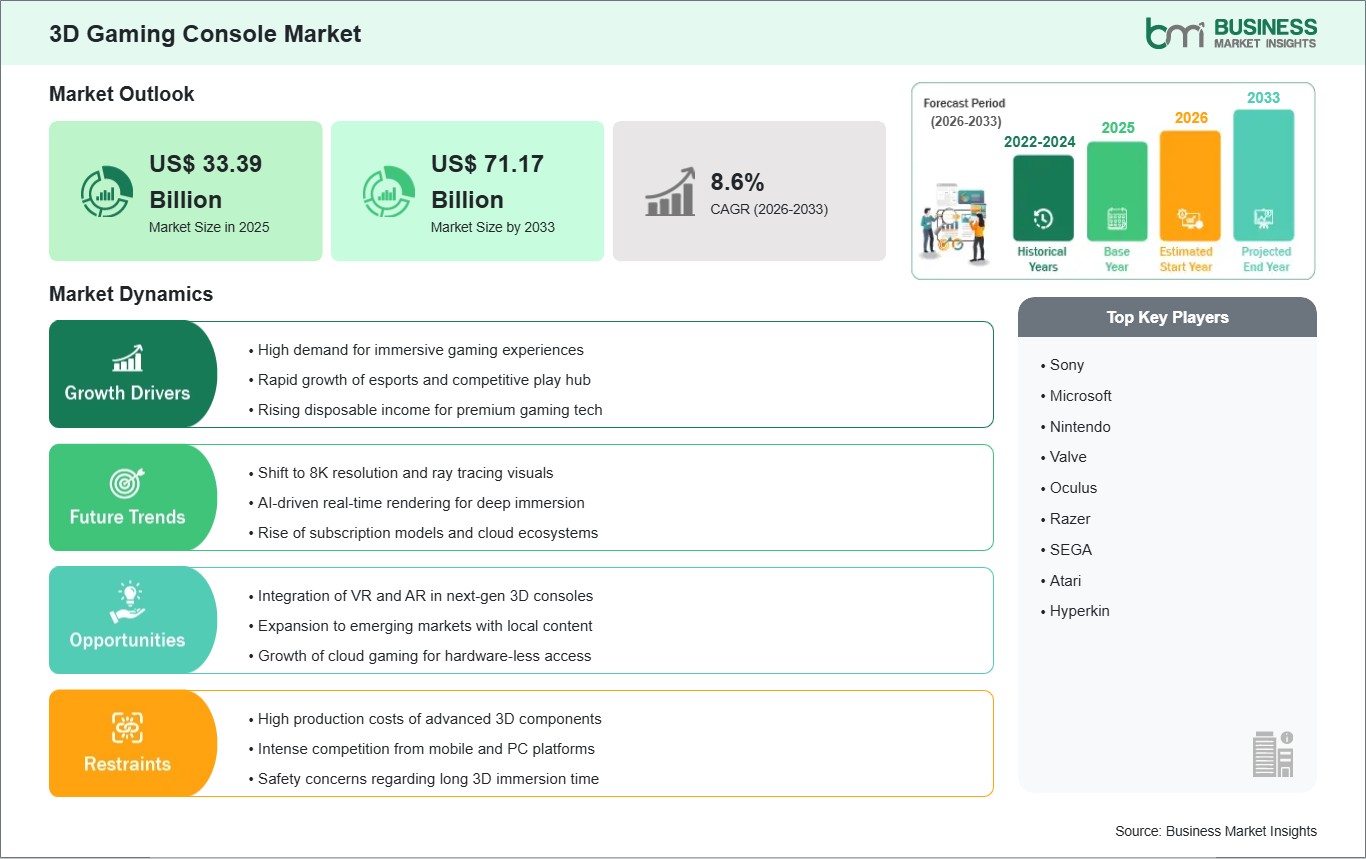
3D gaming consoles represent a new era of interactive entertainment, combining advanced hardware, immersive software ecosystems, and integrated services to deliver stereoscopic visuals and lifelike experiences. These consoles are designed to enhance user engagement through technologies such as virtual reality (VR), augmented reality (AR), and motion sensing, making them relevant not only for gaming but also for applications in healthcare and mobile platforms.
Despite their promise, the market faces notable challenges. High development and hardware costs remain a barrier for both manufacturers and consumers. Limited availability of 3D-specific content and compatibility issues with existing gaming libraries further restrict adoption. Additionally, concerns around user comfort, such as motion sickness and prolonged exposure effects, pose regulatory and design hurdles.
However, the opportunities outweigh these restraints. The integration of AI-driven gaming engines and cloud-based platforms is opening new avenues for personalized, adaptive gameplay. Cross-platform interoperability and the rise of portable 3D consoles are expanding accessibility. Beyond entertainment, healthcare applications, such as rehabilitation therapy and cognitive training, are emerging as lucrative segments, supported by growing investments in digital health technologies. These factors position the 3D gaming console market for sustained innovation and long-term growth.
Segment Analysis
3D Gaming Console Market Segmentation
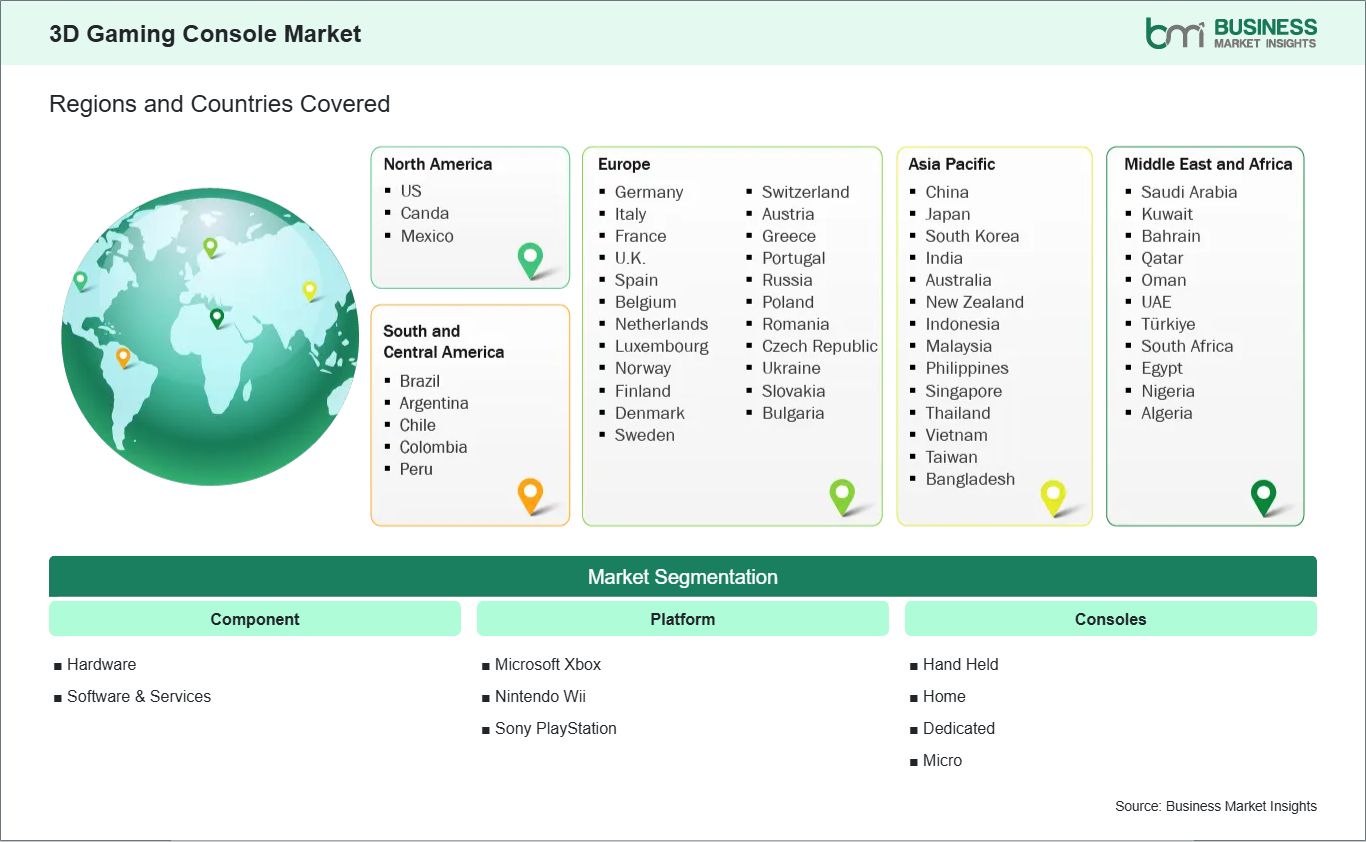
Key segments that contributed to the derivation of the 3D Gaming Console market analysis are component, platform, consoles, and application.
- By Component, the market is segmented into Hardware and Software &Services.
- By Platform, the market is divided into Microsoft Xbox, Nintendo Wii, and Sony PlayStation.
- By Consoles, the market is categorized into Hand‑Held, Home, Dedicated, and Micro.
- By Application, the market is segmented into Healthcare, Gaming, and Mobile.
Market Forces
3D Gaming Console Market Drivers and Opportunities
AI-Driven Adaptive Gameplay Transforming Next-Gen 3D Consoles
Artificial Intelligence is redefining the gaming industry, and Microsoft's introduction of "Muse," a generative AI model co-developed with Ninja Theory, represents a groundbreaking advancement in this space. Muse enables developers to create adaptive, context-aware gaming experiences by dynamically generating environments, storylines, and character interactions based on real-time player behavior. This capability significantly reduces development cycles, allowing studios to deliver richer, more personalized content without the traditional resource-intensive processes. For players, AI-driven gameplay translates into evolving narratives, intelligent NPCs, and immersive worlds that respond organically to decisions, creating a sense of realism and unpredictability that traditional scripted games cannot match. Furthermore, AI integration enhances accessibility by adjusting difficulty levels and gameplay mechanics to suit individual preferences, making gaming more inclusive. As competition intensifies among major platforms, AI-powered tools like Muse position consoles as intelligent ecosystems capable of continuous evolution. This driver is expected to accelerate next-generation console adoption, foster innovation in game design, and set new engagement standards across the global gaming industry.
Immersive Healthcare Rehabilitation Through 3D Gaming Consoles
The healthcare sector offers a transformative opportunity for 3D gaming consoles, leveraging immersive environments for therapeutic and rehabilitative applications. Rehabilitation programs increasingly incorporate gamified exercises to improve patient engagement and adherence, addressing one of the most significant challenges in physical and cognitive therapy. 3D consoles enable interactive sessions that simulate real-world movements, aiding motor skill recovery and enhancing neuroplasticity. For patients with chronic pain or neurological disorders, these systems provide distraction therapy and mental stimulation, reducing reliance on medication and improving overall well-being. Clinical studies have demonstrated improved outcomes when therapy is delivered through engaging, game-based platforms, making this approach attractive to hospitals, rehabilitation centers, and eldercare facilities. Additionally, the integration of motion sensors and VR capabilities allows therapists to monitor progress remotely, aligning with telehealth trends and expanding access to care. As healthcare providers seek cost-effective, tech-driven solutions, 3D gaming consoles offer scalability, measurable benefits, and the potential to revolutionize digital health innovation globally.
Size and Share Analysis
3D Gaming Console Market Size and Share Analysis
The 3D Gaming Console market demonstrates steady growth, with size and share analysis revealing evolving trends and competitive positioning among key players. The report further examines subsegments categorized within component, platform, consoles, and application, offering insights into their contribution to overall market performance.
For instance, the Software subsegment continues to grow rapidly, fueled by AI-driven tools like Muse that empower developers to create dynamic, scalable content across consoles.
On the Platform front, Sony PlayStation remains a central hub for cutting-edge 3D experiences due to its VR-ready ecosystem and strong brand loyalty.
Within the Consoles category, the Hand‑Held segment is gaining traction as manufacturers incorporate stereoscopic displays and motion sensing into portable devices.
In Application, the Healthcare sub-segment is emerging as a key revenue driver, leveraging immersive therapy programs and rehabilitation training built on 3D console platforms.
Report Coverage
3D Gaming Console Market Report Coverage and Deliverables
The "3D Gaming Console Market Size and Forecast (2022 - 2033)" report provides a detailed analysis of the market covering below areas:
- 3D Gaming Console market size and forecast at global, regional, and country levels for all the key market segments covered under the scope
- 3D Gaming Console market trends, as well as market dynamics such as drivers, restraints, and key opportunities
- 3D Gaming Console market analysis covering key market trends, global and regional framework, major players, regulations, and recent market developments
- Industry landscape and competition analysis covering market concentration, heat map analysis, prominent players, and recent developments for the 3D Gaming Console market
- Detailed company profiles, including SWOT analysis
Geographic Insights
3D Gaming Console Market Geographic Insights
The geographical scope of the 3D Gaming Console market report is divided into five regions: North America, Asia Pacific, Europe, the Middle East & Africa, and South & Central America.
North America remains a key innovation hub, benefiting from strong consumer demand for advanced gaming experiences and robust investments in VR/AR infrastructure. The region's mature gaming ecosystem, coupled with high disposable income and rapid adoption of cloud gaming services, supports sustained growth.
Europe is witnessing steady expansion, driven by regulatory support for digital entertainment and the proliferation of cloud-based gaming platforms. Countries such as Germany, France, and the UK are investing in immersive technologies, while regional developers focus on creating localized 3D content.
Asia Pacific stands out as the most dynamic region, with Japan, China, and South Korea leading adoption due to their vibrant gaming cultures and integration of mobile platforms with 3D console experiences. The region's strong manufacturing base also accelerates hardware innovation.
Latin America is experiencing a gradual uptake, supported by the availability of affordable handheld and micro-console devices that cater to price-sensitive consumers in emerging markets.
Meanwhile, Middle East &Africa (MEA) shows promising potential, fueled by smartphone proliferation and public - private partnerships aimed at advancing digital healthcare and entertainment infrastructure. Collectively, these regional trends underscore the global shift toward immersive, interactive gaming experiences, with each region contributing unique growth drivers aligned with local consumer preferences and technological readiness.
Industry Activity
Recent Developments
The 3D Gaming Console market is evaluated by gathering qualitative and quantitative data post-primary and secondary research, which includes important corporate publications, association data, and databases. A few of the key developments in the 3D Gaming Console market are:
- In September 2025, Nintendo revived its iconic Virtual Boy line by launching a dedicated replica dock, available in retro-styled $100 and cardboard $25 versions, and re-releasing 14 classic Virtual Boy titles via Nintendo Switch Online + Expansion Pack. This move brought stereoscopic 3D gaming back to modern platforms and reinforced Nintendo's commitment to innovation in the 3D Gaming Console segment. By integrating nostalgic content with modern hardware, Nintendo successfully bridged the gap between classic gaming experiences and next-generation immersive technologies, signaling a strategic push toward expanding the appeal of 3D Gaming Consoles among both retro enthusiasts and new-age gamers.
- In February 2025, in partnership with Xbox Game Studios' Ninja Theory, Microsoft Research developed a world and human action model (WHAM) named Muse, a first-of-its-kind generative AI model trained on Ninja Theory's multiplayer battle arena game, Bleeding Edge . Both Ninja Theory and Microsoft Research were based in Cambridge, which made collaboration seamless and led to the use of Bleeding Edge for this research. What was groundbreaking about Muse was its detailed understanding of the 3D game world, including game physics and how the game reacted to players' controller actions. This capability allowed the model to create consistent and diverse gameplay rendered by AI, marking a major step toward generative AI models that could empower game creators. The introduction of Muse was considered a significant technological advancement within the 3D Gaming Console Market, as it showcased how AI could transform interactive experiences and accelerate next-generation console development.
Trust & Transparency
Research Methodology
The market analysis combines proprietary research with secondary data from government agencies, company disclosures, regulatory filings, industry databases and expert interviews. Market estimates are validated through data triangulation, cross-market benchmarking and analyst
review.
View Full Research Methodology
Key Sources Referred:
World Bank - Global Trade IndicatorsWorld Trade Organization (WTO)International Monetary Fund (IMF)International Trade Administration (ITA)Company websiteCompany annual reportsCompany investor presentations