
Transcriptomics Market Outlook: Size, Share, Trends, Growth Analysis, Competitive Landscape & Forecast, 2026-2033

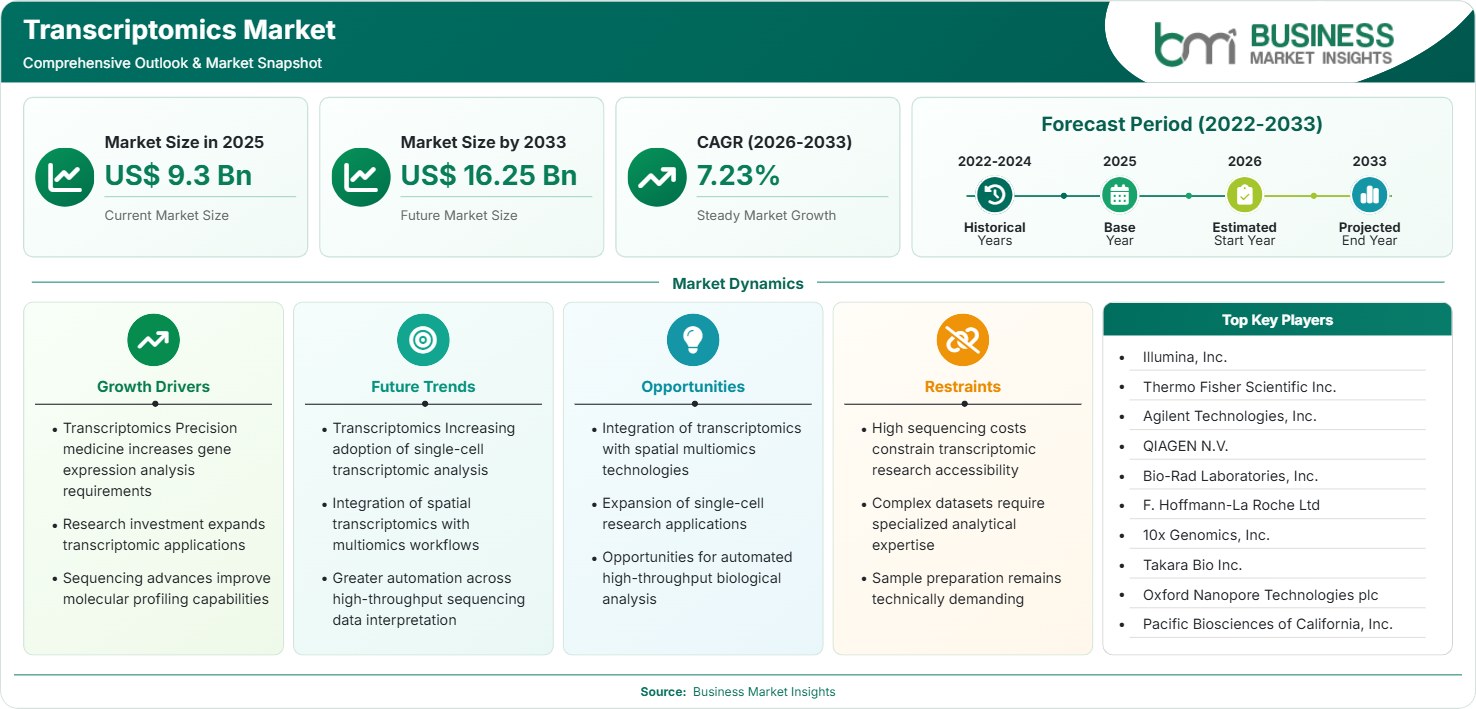
The Transcriptomics Market size was valued at US$ 9.3 Billion in 2025 and is projected to reach US$ 16.25 Billion by 2033, growing at a CAGR of 7.23% during 2026–2033, driven by sequencing adoption, single-cell research, precision diagnostics, spatial biology, and AI-enabled drug discovery.

Report Coverage
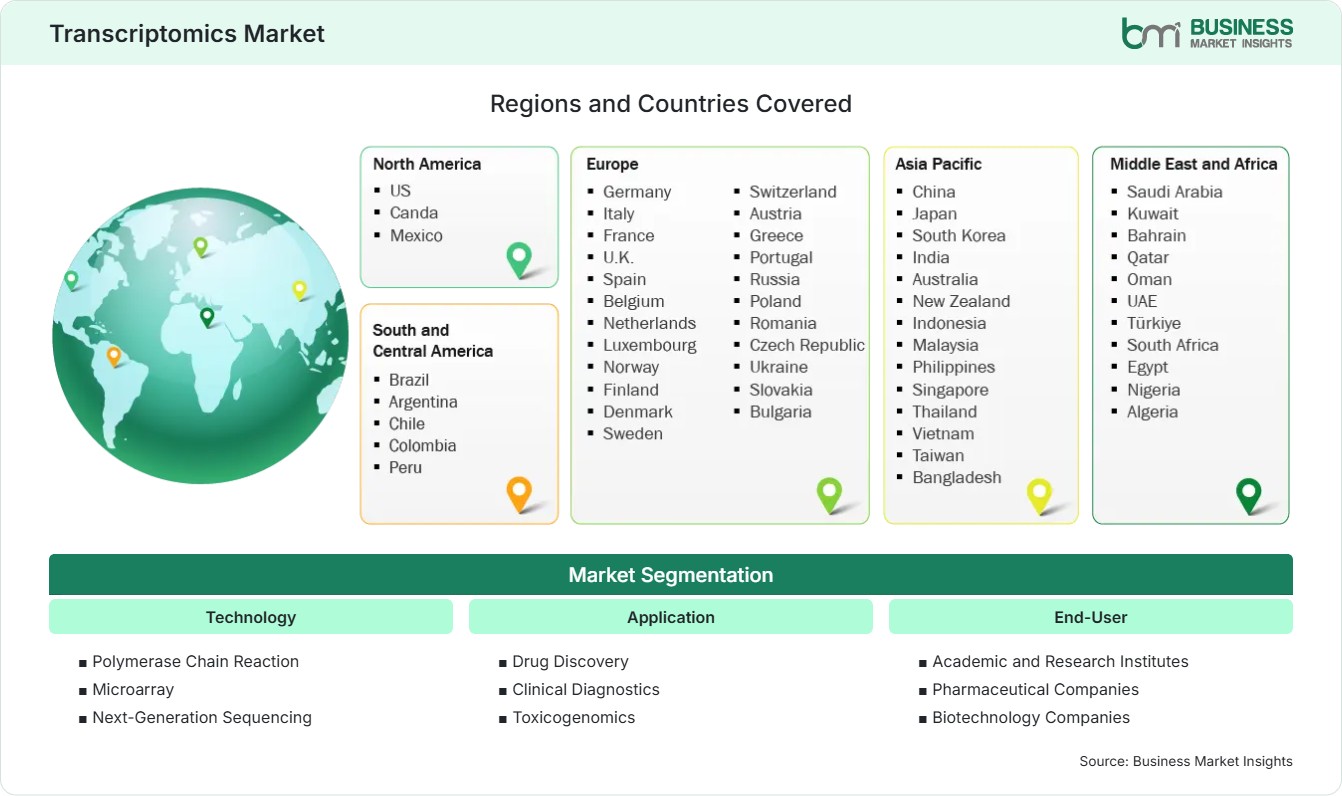
  • Technology: Polymerase Chain Reaction, Microarray, Next-Generation Sequencing
  • Application: Drug Discovery, Clinical Diagnostics, Toxicogenomics
  • End-User: Academic and Research Institutes, Pharmaceutical Companies, Biotechnology Companies
US$ 9.3 Bn Market size in 2025
US$ 16.25 Bn Market Size by 2033
7.23% CAGR, 2026 - 2033
2026-2033 Forecast Period

AI Overview

Transcriptomics Market Summary

  • North America Region: North America holds a 37%–40% Transcriptomics Market share in 2025, growing with a 7.0%–7.5% CAGR, supported by advanced sequencing infrastructure, pharmaceutical R&D, translational genomics, clinical research networks, and strong investment in single-cell platforms. The U.S. market remains dominant, supported by pharmaceutical R&D, NIH-backed research, clinical sequencing adoption, and advanced computational infrastructure, with a 7.1%–7.6% CAGR through 2033.
  • Fastest Growing Region: Asia Pacific accounts for a 22%–25% share in 2025 and is progressing at an 8.0%–8.6% CAGR, supported by expanding sequencing capacity, biotechnology investment, research infrastructure, precision medicine programs, and lower-cost transcriptomic workflows.
  • Leading Segment: Next-Generation Sequencing (NGS) represents a 45%–48% share in 2025 and advances at an 8.0%–8.5% CAGR, supported by scalable RNA sequencing, broader transcript coverage, falling sequencing costs, single-cell workflows, and multiomics integration.
  • High Growth Segment: Clinical Diagnostics represents a 25%–28% share in 2025 and advances at an 8.5%–9.2% CAGR, supported by molecular disease profiling, rare-disease diagnostics, oncology applications, biomarker discovery, and growing precision-medicine infrastructure.
  • Key Market Opportunity: Spatial and single-cell transcriptomics create premium opportunities by combining cellular resolution, tissue context, multimodal datasets, and AI analytics, enabling pharmaceutical target discovery and increasingly sophisticated translational research workflows.
  • Major Market Players: Illumina, Inc.; Thermo Fisher Scientific Inc.; Agilent Technologies, Inc.; QIAGEN N.V.; Bio-Rad Laboratories, Inc.; F. Hoffmann-La Roche Ltd; 10x Genomics, Inc.; Takara Bio Inc.; Oxford Nanopore Technologies plc; Pacific Biosciences of California, Inc.
Strategic Insights

Transcriptomics Market: Strategic Insights

Transcriptomics Market Strategic Framework
FREE PDF
Request your free sample
Request free sample
Stakeholder View

Key Takeaways

  • The supply chain is moving from standalone instruments toward integrated ecosystems spanning RNA extraction, library preparation, sequencing, computational pipelines, data storage, interpretation, and specialized services. Vendors able to connect these stages can capture greater recurring consumables and software value.
  • The strongest upside is emerging where transcriptomics intersects with drug discovery, clinical diagnostics, spatial biology, and single-cell analysis. These applications convert gene-expression measurements into actionable biological information rather than limiting demand to exploratory expression profiling.
  • Technology development is shifting toward higher resolution and richer transcript characterization. Spatial assays preserve tissue context, single-cell workflows resolve cellular heterogeneity, and long-read sequencing improves isoform characterization and alternative-splicing analysis.
  • Asia Pacific provides an investment case built around expanding research infrastructure, large patient populations, biotechnology development, and increasing interest in precision medicine. China, Japan, India, and South Korea offer different combinations of public research funding and commercial adoption.
  • Investment activity is increasingly targeting scalable single-cell and multiomics capabilities. QIAGEN’s acquisition of Parse Biosciences for approximately US$225 million upfront, with potential milestone payments of up to US$55 million, illustrates strategic consolidation around high-throughput single-cell workflows.
  • Commercial differentiation is increasingly tied to workflow economics, analytical usability, sample compatibility, and throughput rather than sequencing performance alone. Vendors that reduce hands-on time or enable difficult samples can expand adoption among pharmaceutical and translational research customers.
Geographic Outlook

Transcriptomics Market Regional Highlights

North America Transcriptomics Market

North America held a 37%–40% share in 2025 and is projected to grow at a 7.0%–7.5% CAGR through 2033. The region benefits from concentrated pharmaceutical R&D, mature sequencing infrastructure, advanced academic centers, and established clinical genomics networks. The United States Transcriptomics Market accounts for 82%–85% of North American demand, while Canada contributes specialized research and biotechnology activity. Strong computational capacity supports complex RNA sequencing, spatial profiling, and multiomics programs across oncology, immunology, neuroscience, and rare-disease research.

  • Pharmaceutical companies increasingly use transcriptomic datasets for target validation, patient stratification, biomarker identification, and mechanism-of-action studies, strengthening recurring demand for sequencing and analytical services.
  • Academic centers are adopting single-cell and spatial methods to characterize tissue heterogeneity, while national research programs continue generating reusable cell-atlas datasets.
  • Clinical adoption is supported by expanding precision-medicine infrastructure and increasing interest in molecular signatures that complement conventional diagnostic testing.
  • Venture funding and strategic partnerships continue to favor platforms capable of integrating transcriptomic, proteomic, imaging, and genomic information into unified research workflows.

US Transcriptomics Market

The U.S. Transcriptomics Market represented 82%–85% of North American demand in 2025 and is projected to advance at a 7.1%–7.6% CAGR through 2033. Its position reflects a dense network of pharmaceutical companies, biotechnology firms, universities, sequencing laboratories, and specialized technology providers. Federal research funding, precision-medicine initiatives, and clinical genomics adoption support demand. The country also hosts many major platform developers, giving researchers early access to new single-cell, spatial, long-read, and multimodal transcriptomic technologies.

  • The NIH ecosystem supports large-scale single-cell research and atlas development, with publicly available datasets exceeding 100 million profiled cells across major resources.
  • Pharmaceutical research increasingly uses transcriptomic readouts to characterize disease biology, assess drug response, and identify molecular subpopulations.
  • Clinical laboratories are evaluating RNA-based signatures and long-read approaches for rare diseases where alternative splicing and transcript isoforms can improve molecular interpretation.

Europe Transcriptomics Market

Europe represented a 25%–28% share in 2025 and is projected to grow at a 6.5%–7.1% CAGR through 2033. Germany, the United Kingdom, France, and the Netherlands form major research centers, while the United Kingdom is estimated to record a 7.2%–7.8% CAGR. Germany remains a leading research market, supported by pharmaceutical manufacturing and academic genomics. European demand is shaped by biobanks, translational research, data governance, and collaborative life-science infrastructure.

  • Germany combines pharmaceutical R&D, university research, and sequencing infrastructure, supporting transcriptomic applications across oncology, immunology, and molecular medicine.
  • The United Kingdom benefits from strong genomic research institutions and expanding integration between sequencing, cell biology, and translational disease research.
  • France and the Netherlands provide additional demand through biomedical research networks, biotechnology clusters, and clinical research collaborations.
  • European data-governance requirements encourage vendors to strengthen secure data handling, consent management, interoperability, and reproducibility within transcriptomic workflows.

Asia Pacific Transcriptomics Market

Asia Pacific Transcriptomics Market accounted for a 22%–25% share in 2025 and is projected to expand at an 8.0%–8.6% CAGR through 2033, making it the fastest-growing regional market. China, Japan, India, South Korea, and Australia are major demand centers. China is estimated to lead regional scale, while India is projected to grow at an 8.7%–9.3% CAGR as sequencing capacity, biotechnology investment, and research outsourcing expand.

  • China benefits from large-scale genomics programs, domestic sequencing capabilities, pharmaceutical research demand, and expanding biotechnology applications in oncology and precision medicine.
  • Japan combines sophisticated academic research with pharmaceutical development, creating demand for high-quality RNA sequencing, biomarker discovery, and disease-mechanism studies.
  • India offers cost-sensitive research environments and expanding genomics infrastructure, creating opportunities for service providers, sequencing laboratories, and workflow automation.
  • South Korea is developing strong biotechnology and precision-health capabilities, supporting adoption of transcriptomics for therapeutic research and molecular characterization.

Rest of World Transcriptomics Market

Rest of World represented a 10%–13% Transcriptomics Market share in 2025 and is projected to grow at a 7.4%–8.0% CAGR through 2033. South and Central America are led by Brazil and Mexico, while the Middle East and Africa are led by Gulf research hubs and South Africa. Brazil is estimated at a 7.8%–8.4% CAGR, supported by biomedical research, agriculture, and infectious-disease applications.

  • Brazil is expanding sequencing and molecular research capabilities, creating demand for transcriptomic applications spanning human health, agricultural science, and infectious disease.
  • Mexico benefits from proximity to North American research ecosystems and increasing biotechnology activity, supporting outsourced sequencing and molecular research services.
  • Gulf countries are investing in precision medicine, research infrastructure, and advanced healthcare technologies, creating opportunities for sequencing and bioinformatics providers.
  • South Africa provides a regional research hub for genomics, infectious disease, population health, and academic sequencing applications across sub-Saharan Africa.
  • Across emerging markets, scalable service models can reduce capital barriers where institutions cannot justify full in-house sequencing infrastructure.
Global Market Geography
FREE PDF
Request your free sample
Request free sample
Segment Analysis

Transcriptomics Market Segmentation

Technology

Transcriptomics Market scope accounted for the largest structural value pool, with NGS representing a 45%–48% share in 2025 and an 8.0%–8.5% CAGR through 2033. Adoption is driven by throughput, RNA-sequencing flexibility, single-cell compatibility, and multiomics integration. PCR remains essential for targeted validation, while microarrays retain demand where standardized expression profiling is sufficient.

  • Polymerase Chain Reaction (PCR): PCR supports targeted expression quantification, validation, and biomarker workflows where rapid turnaround, established protocols, and lower sample requirements outweigh broader transcriptome coverage.
  • Microarray: Microarrays remain useful for standardized gene-expression studies, cohort comparisons, and established biomarker panels, particularly where reproducibility and lower analytical complexity support economical high-throughput research.
  • Next-Generation Sequencing (NGS): NGS enables broad transcript discovery, differential expression, fusion detection, and scalable single-cell workflows, supporting increasingly complex research questions across oncology and drug development.

Application

The use of applications is now shifting more towards translational use cases, with clinical diagnostics estimated to account for 25%-28% of the market in 2025 and to see a CAGR of 8.5%-9.2% by 2033. The use of transcriptomics is now linking molecular signatures to disease mechanisms and therapeutic responses.

  • Drug Discovery: Transcriptomic profiling identifies pathway activation, treatment response, toxicity signals, and molecular subtypes, enabling pharmaceutical teams to prioritize targets and refine development strategies.
  • Clinical Diagnostics: RNA-based profiling can reveal disease-associated expression patterns, transcript variants, and molecular signatures, supporting emerging precision-diagnostic workflows in oncology and rare diseases.
  • Toxicogenomics: Toxicogenomic applications measure transcriptional responses to compounds, helping researchers identify molecular toxicity pathways, prioritize candidates, and reduce dependence on later-stage experimental attrition.

End-User

Pharmaceutical companies are an important user category, as transcriptomics can be used for target identification, biomarker discovery, patient stratification, and mechanism-of-action studies. Academic institutions remain an essential user category, whereas biotech companies are increasingly adopting scalable systems and outsourced services.

  • Academic and Research Institutes: Academic users drive method development, cell-atlas creation, disease biology, and fundamental gene-expression research, with demand supported by grants, shared sequencing facilities, and collaborative projects.
  • Pharmaceutical Companies: Pharmaceutical companies use transcriptomics across target identification, biomarker discovery, patient stratification, mechanism studies, and translational development, increasing demand for reproducible high-throughput workflows.
  • Biotechnology Companies: Biotechnology firms adopt flexible transcriptomic platforms to accelerate discovery while limiting capital requirements, particularly through cloud analytics, sequencing services, and instrument-light single-cell technologies.
Market Forces

Transcriptomics Market Dynamics

Key Market Drivers

Expansion of Single-Cell and Spatial Profiling

Single-cell and spatial profiling technologies are increasing demand for transcriptomics by enabling assessment of cellular heterogeneity and tissue context. NIH-funded projects report over 100 million cells characterized in public single-cell profiling databases, thereby generating reusable resources for biomedical research. Commercially, there is a shift from traditional workflows to those that include sequencing, imaging, segmentation, and interpretation of the results of such analyses. 10x Genomics has improved its Visium HD offering to enable whole-transcriptome spatial profiling at the single-cell level, and Illumina has moved towards whole-transcriptome sequencing-based spatial profiling of intact tissue samples. The technologies will support Transcriptomics Market growth by enabling the development of applications that require deeper, more complex data analysis.

Rising Use of RNA Data in Precision Medicine

Precision medicine is driving up the need for molecular data that not only describes genetic variations but also represents biological states in a functional way. The World Health Organization has documented more than 6,500 clinical studies on human genomics registered worldwide as of 2024. Most of these studies deal with cancer and rare diseases. Transcriptomics can complement genomic tests by revealing gene expression, transcript variants, and pathway activity. RNA sequencing thus provides new possibilities in biomarker discovery, disease classification, therapy response study, and rare disease discovery. The long-read technologies facilitate the detection of complete isoforms and disease-relevant splice variants. The market’s growth will thus be associated with moving from discovery to molecular profiling. Transcriptomics Market trends also favor technologies that can link sequence outputs to clinical interpretation and data management.

Increasing Throughput and Workflow Automation

Greater throughput is altering the cost structure of transcriptomic experiments by enabling larger sample sizes, deeper cell profiling, and repeat tests without necessarily increasing lab labor. One indication of this is QIAGEN’s purchase of Parse Biosciences; Parse has a technology that uses combinatorial barcoding without instrumentation and is optimized for studies requiring millions or billions of cells. The GigaLab technology from Parse can process up to 2.5 billion cells per year, underscoring the scale required in pharmaceutical and academic settings. Lab automation also eliminates variability in sample prep and sequencing. Reproducibility and speed become priorities as labs optimize for sample prep, sequencing, and interpretation.

Key Market Opportunities

Commercialization of Spatial Transcriptomics

Spatial transcriptomics offers an opportunity to move beyond conventional expression datasets by preserving the physical location of transcripts within tissues. This capability is particularly relevant to oncology, neuroscience, immunology, developmental biology, and tissue pathology, where cellular interactions influence disease mechanisms. Spatial technology from Illumina was developed for sequencing-based whole-transcriptome profiling in tissue slices, whereas 10x Genomics continues to develop whole-transcriptome spatial profiling workflows at the single-cell level. There is an opportunity for sales across equipment, consumables, software, image analysis, and data interpretation. The Transcriptomics Market forecasts that pharmaceutical companies will use spatial data to analyze tumor microenvironments and treatment responses, and that research institutions will create tissue atlases. Companies that make tissue handling and computational analysis easier could broaden their applications beyond spatial biology labs.

Large-Scale AI-Ready Transcriptomic Datasets

AI-enabled biology requires sufficiently large, standardized datasets that can support model training, validation, and prediction. Single-cell transcriptomics is particularly well-suited to this opportunity because it can generate millions of cellular observations across disease states, treatments, tissues, and patient cohorts. AI-based biology influenced QIAGEN’s acquisition of Parse, as Parse had developed high-throughput capabilities for cell profiling at scale. There is room not just in sequencing but also in data curation, cloud storage, annotation, model preparation, and federated analysis. Vendors would be able to use their computational offerings without needing to install instrumentation. Cooperation among sequencing vendors, drug discovery companies, AI laboratories, and universities will be beneficial for developing more datasets and meeting the demand for transcriptomic infrastructure.

Expansion of Long-Read RNA Applications

Long-read RNA sequencing offers a distinct advantage in applications where full-length transcript structure matters more than maximum short-read counting efficiency. PacBio’s Iso-Seq workflow is designed to characterize complete transcript isoforms, alternative splicing, fusion genes, and novel transcripts. Clinical studies conducted in 2026 have also assessed the use of HiFi long-read RNA sequencing technology to identify pathogenic splicing in rare diseases. Such applications enable the technology's potential uses in rare disease diagnostics, cancer transcript profiling, immune receptor identification, and functional genome annotation. With reduced sequencing costs and increased throughput, long-read sequencing can become more affordable for research labs. The Transcriptomics Market opportunity is a complement to established high-throughput workflows.

Market Restraints and Challenges

High Capital and Data-Management Requirements

Factor: Sophisticated sequencing machines, sample preparation, powerful computing, storage, and analysis software contribute to increased total cost of ownership. Impact: Small labs and organizations in developing countries will either delay adoption of next-generation sequencing technology or outsource their sequencing needs. Large-scale studies involving single-cell and spatial research are more difficult because higher resolution yields much larger datasets that require secure storage and computing power. Bioinformatics experts will also be required for quality control, normalization, batch effects, segmentation, annotation, and interpretation of genomic data. According to the WHO, precision medicine requires robust infrastructure, education, governance, and the management of genomic data. Suppliers will have to implement workflow automation and cloud-based analytics to reduce technical barriers. Thus, the challenge of cost will shift not only to instrumentation costs but also to the total cost of ownership.

Regulatory, Standardization, and Reproducibility Barriers

Factor: Workflow for transcriptomic analysis may vary in extraction methodology, library preparation, sequencing platforms, reference databases, analytical tools, and documentation. Impact: Variations may complicate comparisons of findings across studies and their implementation in clinical settings. The use of findings in clinical practice requires validation of the tests, adequate controls, data governance, and analytical/clinical validity of test results. WHO has pointed out ethical, governance, transparency, equity, and infrastructure issues in the evolving area of precision medicine. Spatial and single-cell analyses introduce additional factors affecting sample quality, segmentation, cell calling, spatial resolution, and computational processing. Manufacturers who can standardize their workflows, references, software, and analysis pipelines will reduce adoption difficulties. Without harmonization, customers may choose mature platforms over novel ones.

Company Analysis

Competitive Landscape

This Transcriptomics Market analysis indicates a competitive structure spanning sequencing platforms, PCR systems, microarrays, sample preparation, spatial biology, long-read sequencing, and bioinformatics. Competition is increasingly shaped by workflow breadth and recurring consumables rather than individual instruments.

Company Name

Overview

Products and Services relevant to this market

Illumina, Inc.

Major sequencing technology provider with extensive NGS infrastructure and expanding spatial and multiomics capabilities.

RNA sequencing, spatial transcriptomics, sequencing instruments, library workflows, informatics, and multiomics analysis solutions.

Thermo Fisher Scientific Inc.

Broad life-sciences supplier spanning molecular biology, sequencing, PCR, diagnostics, and laboratory workflows.

Ion Torrent sequencing, quantitative PCR, RNA analysis reagents, sample preparation, and molecular biology systems.

Agilent Technologies, Inc.

Analytical technology company with established gene-expression, microarray, genomics, and laboratory workflow capabilities.

RNA quality analysis, microarrays, genomics reagents, instrumentation, and related analytical technologies.

QIAGEN N.V.

Sample-to-insight provider expanding into scalable single-cell sequencing through the Parse Biosciences acquisition.

RNA extraction, library preparation, QIAseq workflows, bioinformatics, single-cell sequencing, and sample technologies.

Bio-Rad Laboratories, Inc.

Life-science technology supplier with strong PCR and digital PCR capabilities supporting expression analysis.

PCR systems, digital PCR, reagents, gene-expression workflows, and nucleic-acid analysis technologies.

F. Hoffmann-La Roche Ltd

Diversified healthcare company combining diagnostics, sequencing, molecular analysis, and pharmaceutical research capabilities.

Molecular diagnostics, sequencing-related technologies, biomarker research, and transcriptomic applications in drug development.

10x Genomics, Inc.

Specialized single-cell and spatial biology company focused on high-resolution cellular analysis.

Chromium single-cell systems, Visium spatial gene-expression products, Xenium platforms, and analysis software.

Takara Bio Inc.

Biotechnology company providing molecular biology tools and sequencing-related sample preparation technologies.

RNA preparation, amplification, library preparation, sequencing reagents, and single-cell research workflows.

Oxford Nanopore Technologies plc

Sequencing company distinguished by real-time nanopore technology and flexible long-read analysis.

Nanopore sequencing, RNA sequencing, direct RNA workflows, library preparation, and portable sequencing systems.

Pacific Biosciences of California, Inc.

Long-read sequencing specialist supporting full-length transcript and isoform characterization.

HiFi sequencing, Iso-Seq RNA analysis, full-length transcript sequencing, library preparation, and bioinformatics.

Trust & Transparency

Research Methodology

The market analysis combines proprietary research with secondary data from government agencies, company disclosures, regulatory filings, industry databases and expert interviews. Market estimates are validated through data triangulation, cross-market benchmarking and analyst review.

View Full Research Methodology

Questions Answered

Frequently Asked Questions

What is included within the Transcriptomics Market Report?

The Market Report evaluates technology, application, end-user, regional dynamics, competitive positioning, recent developments, growth drivers, opportunities, restraints, and forecast conditions across the 2026–2033 period.

How is AI changing transcriptomic workflows?

AI is increasingly applied to segmentation, annotation, pattern recognition, multimodal integration, and predictive modeling. Large-scale single-cell datasets provide the volume and cellular resolution required to develop computational models of disease biology and therapeutic response.

What is the role of spatial transcriptomics in oncology?

Spatial transcriptomics links gene-expression information with tissue location, enabling researchers to examine tumor microenvironments, immune-cell interactions, cellular states, and localized biological pathways that may be obscured in dissociated samples.

Why are single-cell datasets becoming commercially important?

Single-cell datasets preserve differences between individual cell populations that bulk measurements can average out. Their value increases when datasets are sufficiently large, standardized, and annotated for drug discovery, disease modeling, biomarker research, and AI development.

How does long-read sequencing complement conventional RNA sequencing?

Long-read sequencing captures complete transcript structures, improving identification of isoforms, alternative splicing, fusion transcripts, and novel transcripts. Short-read methods remain valuable for high-throughput expression quantification, making the two approaches complementary for complex transcriptome studies.

Access the Full Transcriptomics Market Report

Get segment-level forecasts, regional estimates, competitive benchmarking, company profiles and downloadable Excel datasets.

Access the full Transcriptomics Market Report
350 pages PDF & Excel | 2026-09-30
Similar Research

Related Market Reports