
Solar Backsheet Market Outlook: Size, Share, Trends, Growth Analysis, Competitive Landscape & Forecast, 2026-2033

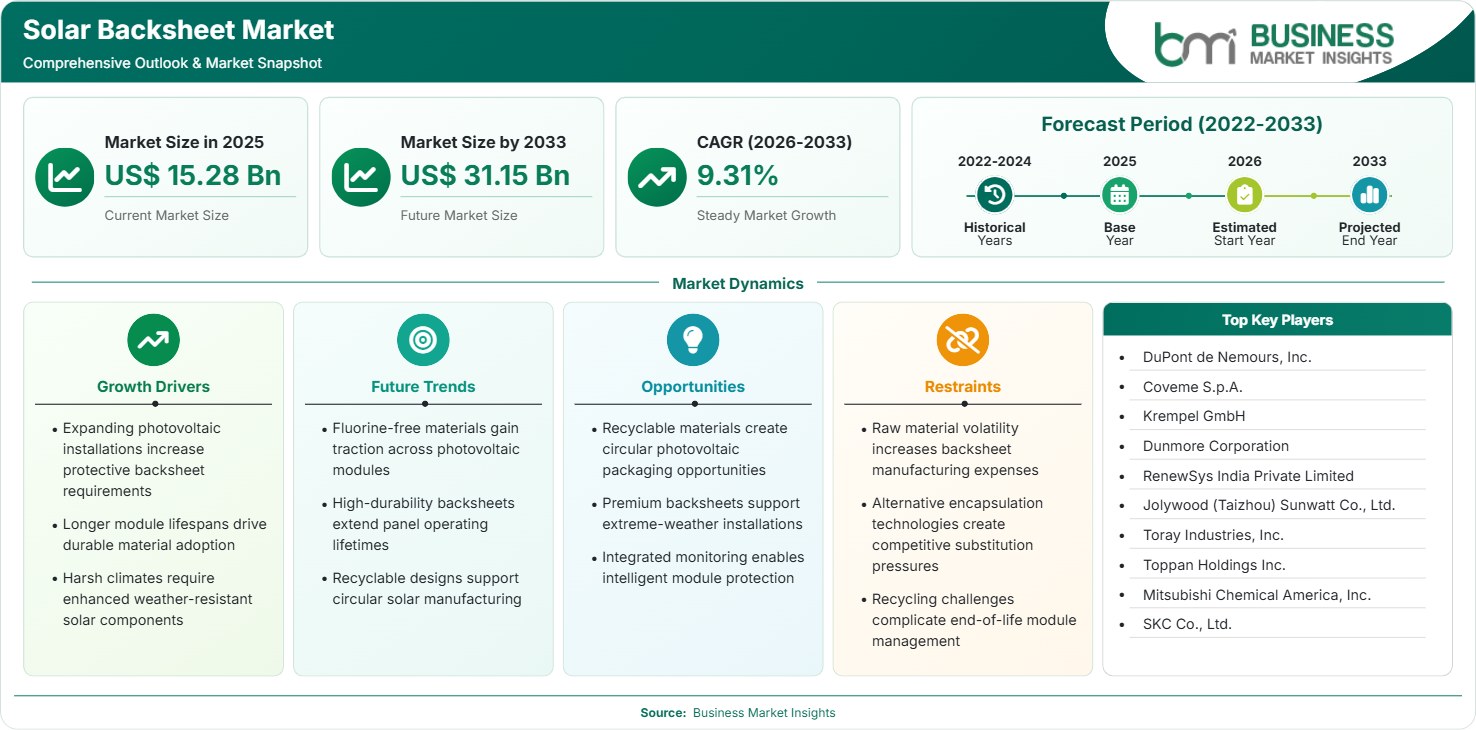
The Solar Backsheet Market size was valued at US$ 15.28 Billion in 2025 and is projected to reach US$ 31.15 Billion by 2033, growing at a CAGR of 9.31% during 2026–2033, driven by photovoltaic expansion, durable materials, high-voltage modules, circularity, and utility-scale solar investment.

Report Coverage
  • Type: Fluoropolymer, Non-fluoropolymer
  • Installation Techniques: Flat Roof Solar, Pitched Roof Solar, Ground Mount Solar & Others
  • Thickness: Less than 100mm, 100-500mm & Greater than 500mm) / Application (Commercial, Industrial & Utilities
US$ 15.28 Bn Market size in 2025
US$ 31.15 Bn Market Size by 2033
9.31% CAGR, 2026 - 2033
2026-2033 Forecast Period

AI Overview

Solar Backsheet Market Summary

  • North America Region: North America holds 22%–25% Solar Backsheet Market share in 2025 and grows at 8.5%–9.5% CAGR, supported by domestic module manufacturing, utility installations, reshoring, tax incentives, advanced materials, replacement demand, and supply-chain localization. US demand is supported by utility deployment and domestic manufacturing, delivering 8.7%–9.6% CAGR through 2033.
  • Fastest Growing Region: Asia Pacific holds 38%–42% share in 2025 and expands at 10.0%–11.0% CAGR, supported by massive Chinese manufacturing capacity, Indian solar additions, Southeast Asian production diversification, utility projects, bifacial modules, localized sourcing, and competitive material economics.
  • Leading Segment: Fluoropolymer holds 55%–59% share in 2025 and advances at 8.7%–9.4% CAGR, supported by proven weatherability, ultraviolet resistance, moisture protection, electrical insulation, field validation, and established module qualification across demanding operating environments.
  • High Growth Segment: Ground Mount Solar holds 42%–46% share in 2025 and advances at 10.2%–11.2% CAGR, supported by utility-scale expansion, larger modules, high-voltage systems, bifacial architectures, harsh exposure, and lifecycle reliability requirements.
  • Key Market Opportunity: The strongest opportunity is the commercialization of recyclable, fluorine-free, transparent, high-voltage, repairable, and lightweight constructions serving bifacial modules, repowering, floating solar, building-integrated photovoltaics, and circular material strategies.
  • Major Market Players: DuPont de Nemours, Inc.; Coveme S.p.A.; Krempel GmbH; Dunmore Corporation; RenewSys India Private Limited; Jolywood (Taizhou) Sunwatt Co., Ltd.; Toray Industries, Inc.; Toppan Holdings Inc.; Mitsubishi Chemical America, Inc.; SKC Co., Ltd.
Strategic Insights

Solar Backsheet Market: Strategic Insights

Solar Backsheet Market Strategic Framework
FREE PDF
Request your free sample
Request free sample
Stakeholder View

Key Takeaways

  • The shift in the value chain is taking place from commodity polyester films to engineered multilayer systems, which is increasing the strategic importance of polymer formulation, coating technology, adhesives, lamination, qualification testing, and application engineering.
  • The ground-mounted utility projects offer the greatest potential for gain since larger module sizes, higher system voltages, bifacial designs, and long-term exposure to the environment all demand more durable electrical and moisture-protection structures.
  • The use of fluorine-free, transparent, lightweight, and repairable designs is becoming increasingly important as module manufacturers work to balance concerns about durability, cost, regulatory requirements, material efficiency, and circularity.
  • India is a tempting investment opportunity since its rapidly growing solar capacity is taking place at the same time as domestic manufacturing of solar modules, which in turn is promoting local sourcing of films, encapsulants, adhesives, and other module components.
  • More of the capital is being directed towards integrated photovoltaic materials, regional manufacturing, advanced coating technologies, recycling systems, and service schemes that extend the operating life of the modules.
  • Instead, module manufacturers are now assessing backsheet suppliers based on their lifecycle reliability, qualification evidence, delivery resilience, customization capability, and sustainability features rather than just on price.
Geographic Outlook

Solar Backsheet Market Regional Highlights

North America Solar Backsheet Market

North America represented 22%–25% share in 2025 and is projected to grow at 8.5%–9.5% CAGR through 2033. The region benefits from domestic module manufacturing, utility-scale development, localized procurement, and demand for certified high-voltage materials. The United States dominates regional demand, while Mexico contributes to supply-chain diversification.

  • The manufacture of domestic modules promotes local sourcing of backsheets, as well as providing technical support, ensuring inventory availability, and speeding up the qualification process for photovoltaic manufacturers.
  • Large-scale projects nowadays need insulation with high voltage resistance, resistance to ultraviolet radiation, protection against moisture, and the ability to endure thermal stress over long periods when operating outdoors.
  • As North American manufacturers look for shorter logistics routes and a reduced reliance on distant suppliers, Mexico offers further diversification of the supply chain.
  • The need for repair films and for other suitable replacement materials that are compatible will be created by repowering and maintenance work.

US Solar Backsheet Market

The US Solar Backsheet Market represented 70%–74% of North American demand in 2025 and is projected to expand at 8.7%–9.6% CAGR through 2033. Demand is supported by utility installations, domestic module manufacturing, reshoring, sourcing requirements, and replacement activity.

  • The main source of demand is still for utility installations, these requiring high-voltage constructions which have to resist ultraviolet exposure, humidity, thermal cycling, and electrical stress.
  • The fact that domestic manufacturing is carried out creates more opportunities for suppliers to offer consistent film specifications, technical documentation, certification assistance, inventory management, and prompt engineering support.
  • The process of repowering leads to the development of a specialised market in repair films and replacement backsheets, which helps to reduce downtime and allows the existing module infrastructure to be preserved.

Europe Solar Backsheet Market

Europe Solar Backsheet Market held 24%–27% share in 2025 and is projected to grow at 8.0%–9.0% CAGR. Germany, Spain, Italy, France, and the Netherlands remain important markets, while circularity and lifecycle requirements influence product selection. The region installed 65.1 GW of solar PV in 2025, taking cumulative capacity to approximately 406 GW.

  • Germany has a leading market, due to the size of its installed fleet, the presence of a well-established module industry, strong commercial demand, and the continued need for replacements.
  • Spain offers a great opportunity for growth since utility-scale projects are still being expanded under favourable solar irradiation and because the economics of power generation are competitive.
  • France provides opportunities in both commercial and utility applications since longer operating lives and a greater emphasis on material sustainability are increasingly affecting the specifications of projects.
  • The European priorities regarding circularity include a preference for recyclable PET, fluorine-free materials, methods for repairing products, the use of recycled content, and full transparency concerning the composition of materials.

Asia Pacific Solar Backsheet Market

Asia Pacific Solar Backsheet Market represented 38%–42% share in 2025 and is projected to grow at 10.0%–11.0% CAGR. China remains the dominant manufacturing center, while India is emerging as a major demand and production market. China commissioned nearly 370 GW of solar PV in 2025, while India approached 50 GW of annual additions.

  • China is still the biggest manufacturing ecosystem, providing the benefits of scale in the production of polyester films, fluoropolymers, adhesives, coatings, laminates, and module assembly.
  • India is a high-growth market since solar capacity additions and domestic manufacture of modules are promoting local procurement of photovoltaic components.
  • Because producers are looking for alternative production bases and want to establish more resilient regional supply chains, Southeast Asia has the potential for manufacturing diversification.
  • Japan and South Korea prefer to use high-quality materials, focusing on durability, insulation, the quality of the coating, reliability, and advanced film engineering.

Rest of World Solar Backsheet Market

Rest of World Solar Backsheet Market accounted for 9%–12% share in 2025 and is projected to expand at 9.0%–10.5% CAGR. South and Central America are led by Brazil, while Chile provides a strong high-irradiance utility opportunity. In the Middle East, Saudi Arabia is a major growth market, while South Africa anchors African demand.

  • There is a wide demand in Brazil for distributed and utility installations, with a variety of module formats and backsheet specifications available.
  • Saudi Arabia has great potential for high-growth due to the fact that large photovoltaic projects are subjected to intense ultraviolet exposure, heat, dust, and thermal cycling.
  • South Africa represents a significant opportunity in Africa as both the use of utility-scale solar power and the installation of distributed solar systems expand in response to energy-security needs.
  • Chile is still a desirable option for projects that require high levels of ultraviolet stability, resistance to moisture, and long-term mechanical durability.
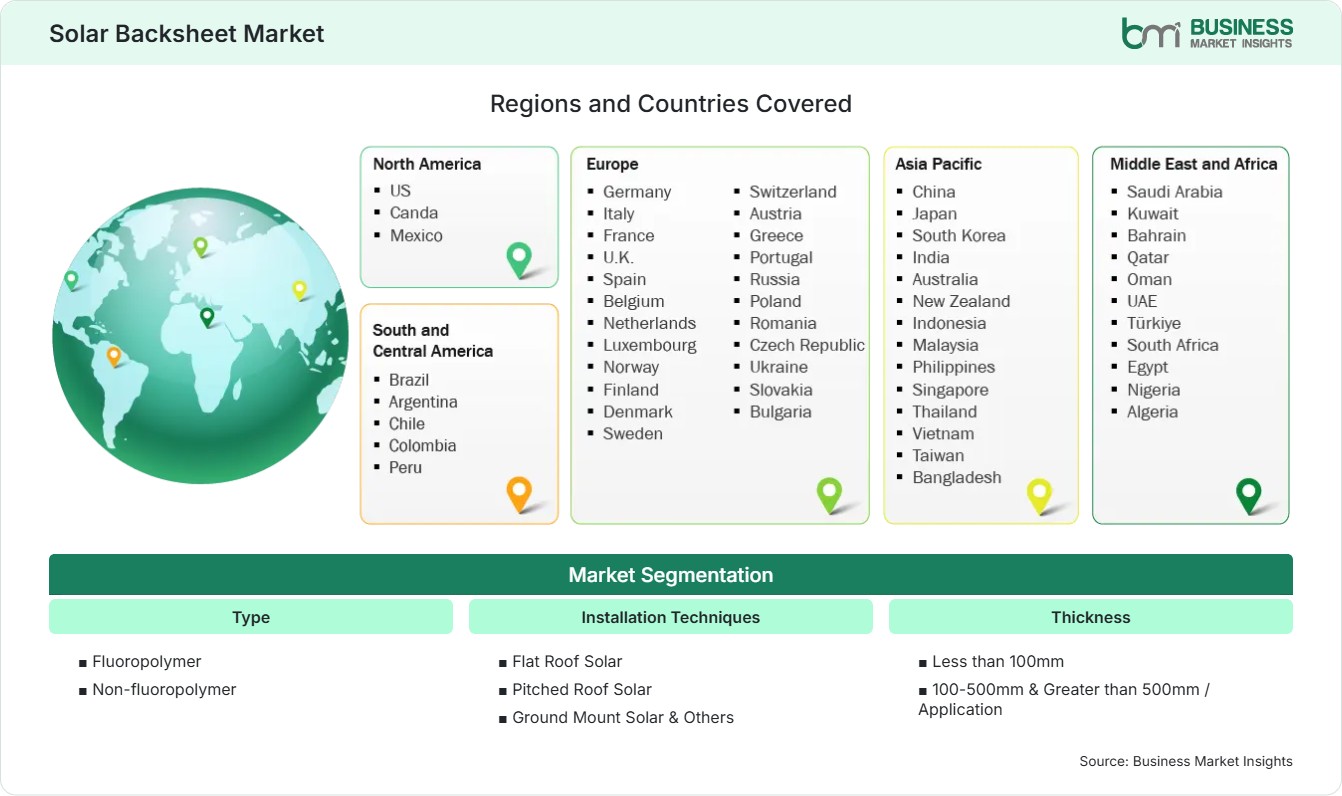
Global Market Geography
FREE PDF
Request your free sample
Request free sample
Segment Analysis

Solar Backsheet Market Segmentation

Type

Fluoropolymer represented 55%–59% share in 2025 and is projected to grow at 8.7%–9.4% CAGR. Established weatherability, chemical resistance, ultraviolet stability, electrical insulation, and long field experience sustain adoption. Non-fluoropolymer alternatives are gaining attention where lower material complexity, recyclability, fluorine reduction, cost optimization, and circularity influence module procurement and product development.

  • Fluoropolymer: Proven UV stability, chemical resistance, moisture protection, and long field performance support demanding utility and commercial modules operating under harsh environmental conditions.
  • Non-fluoropolymer: PET-based constructions gain adoption through material efficiency, recyclability potential, improved coatings, lower complexity, and demand for fluorine-free photovoltaic architectures.

Installation Techniques

Ground Mount Solar represented 42%–46% Solar Backsheet Market share in 2025 and is projected to grow at 10.2%–11.2% CAGR. Utility-scale installations require durable insulation, moisture barriers, high-voltage qualification, thermal stability, and strong environmental resistance.

  • Flat Roof Solar: Commercial rooftops favor lightweight, durable modules where installation efficiency, moisture resistance, reflective properties, and limited roof space influence material selection.
  • Pitched Roof Solar: Residential and commercial pitched roofs emphasize lightweight construction, weatherability, fire performance, adhesion, and long-term resistance to temperature and rainfall.
  • Ground Mount Solar: Utility installations demand high-voltage, UV-resistant, moisture-barrier constructions capable of sustaining severe outdoor exposure and minimizing long-term degradation.

Thickness

Thickness affects mechanical strength, barrier performance, weight, lamination behavior, electrical insulation, and overall module construction. The supplied segmentation comprises Less than 100mm, 100-500mm, and Greater than 500mm.

  • Less than 100mm: Thin constructions support lightweight module concepts and material-reduction strategies where sufficient insulation, adhesion, mechanical stability, and environmental resistance can be maintained.
  • 100-500mm: Mid-range constructions balance mechanical strength, insulation, moisture protection, processing efficiency, and cost, supporting mainstream crystalline-silicon module designs.
  • Greater than 500mm: Thicker structures address demanding mechanical and barrier requirements in specialized photovoltaic constructions exposed to elevated environmental or structural stresses.

Application

Commercial, Industrial & Utilities applications underpin demand across distributed and large-scale photovoltaic systems. Utility projects provide the strongest volume opportunity, while commercial and industrial installations support demand for lightweight, durable, transparent, and application-specific constructions. Solar Backsheet Market scope therefore spans diverse operating environments, procurement models, module technologies, voltage requirements, and lifecycle priorities across global photovoltaic deployment.

  • Commercial: Commercial projects prioritize reliable service life, manageable module weight, roof compatibility, durability, and reduced maintenance exposure across distributed installations.
  • Industrial: Industrial installations require environmental resistance, electrical insulation, and chemical durability where modules operate near manufacturing, logistics, processing, and infrastructure facilities.
  • Utilities: Utility projects prioritize high-voltage capability, UV stability, moisture barriers, thermal cycling resistance, mechanical durability, and lifecycle reliability across extensive outdoor photovoltaic fleets.
Market Forces

Solar Backsheet Market Dynamics

Key Market Drivers

Expansion of Global Solar PV Installations

Global photovoltaic deployment directly expands the addressable requirement for protective module materials. Solar PV additions surpassed 600 GW in 2025, lifting cumulative capacity to approximately 2,800 GW. This deployment creates recurring demand for backsheets across utility, commercial, industrial, and distributed systems. Larger module formats are also increasing the functional importance of moisture protection, electrical insulation, adhesion, ultraviolet resistance, and mechanical stability. Utility installations create especially strong demand because modules remain outdoors for decades under variable climatic conditions. The Solar Backsheet Market growth trajectory therefore, remains closely linked to photovoltaic capacity additions, module production volumes, and replacement requirements.

Shift Toward High-Voltage and Bifacial Module Architectures

Module technology in the Solar Backsheet Market is increasing performance requirements for rear-side protection. Higher voltage systems need better dielectric properties, while bifacial modules generate requirements for transparent or optical backsheets. Big modules generate higher mechanical and thermal loads during use and transportation. Transparent materials can be used instead of glass in specific designs while maintaining light transmittance to the backside cells. This stimulates producers to develop PET-based high-barrier materials, fluoropolymer laminates, transparent coatings, and special adhesives.

Rising Demand for Durable and Lightweight Materials

Module makers are becoming more concerned with ensuring their modules have longevity while reducing weight, using materials efficiently, and allowing flexible installation. Lightweight backsheet materials may help reduce the weight of modules as compared to those made with glass in appropriate scenarios, where flexibility is required for the photovoltaics. Longevity is necessary since moisture penetration, loss of adhesives, UV degradation, and insulation failures can limit the lifespan of modules. The Solar Backsheet Market trends therefore favor constructions that maintain mechanical integrity and electrical performance while reducing unnecessary material consumption.

Key Market Opportunities

Commercialization of Fluorine-Free and Recyclable Backsheets

The fact that constructions free from fluorine and which are recyclable present considerable possibilities for product development as photovoltaic manufacturers place a greater emphasis on circularity and the impact throughout a product's lifecycle. When accompanied by appropriate coatings and adhesives, PET-based structures can be used in designs with a view to recycling, and recycled PET is now being used in commercial backsheet products. Demand is most intense among customers who are looking for environmental declarations, simpler material compositions, and better end-of-life processing. Suppliers who combine recycled content with proven durability can gain an advantage over their competitors in the areas of utility, commercial use, industrial applications, bifacial modules, and lightweight products.

Growth of Repair, Repowering, and Lifecycle Services

The potential benefits of an expanding photovoltaic fleet go beyond the need for new-module materials since damaged backsheets can allow moisture to enter, lower the insulation performance, and lead to production interruptions. Instead of replacing modules that are still working, asset owners can use repair films. Krempel’s KremSol Repair shows this method by means of an engineered repair laminate that is intended for on-site refurbishment and for extending the service life of the modules. This option is particularly pertinent to large solar parks, as their downtime and replacement logistics affect the project's economics.

Expansion in Emerging Solar Markets

Emerging markets offer strong opportunities for localized photovoltaic production and regional distribution as solar installations accelerate. India, Southeast Asia, the Middle East, Latin America, and Africa need materials suited to high temperatures, humidity, dust, UV exposure, and variable grid conditions. Local module manufacturing can support domestic backsheet conversion, coating, lamination, and technical services. Solar Backsheet Market Forecasts should assess both installed capacity and manufacturing shifts. Regional partnerships can strengthen customer access, reduce freight costs, shorten delivery cycles, and secure specifications with rapidly expanding module manufacturers.

Market Restraints and Challenges

Raw Material Price Volatility

Factor: fluctuations in polyester, fluoropolymer, adhesive, coating, and specialty-chemical costs can alter manufacturing economics and increase uncertainty in long-term supply agreements.

Impact: producers must continuously optimize formulations, procurement strategies, inventory levels, manufacturing yields, and pricing mechanisms without compromising reliability. Smaller suppliers can face greater pressure because they generally have less purchasing leverage and fewer opportunities to absorb temporary input-cost increases. Module manufacturers also exert strong price discipline because backsheets represent one component within a highly competitive module bill of materials.

Qualification Complexity and Long Reliability Cycles

Factor: new backsheet constructions require extensive validation for adhesion, electrical insulation, ultraviolet resistance, moisture resistance, thermal cycling, hydrolysis, mechanical integrity, and compatibility with encapsulants and module architectures. Impact: qualification can delay commercial adoption and increase development costs for innovative materials, even when those materials offer improved recyclability, lower environmental impact, or lower production cost. Module manufacturers are cautious because backsheet failure can create safety, warranty, and power-output risks over long operating periods.

Company Analysis

Competitive Landscape

The Solar Backsheet Market analysis indicates competition among integrated photovoltaic-material manufacturers, specialty-film producers, fluoropolymer specialists, polyester suppliers, and engineered laminate companies. Competitive differentiation increasingly depends on reliability, certification, high-voltage performance, transparent structures, recycled content, fluorine-free alternatives, repair capability, customization, and regional supply resilience.

Company Name

Overview

Products and Services relevant to this market

DuPont de Nemours, Inc.

Global materials producer with extensive photovoltaic protection expertise and a long-established installed base of Tedlar PVF applications.

Tedlar PVF film-based TPT and TPE backsheets, transparent solutions, technical support, durability expertise, and photovoltaic material qualification.

Coveme S.p.A.

Italian specialty-film producer focused on engineered polyester laminates and photovoltaic protection technologies for global module manufacturers.

dyMat fluoropolymer and PET backsheets, transparent products, recycled-PET constructions, high-barrier laminates, frontsheets, and customized films.

Krempel GmbH

German electrical-insulation specialist with extensive photovoltaic backsheet experience and growing circular service capabilities.

AKASOL laminates, fluoropolymer-free constructions, transparent materials, high-voltage solutions, repair films, and photovoltaic insulation products.

Dunmore Corporation

US specialty-film manufacturer supplying engineered protective films and backsheet constructions to photovoltaic manufacturers.

DUN-SOLAR PPE+, TPE, TAPE, specialty, transparent, high-voltage, and thin-film photovoltaic backsheet constructions.

RenewSys India Private Limited

Integrated Indian photovoltaic-material manufacturer supplying components for domestic and international module production.

PRESERV backsheets, white, black, transparent, and metallic constructions, moisture barriers, insulation solutions, and photovoltaic material support.

Jolywood (Taizhou) Sunwatt Co., Ltd.

Chinese photovoltaic technology company combining module technologies with large-scale backsheet and material capabilities.

Fluorinated backsheets, transparent structures, reflective products, encapsulation materials, and integrated photovoltaic component solutions.

Toray Industries, Inc.

Global advanced-materials producer with polyester-film expertise supporting photovoltaic backsheet constructions.

Polyester films, hydrolysis-resistant grades, UV-protection films, electrical insulation films, and material technologies for fluorine-free backsheet designs.

Toppan Holdings Inc.

Japanese technology group with established functional-film and photovoltaic protective-material capabilities.

Solar-cell back sheets, vapor-barrier films, protective structures, and advanced functional-film technologies for module applications.

Mitsubishi Chemical America, Inc.

Advanced-film supplier supporting photovoltaic applications through engineered polyester film technologies and specialty materials.

Polyester films, white and clear grades, UV-resistant films, coated films, and customized film specifications for backsheet laminations.

SKC Co., Ltd.

South Korean materials company with PET, fluorine-film, adhesive, and multilayer backsheet capabilities.

FPF, FPE, PPE, co-extruded structures, PVDF and PET films, coatings, adhesives, and integrated photovoltaic backsheet solutions.

Trust & Transparency

Research Methodology

The market analysis combines proprietary research with secondary data from government agencies, company disclosures, regulatory filings, industry databases and expert interviews. Market estimates are validated through data triangulation, cross-market benchmarking and analyst review.

View Full Research Methodology

Access the Full Solar Backsheet Market Report

Get segment-level forecasts, regional estimates, competitive benchmarking, company profiles and downloadable Excel datasets.

Access the full Solar Backsheet Market Report
350 pages PDF & Excel | 2026-10-05
Similar Research

Related Market Reports