Market Summary
Executive Summary and Global Market Analysis
Surgical procedures utilize soft tissue repair devices as medical technologies which restore and reconstruct and support damaged soft tissues. The devices include a wide selection of products which feature fixation systems and surgical meshes and grafts and laparoscopic instruments and biologic materials that support surgical success and healing enhancement and shorter recovery durations. The development of advanced biomaterials and less invasive surgical techniques has established soft tissue repair as an essential procedure for orthopedic medicine and hernia repair and skin and wound healing and dental and reconstructive surgical procedures.
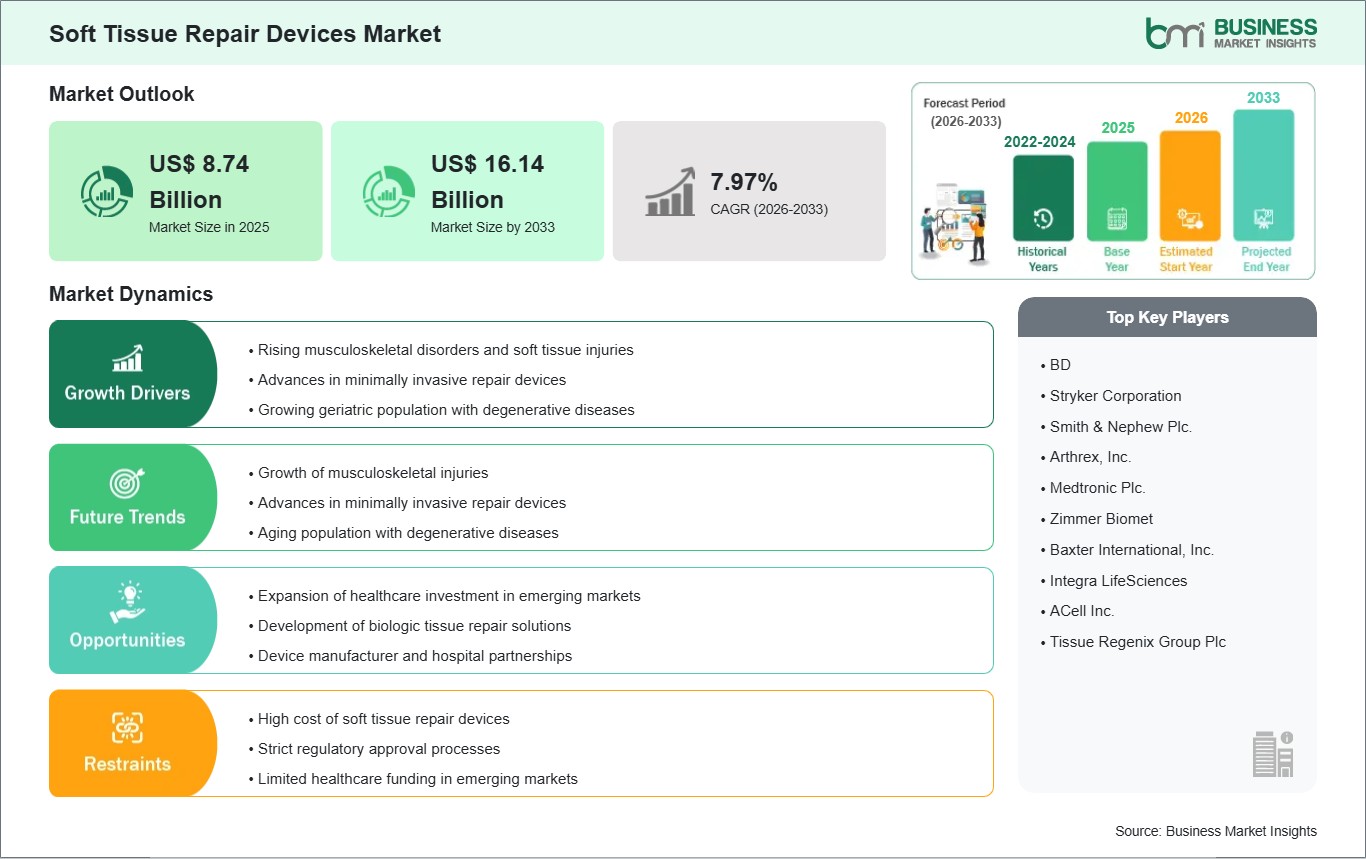
The soft tissue repair devices market exhibits continuous growth because of demographic changes which include increasing elderly populations and more sports-related injuries and rising numbers of people who require surgical treatment for lifestyle diseases. The market expansion receives additional support through new developments in regenerative materials which include bioengineered scaffolds and absorbable fixation technologies and hybrid solutions that support the transition to outpatient and minimally invasive medical procedures. North America maintains its position as the top market holder because of its developed healthcare systems and high medical procedures, while Asia-Pacific will experience the fastest market growth through increased healthcare spending and improved surgical service availability.
Segment Analysis
Soft Tissue Repair Devices Market Segmentation
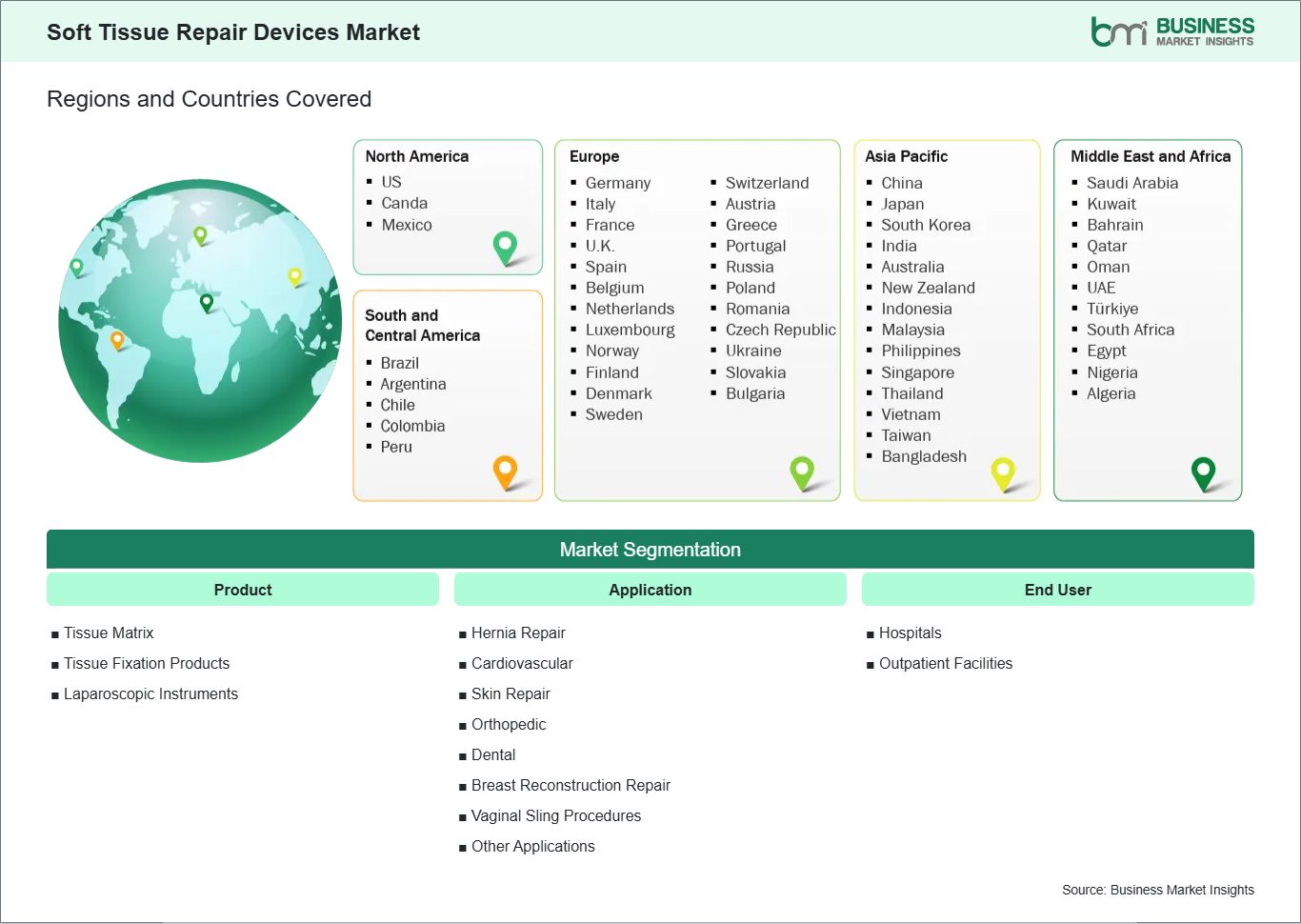
Key segments that contributed to the derivation of the soft tissue repair devices market analysis are product, application, and end user.
- By product, the soft tissue repair devices market is categorized into tissue matrix, tissue fixation products, laparoscopic instruments. The tissue matrix segment held the largest share of the market in 2025.
- By application, the market is segmented into hernia repair, cardiovascular, skin repair, orthopedic, dental, breast reconstruction repair, vaginal sling procedures, other applications. The orthopedic segment held the largest share of the market in 2025.
- By end user, the soft tissue repair devices market is bifurcated into hospitals, outpatient facilities. The hospitals segment dominated the market in 2025.
Market Forces
Soft Tissue Repair Devices Market Drivers and Opportunities
Rising Incidence of Soft Tissue Injuries and Demand for Effective Repair Solutions
The global soft tissue repair devices market experiences its strongest growth because worldwide soft tissue injuries which occur from sports and trauma and among elderly people now happen more frequently. For example, nearly 3.6 million serious injuries occurred in the U.S. in 2022 due to sports and recreational activities, which created a significant demand for surgical repair solutions. Reconstructive procedures show growth because active people sustain ankle sprains and ligament and tendon injuries, which require medical treatment. The market demand increases through aging demographics because older people require surgical treatment for musculoskeletal disorders. Surgeons now prefer to use advanced fixation systems and biologic meshes together with minimally invasive techniques, which enable faster healing processes and shorter recovery durations. The worldwide adoption of soft tissue repair devices in orthopedic procedures and hernia repair and reconstructive surgeries happens because of these factors.
Innovation in Regenerative Technology and Advanced Therapeutics
A major opportunity for the soft tissue repair devices market lies in emerging regenerative technologies and novel product developments that improve healing outcomes and broaden clinical applications. Recent advancements include commercially available next-generation bioabsorbable meshes, synthetic tissue patches with improved integration, and cutting-edge biologic matrices designed to reduce infection and enhance tissue regeneration. Medtronic, BD, and Johnson & Johnson have all launched innovative products targeting improved surgical outcomes, demonstrating the market`s shift toward high-performance solutions. Additionally, FDA approvals of regenerative implants such as Axogen`s nerve repair graft underscore regulatory support for next-generation biologics that simplify procedures and reduce complications. These technological advancements not only elevate clinical standards but also expand the use of soft tissue repair devices across orthopedics, peripheral nerve repair, hernias, and reconstructive surgeries, creating new growth avenues for manufacturers and healthcare providers alike.
Size and Share Analysis
Soft Tissue Repair Devices Market Size and Share Analysis
By product, the soft tissue repair devices market is categorized into tissue matrix, tissue fixation products, laparoscopic instruments. The tissue matrix segment held the largest share of the market in 2025. The tissue matrix segment leads because biologic matrices and meshes offer superior clinical outcomes through enhanced tissue regeneration, biocompatibility, and structural support across diverse surgical procedures. Surgeons favor these matrices for their ability to reduce recurrence and improve healing, especially in reconstructive and hernia repairs, driving both adoption and market share.
By application, the market is segmented into hernia repair, cardiovascular, skin repair, orthopedic, dental, breast reconstruction repair, vaginal sling procedures, other applications. The orthopedic segment held the largest share of the market in 2025. The orthopedic segment dominates due to the high global incidence of musculoskeletal injuries, particularly in aging and active populations. Soft tissue repair devices such as fixation systems and biologic scaffolds are essential in arthroscopic ligament and tendon repairs, making this the largest application area by volume and clinician preference.
By end user, the soft tissue repair devices market is bifurcated into hospitals, outpatient facilities. The hospitals segment dominated the market in 2025. Hospitals maintain the leading end-user share because they handle the majority of complex soft tissue repair surgeries requiring advanced infrastructure, multidisciplinary teams, and comprehensive perioperative care. Their capability to treat high-acuity cases and invest in advanced technologies reinforces this dominance.
Report Coverage
Soft Tissue Repair Devices Market Report Coverage and Deliverables
The " Soft Tissue Repair Devices Market Size and Forecast (2022–2033)" report provides a detailed analysis of the market covering below areas:
- Soft tissue repair devices market size and forecast at global, regional, and country levels for all the key market segments covered under the scope
- Soft tissue repair devices market trends, as well as market dynamics such as drivers, restraints, and key opportunities
- Soft tissue repair devices market analysis covering key market trends, global and regional framework, major players, regulations, and recent market developments
- Industry landscape and competition analysis covering market concentration, heat map analysis, prominent players, and recent developments for the soft tissue repair devices market
- Detailed company profiles, including SWOT analysis
Geographic Insights
Soft Tissue Repair Devices Market Geographic Insights
The geographical scope of the soft tissue repair devices market report is divided into five regions: North America, Asia Pacific, Europe, Middle East and Africa, and South and Central America. The soft tissue repair devices market in Asia Pacific is expected to grow significantly during the forecast period.
The Asia-Pacific soft tissue repair devices market is segmented into China, Japan, South Korea, India, Australia, New Zealand, Indonesia, Malaysia, the Philippines, Singapore, Thailand, Vietnam, Taiwan, Bangladesh, and the Rest of Asia. The Asia-Pacific soft tissue repair devices market is experiencing robust growth, due to multiple factors that combine to create both increased demand and expanded surgical treatment capacity. The healthcare infrastructure in China, India, Japan, South Korea, and Southeast Asian countries currently undergoes rapid development which results in increased hospital construction and establishment of specialized orthopedic and reconstructive centers that enable higher surgical procedures and greater use of advanced repair technologies such as biologic meshes and minimally invasive instruments. People now understand that early intervention helps treat sports-related injuries and degenerative conditions which leads them to seek effective soft tissue repair solutions. The combination of aging populations and increasing cases of lifestyle-induced musculoskeletal disorders produces more hernias and ligament tears and tendon ruptures which creates greater medical demand. International patients visit medical tourism markets in Thailand, Singapore, and India to obtain high-quality medical services at lower prices while regulatory changes and faster device assessment processes in important markets drive international businesses to invest and local companies to produce products for multiple market conditions.
Industry Activity
Recent Developments
The soft tissue repair devices market is evaluated by gathering qualitative and quantitative data post primary and secondary research, which includes important corporate publications, association data, and databases. A few of the key developments in the soft tissue repair devices market are:
- In June 2024, Axogen, Inc. announced the launch of its newest product, Avive+ Soft Tissue Matrix. Avive+ is intended for use as a soft tissue barrier and is a resorbable, multi-layer amniotic membrane allograft that provides temporary protection and tissue separation during the critical phase of peripheral nerve healing. Avive+ is processed and distributed in accordance with U.S. Food and Drug Administration (FDA) requirements for Human Cellular and Tissue-based Products (HCT/P) under 21 CFR Part 1271 regulations, U.S. State regulations as a 361 human tissue product.
- In January 2026, ABANZA, a company focused on next-generation soft-tissue repair solutions, announced that the U.S. FDA has granted 510(k) clearance for QuadLock, its new knotless, bidirectional tension-adjustable fixation system for ACL reconstruction.
Trust & Transparency
Research Methodology
The market analysis combines proprietary research with secondary data from government agencies, company disclosures, regulatory filings, industry databases and expert interviews. Market estimates are validated through data triangulation, cross-market benchmarking and analyst
review.
View Full Research Methodology
Key Sources Referred:
World Health Organization (WHO)Institute for Health Metrics and EvaluationCenters for Disease Control and PreventionUnited Nations Population DivisionOrganisation for Economic Co-operation and Development Health DataWorld Bank Health DataCompany websitesCompany annual reportsCompany investor presentations