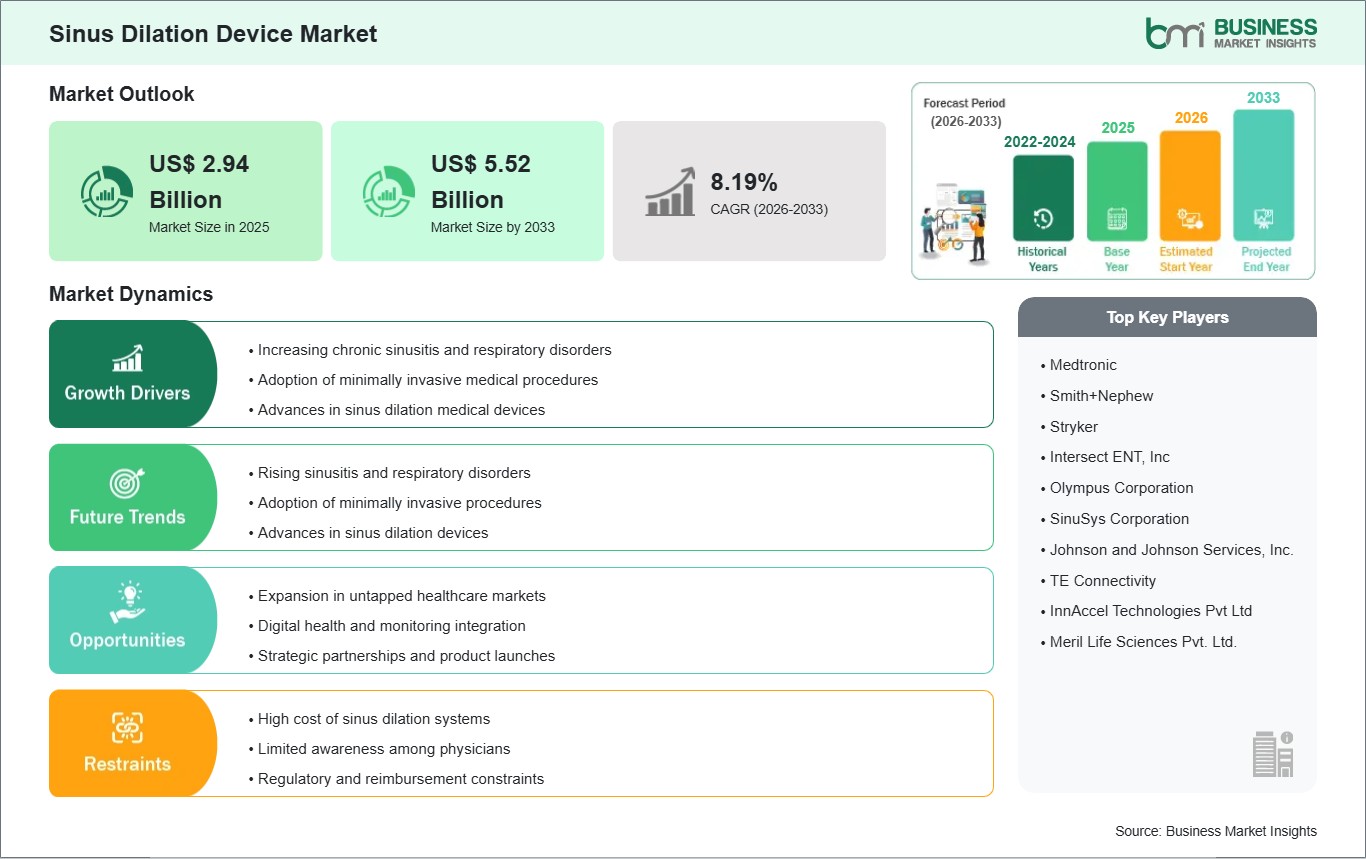
The Sinus Dilation Device Market size is expected to reach US$ 5.52 billion by 2033 from US$ 2.94 billion in 2025. The market is estimated to record a CAGR of 8.19% from 2026 to 2033.
A sinus dilation device is a medical tool used in minimally invasive medical procedures to treat chronic sinusitis and other sinus disorders by using its capability to expand blocked sinus passages which helps to restore proper sinus drainage and normal breathing patterns without needing major surgical intervention. The devices which include balloon sinuplasty systems and endoscopes and sinus stents and specialised handheld instruments find common application in outpatient or office-based environments which allow them to deliver better tissue preservation and faster patient recovery than standard sinus surgery methods.
The global sinus dilation device market is experiencing robust expansion driven by the growing prevalence of chronic rhinosinusitis and rising patient preference for minimally invasive treatments and continuous technological innovation such as image-guided navigation and drug-eluting implants. The current usage pattern shows hospitals and ambulatory surgical centers as the main users while ENT specialty clinics and office-based procedures emerge as affordable options that gain popularity. North America leads in adoption because it has established healthcare systems and beneficial reimbursement practices while Asia Pacific shows the most rapid growth because healthcare investments and clinical facilities development continue to rise. Europe also contributes substantially because it has established systems for ENT treatment. Market drivers include rising ENT disease incidence and favorable insurance coverage in developed markets and the shift from traditional functional endoscopic sinus surgery to less invasive options. Innovation combined with expanded procedural settings and increased global demand for effective sinus treatment solutions will drive sustained market growth for the industry.

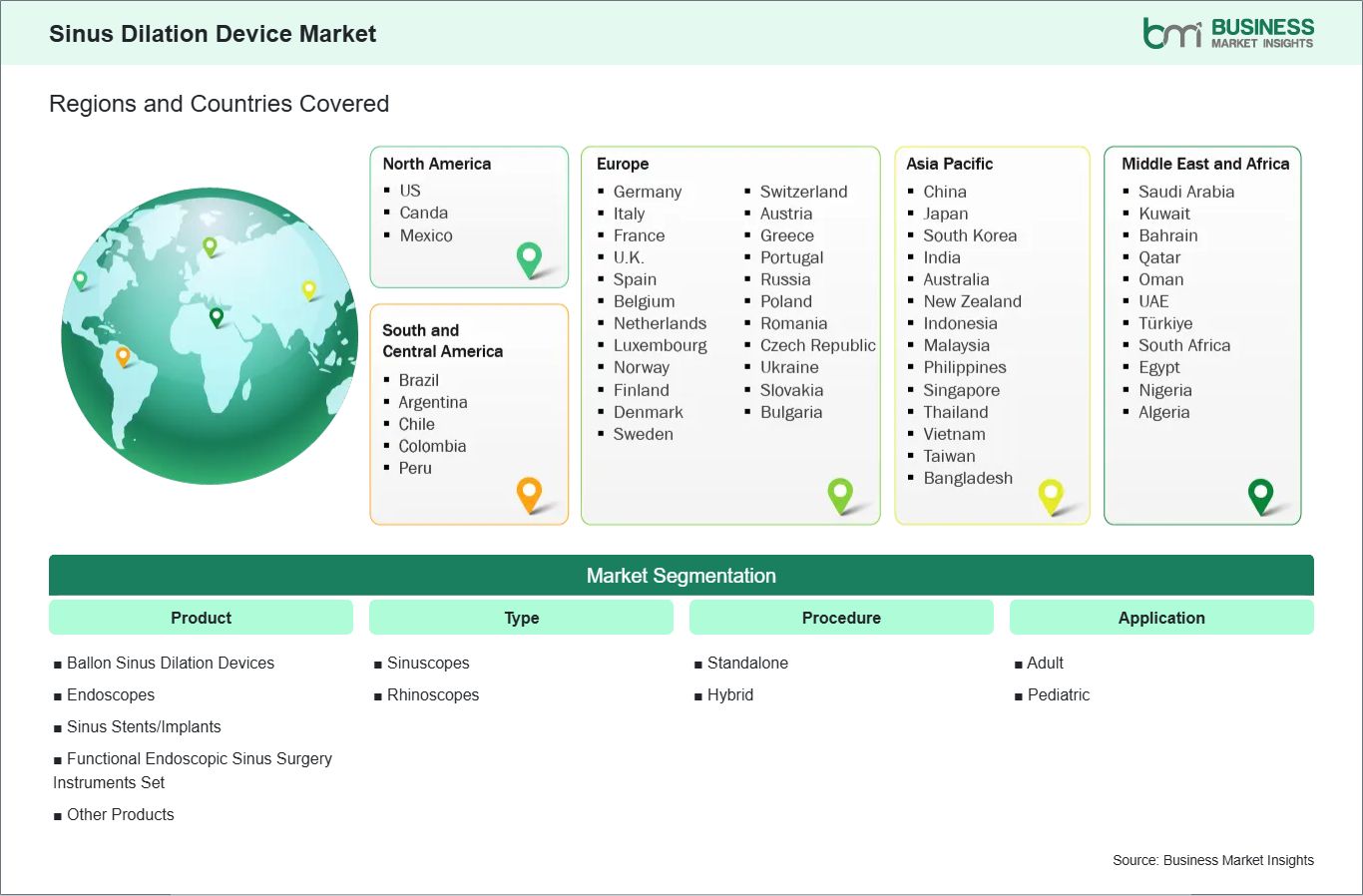
Key segments that contributed to the derivation of the sinus dilation device market analysis are product, type, procedure, application, and end user.
The sinus dilation devices market experiences growth because the worldwide population suffers from chronic rhinosinusitis (CRS), which causes permanent sinus inflammation that deteriorates life quality and requires surgical treatment when doctors cannot cure patients through medication. The worldwide pooled prevalence of chronic rhinosinusitis (CRS) according to epidemiological studies shows that 8.71% of people worldwide experience this condition, which creates a vast potential patient base throughout the globe. The increasing frequency of medical procedures results from the rising number of cases because doctors and patients favor balloon sinuplasty and image-guided dilation as their first choice, which provides them with reduced postoperative pain and faster recovery times while achieving higher success rates than standard surgical methods. The clinical adoption of sinus dilation techniques for chronic rhinosinusitis treatment now accounts for almost 50% of all CRS procedures in developed markets, which shows that medical professionals are increasingly choosing these methods. Advanced sinus dilation devices now see rising demand from hospitals, outpatient centers, and ENT clinics because of increasing disease occurrences and medical staff preferences for these devices.
The sinus dilation devices market offers a significant opportunity because ongoing technological advancements and new product introductions enable more medical applications which lead to better patient results. The major industry companies introduced innovative products in 2025 which included the VenSure Balloon Sinus Dilation System and the Cube 4D Navigation System with VirtuEye photo registration system to create more accurate surgical procedures and better imaging support for sinus operations. The innovations provide clinicians with tools that display live images while maintaining simple operation, which helps them treat difficult bodily structures more securely and successfully. The medical field now utilizes new balloon systems and navigation-enabled devices and hybrid platforms, which enable various treatment methods to reach multiple clinical situations. Healthcare facilities need to separate their services, which leads to significant expansion opportunities through ongoing research and development of image-guided navigation systems and artificial intelligence and modular device systems. The latest technological advancements enable medical professionals to use sinus dilation devices in more scenarios while manufacturers can develop new market segments through their value-based innovations.
By product, the sinus dilation device market is categorized into ballon sinus dilation devices, endoscopes, sinus stents/implants, functional endoscopic sinus surgery instruments set, other products. The ballon sinus dilation devices segment dominated the market in 2025. Balloon sinus dilation devices lead due to their minimally invasive nature, strong clinical adoption, and ability to improve sinus drainage with less tissue damage and faster patient recovery. They are widely embraced by ENT specialists and suitable for office-based procedures, making them the most utilized device type globally.
By type, the market is bifurcated into sinuscopes, rhinoscopes. The sinuscopes segment held a larger share of the market in 2025. Within visualization tools, sinuscopes generally lead as they are specifically designed for sinus and nasal cavity imaging, offering surgeons better access and precision in diagnosing and guiding sinus procedures. Sinuscopes’ focused design drives higher utilization.
By procedure, the market is segmented into standalone, hybrid. The standalone segment held a larger share of the market in 2025. Standalone procedures dominate because they involve using dilation devices independently without combining them with traditional surgery. This simpler, cost-effective, and quick-recovery approach is preferred for chronic sinusitis treatment and outpatient settings, boosting adoption.
By application, the market is bifurcated into adult, pediatric. The adult segment held a larger share of the market in 2025. The adult segment leads given the higher prevalence of chronic sinusitis and related nasal conditions in adult populations, resulting in a greater share of diagnostic and therapeutic sinus dilation procedures.
By end user, the sinus dilation device market is segmented into hospitals, ambulatory surgical centers, ENT clinics. The hospitals segment dominated the market in 2025. Hospitals hold the leading share as they provide comprehensive infrastructure, advanced imaging, and capacity to manage complex or hybrid procedures, attracting more referrals and utilization of sinus dilation devices compared with other care settings.

| Report Attribute | Details |
|---|---|
| Market size in 2025 | US$ 2.94 Billion |
| Market Size by 2033 | US$ 5.52 Billion |
| Global CAGR (2026 - 2033) | 8.19% |
| Historical Data | 2022-2024 |
| Forecast period | 2026-2033 |
| Segments Covered | By Product
|
|
Regions and Countries Covered
| |
| North America | US, Canada, Mexico |
| Europe | Belgium, Austria, Finland, Denmark, Greece, Poland, Romania, Russia, Ukraine, Czech Republic, Slovakia, Bulgaria, Italy, Luxembourg, Germany, Switzerland, France, Netherlands, Norway, Portugal, Spain, Sweden, United Kingdom |
| Asia-Pacific | Australia, China, India, Japan, South Korea, Indonesia, Malaysia, Philippines, Singapore, Thailand, Vietnam, Bangladesh, New Zealand, Taiwan |
| South and Central America | Brazil, Argentina, Peru, Chile, Colombia |
| Middle East and Africa | Bahrain, Kuwait, Oman, Qatar, Saudi Arabia, United Arab Emirates, Turkiye, South Africa, Egypt, Algeria, Nigeria |
| Market leaders and key company profiles |
|
The " Sinus Dilation Device Market Size and Forecast (2022–2033)" report provides a detailed analysis of the market covering below areas:
The geographical scope of the sinus dilation device market report is divided into five regions: North America, Asia Pacific, Europe, Middle East and Africa, and South and Central America. The sinus dilation device market in Asia Pacific is expected to grow significantly during the forecast period.
The Asia-Pacific sinus dilation device market is segmented into China, Japan, South Korea, India, Australia, New Zealand, Indonesia, Malaysia, the Philippines, Singapore, Thailand, Vietnam, Taiwan, Bangladesh, and the Rest of Asia. The Asia-Pacific sinus dilation device market is experiencing robust growth, due to multiple interconnected elements that transform both healthcare systems and patient driving treatment decisions. First, the rising number of chronic sinusitis and allergic rhinitis cases in China and India, which contain large populations, has created better understanding of effective treatment methods, leading more patients to visit specialized ENT facilities. Second, the development of healthcare facilities and financial support for new medical establishments in both urban and semi-urban regions, which provide access to modern surgical techniques, enables medical centers to implement advanced sinus treatment methods through their use of balloon sinuplasty and image-guided systems. Third, rising disposable incomes and greater health insurance coverage are enabling more patients to afford elective procedures that were previously cost-prohibitive, boosting procedural volumes. Fourth, there is growing clinical expertise and training among ENT specialists in the region, supported by international collaborations and professional education, which enhances physician confidence in using sinus dilation devices. The rising medical tourism in Thailand, Singapore, and Malaysia attracts patients who seek affordable yet effective sinus treatment from nearby regions. The combination of these factors establishes a strong foundation for continuous market expansion in the Asia-Pacific region, where both customer needs and product availability will drive increased adoption of sinus dilation devices.

The sinus dilation device market is evaluated by gathering qualitative and quantitative data post primary and secondary research, which includes important corporate publications, association data, and databases. A few of the key developments in the sinus dilation device market are:
The Sinus Dilation Device Market is valued at US$ 2.94 Billion in 2025, it is projected to reach US$ 5.52 Billion by 2033.
As per our report Sinus Dilation Device Market, the market size is valued at US$ 2.94 Billion in 2025, projecting it to reach US$ 5.52 Billion by 2033. This translates to a CAGR of approximately 8.19% during the forecast period.
The Sinus Dilation Device Market report typically cover these key segments-
The historic period, base year, and forecast period can vary slightly depending on the specific market research report. However, for the Sinus Dilation Device Market report:
The Sinus Dilation Device Market is populated by several key players, each contributing to its growth and innovation. Some of the major players include:
The Sinus Dilation Device Market report is valuable for diverse stakeholders, including:
Essentially, anyone involved in or considering involvement in the Sinus Dilation Device Market value chain can benefit from the information contained in a comprehensive market report.
Please tell us your area of interest
(Market Segments/ Regions and Countries/ Companies)