
Prothrombin Complex Concentrate Market Outlook: Size, Share, Trends, Growth Analysis, Competitive Landscape & Forecast, 2026-2033

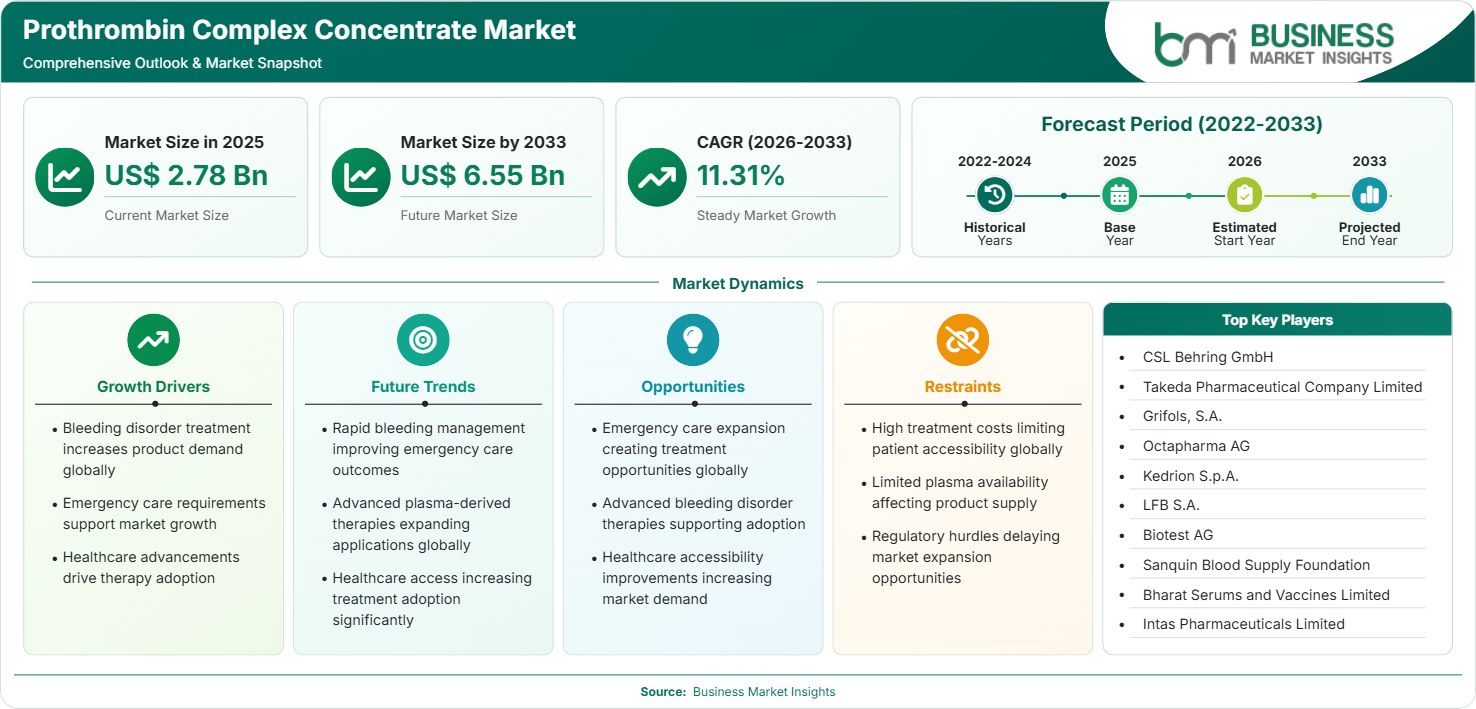
The Prothrombin Complex Concentrate Market size was valued at US$ 2.78 Billion in 2025 and is projected to reach US$ 6.55 Billion by 2033, growing at a CAGR of 11.31% during 2026–2033, driven by anticoagulant reversal demand, surgical bleeding management, plasma-derived innovation, and expanding emergency-care capacity.

Report Coverage
  • Product: 3-factor PCC, 4-factor PCC
  • Application: Acquired Coagulation Factor Deficiency, Congenital Coagulation Factor Deficiency
  • End User: Hospitals & Ambulatory Surgical Centers, Specialty Clinics, Others
US$ 2.78 Bn Market size in 2025
US$ 6.55 Bn Market Size by 2033
11.31% CAGR, 2026 - 2033
2026-2033 Forecast Period

AI Overview

Prothrombin Complex Concentrate Market Summary

  • North America Region: North America holds 42%–46% share in 2025, with a 10.2%–11.0% CAGR through 2033, supported by established PCC protocols, emergency bleeding programs, anticoagulant use, hospital purchasing, regulatory clarity, and rapid adoption of four-factor products. The US market remains dominant within North America because major hospitals increasingly integrate rapid reversal protocols into emergency, surgical, and trauma pathways, supporting a 10.4%–11.2% CAGR through 2033.
  • Fastest Growing Region: Asia Pacific holds 18%–22% share in 2025 and is projected to expand at a 12.0%–13.0% CAGR, supported by improving diagnosis, expanding tertiary hospitals, rising surgical volumes, broader plasma-derived therapy access, government healthcare investment, and increasing adoption of standardized coagulation management pathways.
  • Leading Segment: 4-factor PCC holds 78%–82% share in 2025 and is projected to grow at an 11.4%–12.1% CAGR, supported by comprehensive factor replacement, established reversal protocols, rapid INR correction, emergency surgery demand, clinical familiarity, and increasing institutional preference for concentrated therapies over plasma.
  • High Growth Segment: Congenital Coagulation Factor Deficiency is projected to expand at a 12.3%–13.2% CAGR, supported by improved rare-disease diagnosis, specialist hematology centers, prophylactic management, genetic testing, personalized treatment pathways, and growing healthcare access for inherited bleeding disorders across emerging economies.
  • Key Market Opportunity: Expansion of four-factor PCC availability beyond mature markets creates opportunities for localized manufacturing, plasma-supply partnerships, clinical education, emergency protocols, specialty distribution, and value-based procurement across developing healthcare systems.
  • Major Market Players: CSL Behring GmbH, Takeda Pharmaceutical Company Limited, Grifols, S.A., Octapharma AG, Kedrion S.p.A., LFB S.A., Biotest AG, Sanquin Blood Supply Foundation, Bharat Serums and Vaccines Limited, and Intas Pharmaceuticals Limited.
Strategic Insights

Prothrombin Complex Concentrate Market: Strategic Insights

Prothrombin Complex Concentrate Market Strategic Framework
FREE PDF
Request your free sample
Request free sample
Stakeholder View

Key Takeaways

  • Supply chain resilience is turning into a strategic advantage since the capacity for plasma collection, the ability to carry out fractionation, quality control, and the availability of stocks all have a direct effect on the capacity to provide the concentrates when there are urgent bleeding episodes.
  • The four-factor PCC is the most straightforward way of achieving commercial growth since complete factor replacement is in line with the standard protocols for reversing VKA and the requirements for emergency surgery in major hospital systems.
  • The development of products is heading in the direction of generating stronger evidence, improving dosing protocols, achieving better manufacturing yields, and carrying out a wider range of investigations into the uses of PCC beyond its conventional role as an anticoagulant reversal.
  • The Asia Pacific region offers a promising environment for expansion since specialist hospitals are developing along with diagnostic capabilities and access to plasma-derived therapies, leading to opportunities for local distribution and clinical education.
  • More money is being invested in vertically integrated plasma platforms; when Kedrion announced in May 2026 a €150 million investment aimed at increasing its production capacity in Italy, it showed how important it is to have a large manufacturing scale.
  • Clinical evidence is still an important means of gaining a competitive advantage; in March 2025, Octapharma published the findings from the FARES-II study, which showed that four-factor PCC had better hemostatic efficacy than frozen plasma in the case of bleeding during cardiac surgery.
Geographic Outlook

Prothrombin Complex Concentrate Market Regional Highlights

North America Prothrombin Complex Concentrate Market

North America represents 42%–46% share in 2025 and is projected to grow at a 10.2%–11.0% CAGR through 2033. The Prothrombin Complex Concentrate Market share is reinforced by standardized reversal protocols and high hospital purchasing capacity.

  • Products that have four factors take advantage of the existing institutional procedures for rapidly reversing anticoagulation, especially in cases where quick correction of the INR and a reduction in the amount of infusion affect decisions about emergency treatment.
  • Hospitals are now giving greater preference to drugs that have received regulatory approvals, are backed by clinical evidence, have predictable dosing, and have existing supply agreements, which in turn raises the competitive barriers for smaller suppliers.
  • Specialist hematology centers meet the demand for plasma-derived coagulation therapies while providing the clinical expertise needed for complicated bleeding and inherited coagulation disorders.
  • Nowadays, procurement places a greater emphasis on the continuity of supply, on verified manufacturing quality, and on having emergency availability, which makes the capacity for plasma collection and fractionation an important factor in competition.

US Prothrombin Complex Concentrate Market

The US accounts for 82%–86% of the North American share in 2025 and is expected to expand at a 10.4%–11.2% CAGR through 2033. The US Prothrombin Complex Concentrate Market benefits from established clinical protocols and broad availability.

  • To enable quick access to reversal therapies, emergency departments and operating rooms have institutional stocks and make use of protocols when major bleeding or urgent invasive procedures occur.
  • Clinical evidence that compares PCC with plasma is still affecting treatment pathways, especially in cases where a low administration volume and rapid correction of coagulation are top priorities.
  • The existence of specialist distribution networks and centralized hospital procurement provides manufacturers with opportunities if they offer a reliable supply, medical education, and pharmacovigilance support.

Europe Prothrombin Complex Concentrate Market

Europe holds 25%–29% share in 2025 and is projected to grow at a 10.7%–11.5% CAGR. Germany, France, the United Kingdom, Italy, and Spain form important established markets, while Germany and the United Kingdom provide strong specialist-care infrastructure. The Prothrombin Complex Concentrate Market growth is supported by structured blood-product systems, specialist hematology services, and continued investment in plasma-derived medicine capacity.

  • Germany is still a major market for coagulation care, due to the presence of specialist hospitals, the existing infrastructure for blood products, and widespread access to emergency hemostatic therapies.
  • The United Kingdom has access to organized anticoagulation services and is seeing increasing demand for rapid reversal methods in acute hospitals and in surgical situations.
  • Italy has the opportunity to develop its manufacturing and plasma-network sectors, with Kedrion intending to expand its production capacity through a €150 million investment that was announced in 2026.
  • In the central and eastern European markets, there are additional opportunities because specialist diagnostic facilities, hospital capacity, and the availability of plasma-derived therapies are all improving.

Asia Pacific Prothrombin Complex Concentrate Market

Asia Pacific represents 18%–22% share in 2025 and is forecast to record a 12.0%–13.0% CAGR, making it the fastest-growing region. The Prothrombin Complex Concentrate Market share is supported by rising tertiary-care capacity, increasing surgical activity, improving rare-disease diagnosis, and expanding specialist hematology services.

  • Japan has a well-developed hospital infrastructure and a proven use of plasma-derived therapies, which provides a solid foundation for advanced management of coagulation and for emergency reversal.
  • China achieves scale by expanding its tertiary hospitals, increasing government investment in healthcare, and improving access to specialized medicines, even though the conditions for procurement and reimbursement are still specific to the market.
  • India offers an opportunity by expanding its specialty hospitals, enhancing its diagnostic capabilities, and meeting the rising demand for advanced therapies for bleeding disorders.
  • In South Korea and Australia, there are healthcare systems that are technologically advanced and where the specialist treatment protocols can speed up the adoption of concentrated coagulation products.

Rest of World Prothrombin Complex Concentrate Market

South and Central America account for a smaller portion of global demand but provide opportunities as hospital infrastructure and specialist hematology services expand. The Prothrombin Complex Concentrate Market share is influenced by healthcare expenditure, specialist availability, and access to imported plasma-derived therapies.

  • Because Brazil has a large healthcare system and is expanding its specialist care, there are more opportunities for coagulation-factor replacement therapies to become available.
  • Mexico has growth potential due to its private hospitals, specialty clinics, and better access to advanced emergency-care products.
  • Saudi Arabia and the United Arab Emirates are expanding their abilities to provide tertiary-care services in response to the growing demand for specialized hemostatic therapies.
  • South Africa has the potential to act as a regional hub for specialist hematology services and for their distribution to the healthcare markets of neighboring African countries.
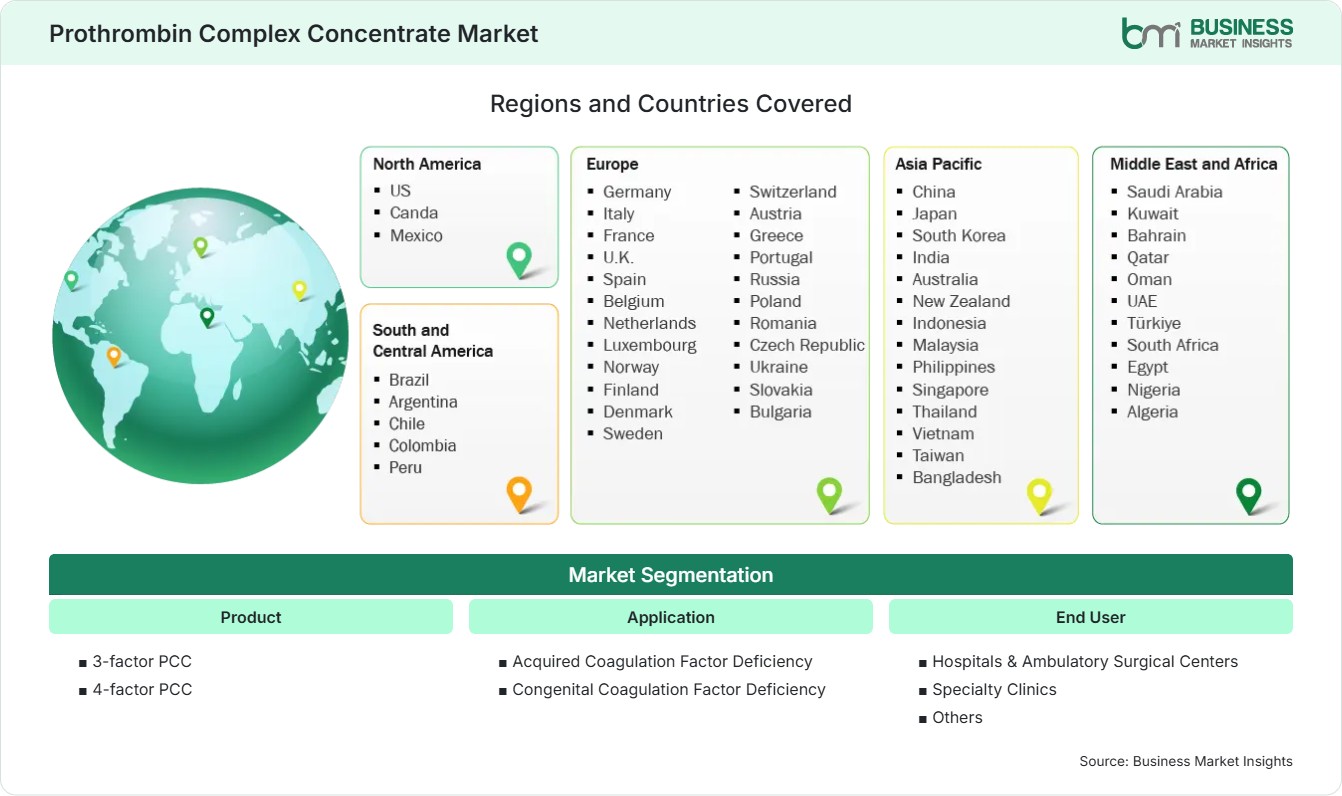
Global Market Geography
FREE PDF
Request your free sample
Request free sample
Segment Analysis

Prothrombin Complex Concentrate Market Segmentation

Product

The Product segment is led by 4-factor PCC, representing 78%–82% share in 2025 and projected to grow at an 11.4%–12.1% CAGR through 2034. Broad factor replacement, emergency reversal protocols, and clinical familiarity support adoption, while 3-factor products retain relevance where specific therapeutic protocols and availability shape purchasing decisions.

  • 3-factor PCC: Used where replacement emphasizes factors II, IX, and X, with clinical selection influenced by local protocols, availability, patient characteristics, and the need for targeted coagulation support.
  • 4-factor PCC: Provides factors II, VII, IX, and X, supporting rapid reversal requirements and broad hospital adoption where comprehensive factor replacement, established protocols, and emergency treatment speed are priorities.

Application

The Application segment is primarily supported by acquired coagulation factor deficiency, while congenital deficiency provides higher expansion potential. Acquired deficiency benefits from anticoagulant reversal demand, whereas congenital disorders require specialist diagnosis and long-term management. The Prothrombin Complex Concentrate scope, therefore, spans emergency medicine and rare hematology applications.

  • Acquired Coagulation Factor Deficiency: Demand is linked to urgent VKA reversal, major bleeding, emergency surgery, and invasive procedures requiring rapid restoration of coagulation capacity.
  • Congenital Coagulation Factor Deficiency: Specialist diagnosis, rare-disease programs, genetic testing, and improved access to hematology services support adoption in selected inherited coagulation disorders and complex bleeding cases.

End User

Hospitals and Ambulatory Surgical Centers represent the principal end-user category because PCC administration requires rapid clinical assessment and monitoring. Specialty clinics support complex hematology management, while other facilities contribute smaller volumes. The segment benefits from emergency protocols, specialist expertise, and increasing availability of dedicated coagulation services.

  • Hospitals & Ambulatory Surgical Centers: High-acuity procedures, emergency bleeding, trauma, and anticoagulant reversal create concentrated demand where rapid access to PCC directly supports treatment workflows.
  • Specialty Clinics: Hematology-focused clinics provide diagnosis, monitoring, and treatment planning for complex coagulation disorders, supporting demand for specialist-administered plasma-derived therapies.
  • Others: Other healthcare settings contribute through selected specialist services, referral pathways, and localized treatment programs where hospital-level coagulation capabilities are not continuously available.
Market Forces

Prothrombin Complex Concentrate Market Dynamics

Key Market Drivers

Rising Need for Rapid Anticoagulant Reversal

Growing use of anticoagulant therapy increases the clinical requirement for reliable reversal strategies when major bleeding or urgent surgery occurs. Four-factor PCC provides concentrated replacement of factors II, VII, IX, and X and is specifically indicated for urgent reversal of VKA-associated acquired coagulation factor deficiency in appropriate adult patients. The Prothrombin Complex Concentrate Market growth trajectory, therefore, reflects both anticoagulant exposure and the need for rapid hospital intervention. FDA-approved Kcentra provides a clear example of regulatory acceptance for this use.

Expansion of Four-Factor PCC Adoption

Four-factor formulations are increasingly central to emergency coagulation management because they replace a broader group of vitamin K-dependent clotting factors than three-factor alternatives. The Prothrombin Complex Concentrate Market trends toward four-factor adoption are reinforced by clinical familiarity, established dosing protocols, and evidence supporting rapid correction of anticoagulation-associated coagulopathy. CSL Behring describes Kcentra as a four-factor PCC indicated for urgent reversal of VKA therapy in adults experiencing acute major bleeding or requiring urgent surgery.

Increasing Surgical and Acute-Care Utilization

The increasing need for rapid hemostatic treatment in complex surgery, cardiovascular operations, trauma care, and emergency interventions results in greater demand for such treatment. Cardiac surgery is a key focus of clinical research since bleeding after surgery may require immediate coagulation support. In March 2025, Octapharma released the findings from the FARES-II study involving 12 hospitals in Canada and the United States, and in the population studied, the four-factor PCC showed 17.6% greater hemostatic efficacy than frozen plasma without an increased risk of thromboembolism.

Key Market Opportunities

Expansion Across Emerging Healthcare Systems

Emerging healthcare systems provide a substantial opportunity as tertiary hospitals expand, specialist hematology capacity improves, and diagnostic pathways become more accessible. The Prothrombin Complex Concentrate Market Forecasts can benefit from localized distribution partnerships, clinician education, hospital formulary development, and regional inventory hubs. Asia Pacific is particularly relevant because its projected 12.0%–13.0% CAGR exceeds mature-region growth ranges. Manufacturers can support adoption by developing training programs around dosing, storage, contraindications, and emergency protocols.

Investment in Plasma Collection and Manufacturing

Plasma availability continues to be a basic limitation and a potential advantage since the production of PCC relies on a steady supply of plasma and on advanced fractionation techniques. In 2025, Kedrion reported having collected 3.002 million liters of plasma and had plans to expand its collection capacity, while its announcement for 2026 mentioned an investment of €150 million to boost production capacity in Italy. These kinds of investments help to strengthen the upstream base that supports plasma-derived therapies. It is possible for producers to carry out vertical integration, form manufacturing partnerships, source plasma regionally, and use yield-improvement technologies. Greater manufacturing scale can also enhance supply resilience when there are periods of volatile demand.

Development of Next-Generation Hemostatic Applications

There is a promising innovation potential in research concerning better PCC formulations, dosing methods, and wider uses as a hemostatic. Sanquin has identified the development of an improved PCC as one of its areas of research, together with other methods of managing bleeding. Future products might focus on predictable factor composition, higher manufacturing yields, optimized pharmacological properties, and more targeted applications across complex bleeding groups. Digital decision-support systems could likewise help with choosing the right dose by taking into account body weight, INR, the urgency of the clinical situation, and the patient's medication history.

Market Restraints and Challenges

Plasma Supply and Manufacturing Complexity

The production of PCC relies on the collection of human plasma, followed by testing, fractionation, purification, formulation, and strict quality control measures. As a result, if there is a disruption at any of these stages, it can affect manufacturing schedules, inventory availability, and supply continuity across regions. Since plasma-derived therapies involve complicated processing and require extensive quality supervision, the barriers to expanding capacity are greater than those associated with conventional small-molecule manufacturing.

Thromboembolic Risk and Clinical Selection

The fact that PCC quickly restores several coagulation factors establishes a clinically significant balance between stopping bleeding and preventing excessive coagulation. As a result, doctors have to consider the indication, the patient's history of thrombosis, any contraindications, the dose, and other available treatments before giving the drug. CSL Behring includes thromboembolic events among the serious adverse reactions linked with Kcentra and lists the contraindications, such as disseminated intravascular coagulation and heparin-induced thrombocytopenia.

Company Analysis

Competitive Landscape

The Prothrombin Complex Concentrate analysis indicates a concentrated competitive structure shaped by plasma access, regulatory approvals, manufacturing capabilities, clinical evidence, distribution reach, and specialist hematology relationships. The competitive environment includes established plasma-derived medicine manufacturers alongside regional specialists with coagulation-focused portfolios.

Company Name

Overview

Products and Services relevant to this market

CSL Behring GmbH

Major plasma-derived therapeutics manufacturer with established coagulation expertise and broad international commercial infrastructure.

Kcentra, a human four-factor PCC, supports urgent VKA reversal in adult patients with major bleeding or urgent procedures.

Takeda Pharmaceutical Company Limited

Global biopharmaceutical company with extensive plasma-derived therapy capabilities and vertically integrated plasma collection infrastructure.

Plasma-derived therapies, manufacturing, plasma collection, hematology expertise, and global distribution capabilities relevant to coagulation care.

Grifols, S.A.

Global healthcare company focused strongly on plasma-derived medicines, diagnostics, and integrated plasma collection and manufacturing.

Plasma-derived products, fractionation infrastructure, specialty proteins, and global plasma supply capabilities supporting coagulation portfolios.

Octapharma AG

Swiss plasma-derived medicines specialist with an established coagulation portfolio and international clinical development capabilities.

Four-factor PCC products, including Octaplex and Balfaxar, alongside clinical evidence development for bleeding management.

Kedrion S.p.A.

Italy-based plasma-derived therapies company with extensive collection, fractionation, manufacturing, and international distribution capabilities.

Coagulation factors, plasma-derived proteins, manufacturing capacity, plasma collection, and specialist rare-disease therapies.

LFB S.A.

French biopharmaceutical group specializing in plasma-derived and recombinant medicines for complex therapeutic needs.

Plasma-derived coagulation products, fractionation expertise, specialist hematology therapies, and international pharmaceutical distribution.

Biotest AG

German plasma-protein specialist operating within Grifols and focused on plasma-derived medicines and specialty therapeutic products.

Plasma-derived proteins, coagulation-related therapies, manufacturing expertise, and specialized plasma-processing capabilities.

Sanquin Blood Supply Foundation

Dutch blood and plasma organization combining blood supply, research, diagnostics, and plasma-protein development capabilities.

Plasma proteins, coagulation research, improved PCC development, blood services, and specialized hemostasis research.

Bharat Serums and Vaccines Limited

An Indian biopharmaceutical company with a portfolio spanning critical-care and specialized biological medicines.

Plasma-derived and biological therapies, specialty hospital products, distribution infrastructure, and critical-care pharmaceutical capabilities.

Intas Pharmaceuticals Limited

An Indian pharmaceutical company with broad international operations and capabilities across complex pharmaceutical and biological products.

Specialty medicines, hospital-focused products, manufacturing capabilities, and distribution networks relevant to hematology and coagulation markets.

Trust & Transparency

Research Methodology

The market analysis combines proprietary research with secondary data from government agencies, company disclosures, regulatory filings, industry databases and expert interviews. Market estimates are validated through data triangulation, cross-market benchmarking and analyst review.

View Full Research Methodology

Questions Answered

Frequently Asked Questions

What does the Prothrombin Complex Concentrate Report typically evaluate?

A Prothrombin Complex Concentrate Report evaluates product categories, clinical applications, end users, geographic demand, competitive positioning, manufacturing dynamics, regulatory factors, supply-chain conditions, innovation, and future commercial opportunities.

How are clinical protocols influencing hospital purchasing?

Hospitals increasingly assess PCC through standardized reversal pathways that consider indication, INR, dose, emergency severity, contraindications, inventory availability, and monitoring requirements. Protocol integration can influence formulary inclusion and purchasing decisions.

What manufacturing issue most affects long-term supply security?

Reliable access to source plasma is a major consideration because collection, testing, fractionation, and quality-control processes require specialized infrastructure. Expanding collection networks and manufacturing capacity can improve resilience.

How does four-factor PCC differ from three-factor PCC?

Four-factor PCC contains factors II, VII, IX, and X, while three-factor PCC primarily provides factors II, IX, and X. The broader factor composition supports comprehensive replacement where factor VII replenishment is clinically required.

What clinical situations most commonly support PCC use?

PCC is primarily used when rapid coagulation-factor replacement is required, particularly urgent reversal of vitamin K antagonist therapy in adults with major bleeding or an urgent need for surgery or invasive procedures.

Access the Full Prothrombin Complex Concentrate Market Report

Get segment-level forecasts, regional estimates, competitive benchmarking, company profiles and downloadable Excel datasets.

Access the full Prothrombin Complex Concentrate Market Report
350 pages PDF & Excel | 2026-10-22
Similar Research

Related Market Reports