Market Summary
Executive Summary and Global Market Analysis
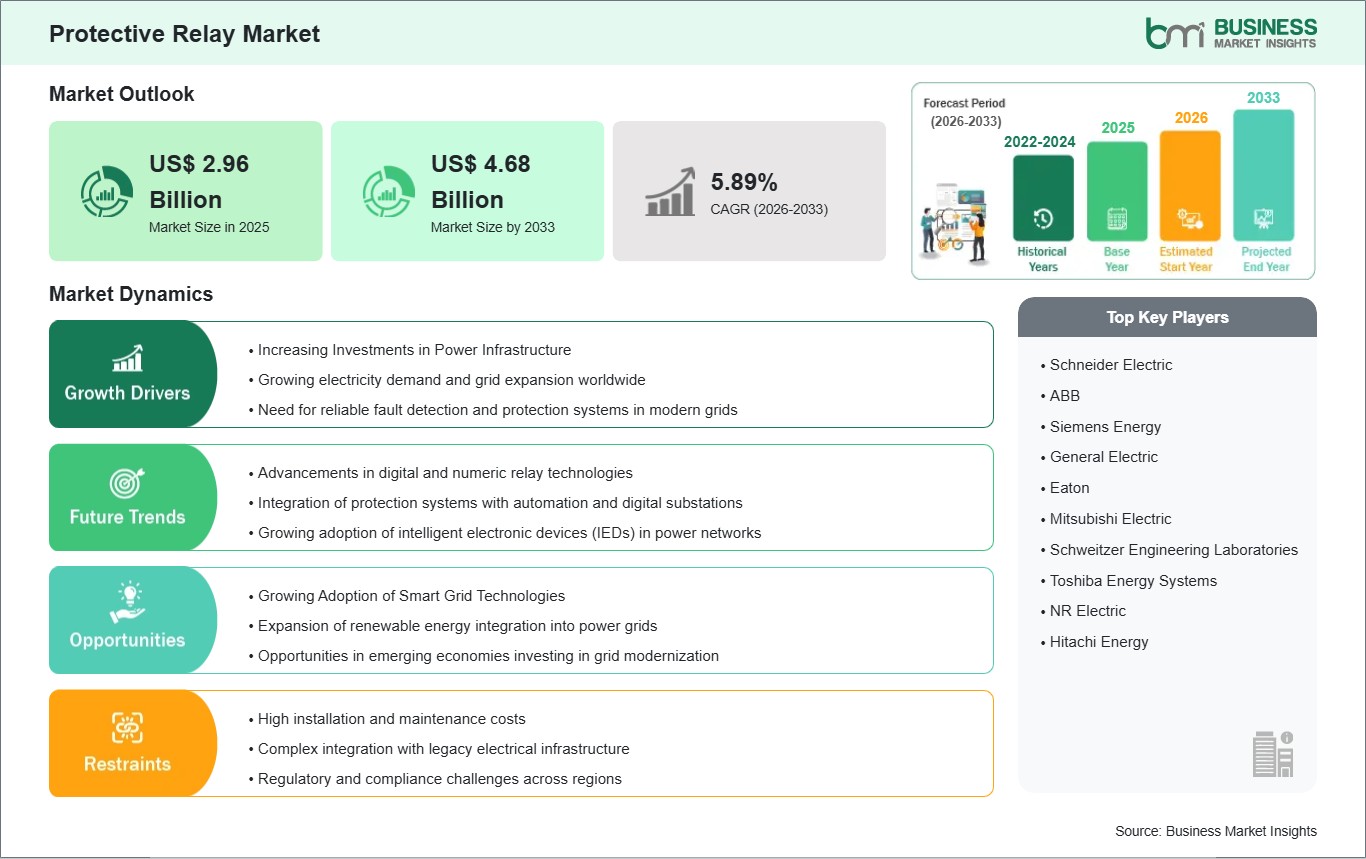
The global protective relay market is expanding steadily as power utilities and industrial operators increasingly focus on improving grid reliability, operational safety, and fault management. Protective relays are essential components of electrical power systems that detect abnormal operating conditions—such as short circuits, overloads, or voltage fluctuations—and initiate corrective actions by isolating faulty sections of the network. These devices play a critical role in protecting electrical equipment and maintaining the stability of power distribution networks.
The modernization of power infrastructure and the growing complexity of electrical grids are driving the demand for advanced protective relay systems. As electricity networks integrate renewable energy sources, distributed generation, and smart grid technologies, the need for reliable protection mechanisms becomes increasingly important. Modern digital and numeric relays provide faster fault detection, enhanced monitoring capabilities, and improved communication with grid control systems.
Additionally, industrial sectors such as manufacturing, oil and gas, mining, and transportation are investing in modern power protection solutions to safeguard critical infrastructure. As power demand continues to grow globally and power systems become more interconnected, protective relays will remain fundamental to ensuring safe and reliable electricity distribution.
Segment Analysis
Protective Relay Market Segmentation
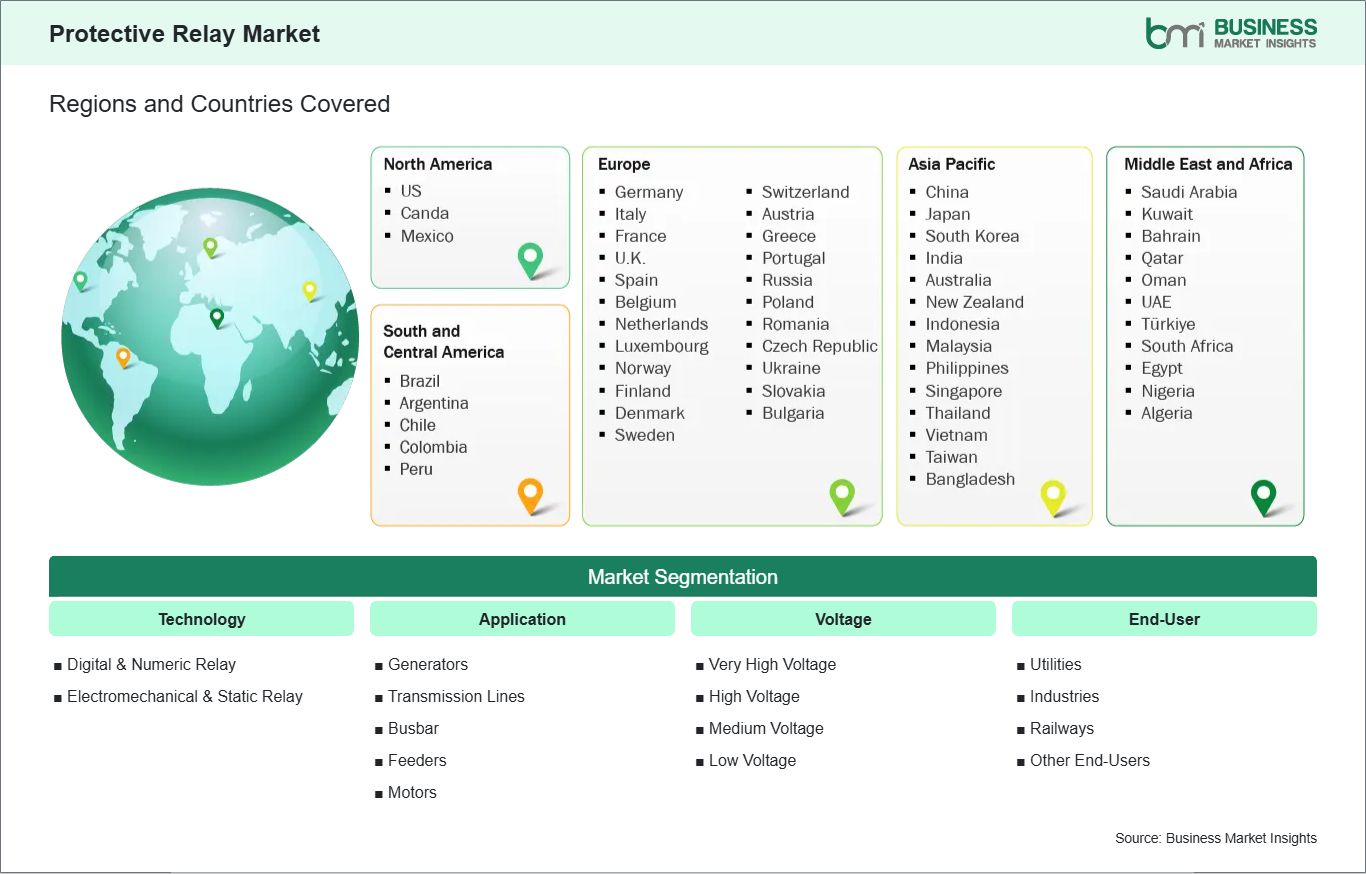
Key segments that contributed to the derivation of the protective relay market analysis are technology, application, voltage, and end-user.
- By technology, the protective relay market is segmented into digital & numeric relay and electromechanical & static relay. The digital & numeric relay segment dominated the market in 2025.
- By application, the protective relay market is segmented into generators, transmission lines, busbar, feeders, and motors. The transmission lines segment dominated the market in 2025.
- By voltage, the protective relay market is segmented into very high voltage, high voltage, medium voltage, and low voltage. The high voltage segment dominated the market in 2025.
- By end-user, the protective relay market is segmented into utilities, industries, railways, and other end-users. The utilities segment dominated the market in 2025.
Market Forces
Protective Relay Market Drivers and Opportunities
Increasing Investments in Power Infrastructure
Rising investments in electricity generation, transmission, and distribution infrastructure are driving the protective relay market. Utilities are upgrading aging grids to improve reliability, reduce outages, and meet growing demand. Protective relays help detect and isolate faults, maintaining grid stability and minimizing system disruptions.
Growing Adoption of Smart Grid Technologies
The shift toward smart grids is creating opportunities for protective relays. Digital relays integrated with communication protocols enable remote monitoring, automated fault analysis, and SCADA integration, improving operational efficiency and supporting industrial facilities with uninterrupted production processes.
Technological Advancements in Protective Relay Systems
Advanced digital and numeric relays provide faster fault detection, improved monitoring, and better communication with grid control systems. Innovations such as AI-assisted diagnostics, predictive maintenance, and automated protection schemes are enhancing the efficiency and reliability of power networks.
Size and Share Analysis
Protective Relay Market Size and Share Analysis
The Protective Relay Market demonstrates steady growth, with size and share analysis highlighting evolving trends and competitive dynamics among key players. The report examines subsegments categorized within technology, application, voltage, and end-user, offering insights into their contribution to overall market performance.
By technology, the digital & numeric relay segment dominated the market in 2025, driven by the growing transition from traditional electromechanical systems to advanced digital protection technologies.
Based on application, the transmission lines segment dominated the market in 2025, driven by the increasing deployment of protection systems in high-capacity transmission networks.
In terms of voltage, the high voltage segment dominated the market in 2025, driven by large-scale transmission infrastructure projects and grid expansion initiatives.
By end-user, the utilities segment dominated the market in 2025, as electricity providers continue to upgrade grid protection systems to ensure reliable power distribution.
Report Coverage
Protective Relay Market Report Coverage and Deliverables
The "Protective Relay Market Size and Forecast (2022 - 2033)" report provides a detailed analysis of the market covering below areas:
- Protective Relay Market size and forecast at global, regional, and country levels for all the key market segments covered under the scope
- Protective Relay Market trends, as well as drivers, restraints, and opportunities
- Protective Relay Market analysis covering key trends, global and regional framework, major players, regulations, and recent developments
- Industry landscape and competition analysis covering market concentration, heat map analysis, prominent players, and recent developments for the Protective Relay Market
- Detailed company profiles, including SWOT analysis
Geographic Insights
Protective Relay Market Geographic Insights
The geographical scope of the Protective Relay Market report is divided into North America, Asia Pacific, Europe, Middle East & Africa, and South & Central America. North America held the largest share in 2025.
North America represents a mature market supported by the modernization of aging power infrastructure and increasing adoption of smart grid technologies. Utilities in the United States and Canada are upgrading protection systems to improve grid resilience and reliability.
Asia Pacific is important market due to large-scale investments in electricity infrastructure and rapid industrialization in countries such as China, India, and Japan. The region’s expanding power generation capacity and ongoing grid modernization projects are driving strong demand for advanced protection systems.
Europe is another key market where governments are investing in renewable energy integration and advanced grid technologies. The expansion of renewable energy capacity across European countries is increasing the need for modern protective relay systems capable of managing complex power flows.
Emerging markets in Latin America and the Middle East & Africa are also witnessing growing demand for protective relays as power generation capacity expands and industrial sectors develop.
Industry Activity
Recent Developments
The Protective Relay Market is evaluated by gathering qualitative and quantitative data post primary and secondary research, which includes important corporate publications, association data, and databases. A few of the key developments in the protective relay market are:
- In September 2025, Schneider Electric showcased innovative new products developed with electrical contractors in mind, reinforcing its leadership in digital energy management and automation. The focus was on solutions aligned with evolving NEC code requirements and smart grid modernization.
- In February 2025, Schneider Electric unveiled advanced energy management and automation technologies, including gas‑free switchgear, smart automation, EV solutions, and AI‑driven services, supporting India’s sustainability and industrial self‑reliance goals.
Trust & Transparency
Research Methodology
The market analysis combines proprietary research with secondary data from government agencies, company disclosures, regulatory filings, industry databases and expert interviews. Market estimates are validated through data triangulation, cross-market benchmarking and analyst
review.
View Full Research Methodology
Key Sources Referred:
International Energy Agency (IEA)International Electrotechnical Commission (IEC)World Bank GroupU.S. Energy Information Administration (EIA)Organisation for Economic Cooperation and Development (OECD)International Renewable Energy Agency (IRENA)