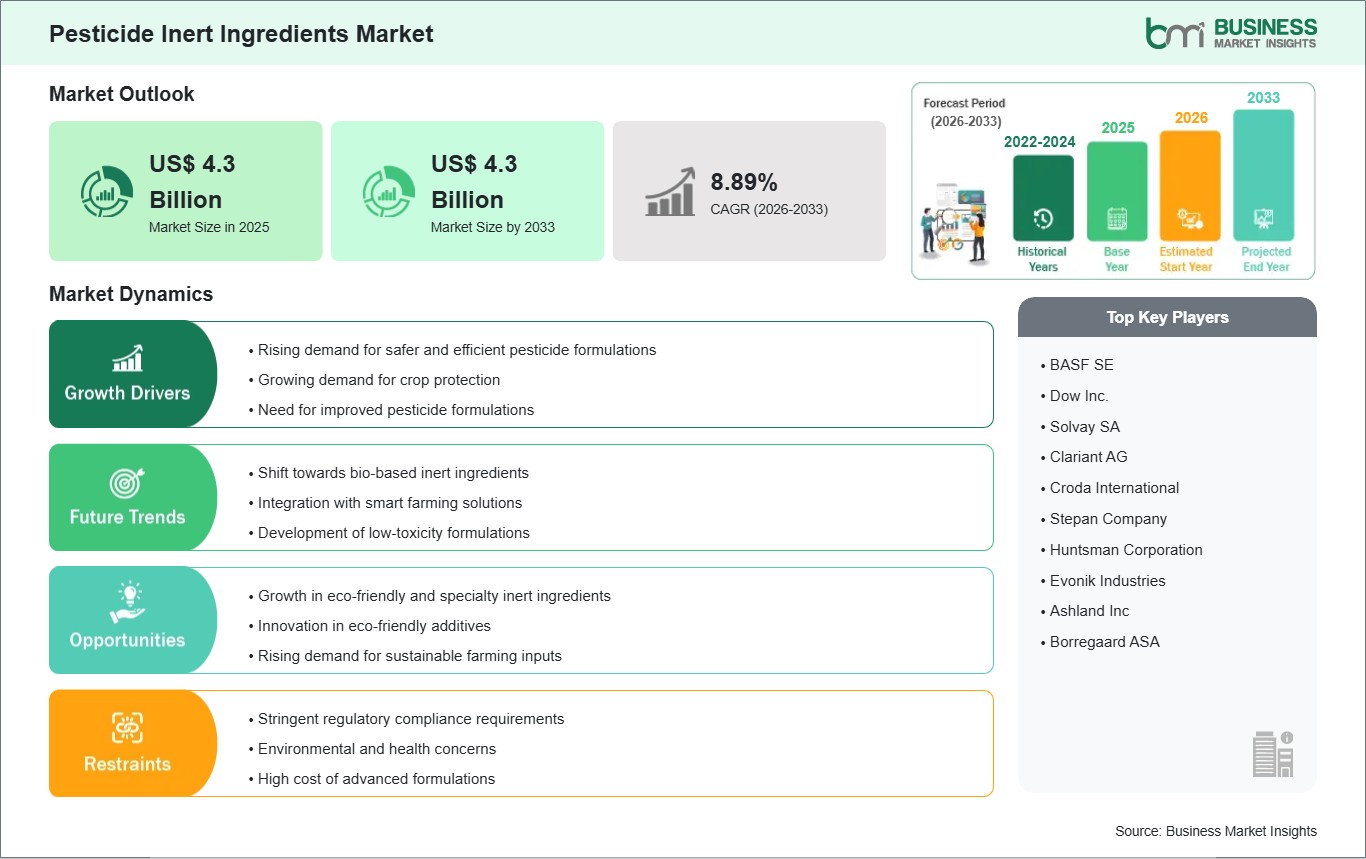
The Pesticide Inert Ingredients Market size is expected to reach US$ 8.5 billion by 2033 from US$ 4.3 billion in 2025. The market is estimated to record a CAGR of 8.89% from 2026 to 2033.
The market for pesticide inert ingredients is growing rapidly. This is due to the increasing need for better agricultural productivity and the safe use of pesticides. Inert ingredients are solvents, surfactants, adjuvants, and carriers that play a vital role in improving the effectiveness of pesticides. Even though inert ingredients do not have any pesticide properties, their importance in improving the effectiveness of pesticides is now being recognized. One of the trends in the inert ingredients market is the increasing trend towards using environmentally safe and bio-based inert ingredients.
Due to health and environmental hazards, strict regulations have been put in place for using some chemical-based carriers and surfactants. This has prompted manufacturers to innovate in low-toxicity, biodegradable, and non-volatile solvent systems that comply with evolving regulatory frameworks while maintaining formulation performance. Technological advancements in formulation science are enabling multifunctional inert ingredients that improve spreading, adhesion, and rainfastness, enhancing overall pesticide efficiency. Simultaneously, precision agriculture and smart application technologies are influencing the selection of inert ingredients compatible with advanced delivery systems, such as foliar sprays, seed treatments, and controlled-release formulations.
The competitive landscape is moderately consolidated, with leading agrochemical and chemical companies investing in R&D to develop proprietary inert technologies and strategic partnerships with pesticide formulators. Supply chain optimization, product standardization, and cost-efficiency are key factors shaping adoption, particularly in high-volume agricultural regions. Overall, the pesticide inert ingredients market is defined by the intersection of regulatory compliance, sustainable innovation, and demand for high-performance crop protection. Manufacturers that can deliver safe, multifunctional, and application-optimized inert ingredients are well-positioned to capture opportunities in both developed and emerging agricultural markets.

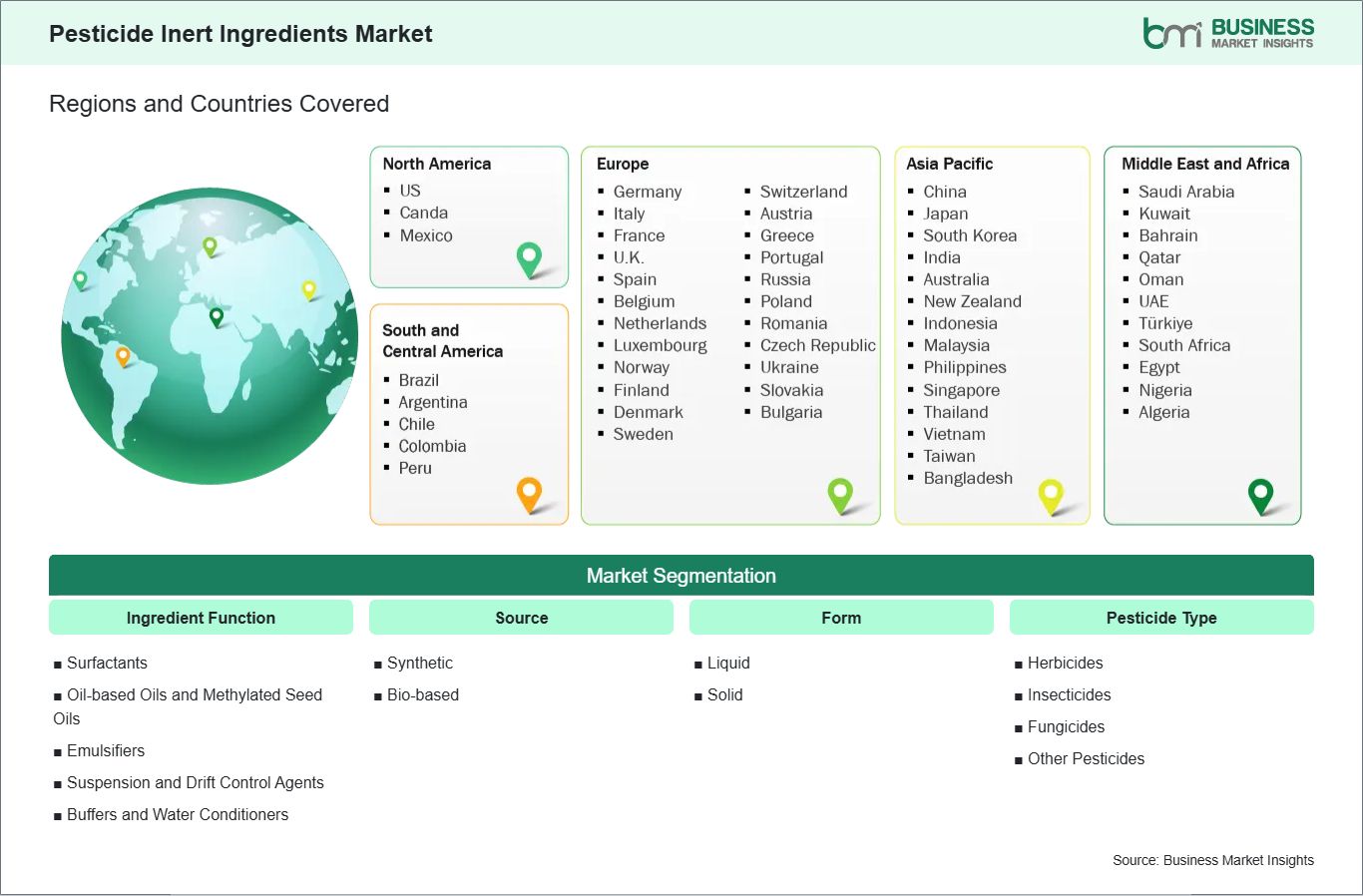
Key segments that contributed to the derivation of the pesticide inert ingredients market analysis are ingredient function, source, form, pesticide type, and crop type.
The need for pesticide inert ingredients is rising as companies work to make pesticides safer, more stable, and more effective. Inert ingredients do not have active properties but make active ingredients in pesticides more efficient by improving their ability to disperse, stick to surfaces, and be released in a controlled manner. With growing agricultural productivity and pest control demands, companies are looking for inert ingredients that maximize pesticide efficiency while minimizing their impact on the environment and public health.
Advances in formulation techniques are driving the discovery of inert ingredients that can increase solubility, compatibility, and usage efficiency. This ensures that active ingredients in pesticides work more consistently to control pests. Inert ingredients can also reduce the amount of chemicals needed for pest control, which can minimize exposure to the environment and production costs while remaining within regulatory guidelines.
In addition, they are also looking at multi-functional inert ingredients that will give extra benefits such as reduced drift, improved wetting, and longer shelf life. These developments will help to meet the increasing demand for quality and dependable pesticides for conventional and specialty crops. With the advancement in global agricultural practices to meet food security and sustainability needs, the importance of inert ingredients in pesticide formulations will continue to grow.
Sustainability has become a key driver for innovation in the pesticide inert ingredients industry. Companies are developing environmentally friendly inert ingredients that are obtained from renewable resources and are safe for humans, useful organisms, and the environment. Sustainable inert ingredients have been developed to ensure that pesticides have enhanced performance while minimizing their potential harmful impacts. This is in line with new regulations that have become more rigorous and consumer demands for environmentally safe products.
The trend in the pesticide inert ingredients industry is also the growing popularity of specialty inert ingredients. This is due to the need for formulators to address pest control challenges. Inert ingredients that enhance the delivery and stability of pesticides under different climatic conditions have become essential. Such advanced inert ingredients enable precise control of pests while ensuring that there is no wastage and exposure to the environment.
Currently, research and development activities are aimed at ensuring the balance between performance and environmental safety. Advances in processing and material sciences have allowed the development of inert ingredients with predictable performance across various formulations, while also ensuring sustainability. As the agricultural and horticultural industries increasingly adopt advanced crop protection products, the growth prospects for eco-friendly and specialty inert ingredients are expected to increase.
The pesticide inert ingredients market demonstrates steady growth, with size and share analysis highlighting evolving trends and competitive dynamics among key players. The report examines subsegments categorized within ingredient function, source, form, pesticide type, and crop type, offering insights into their contribution to overall market performance.
By Ingredient Function, the surfactants subsegment dominated the market in 2025, driven by its role in enhancing wetting, penetration, and drift control for modern formulations.
Based on Source, the synthetic subsegment dominated the market in 2025, supported by its cost advantages and large‑scale production.
On the Basis of Form, the liquid subsegment dominated the market in 2025, owing to its ease of integration with high‑pressure boom equipment and UAV (drone) applications.
In Terms of Pesticide Type, the herbicides subsegment dominated the market in 2025, driven by widespread adoption across field crops.
By Crop Type, the cereals & grains subsegment dominated the market in 2025, propelled by extensive acreage and consistent pesticide applications in staple crop production.
| Report Attribute | Details |
|---|---|
| Market size in 2025 | US$ 4.3 Billion |
| Market Size by 2033 | US$ 4.3 Billion |
| Global CAGR (2026 - 2033) | 8.89% |
| Historical Data | 2022-2024 |
| Forecast period | 2026-2033 |
| Segments Covered | By Ingredient Function
|
|
Regions and Countries Covered
| |
| North America | US, Canada, Mexico |
| Europe | Belgium, Austria, Finland, Denmark, Greece, Poland, Romania, Russia, Ukraine, Czech Republic, Slovakia, Bulgaria, Italy, Luxembourg, Germany, Switzerland, France, Netherlands, Norway, Portugal, Spain, Sweden, United Kingdom |
| Asia-Pacific | Australia, China, India, Japan, South Korea, Indonesia, Malaysia, Philippines, Singapore, Thailand, Vietnam, Bangladesh, New Zealand, Taiwan |
| South and Central America | Brazil, Argentina, Peru, Chile, Colombia |
| Middle East and Africa | Bahrain, Kuwait, Oman, Qatar, Saudi Arabia, United Arab Emirates, Turkiye, South Africa, Egypt, Algeria, Nigeria |
| Market leaders and key company profiles |
|
The "Pesticide Inert Ingredients Market Size and Forecast (2022 - 2033)" report provides a detailed analysis of the market covering below areas:
The geographical scope of the Pesticide Inert Ingredients Market report is divided into North America, Asia Pacific, Europe, Middle East & Africa, and South & Central America. North America held the largest share in 2025. Regional-level dynamics in the pesticide inert ingredients market reveal distinct demand patterns shaped by agricultural intensity, regulatory environments, and formulation practices.
North America dominates the market, led by the United States and Canada, where large-scale, technologically advanced agriculture drives demand for high-performance and compliant inert ingredients. Regulatory oversight by agencies such as the EPA ensures safety and environmental compliance, encouraging the adoption of bio-based and low-toxicity carriers, surfactants, and solvents. Precision agriculture practices and high-value crop cultivation further reinforce the use of multifunctional inert ingredients.
Europe is a mature and sustainability-focused market, with Germany, France, and Italy emphasizing eco-friendly and regulatory-compliant formulations. EU regulations restrict harmful chemical inerts, accelerating the shift toward biodegradable and non-volatile alternatives. The demand is high for inert ingredients that enhance pesticide efficacy while aligning with strict environmental standards.
Asia Pacific is witnessing rapid growth, driven by India, China, and Japan, due to expanding agricultural acreage, rising food demand, and modernization of crop protection practices. Regulatory awareness and adoption of integrated pest management systems are fostering the use of safe and efficient inert ingredients. Local manufacturers are increasing production capacities to meet high-volume demand while balancing cost-effectiveness.
Middle East & Africa is an emerging market where arid climates and intensive irrigation practices increase the need for inert ingredients that enhance pesticide adhesion, spreading, and rainfastness. Market growth is supported by investments in modern agriculture and government initiatives to boost crop yields. South & Central America shows steady growth, particularly in Brazil and Argentina, driven by large-scale commercial farming and export-oriented agriculture. Cost-sensitive adoption is common, but rising demand for more effective and safe formulations is gradually increasing the use of advanced inert ingredients to improve pesticide performance and sustainability.

The Pesticide Inert Ingredients Market is evaluated by gathering qualitative and quantitative data post primary and secondary research, which includes important corporate publications, association data, and databases. A few of the key developments in the pesticide inert ingredients market are:
The Pesticide Inert Ingredients Market is valued at US$ 4.3 Billion in 2025, it is projected to reach US$ 4.3 Billion by 2033.
As per our report Pesticide Inert Ingredients Market, the market size is valued at US$ 4.3 Billion in 2025, projecting it to reach US$ 4.3 Billion by 2033. This translates to a CAGR of approximately 8.89% during the forecast period.
The Pesticide Inert Ingredients Market report typically cover these key segments-
The historic period, base year, and forecast period can vary slightly depending on the specific market research report. However, for the Pesticide Inert Ingredients Market report:
The Pesticide Inert Ingredients Market is populated by several key players, each contributing to its growth and innovation. Some of the major players include:
The Pesticide Inert Ingredients Market report is valuable for diverse stakeholders, including:
Essentially, anyone involved in or considering involvement in the Pesticide Inert Ingredients Market value chain can benefit from the information contained in a comprehensive market report.
Please tell us your area of interest
(Market Segments/ Regions and Countries/ Companies)