Market Summary
Executive Summary and Global Market Analysis
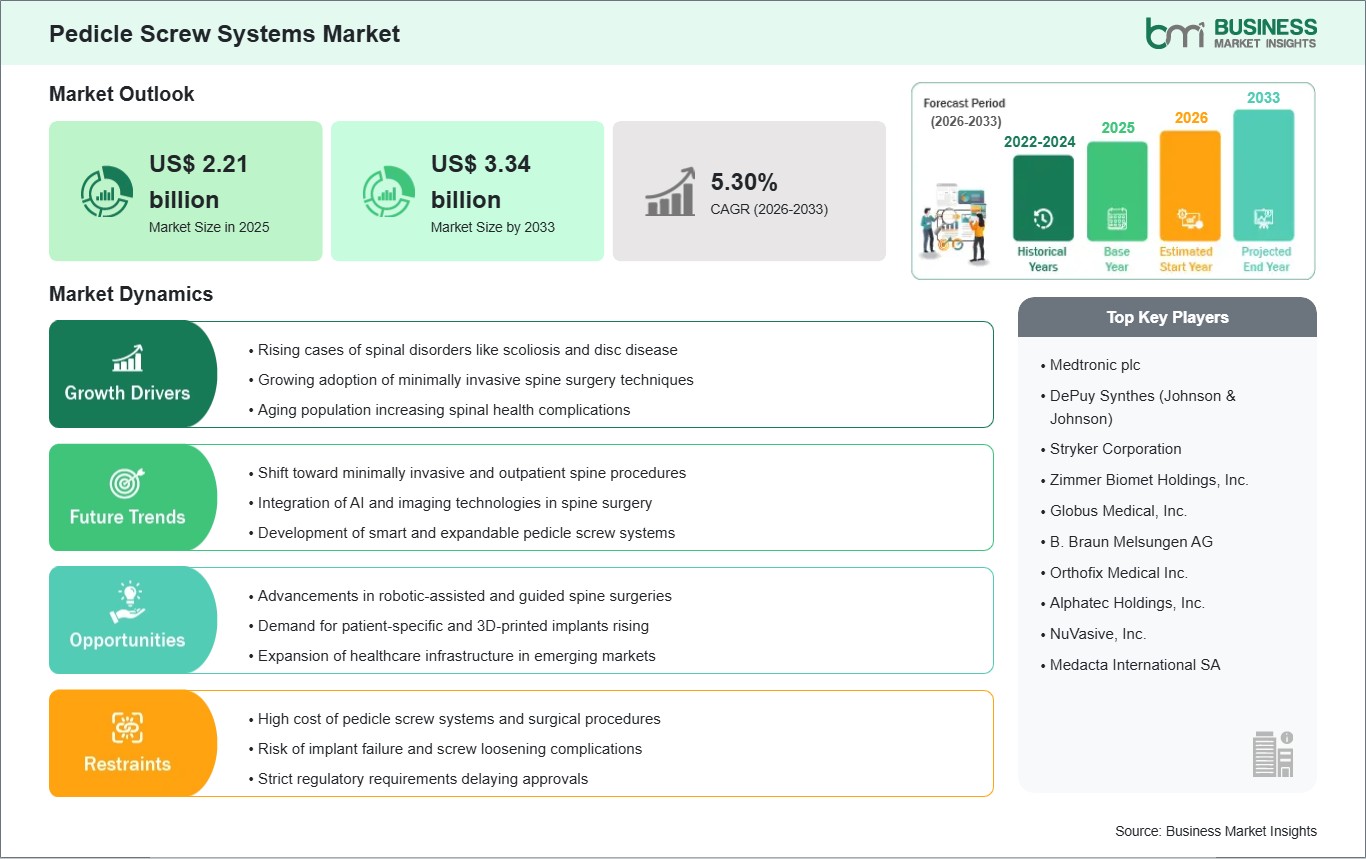
Pedicle screw systems are specialized orthopedic devices designed to provide permanent or temporary stabilization and immobilization of spinal segments. These systems function by anchoring screws into the pedicles, the strong, cylindrical bridges of bone that connect the front and back of each vertebra, to serve as secure attachment points for connecting rods. Market expansion is primarily driven by the global aging population, as older individuals exhibit a higher prevalence of spinal instability and fragility fractures. Furthermore, the shift toward minimally invasive surgery (MIS), supported by the development of percutaneous screw delivery systems, is improving recovery outcomes by reducing soft-tissue disruption and post-operative pain.
However, several factors can restrain market growth. The high cost of advanced instrumentation and the capital investment required for navigation and robotic-assisted platforms can be prohibitive for healthcare facilities in developing regions. Stringent regulatory approval cycles for next-generation materials and patient-specific implants often delay the introduction of innovative technologies. Additionally, the industry faces constraints due to potential complications, such as hardware failure or screw loosening, which can necessitate revision surgeries and increase the overall cost of care.
Despite these hurdles, the market holds significant opportunities in the integration of artificial intelligence for pre-operative planning and intraoperative screw trajectory guidance. The rise of 3D-printed, patient-specific guides and the expansion of bioabsorbable materials, which may reduce the need for permanent hardware, are expected to support long-term development within the sector.
Segment Analysis
Pedicle Screw Systems Market Segmentation
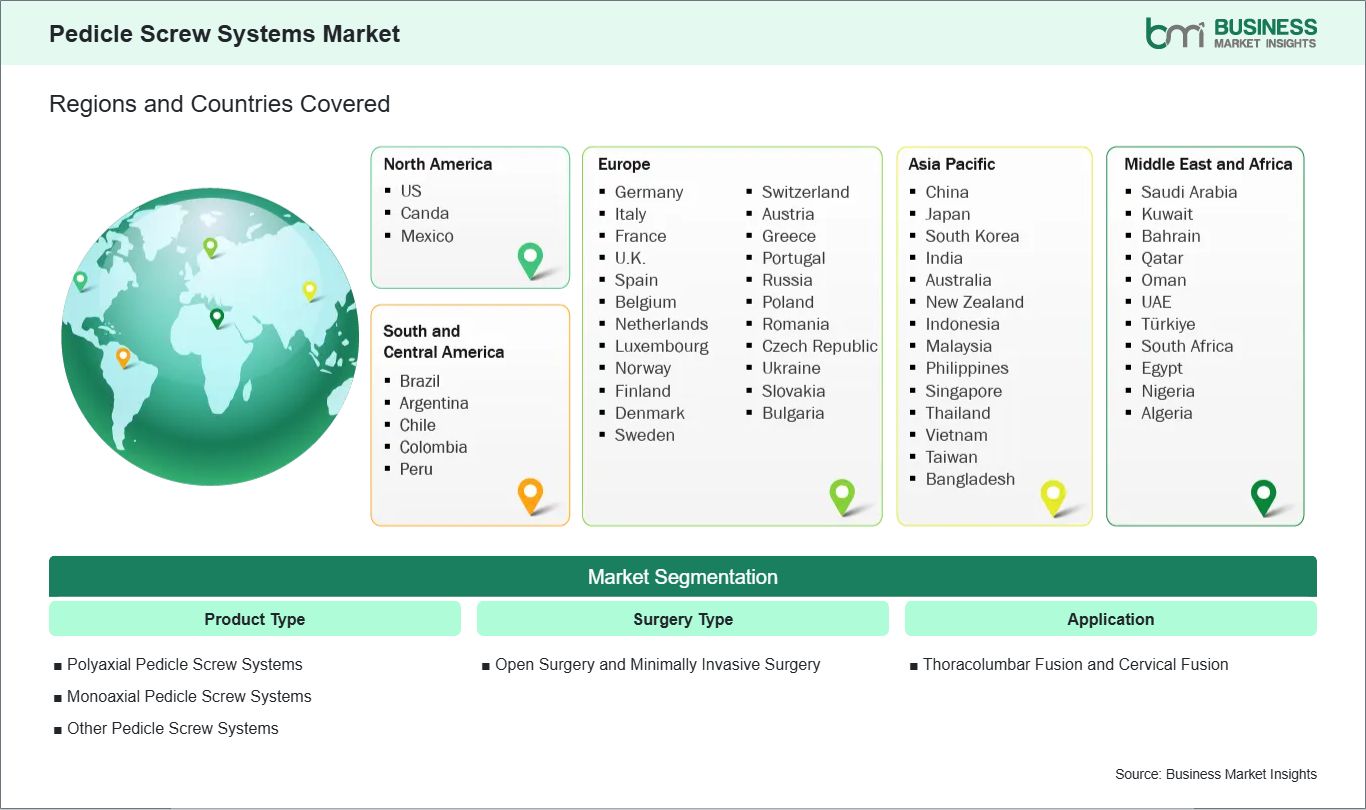
Key segments that contributed to the derivation of the Pedicle Screw Systems market analysis are product type, surgery type, indication, and application.
- By Product Type, the market is segmented into Polyaxial Pedicle Screw Systems, Monoaxial Pedicle Screw Systems, and Other Pedicle Screw Systems.
- By Surgery Type, the market is divided into Open Surgery and Minimally Invasive Surgery.
- By Indication, the market is categorized into Spinal Degeneration, Spinal Trauma, Spinal Deformities, and Other Indications.
- By Application, the market is segmented into Thoracolumbar Fusion and Cervical Fusion.
Market Forces
Pedicle Screw Systems Market Drivers and Opportunities
Geriatric Spinal Fragility and Minimally Invasive Surgery
The primary driver for the Pedicle Screw Systems Market is the systemic global increase in degenerative spinal disorders necessitated by an aging population. The Rising Prevalence of Degenerative Disc Disease, Spinal Stenosis, and Spondylolisthesis acts as a foundational catalyst, as these conditions, along with osteoporosis-related vertebral fractures, create a sustained demand for rigid internal fixation. This momentum is further propelled by the Global Shift Toward Minimally Invasive Spine Surgery (MISS); both patients and healthcare payers are prioritizing techniques that involve smaller incisions and faster recovery times, driving the adoption of specialized percutaneous pedicle screw kits. In the technology sphere, the Rapid Adoption of Robotic-Assisted and Navigation-Integrated Systems serves as a critical driver, as these platforms significantly enhance screw placement accuracy and reduce intraoperative radiation exposure for the surgical team. Furthermore, the Expansion of Specialized Spine Centers and Ambulatory Surgical Centers (ASCs) is decentralizing procedural access, allowing for high-volume, cost-effective stabilization outside of traditional tertiary hospitals. Together, these factors, demographic aging, the MISS mandate, and robotic precision, ensure a resilient and technologically advancing growth path for the global Pedicle Screw Systems Market.
3D-Printed Patient-Specific Implants and Bioresorbable Fixation
A significant high-value opportunity lies in the convergence of Pedicle Screw Systems with Additive Manufacturing (3D Printing). Next-generation patient-specific implants are being developed to match a patient's unique vertebral anatomy, improving the bone-to-implant interface and potentially accelerating osseointegration through porous titanium surfaces. There is also a major growth frontier in the development of Bioresorbable and Biomimetic Screw Materials; by creating implants that provide temporary stabilization before gradually being replaced by natural bone, manufacturers could eliminate the complications associated with long-term stress shielding and secondary hardware removal. Furthermore, the expansion of Augmented Reality (AR) Overlay Systems presents a lucrative opportunity, as AR headsets allow surgeons to see a holographic 3D model of the patient`s spine superimposed directly onto the operative field, eliminating the line-of-sight issues common with traditional monitors. Beyond the implant itself, the rise of AI-Driven Predictive Analytics for Surgical Planning offers a unique frontier, where software can simulate various screw trajectories and rod contours to determine the optimal biomechanical construct for an individual`s deformity. Manufacturers who focus on Low-Profile Ultra-Small Pedicle Screws for Pediatric Deformities and those pioneering Wireless Smart Screws with Embedded Strain Sensors are positioned to lead the most innovative and high-margin segments of the global Pedicle Screw Systems Market.
Size and Share Analysis
Pedicle Screw Systems Market Size and Share Analysis
The Pedicle Screw Systems market demonstrates steady growth, with size and share analysis revealing evolving trends and competitive positioning among key players. The report examines subsegments categorized within are product type, surgery type, indication, and application, offering insights into their contribution to overall market performance.
Based on the product type, the Polyaxial Pedicle Screw Systems subsegment holds the primary market presence, acting as the versatile anchor for modern spinal fusion. These systems are indispensable for the market, maintaining the largest market share as their multi-directional ball-and-socket design allows for significant angulation, making them the preferred choice for complex multi-level constructs where rod alignment is a critical challenge. While Monoaxial Pedicle Screw Systems and other specialized variations provide essential rigid fixation in specific trauma cases, they hold a secondary position compared to the high-utilization polyaxial platforms. A notable trend is the surge in Expandable and Augmented Pedicle Screw subsegments, which are registering the highest pace of adoption. These systems are becoming essential for Fragile Bone Management, providing superior pull-out strength in elderly patients with reduced bone density, thereby holding a critical presence in the evolving geriatric spine care vertical.
Report Coverage
Pedicle Screw Systems Market Report Coverage and Deliverables
The "Pedicle Screw Systems Market Size and Forecast (2022–2033)" report provides a detailed analysis of the market covering below areas:
- Pedicle Screw Systems market size and forecast at global, regional, and country levels for all market segments covered under the scope
- Pedicle Screw Systems market trends, as well as drivers, restraints, and opportunities
- Pedicle Screw Systems market analysis covering key trends, global and regional framework, major players, regulations, and recent developments
- Industry landscape and competition analysis covering market concentration, heat map analysis, prominent players, and recent developments for the Pedicle Screw Systems market
- Detailed company profiles, including SWOT analysis
Geographic Insights
Pedicle Screw Systems Market Geographic Insights
The geographical scope of the Pedicle Screw Systems market report is divided into five regions: North America, Asia Pacific, Europe, Middle East & Africa, and South & Central America.
North America maintains the primary market position, supported by a sophisticated healthcare infrastructure, high surgical volumes for spinal fusion, and the early clinical integration of robotic-assisted navigation systems. Europe represents a mature market segment where growth is sustained by a robust framework for orthopedic research and a strong institutional emphasis on high-precision instrumentation for deformity correction. Asia Pacific is identified as the most rapidly advancing region, propelled by accelerating healthcare modernization, an expanding geriatric population in China and Japan, and significant public investments in specialized trauma centers.
The Asia-Pacific Pedicle Screw Systems Market is segmented into China, Japan, South Korea, India, Australia, and the Rest of Asia Pacific. China serves as a central engine for regional growth, driven by a high prevalence of spinal trauma injuries and government initiatives to modernize regional hospital surgical suites. India is experiencing a notable surge in demand as private healthcare providers invest in advanced spinal fixation technologies to address the rising volume of degenerative disc disease and scoliosis cases. Japan and South Korea continue to lead in technological adoption, prioritizing the use of 3D-printed patient-specific guides and miniaturized instrumentation tailored for geriatric patients with osteoporotic bone conditions.
Industry Activity
Recent Developments
The Pedicle Screw Systems market is evaluated by gathering qualitative and quantitative data post primary and secondary research, which includes important corporate publications, association data, and databases. A few of the key developments in the Pedicle Screw Systems market are:
- In February 2024, Intelivation Technologies launched the Hammerdesis™ Interphalangeal Fusion System, a novel orthopedic implant designed to simplify toe joint fusion procedures. This innovative system represents a positive advancement in minimally invasive fusion technology, enhancing surgical efficiency and aligning well with growth trends in the broader pedicle screw and spinal/orthopedic fusion market.
- In June 2024, Curiteva launched its FDA-cleared Inspire® Posterior Interbody Fusion Solutions, featuring 3D-printed Trabecular PEEK with HAFUSE Technology to promote bone in-growth and enhance fusion outcomes. This innovative platform advances spinal surgery by offering superior biomechanical properties and supporting improved patient recovery. This launch represents a notable development in the spinal fusion and pedicle screw systems market, highlighting innovation in implant technology and improved patient outcomes.
Trust & Transparency
Research Methodology
The market analysis combines proprietary research with secondary data from government agencies, company disclosures, regulatory filings, industry databases and expert interviews. Market estimates are validated through data triangulation, cross-market benchmarking and analyst
review.
View Full Research Methodology
Key Sources Referred:
World Bank – Global Trade IndicatorsWorld Trade Organization (WTO)(International Monetary Fund )IMFInternational Trade Administration (ITA)Company websiteCompany annual reportsCompany investor presentations