Market Summary
Executive Summary and Global Market Analysis
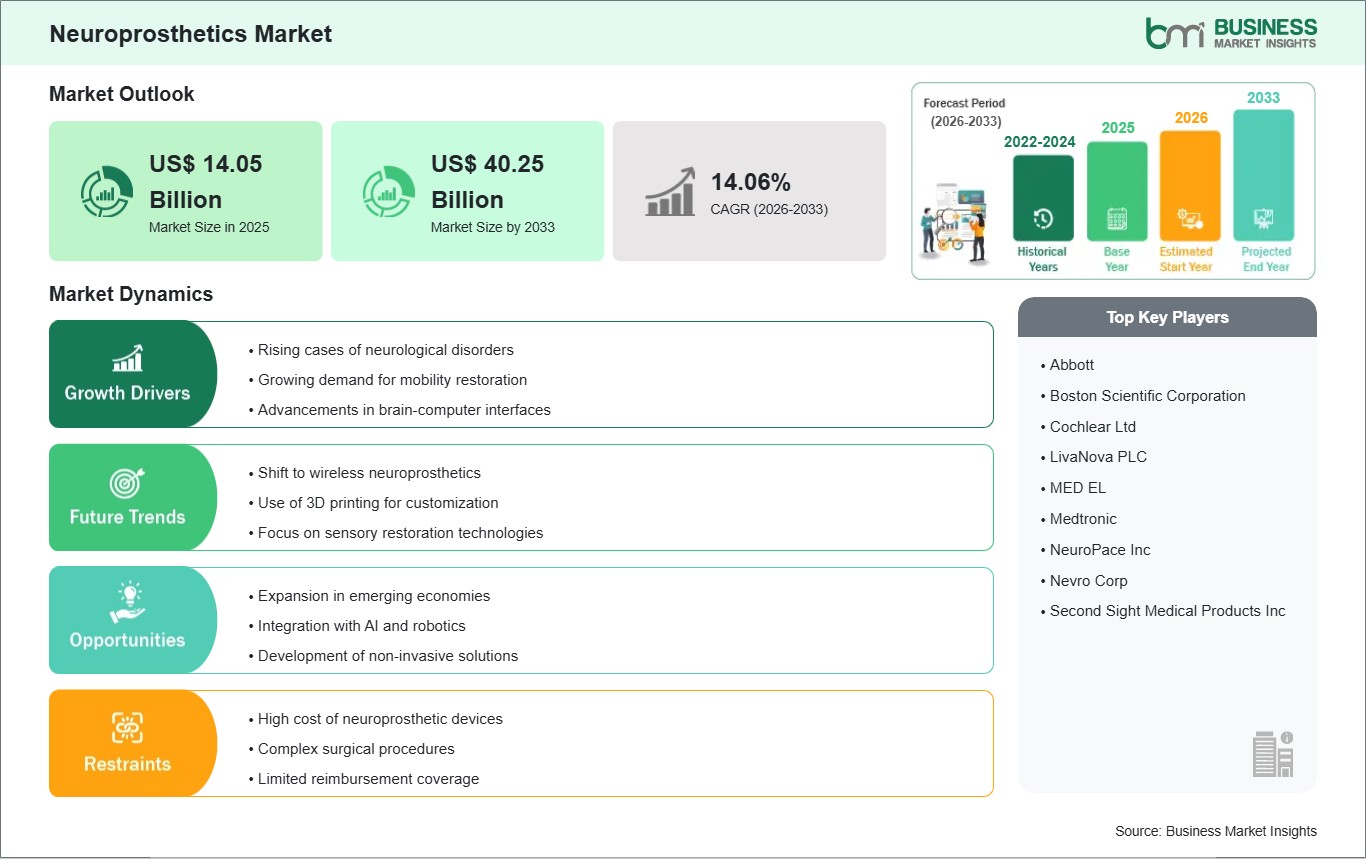
Neuroprosthetics is a transformative intersection of neuroscience, biomedical engineering, and advanced computing, aimed at restoring or enhancing lost neural functions. These devices, ranging from cochlear implants for auditory restoration to deep-brain stimulators (DBS) for movement disorders, are increasingly deployed to address conditions such as Parkinson's disease, epilepsy, chronic pain, and sensory impairments. Emerging technologies like brain-computer interfaces (BCIs) and adaptive closed-loop systems are redefining therapeutic possibilities by enabling real-time feedback and personalized stimulation.
However, the market faces significant challenges. High development and implementation costs, coupled with stringent regulatory requirements, create barriers for widespread adoption. Ethical concerns surrounding invasive neural devices and data privacy further complicate commercialization. Additionally, the technical complexity of integrating hardware, software, and biological systems demands specialized expertise, limiting participation to a few advanced players.
Despite these hurdles, the outlook remains highly promising. Opportunities abound in AI-driven neuroprosthetics, which enable predictive analytics and adaptive control, improving patient outcomes and reducing adverse effects. Expanding indications for neuromodulation, beyond traditional motor and sensory disorders into psychiatric and cognitive rehabilitation, open new revenue streams. Furthermore, rising healthcare investments in emerging economies and the miniaturization of implantable devices are accelerating global accessibility. Collectively, these factors position neuroprosthetics as a cornerstone of next-generation neurotherapeutics, with strong potential for sustained growth through 2033.
Segment Analysis
Neuroprosthetics Market Segmentation
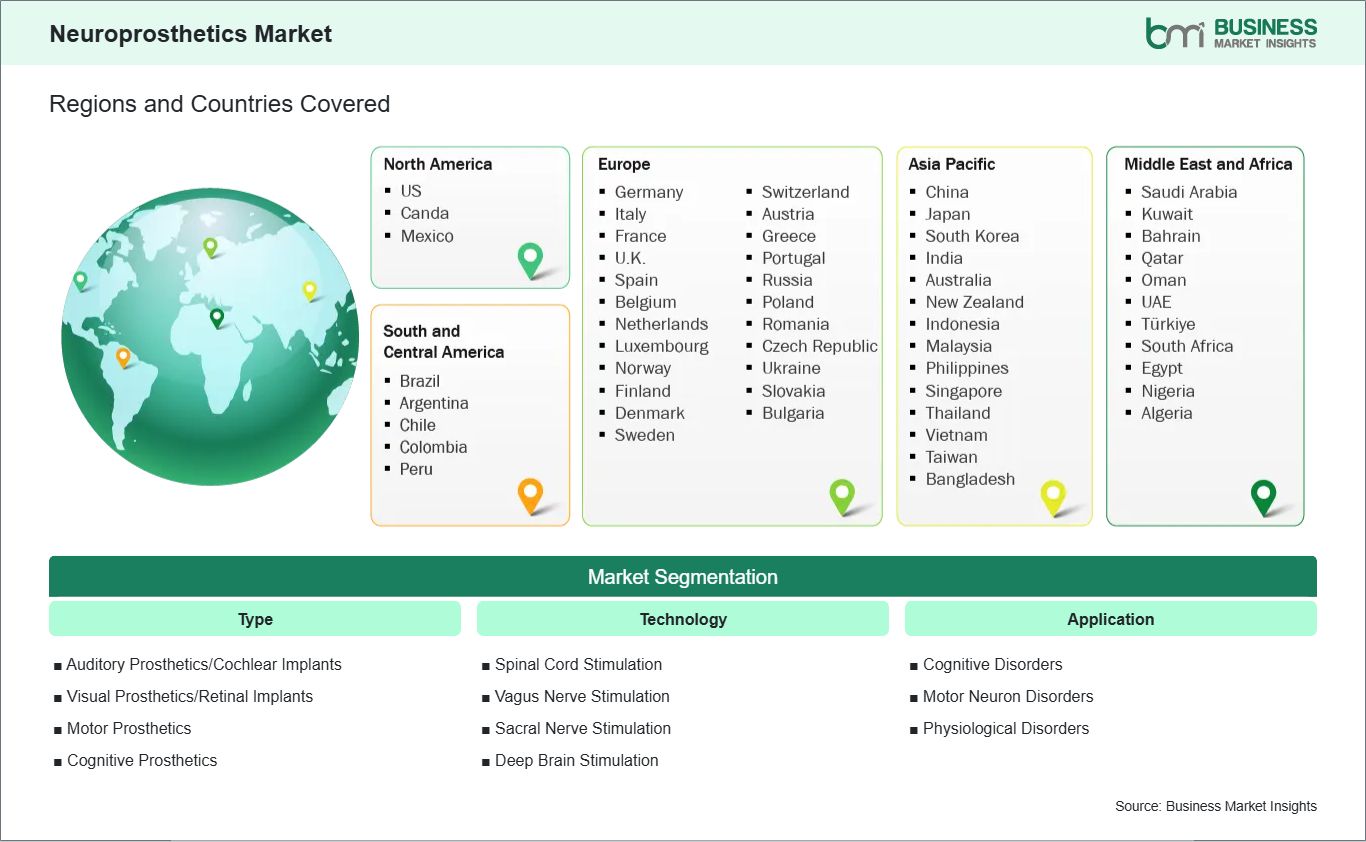
Key segments that contributed to the derivation of the Neuroprosthetics market analysis are type, technology, and application.
- By Type, the market is segmented into Auditory Prosthetics/Cochlear Implants, Visual Prosthetics/Retinal Implants, Motor Prosthetics, and Cognitive Prosthetics.
- By Technology, the market is segmented into Spinal Cord Stimulation, Vagus Nerve Stimulation, Sacral Nerve Stimulation, and Deep Brain Stimulation.
- By Application, the market is segmented into Cognitive Disorders, Motor Neuron Disorders, and Physiological Disorders.
Market Forces
Neuroprosthetics Market Drivers and Opportunities
Expansion of Closed-Loop Adaptive Neuroprosthetics
One of the most significant growth drivers for the neuroprosthetics market is the rapid adoption of closed-loop and adaptive neuromodulation systems. Unlike traditional open-loop stimulators, these advanced platforms continuously monitor neural signals and automatically adjust stimulation parameters in real time. This capability dramatically improves therapeutic precision, reduces side effects such as overstimulation, and enhances overall patient comfort.
Clinical evidence and early commercial success, such as Medtronic's FDA-approved adaptive DBS systems, underscore the strong demand for personalized neuromodulation solutions. According to industry estimates, the growth of the market is fueled by healthcare providers' preference for technologies that deliver measurable improvements in patient outcomes while reducing long-term treatment costs. The convergence of sensor technology, algorithmic intelligence, and miniaturized hardware is accelerating clinician confidence and patient adoption, making closed-loop systems a cornerstone of next-generation neuroprosthetics.
Emergence of AI-Enabled Brain-Computer Interfaces
Artificial intelligence integration within brain-computer interfaces (BCIs) represents a transformative opportunity for market players. Traditional neuroprosthetic systems rely on pre-programmed stimulation protocols. AI-driven BCIs introduce adaptive learning capabilities, enabling devices to interpret complex neural patterns and optimize therapy dynamically. This evolution opens doors to advanced applications beyond motor and sensory restoration, including cognitive rehabilitation and psychiatric disorder management.
AI enhances device adaptability, predictive analytics, and automation, reducing clinician workload and improving patient engagement. Furthermore, as machine learning algorithms become more sophisticated, BCIs can deliver highly personalized interventions, creating a competitive advantage for manufacturers investing in AI-centric platforms. Strategic partnerships between neurotechnology firms and AI developers are already emerging, signaling a clear trajectory toward intelligent neuroprosthetics that redefine therapeutic standards and unlock new revenue streams in high-growth clinical segments.
Size and Share Analysis
Neuroprosthetics Market Size and Share Analysis
The Neuroprosthetics market demonstrates steady growth, with size and share analysis revealing evolving trends and competitive positioning among key players. The report further examines subsegments categorized within type, technology, and application, offering insights into their contribution to overall market performance.
For instance, within the type segmentation, Auditory Prosthetics/Cochlear Implants remain a critical growth pillar, driven by rising global prevalence of hearing loss and continuous innovation in implantable auditory devices. These systems have matured technologically, offering improved sound processing and wireless connectivity, which enhances patient adoption and clinical outcomes. In the Technology category, Deep Brain Stimulation (DBS) stands out as a dominant subsegment due to its proven efficacy in managing Parkinson's disease, essential tremor, and other movement disorders. From the Application perspective, Motor Neuron Disorders represent a significant share of contributors, fueled by increasing cases of Parkinson's disease, ALS, and stroke-related motor impairments. Neuroprosthetic interventions in this area are gaining traction as they offer functional restoration and improved quality of life, positioning this application as a key driver of overall market performance.
Report Coverage
Neuroprosthetics Market Report Coverage and Deliverables
The Neuroprosthetics Market Size and Forecast (2022–2033) report provides a detailed analysis of the market covering below areas:
- Neuroprosthetics market size and forecast at global, regional, and country levels for all the key market segments covered under the scope
- Neuroprosthetics market trends, as well as market dynamics such as drivers, restraints, and key opportunities
- Neuroprosthetics market analysis covering key market trends, global and regional framework, major players, regulations, and recent market developments
- Industry landscape and competition analysis covering market concentration, heat map analysis, prominent players, and recent developments for the Neuroprosthetics market
- Detailed company profiles, including SWOT analysis
Geographic Insights
Neuroprosthetics Market Geographic Insights
The geographical scope of the Neuroprosthetics market report is divided into five regions: North America, Asia Pacific, Europe, the Middle East & Africa, and South & Central America.
North America continues to advance neuroprosthetic adoption through strong R&D investments and supportive regulatory frameworks, fostering rapid innovation. Europe emphasizes reimbursement programs and collaborative research initiatives, accelerating clinical integration of advanced devices. Asia Pacific is emerging as a high-growth region, driven by expanding healthcare infrastructure and rising neurological disorder prevalence. The Middle East & Africa shows gradual progress, focusing on improving access to neuromodulation therapies. Latin America is witnessing incremental adoption through public–private partnerships and modernization of healthcare systems.
Industry Activity
Recent Developments
The Neuroprosthetics market is evaluated by gathering qualitative and quantitative data post primary and secondary research, which includes important corporate publications, association data, and databases. A few of the key developments in the Neuroprosthetics market are:
- In August 2024, Medtronic plc, a global leader in healthcare technology, received U.S. Food and Drug Administration (FDA) approval of Asleep Deep Brain Stimulation (DBS) surgery for people with Parkinson's and people with essential tremor. Medtronic is the first and only company to receive FDA approval to offer DBS surgery while a patient is asleep (under general anesthesia) or awake. DBS uses a surgically implanted medical device, similar to a cardiac pacemaker. Medtronic Percept™ neurostimulators transmit electrical signals via slender wires to specific brain targets affected by debilitating neurological disorders. The Medtronic Percept™ family of neurostimulators is the first and only DBS system with sensing, directionality, and advanced programming.
- In June 2024, Boston Scientific Corporation obtained CE Mark on the Vercise™ Neural Navigator 5 Software with STIMVIEW™ XT technology, which, when used as part of the Vercise Genus™ Deep Brain Stimulation (DBS) Systems, can provide clinicians with simple and actionable data for efficient programming in the treatment of people living with Parkinson's disease, essential tremor, and dystonia, aiming to develop tools that make a meaningful difference to people living with neurological conditions alike.
Trust & Transparency
Research Methodology
The market analysis combines proprietary research with secondary data from government agencies, company disclosures, regulatory filings, industry databases and expert interviews. Market estimates are validated through data triangulation, cross-market benchmarking and analyst
review.
View Full Research Methodology
Key Sources Referred:
World Bank – Global Trade IndicatorsWorld Trade Organization (WTO)International Monetary Fund (IMF)International Trade Administration (ITA)Company WebsitesCompany Annual ReportsCompany Investor Presentations