Market Summary
Executive Summary and Global Market Analysis
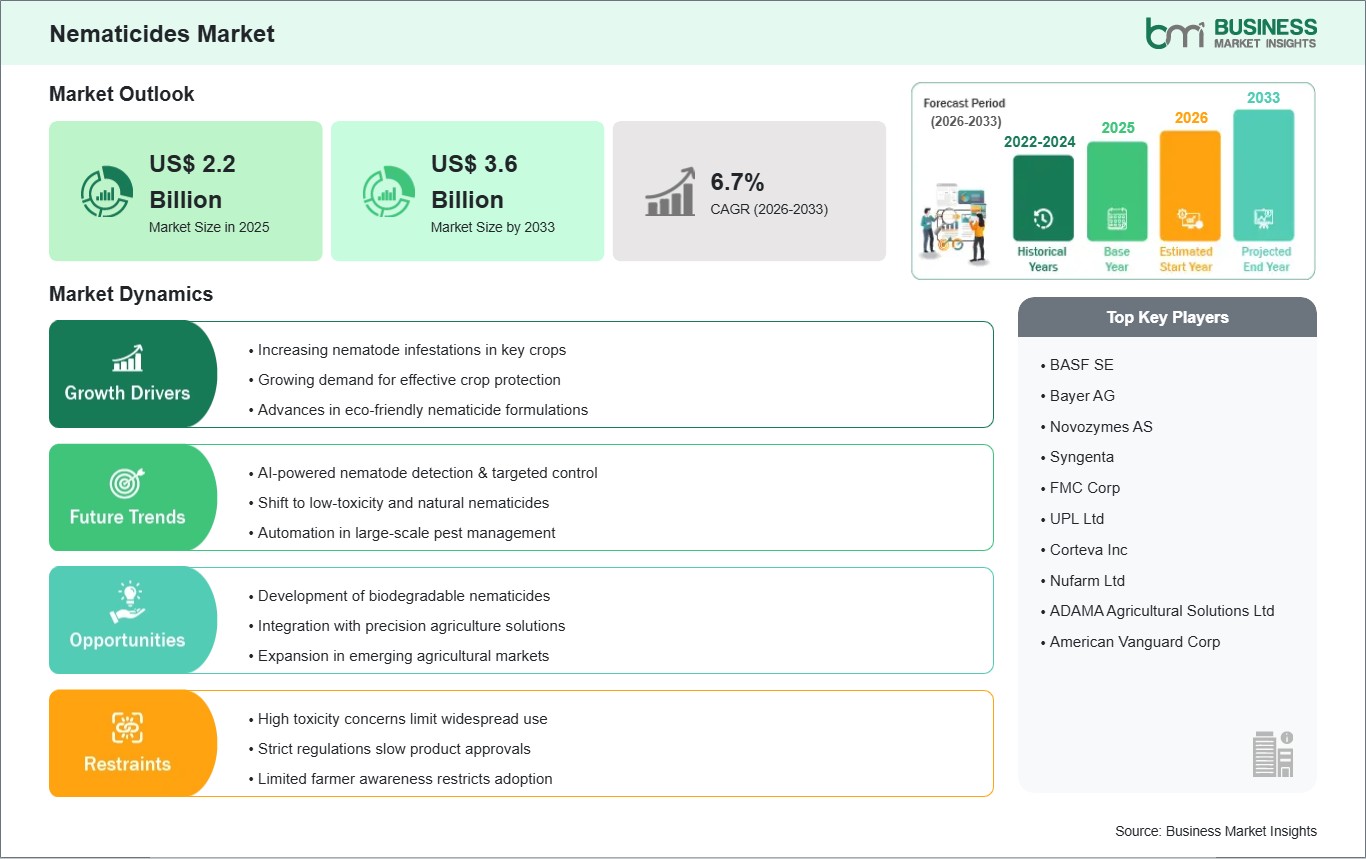
Nematicides provide the critical pest management infrastructure essential for high-yield agriculture, encompassing fumigants, carbamates, organophosphates, and biological nematicides. These agents offer distinct advantages, including broad-spectrum control of soil-borne pathogens, protection for high-value crops like fruits and vegetables, and improved nutrient uptake by securing root integrity. Growth is driven by the rising global incidence of nematode infestations, the mandate for food security amidst shrinking arable land, and the increasing cultivation of nematode-susceptible high-value crops. Additionally, the shift toward bio-based formulations is fundamentally enhancing environmental sustainability and compliance with stringent residue regulations.
However, several challenges can restrain market growth: high R&D costs for novel active ingredients and stringent regulatory hurdles, including the phasing out of traditional, toxic fumigants, pose significant barriers. Intensifying trade tensions and tariffs on agrochemical intermediates can further inflate production costs and disrupt global supply chains. Furthermore, the industry faces constraints due to technical knowledge gaps among smallholder farmers regarding proper application and a lack of accessible diagnostic tools for "hidden" soil pests. Despite these hurdles, the market holds immense opportunities in the universal mandate for sustainable agriculture, the accelerating deployment of precision application technologies (GPS and drones), and the rising adoption of nematicidal seed treatments. The transition toward AI-driven predictive soil analytics and integrated pest management (IPM) frameworks is expected to create significant opportunities for market growth.
Segment Analysis
Nematicides Market Segmentation
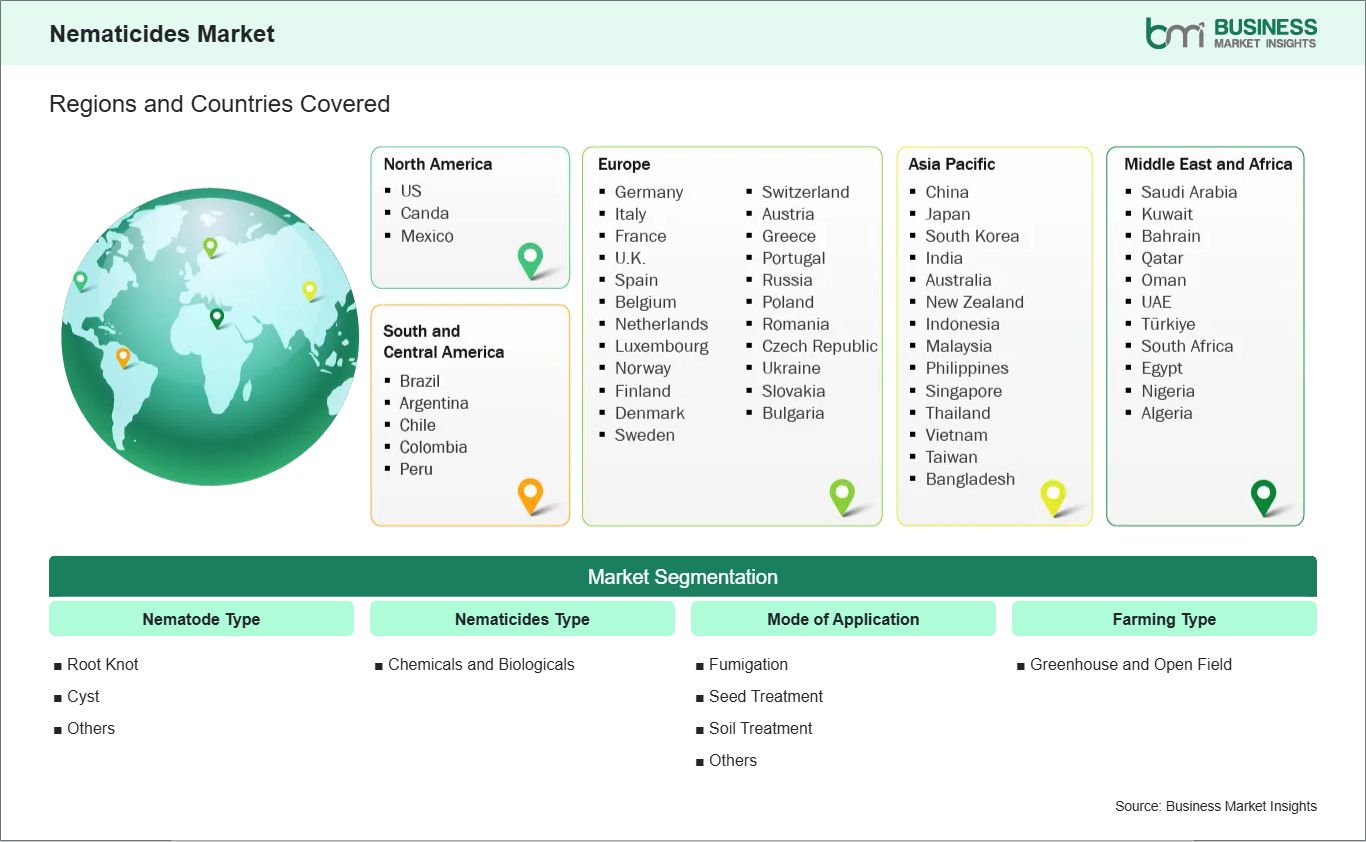
Key segments that contributed to the derivation of the Nematicides market analysis are nematode type, nematicides type, mode of application, and farming type.
- By Nematode Type, the market is segmented into Root Knot, Cyst, and Others.
- By Nematicides Type, the market is bifurcated into Chemicals and Biologicals.
- By Mode of Application, the market is segmented into Fumigation, Seed Treatment, Soil Treatment, and Others.
- By Farming Type, the market is divided into Greenhouse and Open Field.
Market Forces
Nematicides Market Drivers and Opportunities
Intensifying Infestations and Yield Security
The primary driver for the Nematicides Market is the escalating global impact of plant-parasitic nematodes, which cause significant annual agricultural losses. As global temperatures rise and monocropping becomes more prevalent, nematode populations, particularly root-knot and cyst varieties, are expanding into new territories, severely threatening food security. This biological pressure is compounded by the critical challenge of declining available agricultural land per person. To maintain profitability on limited acreage, farmers are increasingly reliant on nematicides to protect high-value crops like fruits, vegetables, and ornamentals that are highly sensitive to root damage. Furthermore, the industry is seeing a major shift toward Integrated Pest Management (IPM), where targeted nematicides are used to combat emerging resistance to traditional chemical treatments, ensuring that crop yields remain stable despite intensifying environmental and biological stressors.
Surge in Bio-Innovation and Precision Agriculture
A significant high-value opportunity lies in the rapid development of bionematicides and the integration of precision application technologies. Stringent regulatory crackdowns on toxic fumigants, such as methyl bromide, have created a massive market opening for eco-friendly, microbial-based solutions that meet consumer demand for residue-free produce. There is a burgeoning market for seed-applied nematicides, which offer a low-dose, targeted approach that reduces environmental runoff while protecting the plant during its most vulnerable early growth stages. Simultaneously, the rise of precision agriculture, using AI-driven soil sensors and drone-based spraying, enables farmers to apply nematicides only where "hotspots" of infestation are detected. This data-driven strategy not only lowers input costs but also aligns with global sustainability mandates. Manufacturers who pioneer "closed-loop" systems, combining advanced biological formulations with digital monitoring tools, are positioned to lead the transition toward a more resilient and climate-smart agricultural economy.
Size and Share Analysis
Nematicides Market Size and Share Analysis
The Nematicides market demonstrates steady growth, with size and share analysis revealing evolving trends and competitive positioning among key players. The report further examines subsegments categorized within nematode type, nematicides type, mode of application, and farming type, offering insights into their contribution to overall market performance.
For instance, the Root Knot subsegment holds a significant market share due to its wide geographical distribution and devastating impact on high-value crops like tomatoes and potatoes. These pests are primarily managed through Chemicals in Open Field operations, where large-scale Fumigation is utilized to ensure broad-spectrum control before planting. While chemical fumigants remain a workhorse for the industry, they are facing increasing regulatory scrutiny, leading to a surge in R&D for more targeted, lower-residue synthetic alternatives.
Report Coverage
Nematicides Market Report Coverage and Deliverables
The Nematicides Market Size and Forecast (2022–2033) report provides a detailed analysis of the market covering below areas:
- Nematicides market size and forecast at global, regional, and country levels for all the key market segments covered under the scope
- Nematicides market trends, as well as market dynamics such as drivers, restraints, and key opportunities
- Nematicides market analysis covering key market trends, global and regional framework, major players, regulations, and recent market developments
- Industry landscape and competition analysis covering market concentration, heat map analysis, prominent players, and recent developments for the Nematicides market
- Detailed company profiles, including SWOT analysis
Geographic Insights
Nematicides Market Geographic Insights
The geographical scope of the Nematicides market report is divided into five regions: North America, Asia Pacific, Europe, Middle East & Africa, and South & Central America.
The Asia-Pacific Nematicides Market is segmented into China, Japan, South Korea, India, Australia, New Zealand, Indonesia, Malaysia, the Philippines, Singapore, Thailand, Vietnam, Taiwan, Bangladesh, and the Rest of Asia. The market is primarily driven by the region's massive agricultural output and the increasing prevalence of root-knot nematodes in high-value horticultural crops.
Growth is further bolstered by a significant shift toward bio-nematicides as a sustainable alternative to traditional chemical fumigants, particularly in fruit and vegetable production. The integration of precision agriculture and the expansion of protected cultivation (greenhouses) in Southeast Asia solidify Asia-Pacific as the critical global driver for nematicide innovation and volume consumption.
Industry Activity
Recent Developments
The Nematicides market is evaluated by gathering qualitative and quantitative data post primary and secondary research, which includes important corporate publications, association data, and databases. A few of the key developments in the Nematicides market are:
- In March 2024, TYMIRIUM® technology launched a remarkably effective nematicide and fungicide that can be applied in minuscule amounts in fields, or directly on seeds, to help young seedlings thrive in the first few weeks of life. Unlike many previous molecules in this category, TYMIRIUM® technology doesn’t harm the many varieties of nematodes—microscopic worms—that are beneficial to soil health and biodiversity. It also has multiple uses to protect crops in later stages against diseases such as the devastating fusarium that has been destroying banana fields in the Philippines.
- In June 2024, BASF Agricultural Solutions introduced Nemasphere™ nematode resistance trait, the most groundbreaking innovation in soybean cyst nematode (SCN) management in over 60 years. Nemasphere is the first and only biotechnology trait for SCN, the number one yield-robbing pest in soybeans in the United States.
Trust & Transparency
Research Methodology
The market analysis combines proprietary research with secondary data from government agencies, company disclosures, regulatory filings, industry databases and expert interviews. Market estimates are validated through data triangulation, cross-market benchmarking and analyst
review.
View Full Research Methodology
Key Sources Referred:
World Bank – Global Trade IndicatorsWorld Trade Organization (WTO)International Monetary Fund (IMF)International Trade Administration (ITA)Company WebsitesCompany Annual ReportsCompany Investor Presentations