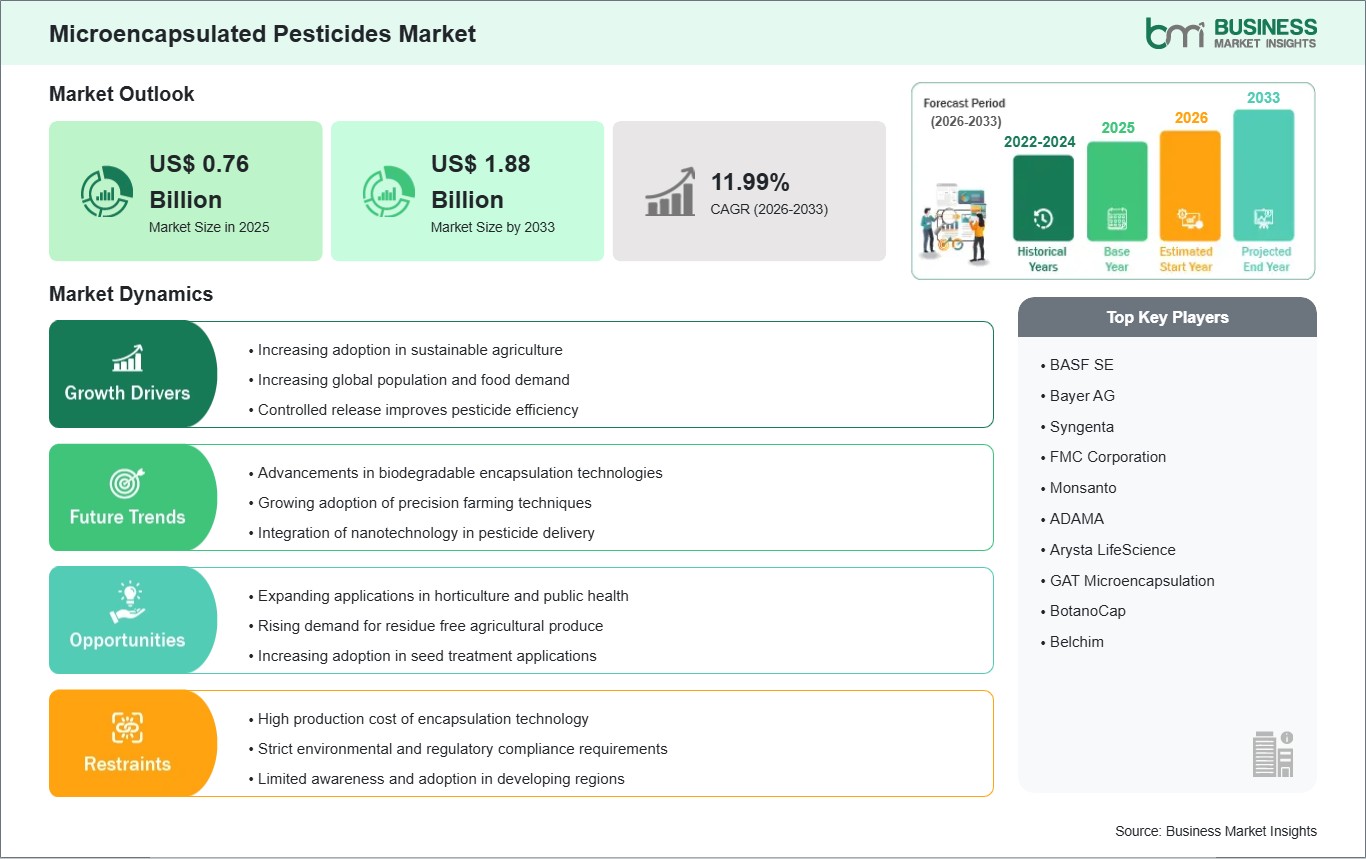
The Microencapsulated Pesticides Market size is expected to reach US$ 1.88 Billion by 2033 from US$ 0.76 Billion in 2025. The market is estimated to record a CAGR of 11.99% from 2026 to 2033.
The pesticide microencapsulation market has experienced tremendous growth due to the increasing emphasis on precision, effectiveness, and environmental safety by the modern agricultural community. The microencapsulation of active ingredients used in pesticides allows for a controlled release of the active ingredient(s) over time, thus improving pest management effectiveness while simultaneously reducing the amount of chemicals used by non-target organisms and the environment. The controlled-release mechanism also provides an additional benefit of improving stability against degradation from the effects of heat, moisture, and UV light (sunlight). This extends the effective life of the pesticide and helps to reduce the amount of overall chemical use. Current market drivers include the increased demand for sustainable farming methods, the increased need for integrated pest management (IPM), and the need to comply with stringent government regulations regarding pesticide residue levels on food crops. Technological advances such as biodegradable polymer coatings, nano-encapsulation, and targeted delivery systems are increasing the number of available formulations for agricultural production of many crops, including cereal grains, fruit and vegetable crops, and commercial cash crops.
The microencapsulation market is further supported by a growing awareness on the part of producers/farmers of how to utilize inputs more efficiently, save on labor costs, and reduce the incidence of pest resistance to the use of pesticides through microencapsulation. The market continues to deal with challenges associated with high production costs, the complexity of regulatory approvals, and needs related to producer/farmer education on appropriate application techniques. Companies that lead the microencapsulation market are focused on research and development to improve their encapsulation efficiencies, increase the compliance rate with environmental regulations, and develop crop-specific solutions. In addition, many of the leading microencapsulation companies are using strategic partnerships with distribution companies and chemical manufacturers to grow their market presence.

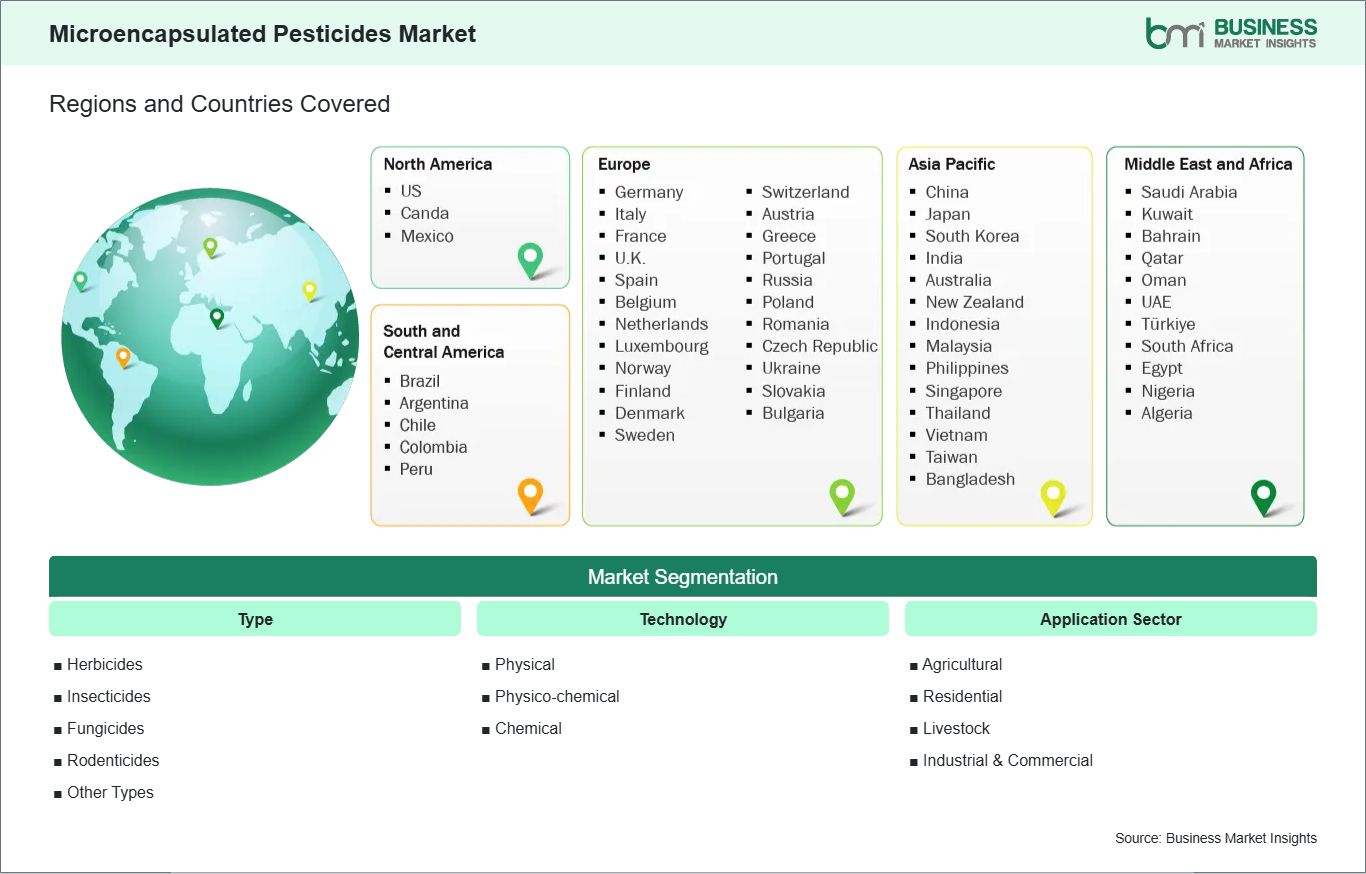
Key segments that contributed to the derivation of the microencapsulated pesticides market analysis are type, technology, application sector.
The agriculture industry is increasingly turning to microencapsulated pesticides to improve efficiency and minimize environmental impact. These formulations provide a controlled release of active ingredients, allowing for longer-lasting protection against pests while reducing the frequency of application. This approach helps limit chemical runoff into soil and waterways, supporting more environmentally responsible farming practices.
Microencapsulation helps to stabilize pesticides and protect them from breaking down because of UV light, heat, and moisture. This ensures that crops have uniform pest protection, which can enhance yield quality and decrease loss from pests. In addition to maintaining the effectiveness of these pesticides, microencapsulated products allow farmers to apply smaller quantities of chemicals to achieve similar or improved results, resulting in lower input costs and less operational effort.
Microencapsulated pesticides are gaining increasing attention as sustainable and precision agriculture practices continue to grow in importance because they are effective and safe for the environment. They can be used on a wide range of crops and farming systems, thereby meeting regulatory and consumer demands for environmentally-friendly farming practices. With this combination of environmental efficiency, less use of chemicals, and improved crop protection, microencapsulated pesticides will become an important part of modern agriculture and provide producers with greater production while using sustainable agricultural practices.
Microencapsulated pesticides are also finding broader use outside traditional crop farming, particularly in horticulture, landscaping, and public health programs. In ornamental and turf applications, controlled-release formulations provide long-lasting protection against pests while limiting exposure to surrounding plants, animals, and soil. This reduces the need for repeated applications and lowers overall chemical use, benefiting both operational efficiency and the environment.
In public health, these pesticides are employed to control vectors such as mosquitoes and other disease-carrying insects. The technology allows for precise release of active ingredients over extended periods, ensuring consistent effectiveness while minimizing human and animal exposure. Microencapsulation also improves the safety profile of these chemicals, making them suitable for sensitive urban and residential areas.
The versatility of microencapsulated pesticides is driving innovation, with formulations being tailored for specific crops, pest types, and environmental conditions. Their combination of long-term efficacy, reduced environmental impact, and operational convenience makes them an increasingly important choice for sustainable pest management. As awareness of ecological and public health concerns grows, microencapsulated pesticides are emerging as a preferred solution across agriculture, horticulture, and vector control programs, supporting safer, more efficient, and environmentally responsible pest management practices worldwide.

The microencapsulated pesticides market demonstrates steady growth, with size and share analysis highlighting evolving trends and competitive dynamics among key players. The report examines subsegments categorized within type, technology, and application sector, offering insights into their contribution to overall market performance.
By Type, the herbicides subsegment dominated the market in 2025, driven by increasing demand for crop protection and yield enhancement.
Based on Technology, the physico‑chemical subsegment dominated the market in 2025, supported by its ability to enhance pesticide stability and controlled release.
Based on Application Sector, the agricultural subsegment dominated the market in 2025, supported by growing adoption of pesticides in large-scale crop cultivation.
| Report Attribute | Details |
|---|---|
| Market size in 2025 | US$ 0.76 Billion |
| Market Size by 2033 | US$ 1.88 Billion |
| Global CAGR (2026 - 2033) | 11.99% |
| Historical Data | 2022-2024 |
| Forecast period | 2026-2033 |
| Segments Covered | By Type
|
|
Regions and Countries Covered
| |
| North America | US, Canada, Mexico |
| Europe | Belgium, Austria, Finland, Denmark, Greece, Poland, Romania, Russia, Ukraine, Czech Republic, Slovakia, Bulgaria, Italy, Luxembourg, Germany, Switzerland, France, Netherlands, Norway, Portugal, Spain, Sweden, United Kingdom |
| Asia-Pacific | Australia, China, India, Japan, South Korea, Indonesia, Malaysia, Philippines, Singapore, Thailand, Vietnam, Bangladesh, New Zealand, Taiwan |
| South and Central America | Brazil, Argentina, Peru, Chile, Colombia |
| Middle East and Africa | Bahrain, Kuwait, Oman, Qatar, Saudi Arabia, United Arab Emirates, Turkiye, South Africa, Egypt, Algeria, Nigeria |
| Market leaders and key company profiles |
|
The "Microencapsulated Pesticides Market Size and Forecast (2022 - 2033)" report provides a detailed analysis of the market covering below areas:
The geographical scope of the Microencapsulated Pesticides Market report is divided into North America, Asia Pacific, Europe, Middle East & Africa, and South & Central America. North America held the largest share in 2025.
Regional-level dynamics in the microencapsulated pesticides market reveal varied growth patterns influenced by agricultural intensity, regulatory frameworks, and adoption of modern farming technologies. North America dominates the market, driven by advanced agriculture, stringent regulatory compliance, and widespread adoption of precision farming technologies that enhance crop yield while ensuring environmental safety. The United States, in particular, leads in the development and application of innovative encapsulated pesticide formulations.
Europe demonstrates steady growth, supported by the European Union`s strict regulations on pesticide residues, sustainability mandates, and the emphasis on integrated pest management, with Germany, France, and Italy serving as primary hubs for adoption.
Asia Pacific is the fastest-growing region due to large-scale agricultural activity, expanding arable land, and adoption of modern agronomic practices in China, India, and Japan. The region also benefits from rising awareness of crop protection efficiency and sustainable agriculture initiatives.
Middle East & Africa shows moderate growth, primarily driven by horticulture and high-value crops in arid regions, where microencapsulated formulations help conserve water and reduce chemical wastage.
South & Central America is emerging as a growth region due to increasing investments in commercial agriculture, particularly in Brazil and Argentina, although adoption is constrained by cost sensitivity and limited technical awareness.
Across all regions, market expansion is driven by regulatory alignment, technological innovation, and the global shift toward environmentally responsible crop protection.

The Microencapsulated Pesticides Market is evaluated by gathering qualitative and quantitative data post primary and secondary research, which includes important corporate publications, association data, and databases. A few of the key developments in the microencapsulated pesticides market are:
The Microencapsulated Pesticides Market is valued at US$ 0.76 Billion in 2025, it is projected to reach US$ 1.88 Billion by 2033.
As per our report Microencapsulated Pesticides Market, the market size is valued at US$ 0.76 Billion in 2025, projecting it to reach US$ 1.88 Billion by 2033. This translates to a CAGR of approximately 11.99% during the forecast period.
The Microencapsulated Pesticides Market report typically cover these key segments-
The historic period, base year, and forecast period can vary slightly depending on the specific market research report. However, for the Microencapsulated Pesticides Market report:
The Microencapsulated Pesticides Market is populated by several key players, each contributing to its growth and innovation. Some of the major players include:
The Microencapsulated Pesticides Market report is valuable for diverse stakeholders, including:
Essentially, anyone involved in or considering involvement in the Microencapsulated Pesticides Market value chain can benefit from the information contained in a comprehensive market report.
Please tell us your area of interest
(Market Segments/ Regions and Countries/ Companies)