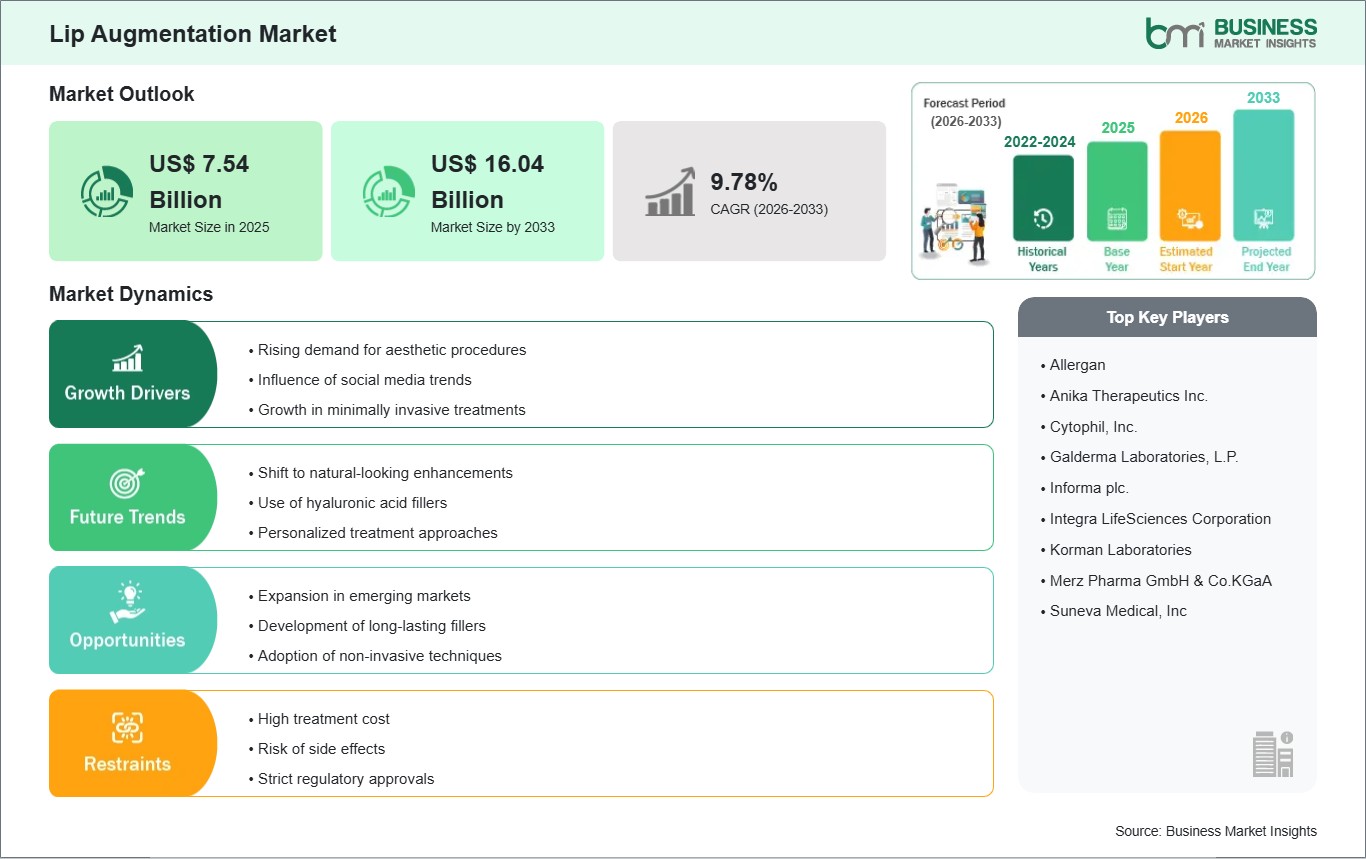
The Lip Augmentation market size is expected to reach US$ 16.04 billion by 2033 from US$ 7.54 billion in 2025. The market is estimated to record a CAGR of 9.78% from 2026 to 2033.
Lip augmentation represents a rapidly evolving trend in the aesthetic medicine industry, encompassing both surgical and nonsurgical techniques aimed at enhancing lip volume, contour, and overall perioral aesthetics. Traditionally dominated by surgical implants and fat grafting, the market has shifted toward minimally invasive solutions, particularly dermal fillers, which offer reversibility, shorter recovery times, and natural-looking results. This transformation is fueled by advancements in filler science, improved rheology for dynamic facial movement, and the integration of anesthetic agents to enhance patient comfort.
Despite its growth trajectory, the market faces notable challenges. Regulatory hurdles remain significant, as expanding indications for lip and perioral treatments require rigorous clinical evidence and compliance with evolving frameworks such as MDR in Europe and FDA pathways in the US. Safety concerns, including vascular occlusion and technique variability, underscore the need for standardized injector training and robust clinical protocols. Additionally, market fragmentation, driven by multiple competing portfolios and emerging technologies, creates complexity for practitioners in product selection and inventory management.
Nevertheless, opportunities abound. The rise of patient-centric treatment programs and holistic facial planning is redefining lip augmentation as part of a comprehensive aesthetic journey rather than a standalone procedure. Innovations such as skin-quality microdroplet injectables, longer-lasting formulations, and biostimulatory materials are expanding the scope of lip enhancement beyond volume to include texture and hydration. Furthermore, growing demand for subtle, natural enhancements among younger demographics and emerging male segments, coupled with education-led initiatives by leading manufacturers, positions the market for sustained growth.

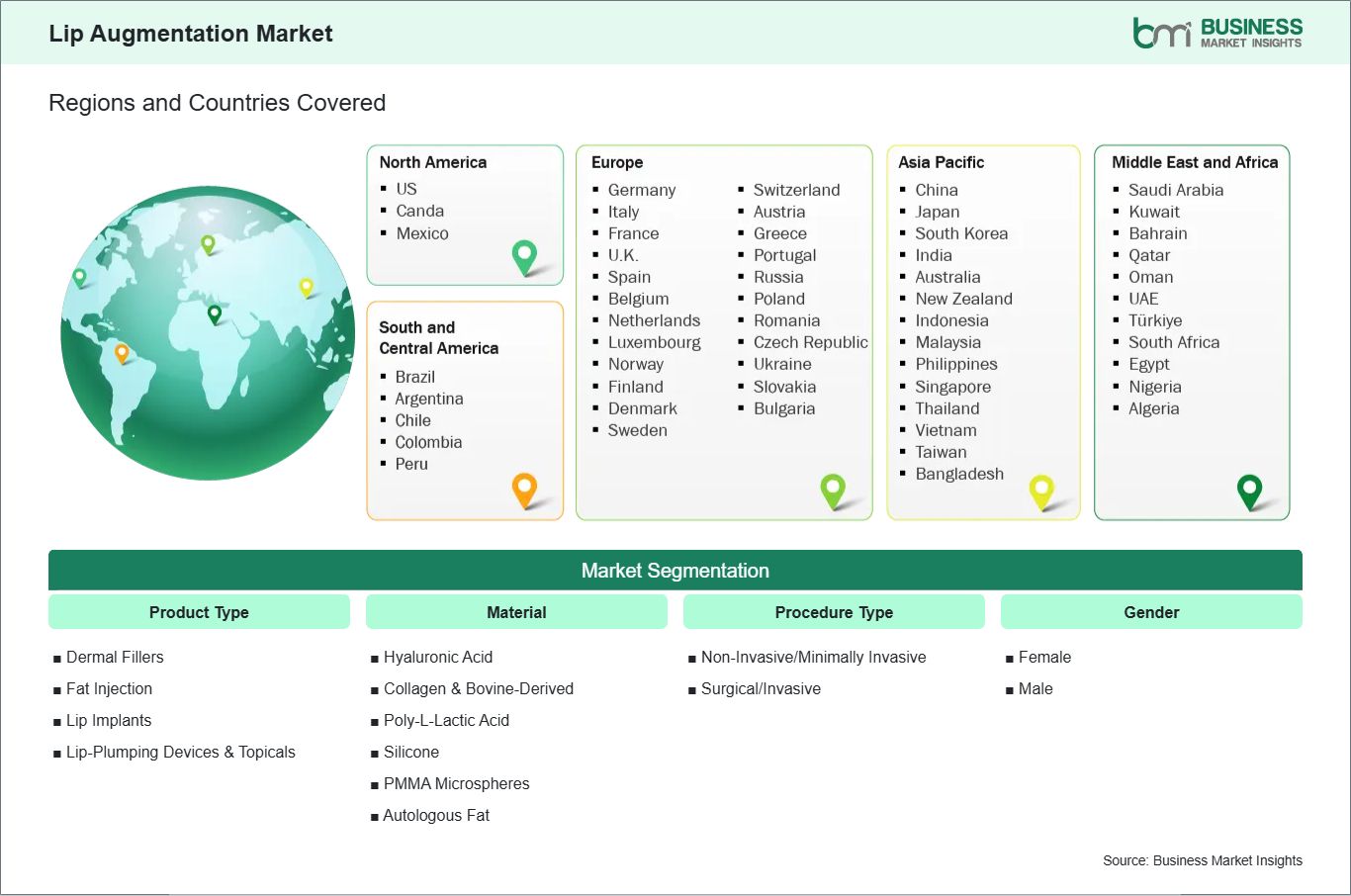
Key segments that contributed to the derivation of the Lip Augmentation market analysis are product type, material, procedure type, and gender.
The global aesthetic industry has experienced a pronounced shift toward non-invasive and minimally invasive procedures, and lip augmentation has emerged as one of the most sought-after treatments within this evolving landscape. Consumers today increasingly prioritize options that provide subtle, natural-looking enhancements while avoiding the extended recovery times, discomfort, and higher complication rates associated with surgical interventions. This preference aligns closely with broader lifestyle trends, where individuals seek cosmetic improvements that fit seamlessly into their daily routines without major disruption.
Dermal fillers—especially hyaluronic acid (HA)-based formulations—have become the gold standard for lip enhancement due to their strong safety record, versatility, and reversibility. HA fillers allow practitioners to tailor results with precision, adapting shape, volume, and definition to each patient’s unique facial anatomy. Their temporary nature also appeals to first-time patients who may be hesitant about committing to permanent changes.
Beyond clinical advantages, cultural and social factors play a significant role in driving demand. The influence of social media platforms, beauty influencers, and high-definition imaging has heightened awareness of facial aesthetics, encouraging people across diverse age groups and demographics to pursue refined, harmonious lip proportions. As a result, lip augmentation has transitioned from a niche cosmetic treatment to a mainstream aesthetic preference, contributing significantly to the overall expansion of the non-surgical aesthetics market.
Beyond traditional volume enhancement, patients today are increasingly seeking comprehensive lip rejuvenation solutions that address texture, hydration, and the overall quality of the perioral skin. This shift reflects a broader aesthetic trend in which consumers value subtle refinement and natural rejuvenation just as much as they do structural enhancement. As a result, there is a growing opportunity for manufacturers and aesthetic clinics to create bundled treatment offerings that combine lip augmentation with advanced skin-quality injectables, energy-based therapies, and multimodal facial rejuvenation programs.
Innovations such as microdroplet hyaluronic acid (HA) injectables, skin boosters, and biostimulatory fillers—including calcium hydroxylapatite and poly-L-lactic acid—enable practitioners to design highly personalized treatment plans. These solutions improve dermal hydration, enhance elasticity, and stimulate collagen production around the lips, helping patients achieve smoother texture and a more youthful perioral appearance. By addressing both structural and surface-level concerns, clinicians can deliver outcomes that feel more holistic and long-lasting.
Positioning lip augmentation as part of a broader aesthetic journey rather than a one-off procedure also provides meaningful business advantages. Bundled treatments improve patient satisfaction, create opportunities for ongoing maintenance visits, and help clinics capture higher-value, premium pricing segments. In a competitive aesthetic marketplace, this integrated approach enhances loyalty, differentiates service offerings, and supports sustainable revenue growth.

The Lip Augmentation market demonstrates steady growth, with size and share analysis revealing evolving trends and competitive positioning among key players. The report further examines subsegments categorized within product type, material, procedure type, and gender, offering insights into their contribution to overall market performance.
For instance, within the Product Type segment, Dermal Fillers dominate procedural preference due to their versatility, reversibility, and evolving rheology that supports natural lip movement. In terms of Material, Hyaluronic Acid remains the cornerstone for lip enhancement, favored for its biocompatibility and hydration benefits, while newer cross-linked formulations improve longevity. Across Procedure Type, Non-Invasive/Minimally Invasive approaches lead patient adoption, driven by shorter recovery times and reduced risk compared to surgical alternatives. Based on Gender, the Female segment continues to anchor demand, with growing interest in subtle, natural-looking transformations.
| Report Attribute | Details |
|---|---|
| Market size in 2025 | US$ 7.54 Billion |
| Market Size by 2033 | US$ 16.04 Billion |
| Global CAGR (2026 - 2033) | 9.78% |
| Historical Data | 2022-2024 |
| Forecast period | 2026-2033 |
| Segments Covered | By Product Type
|
| Regions and Countries Covered | North America
|
| Market leaders and key company profiles |
|
The Lip Augmentation Market Size and Forecast (2022–2033) report provides a detailed analysis of the market covering below areas:
The geographical scope of the Lip Augmentation market report is divided into five regions: North America, Asia Pacific, Europe, the Middle East & Africa, and South & Central America.
North America benefits from a mature aesthetics ecosystem and strong injector education programs, fostering advanced techniques and multimodal treatment planning. Europe continues to emphasize compliance with stringent regulatory frameworks such as MDR, while clinics increasingly favor natural, subtle enhancements supported by portfolio innovations. In Asia Pacific, rising consumer awareness and expanding access to branded training initiatives are driving procedural uptake, particularly in urban centers. The Middle East & Africa are witnessing growth through international congress-led education and modernization of aesthetic clinics, improving access to premium treatments. Meanwhile, South & Central America leverage expanding aesthetics networks and branded consultation programs to standardize patient care and broaden market penetration.

The Lip Augmentation market is evaluated by gathering qualitative and quantitative data post-primary and secondary research, which includes important corporate publications, association data, and databases. A few of the key developments in the Lip Augmentation market are:
The Lip Augmentation Market is valued at US$ 7.54 Billion in 2025, it is projected to reach US$ 16.04 Billion by 2033.
As per our report Lip Augmentation Market, the market size is valued at US$ 7.54 Billion in 2025, projecting it to reach US$ 16.04 Billion by 2033. This translates to a CAGR of approximately 9.78% during the forecast period.
The Lip Augmentation Market report typically cover these key segments-
The historic period, base year, and forecast period can vary slightly depending on the specific market research report. However, for the Lip Augmentation Market report:
The Lip Augmentation Market is populated by several key players, each contributing to its growth and innovation. Some of the major players include:
The Lip Augmentation Market report is valuable for diverse stakeholders, including:
Essentially, anyone involved in or considering involvement in the Lip Augmentation Market value chain can benefit from the information contained in a comprehensive market report.
Please tell us your area of interest
(Market Segments/ Regions and Countries/ Companies)