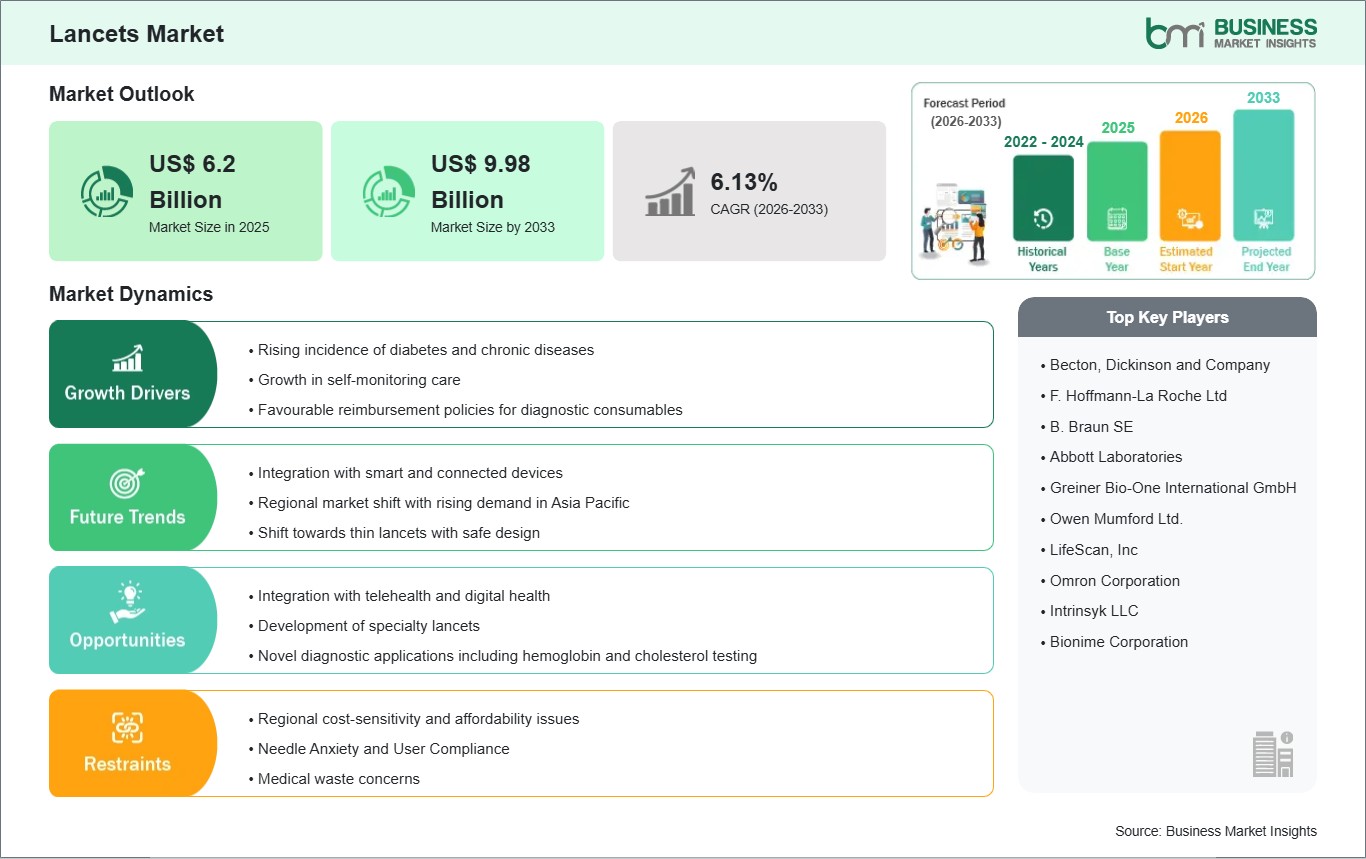
The Lancets market size is expected to reach US$ 9.98billion by 2033 from US$ 6.2 Billion in 2025. The market is estimated to record a CAGR of 6.13% from 2026 to 2033.
The lancets market covers the most common devices used for capillary blood sampling, which is the base for glucose monitoring, hemoglobin testing, and other diagnostic applications. The market has been propelled by the rise in the number of diabetes cases and other chronic diseases that require frequent self, monitoring and has shifted remarkably towards safety lancets, which are prevailing due to their features such as retractable needles, low risk of needlestick injuries, and better infection, control capabilities as compared to a standard lancet.
The key trends are technological improvements such as painless, ergonomic designs with adjustable depth, settings, pressure activated devices, and integration with home diagnostic kits to enhance patient comfort and compliance. The focus on home healthcare, point, of, care testing, and preventive diagnostics is thus getting faster adoption, especially among the elderly who prefer minimally invasive procedures. Major players such as BD, Roche, and Owen Mumford keep on upgrading their products to be more environmentally friendly and easier to use.

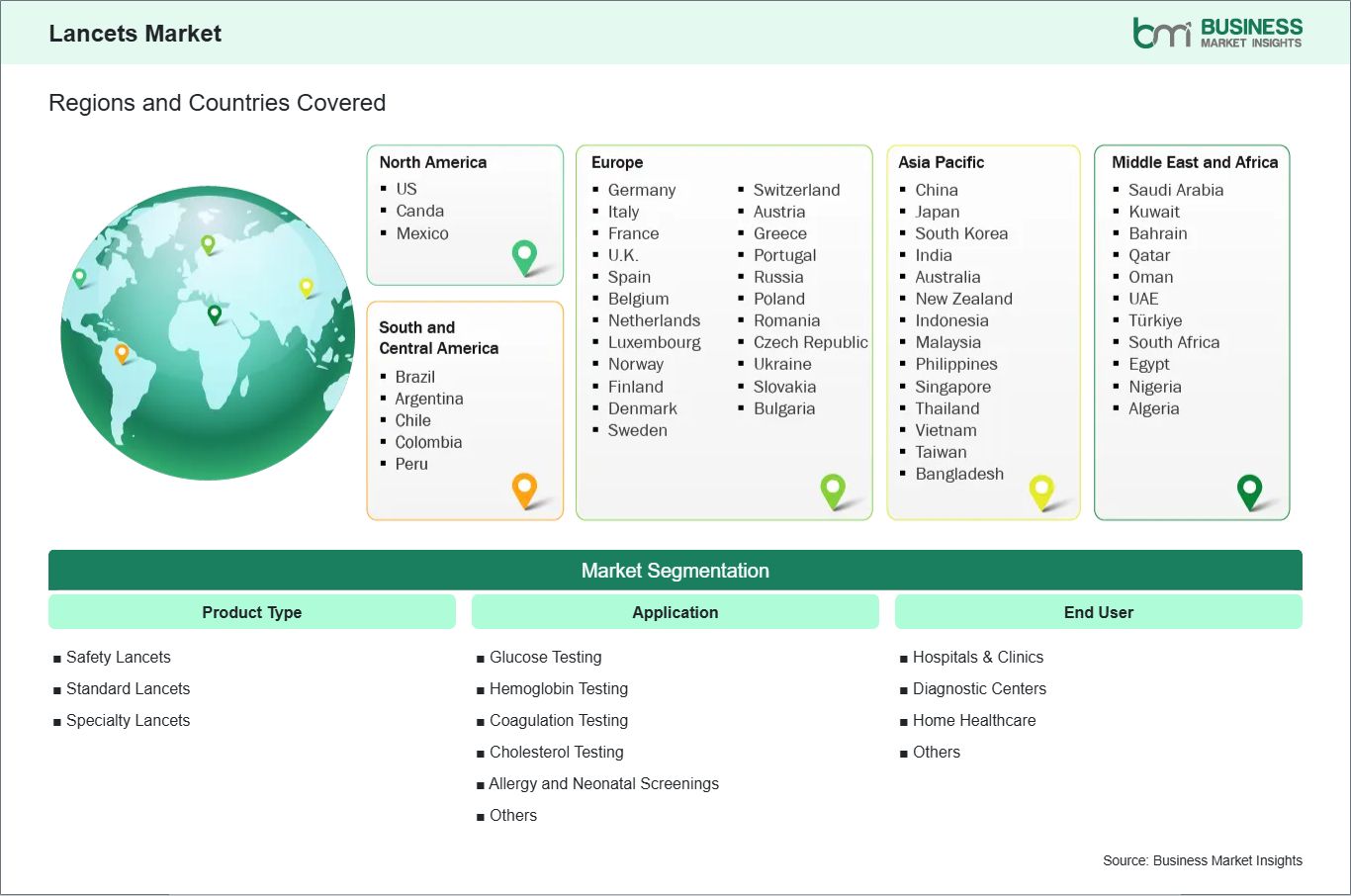
Key segments that contributed to the derivation of the Lancets market analysis are product type, application, and end user. • By product type, the lancets market is segmented into safety lancets, standard lancets, specialty lancets. The safety lancets segment dominated the market in 2025. • By application, the market is segmented into glucose testing, hemoglobin testing, coagulation testing, cholesterol testing, allergy and neonatal screenings, others. The glucose testing segment held the largest share of the market in 2025. • By end user, the market is segmented into hospitals & clinics, diagnostic centers, home healthcare, others. The hospitals & clinics segment held the largest share of the market in 2025.
Safety and pain reduction related technological advances are the main factors strongly influencing the lancets market, as they meet patient demands and comply with strict infection control regulations. Nowadays, lancets have silicone, coated, laser, sharpened needles and are vibration, damping for less trauma and discomfort. Also, pressure, activated models do not require manual cocking, thus, errors are lowered for self, testers with limited dexterity.
The safety lancets are at the forefront with automatic retraction, thus, needlesticks are avoided and they are suitable for both clinical and home use. Single, use, pre, loaded systems which are integrated with glucometers make testing easy, thus, compliance in chronic care is improved. The thinnest needles (up to 33G) with the least depth can provide sufficient samples without causing any pain, thus, they are perfect for children and the elderly. Material, wise, there are new possibilities for antimicrobial coating as well as for better sterilization. Being compatible with digital platforms also allows AI to provide insights from usage data. Regulators focus on infection and waste reduction is the reason why this led to the engineered features. Though non-invasive alternatives are less accurate, the ongoing improvements of lancets keep the demand at the same level by providing better experiences. This factor, in turn, increases users trust in routine monitoring which is a prerequisite for improved disease management and better health outcomes.
The lancet market presents an immense potential with the increase of home, based chronic disease management, especially for diabetes and diseases that require frequent blood sampling. The move of healthcare towards decentralized and patient, centered models, which is a result of the COVID, 19 pandemic and policies that support aging in place, makes lancets the instrument of self, monitoring. Besides daily glucose testing which is the main use, a few other uses are also coming in for hemoglobin A1c, cholesterol, and coagulation checks through point, of, care devices.
On top of that, being part of a connected ecosystem such as a Bluetooth lancing device can create a whole different user experience by making it easy for data tracking, sharing with the provider and so on. A user of home care situations such as the idea of safety lancets that have auto, retraction as it minimizes the risk of injury and infection. Some manufacturers can experiment with ultra, thin, painless designs with features such as adjustable depths and ergonomics for an elderly/dexterity, challenged user.
The creating of bundles with CGM or smart pen devices is one way of making the kits, thus the use going up. Support from the regulatory side for home diagnostics and the preventive health, awareness trend is a favorable environment for environmentally friendly lancets. The provision of education and the availability of affordable packs for the underserved groups that might become the target of the lancet market is the expansion of their reach. Such a trend will give patients greater control, improve convenience and outcomes, as well as reduce the pressure on healthcare by allowing them to skip clinic visits, thus making lancets a crucial part of the home health system which is proactive in nature.

By product type, the lancets market is segmented into safety lancets, standard lancets, specialty lancets. The safety lancets segment dominated the market in 2025. Safety lancets feature automatic needle retraction, minimizing needlestick injuries and cross-contamination risks, which is critical in clinical settings and for self-monitoring. Their alignment with safety priorities and rising chronic disease management needs.
By application, the market is segmented into glucose testing, hemoglobin testing, coagulation testing, cholesterol testing, allergy and neonatal screenings, others. The glucose testing segment held the largest share of the market in 2025. The global increase in diabetes cases (both type 1 and type 2) drives demand for frequent blood glucose monitoring, requiring daily or multiple lancet uses per patient. This is the primary factor, as lancets are essential for self-monitoring blood glucose (SMBG) in home settings.
By end user, the market is segmented into hospitals & clinics, diagnostic centers, home healthcare, others. The hospitals & clinics segment held the largest share of the market in 2025. Hospitals and clinics perform a wide range of routine and specialized blood tests (e.g., glucose, hemoglobin, coagulation, cholesterol), requiring large quantities of lancets daily, especially safety variants for infection control.
| Report Attribute | Details |
|---|---|
| Market size in 2025 | US$ 6.2 Billion |
| Market Size by 2033 | US$ 9.98 Billion |
| Global CAGR (2026 - 2033) | 6.13% |
| Historical Data | 2022 - 2024 |
| Forecast period | 2026-2033 |
| Segments Covered | By Product Type
|
|
Regions and Countries Covered
| |
| North America | US, Canada, Mexico |
| Europe | Belgium, Austria, Finland, Denmark, Greece, Poland, Romania, Russia, Ukraine, Czech Republic, Slovakia, Bulgaria, Italy, Luxembourg, Germany, Switzerland, France, Netherlands, Norway, Portugal, Spain, Sweden, United Kingdom |
| Asia-Pacific | Australia, China, India, Japan, South Korea, Indonesia, Malaysia, Philippines, Singapore, Thailand, Vietnam, Bangladesh, New Zealand, Taiwan |
| South and Central America | Brazil, Argentina, Peru, Chile, Colombia |
| Middle East and Africa | Bahrain, Kuwait, Oman, Qatar, Saudi Arabia, United Arab Emirates, Turkiye, South Africa, Egypt, Algeria, Nigeria |
| Market leaders and key company profiles |
|
The Lancets Market Size and Forecast (2025-2033) report provides a detailed analysis of the market covering below areas:
The geographical scope of the Lancets market report is divided into five regions: North America, Asia Pacific, Europe, Middle East & Africa, and South & Central America. The Lancets market in Asia Pacific is expected to grow significantly during the forecast period.
The Asia-Pacific Lancets market is segmented into China, Japan, South Korea, India, Australia, New Zealand, Indonesia, Malaysia, the Philippines, Singapore, Thailand, Vietnam, Taiwan, Bangladesh, and the Rest of Asia. Demographic, epidemiological, economic, and healthcare system factors are driving the Asia-Pacific lancet market. The growing prevalence of diabetes in countries such as China, India, and other countries in Southeast Asia attributed to urbanization and changing lifestyles leads to increased demand for blood glucose monitors and lancets. The large and aging population of this region contributes to an increased rate of chronic diseases requiring frequent diagnostic testing.
Additionally, improved healthcare infrastructure, including hospitals, clinics, and home care services, expands access to diagnostic services from emerging economies. Governments are also supporting growth in the lancet market through initiatives that promote early disease detection, preventive health care, and diabetes management. Awareness of self-monitoring along with increased adoption of home-based testing devices is further expanding the use of lancets. Economic growth plus increased disposable income offers a greater opportunity for consumers to spend more on personal healthcare products. Recent technological advancements, including safety lancets and single-use designs, inspire more users to choose lancets due to added comfort and decreased risk of infection. Collectively these factors continue to sustain the need for lancets across the Asia-Pacific region.

The Lancets market is evaluated by gathering qualitative and quantitative data post primary and secondary research, which includes important corporate publications, association data, and databases. A few of the key developments in the lancets market are:
The Lancets Market is valued at US$ 6.2 Billion in 2025, it is projected to reach US$ 9.98 Billion by 2033.
As per our report Lancets Market, the market size is valued at US$ 6.2 Billion in 2025, projecting it to reach US$ 9.98 Billion by 2033. This translates to a CAGR of approximately 6.13% during the forecast period.
The Lancets Market report typically cover these key segments-
The historic period, base year, and forecast period can vary slightly depending on the specific market research report. However, for the Lancets Market report:
The Lancets Market is populated by several key players, each contributing to its growth and innovation. Some of the major players include:
The Lancets Market report is valuable for diverse stakeholders, including:
Essentially, anyone involved in or considering involvement in the Lancets Market value chain can benefit from the information contained in a comprehensive market report.
Please tell us your area of interest
(Market Segments/ Regions and Countries/ Companies)