
Knee Replacement Implants Market Outlook: Size, Share, Trends, Growth Analysis, Competitive Landscape & Forecast, 2026-2033

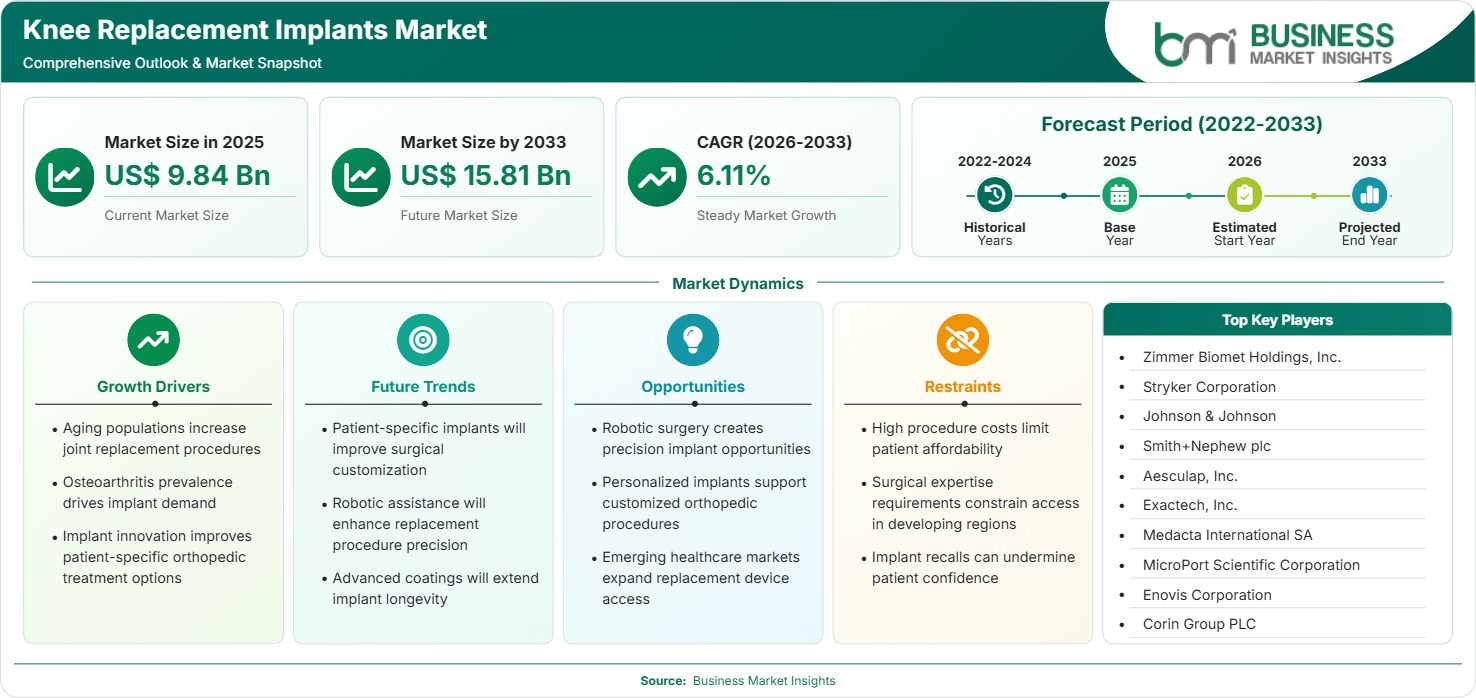
The Knee Replacement Implants Market size was valued at US$ 9.84 Billion in 2025 and is projected to reach US$ 15.81 Billion by 2033, growing at a CAGR of 6.10% during 2026–2033, driven by aging, osteoarthritis, robotics, outpatient care, premium implants, and emerging-market access.

Report Coverage
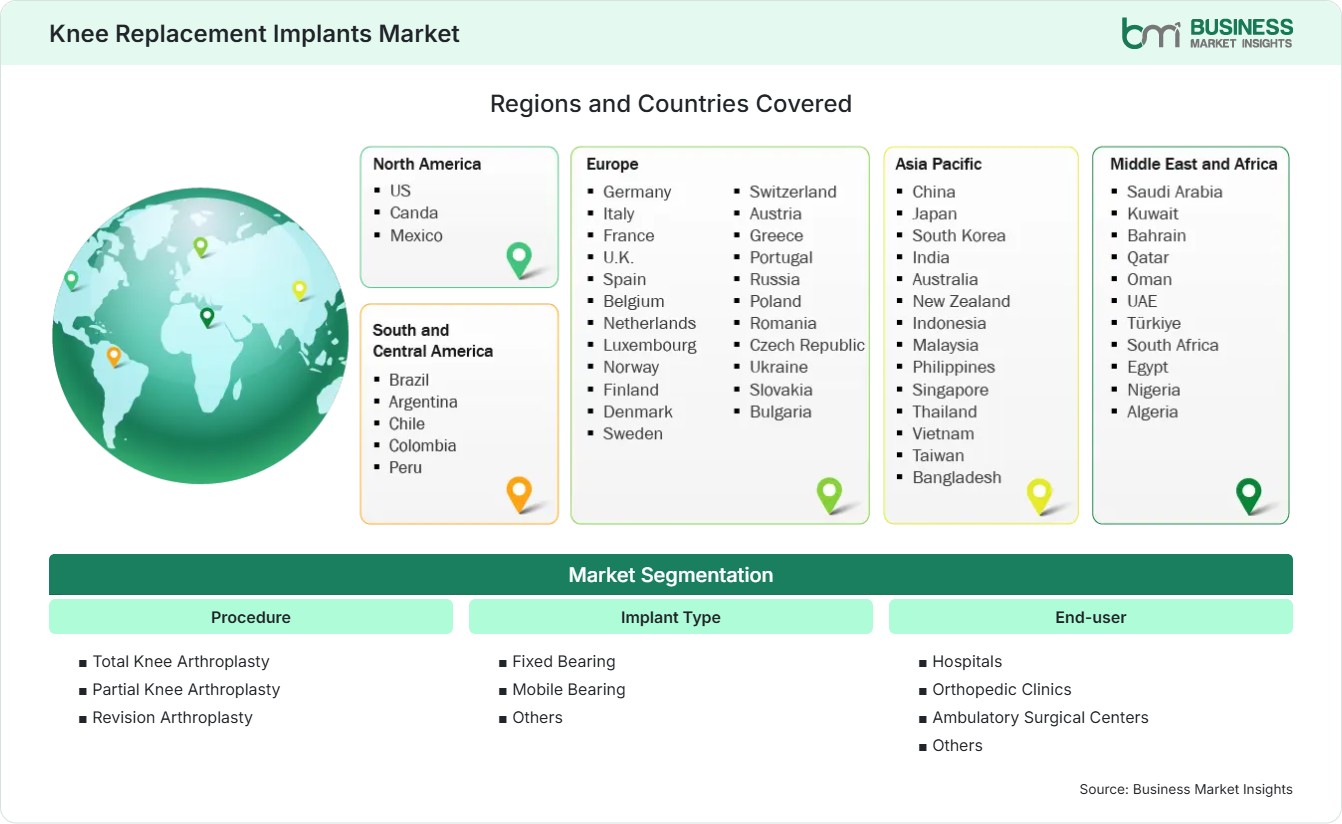
  • Procedure: Total Knee Arthroplasty, Partial Knee Arthroplasty, Revision Arthroplasty
  • Implant Type: Fixed Bearing, Mobile Bearing, Others
  • End-user: Hospitals, Orthopedic Clinics, Ambulatory Surgical Centers, Others
US$ 9.84 Bn Market size in 2025
US$ 15.81 Bn Market Size by 2033
6.11% CAGR, 2026 - 2033
2026-2033 Forecast Period

AI Overview

Knee Replacement Implants Market Summary

  • North America Region: North America holds 42%–46% share in 2025, growing at a 5.8%–6.3% CAGR, supported by procedure volumes, reimbursement, robotics, revision demand, premium implants, outpatient migration, surgeon training, and hospital technology investment. The US remains the principal market, supported by established reimbursement, high procedure volumes, robotic adoption, and extensive orthopedic infrastructure, with a 5.9%–6.4% CAGR through 2033.
  • Fastest Growing Region: Asia Pacific holds 20%–24% share in 2025, growing at a 7.2%–7.8% CAGR, driven by aging populations, expanding hospitals, surgeon training, private healthcare, medical tourism, local manufacturing, reimbursement development, and greater awareness of joint replacement.
  • Leading Segment: Total Knee Arthroplasty holds 62%–66% share in 2025, growing at a 5.9%–6.3% CAGR, supported by advanced osteoarthritis, established surgical protocols, surgeon familiarity, robotic assistance, cementless fixation, and broad implant availability.
  • High Growth Segment: Partial Knee Arthroplasty holds 10%–14% share in 2025, growing at a 7.0%–7.6% CAGR, supported by compartment-specific treatment, bone preservation, faster rehabilitation objectives, improved imaging, robotic guidance, broader indications, and patient preference for less invasive procedures.
  • Key Market Opportunity: Personalized arthroplasty combining patient-specific planning, robotic execution, cementless fixation, smart implants, and ambulatory workflows offers manufacturers opportunities to differentiate products, improve efficiency, and deepen provider relationships.
  • Major Market Players: Zimmer Biomet Holdings, Inc.; Stryker Corporation; Johnson & Johnson; Smith+Nephew plc; Aesculap, Inc.; Exactech, Inc.; Medacta International SA; MicroPort Scientific Corporation; Enovis Corporation; and Corin Group PLC.
Strategic Insights

Knee Replacement Implants Market: Strategic Insights

Knee Replacement Implants Market Strategic Framework
FREE PDF
Request your free sample
Request free sample
Stakeholder View

Key Takeaways

  • The value chain increasingly favors companies combining implants, instrumentation, robotics, planning software, training, and clinical services, because integrated offerings can strengthen surgeon loyalty and increase hospital switching costs.
  • Partial Knee Arthroplasty provides an attractive growth pocket as improved imaging, robotic guidance, and patient selection expand confidence in compartment-specific reconstruction and bone-preserving procedures.
  • Product innovation is moving toward porous cementless surfaces, advanced alloys, additive manufacturing, patient-specific planning, sensor-enabled technologies, and alignment approaches designed around individual anatomy and functional objectives.
  • Asia Pacific provides the strongest geographic expansion opportunity, particularly India and China, where aging, healthcare infrastructure, specialist training, and comparatively low procedure penetration create substantial long-term runway.
  • Investment activity increasingly targets enabling technologies, with acquisitions, distribution partnerships, platform integrations, and strategic collaborations allowing established manufacturers to strengthen robotics, navigation, digital planning, and outpatient capabilities.
  • Ambulatory migration will influence implant and instrument design as providers prioritize shorter stays, efficient operating-room turnover, predictable rehabilitation, compact trays, and standardized primary arthroplasty workflows.
Geographic Outlook

Knee Replacement Implants Market Regional Highlights

North America Knee Replacement Implants Market

North America represents 42%–46% of 2025 revenue and is projected to expand at a 5.8%–6.3% CAGR through 2033. Mature orthopedic infrastructure, established reimbursement, specialist networks, robotics availability, and revision activity support demand. The US contributes most regional revenue, while Canada and Mexico provide additional opportunities through improving specialist access. Premium systems retain strong positioning where clinical evidence and hospital economics justify technology investment. The Knee Replacement Implants Market share remains concentrated among established manufacturers with broad implant and enabling-technology portfolios.

  • Robotic-assisted surgery increasingly influences capital purchasing as hospitals evaluate precision, surgeon recruitment, workflow standardization, utilization, and patient differentiation alongside implant procurement.
  • Outpatient migration supports compact instruments, efficient turnover, standardized rehabilitation protocols, and implant systems suited to shorter hospital stays and ambulatory workflows.
  • Revision procedures create recurring demand for modular stems, augments, cones, constrained components, and specialized fixation products, strengthening the strategic value of comprehensive portfolios.
  • Canada offers measured expansion potential as orthopedic capacity develops, while Mexico provides opportunities through private healthcare investment, specialist centers, and medical tourism.

US Knee Replacement Implants Market

The US represents 76%–82% of North American revenue in 2025 and is projected to grow at a 5.9%–6.4% CAGR through 2033. A large installed clinical ecosystem, specialist surgeons, established reimbursement, and technology availability support premium adoption. Hospitals remain dominant, while ambulatory surgical centers gain strategic importance as patient selection and postoperative pathways become more standardized. The US Knee Replacement Implants Market increasingly rewards suppliers demonstrating clinical differentiation, operating-room efficiency, digital integration, and dependable supply.

  • Robotic platforms increasingly influence hospital investment decisions, particularly where technology utilization can support surgeon recruitment, workflow efficiency, patient differentiation, and standardized procedures.
  • Cementless fixation is gaining attention as porous surfaces, component designs, instrumentation, and clinical evidence improve for appropriately selected patient groups.
  • Revision demand remains commercially attractive because complex cases require broader component portfolios, specialized instruments, modular fixation, and advanced surgical planning.

Europe Knee Replacement Implants Market

Europe Knee Replacement Implants Market accounts for 24%–28% of 2025 revenue and is projected to grow at a 5.4%–5.9% CAGR through 2033. Germany, the UK, France, Italy, and Spain form the principal demand base. Germany leads regional adoption, while Spain provides stronger expansion potential. Italy is projected at a 5.8%–6.3% CAGR and Spain at a 6.0%–6.5% CAGR. Procurement increasingly considers treatment economics, operating-room efficiency, implant longevity, inventory management, and clinical evidence alongside acquisition price.

  • Germany combines advanced orthopedic specialization with substantial hospital capacity, supporting premium implants, robotic systems, revision products, and digitally assisted surgery.
  • Spain provides opportunities through private healthcare investment, increasing orthopedic capacity, medical tourism, and adoption of technologies supporting minimally invasive procedures.
  • France and the UK offer opportunities for suppliers capable of navigating evidence requirements, centralized procurement, capacity constraints, and technology adoption.
  • Italy benefits from established orthopedic expertise and aging demographics, while specialized centers increasingly evaluate personalized surgical technologies.

Asia Pacific Knee Replacement Implants Market

Asia Pacific represents 20%–24% of 2025 revenue and is projected to record a 7.2%–7.8% CAGR through 2033, making it the fastest-growing region. China, Japan, South Korea, India, and Australia anchor regional demand. India is projected at a 7.8%–8.4% CAGR and China at 7.3%–7.9%. Infrastructure expansion, surgeon training, local manufacturing, private healthcare, medical tourism, and improving access support adoption. The Knee Replacement Implants Market increasingly spans premium, mid-tier, and value-oriented product strategies.

  • China offers scale through aging demographics, expanding specialist infrastructure, domestic medical-device capabilities, and demand for differentiated orthopedic technologies.
  • India combines rising osteoarthritis burden with relatively low procedure penetration, creating opportunities for affordable implants, surgeon education, distribution expansion, and localized production.
  • Japan has mature orthopedic capabilities and strong demand for dependable implant systems, while demographic aging sustains primary and revision procedures.
  • Southeast Asia provides emerging opportunities through private hospitals, medical tourism, specialist center expansion, and increasing investment in robotic and minimally invasive surgery.

Rest of World Knee Replacement Implants Market

Rest of World Knee Replacement Implants Market accounts for 9%–13% of 2025 revenue and is projected to grow at a 6.2%–6.8% CAGR through 2033. South and Central America are led by Brazil and Mexico, while Colombia offers emerging potential. Brazil is projected at a 6.4%–7.0% CAGR, supported by private healthcare, specialist capacity, and medical tourism.

Middle East and Africa demand is concentrated in Gulf healthcare hubs, South Africa, and selected North African markets. The UAE is projected at a 6.8%–7.4% CAGR, supported by private hospital investment, medical tourism, specialist recruitment, and advanced surgery. Saudi Arabia provides additional potential through healthcare infrastructure development and hospital modernization.

  • Brazil provides the broadest Latin American opportunity, combining a large patient population with expanding private hospitals, orthopedic specialization, and differentiated implant demand.
  • Mexico benefits from private healthcare development and cross-border medical services, creating opportunities for manufacturers with established distribution and training capabilities.
  • Gulf markets prioritize advanced orthopedic services, making robotic systems, premium implants, revision solutions, and integrated technologies attractive within leading hospitals.
  • South Africa can serve as a specialist orthopedic hub, although affordability, public-sector capacity, and procurement constraints continue influencing accessibility.
Global Market Geography
FREE PDF
Request your free sample
Request free sample
Segment Analysis

Knee Replacement Implants Market Segmentation

Procedure

Total Knee Arthroplasty will have a revenue share of 62%-66% in 2025 and will exhibit a compound annual growth rate of 5.9%-6.3% through 2033. The scope of the Knee Replacement Implants Market will encompass partial and revision surgeries, driven by improved clinical choices, with total knee replacement as the volume driver for multicompartment implants.

  • Total Knee Arthroplasty: Dominant procedure addressing advanced multi-compartment disease, supported by standardized systems, surgeon familiarity, robotics, cementless fixation, and broad hospital availability.
  • Partial Knee Arthroplasty: Treats compartment-specific degeneration while preserving healthy anatomy, supported by bone conservation, faster rehabilitation objectives, imaging improvements, and robotic positioning.
  • Revision Arthroplasty: Addresses failed primary replacements and requires modular stems, augments, cones, constrained components, specialized instruments, and advanced planning for complex bone loss.

Implant Type

The Fixed Bearing segment accounts for 55% - 60% of revenue in 2025 and is estimated to register a 5.5% - 6.0% CAGR through 2033. The Mobile Bearing and other technologies broaden clinical options, while fixed-bearing systems can leverage familiarity, instrumentation, manufacturing, and procurement economics.

  • Fixed Bearing: Provides established kinematic performance and familiar instrumentation, supporting widespread primary procedures where surgeons prioritize proven designs, simplicity, and procurement predictability.
  • Mobile Bearing: Provides insert mobility in selected designs, attracting surgeons seeking alternative kinematic characteristics and greater personalization for appropriately selected patients.

End-user

Hospitals contribute 68% - 73% of total revenues in 2025, growing at a CAGR of 5.6% - 6.1% until 2033 in the Knee Replacement Implants Market. The orthopedic clinic and ambulatory surgery center segments are seeing growth due to the increasing standardization of care processes. Factors such as operating-room utilization and length of stay are becoming important drivers of procurement.

  • Hospitals: Remain the principal setting because they accommodate high procedure volumes, complex revisions, multidisciplinary care, robotics, and patients requiring extended perioperative support.
  • Orthopedic Clinics: Benefit from specialist-led assessment, focused rehabilitation pathways, streamlined workflows, and increasing demand for elective outpatient orthopedic services.
  • Ambulatory Surgical Centers: Gain relevance through shorter stays, standardized primary procedures, efficient turnover, and capital investment supporting predictable arthroplasty workflows.
Market Forces

Knee Replacement Implants Market Dynamics

Key Market Drivers

Rising Osteoarthritis and Aging Patient Populations

The World Health Organization estimates that approximately 528 million people globally were living with osteoarthritis in 2019, making joint degeneration a substantial long-term demand driver. Increased aging is associated with the number of people needing surgical intervention for end-stage knee problems, whereas increased obesity is linked to increasing mechanical load and risk of progression. Increased longevity increases the likelihood of revision in one’s lifetime. These demographic changes underpin the Knee Replacement Implants Market growth by driving demand for primary and secondary procedures. Companies can thus benefit from demand for durable replacements rather than relying on a single product cycle.

Robotic Assistance and Digital Surgical Planning

Robotic systems are increasingly used to integrate preoperative planning, intraoperative navigation, bone preparation, implant placement, and surgery. Industry projections indicate that more than 1,200 orthopedic robotic systems will have been installed worldwide by the end of 2024, reflecting increasing access to technology. Robotic systems may prove especially useful in alignment-dependent total surgeries and specific-compartment partial surgeries. The above points help define the Knee Replacement Implants Market trends, shifting the competitive landscape towards implant-and-technology combinations. Manufacturers can build stronger relationships with customers by integrating implants with software, instruments, robotics, education, and other medical support services. Digital workflows can also be used for providing data in the context of procedural standardization and post-surgery assessment.

Cementless Fixation and Advanced Implant Materials

Porous structures and additive manufacturing offer additional design freedom for components intended for biological fixation. Modern manufacturing techniques enable the controlled creation of porous structures and sophisticated geometries that are difficult to achieve with traditional methods. Cementless components may be appropriate for selected patients when the surgeon desires biological fixation and component stability. Such developments further emphasize Market trends towards customization according to age, physical activity, anatomy, bone structure, and revision needs. The manufacturers will have to combine new materials with proper validation, dimensional control, sterilization, traceability, and clinical results. Competitive advantage becomes increasingly difficult to achieve through technological innovation alone. Additive manufacturing capabilities, along with existing quality control systems, might help suppliers grow their premium range.

Key Market Opportunities

Expansion of Ambulatory Arthroplasty Pathways

Ambulatory surgery provides an environment to design implant systems with the predictability of primary surgery, minimal instrumentation, short operating room cycles, and postoperative pathways. Patient selection is becoming more sophisticated as a result of better anesthesia, blood management, pain management, and rehabilitation methods. Manufacturers can leverage their offerings through compact tray designs, efficient instruments, an easy-to-use implantation process, and digital solutions to reduce process variability. The scope of opportunity is not limited to implants but also includes capital equipment, training, service, and software. Hospitals and ambulatory facilities may optimize operating room utilization and minimize the need for inpatient care by implementing standardized systems. Suppliers who can integrate implants with robotic technology, planning technology, instrumentation, and training can develop broader relationships with hospitals.

Personalized and Data-Enabled Knee Reconstruction

The use of patient-specific planning and technology presents the chance to complement traditional follow-up with objective data on recovery. For instance, smart implants can provide specific functional data, while digital planning merges patient anatomy, alignment, and surgical goals before implants are placed. This means that commercial applications could develop further to include software, analysis, remote monitoring, clinical decision support, and engagement. Companies that have demonstrated value from a workflow or clinical perspective will be able to differentiate their portfolios and improve their relationships with providers. These factors are essential conditions for acceptance. In the future, there will be opportunities for those who can integrate planning, implementation, rehabilitation, and evaluation, rather than providing only individual technology solutions.

Emerging-Market Manufacturing and Distribution Partnerships

Growth in regional development across India, China, Southeast Asia, Brazil, and the Gulf regions offers room to marry procedural penetration with local manufacturing, pricing, surgeon training, and distribution. Local manufacturing can help reduce logistics risk and gain a competitive advantage in procurement, while regional training centers can accelerate the adoption of new procedures. Alliances can help multinational manufacturers cope with regulations, procurement, and complicated distribution systems. The Knee Replacement Implants Market forecasts have become more dependent on increasing procedure penetration in developing markets than on replacement demand in developed countries. Clinical collaboration can lead to the creation of reference centers and increased surgeons' confidence. Manufacturers that ensure product quality and tailor their portfolios to local markets will increase market access without compromising their brands.

Market Restraints and Challenges

High Procedure Costs and Uneven Reimbursement

Factor: Premium implants, robotic capital equipment, instruments, OR staff, rehabilitation, and post-op care can increase overall treatment costs, especially when there is little or no insurance coverage. Impact: Cost consciousness will slow the adoption of new technology, lead to a preference for standardized, cheaper systems, and create greater disparity between large hospitals and small clinics. Thus, the producers need to demonstrate the economic value of their products through increased production speed, improved inventory management, shorter time in inventory, fewer revisions, or more efficient workflow. In the case of developing nations, additional costs could include import duty, distributor profit margin, or foreign currency risk. The hospitals are now looking at the overall economics of treatment, not just the cost of the implant.

Regulatory Complexity and Clinical Evidence Requirements

Factor: Design, validation, biocompatibility testing, production control, clinical data, regulatory submission, and post-launch surveillance for knee implants are necessary, and software and cybersecurity issues are added when using robotic and connected technologies. Impact: Increased time spent on the design and development process and higher compliance costs can lead to delays in product launches, increased capital expenses, and an advantage for large producers who already have regulatory frameworks in place. New materials, new fixation methods, software and hardware integration, and expanded use may require new data before or after commercialization. Smaller producers might have difficulty financing multi-center clinical trials and establishing a global regulatory framework. Therefore, regulatory compliance should be planned from the beginning of product development to its post-launch surveillance.

Company Analysis

Competitive Landscape

The Knee Replacement Implants Market analysis indicates a concentrated competitive environment led by diversified orthopedic manufacturers with broad implant portfolios, established surgeon relationships, regulatory capabilities, and increasingly integrated robotic technologies.

Company Name

Overview

Products and Services relevant to this market

Zimmer Biomet Holdings, Inc.

Major orthopedic technology company with extensive reconstructive implant capabilities and global hospital relationships.

Persona knee systems, Oxford partial knee, revision solutions, cementless technologies, ROSA robotics, and digital planning.

Stryker Corporation

Diversified medical technology company with strong joint reconstruction and robotic-assisted orthopedic capabilities.

Triathlon knee system, Mako SmartRobotics, instrumentation, digital planning, and primary and revision solutions.

Johnson & Johnson

Global healthcare company with the DePuy Synthes orthopedic reconstruction franchise.

Attune knee system, VELYS robotic technology, instrumentation, revision solutions, and digital surgical capabilities.

Smith+Nephew plc

Medical technology company competing in reconstruction through implants, robotics, and personalized surgery.

LEGION and JOURNEY knee systems, CORI Surgical System, planning tools, and revision products.

Aesculap, Inc.

Orthopedic implant provider within the B. Braun ecosystem serving specialist surgical markets.

Knee reconstruction systems, instrumentation, fixation technologies, and orthopedic operating-room solutions.

Exactech, Inc.

Orthopedic device specialist focused on joint replacement and patient-oriented implant design.

Optetrak knee systems, revision components, instrumentation, and related orthopedic technologies.

Medacta International SA

Swiss orthopedic company emphasizing personalized surgery and minimally invasive techniques.

GMK knee systems, MyKnee patient-specific solutions, revision implants, and planning technologies.

MicroPort Scientific Corporation

China-based medical technology group with expanding orthopedic implant capabilities.

Medial-Pivot knee systems, orthopedic reconstruction implants, instrumentation, and surgical technologies.

Enovis Corporation

Medical technology company with orthopedic reconstruction and enabling technologies.

Knee reconstruction implants, surgical systems, orthopedic instruments, and supporting technologies.

Corin Group PLC

International orthopedic company specializing in joint reconstruction and personalized surgical solutions.

Unity knee systems, partial knee solutions, revision products, instrumentation, and digital planning.

Trust & Transparency

Research Methodology

The market analysis combines proprietary research with secondary data from government agencies, company disclosures, regulatory filings, industry databases and expert interviews. Market estimates are validated through data triangulation, cross-market benchmarking and analyst review.

View Full Research Methodology

Questions Answered

Frequently Asked Questions

What does the Knee Replacement Implants Market Report help buyers evaluate?

The report supports evaluation of procedure patterns, implant configurations, end-user dynamics, regional opportunities, competitive positioning, technology adoption, growth drivers, constraints, and investment priorities through 2033.

What manufacturing capability is becoming more important?

Additive manufacturing and advanced surface engineering are increasingly relevant because they enable porous structures, complex geometries, and differentiated fixation concepts. Scalable quality systems remain essential for dimensional consistency and traceability.

Why is revision arthroplasty strategically important?

Revision procedures require stems, augments, cones, constrained components, specialized fixation, and complex planning. Manufacturers with broad revision portfolios can therefore deepen hospital relationships and capture higher-value reconstruction requirements.

How are smart implants changing postoperative care?

Smart implants can provide selected recovery measurements that supplement conventional follow-up. Their value depends on whether data produces actionable insights, improves rehabilitation adherence, identifies recovery deviations, or reduces unnecessary clinical visits.

What factors most influence implant selection by surgeons?

Surgeons balance anatomy, bone quality, disease pattern, alignment objectives, implant familiarity, clinical evidence, instrumentation, and available enabling technology. Hospital procurement and reimbursement also influence portfolio selection.

Access the Full Knee Replacement Implants Market Report

Get segment-level forecasts, regional estimates, competitive benchmarking, company profiles and downloadable Excel datasets.

Access the full Knee Replacement Implants Market Report
350 pages PDF & Excel | 2026-10-05
Similar Research

Related Market Reports