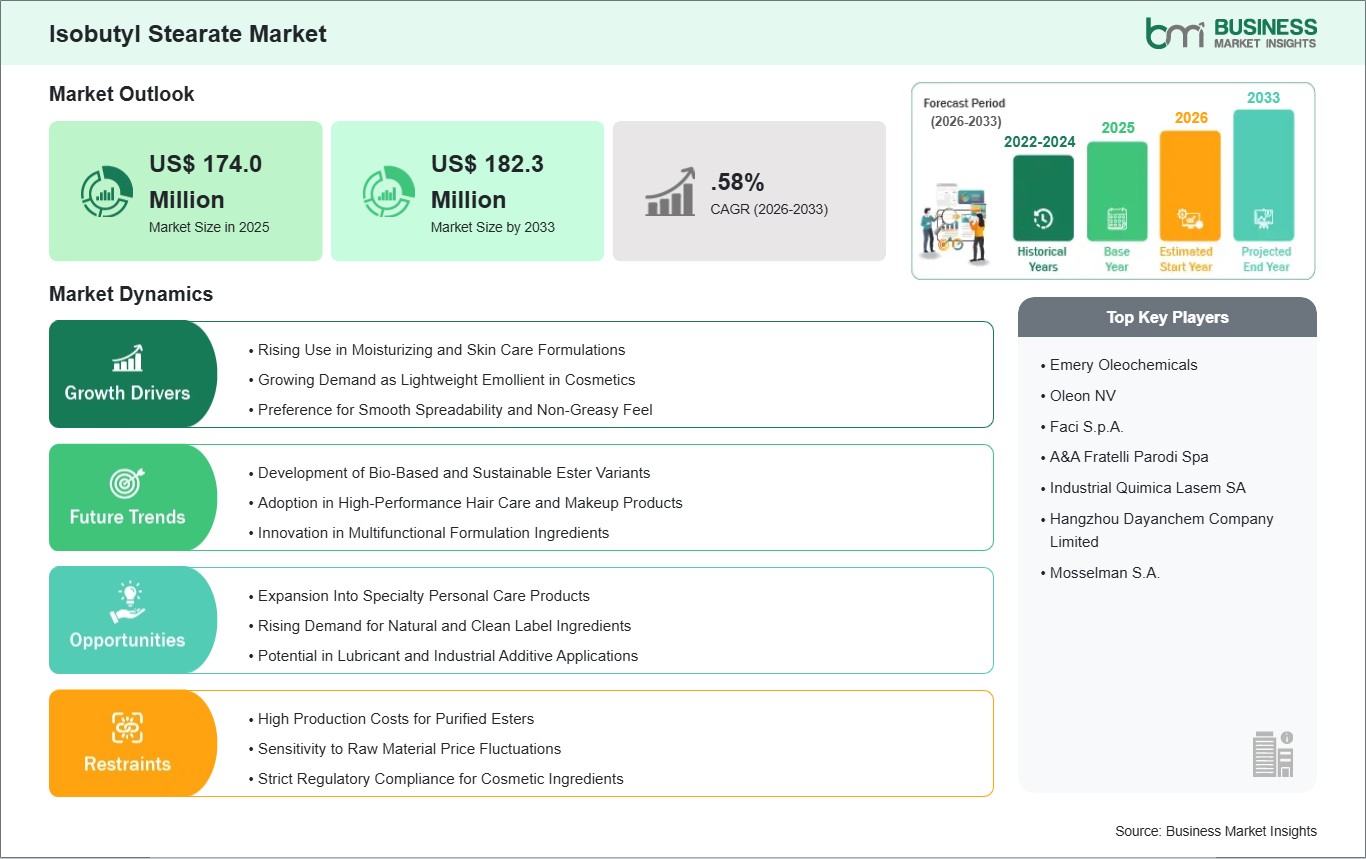
The Isobutyl Stearate Market size is expected to reach US$ 182.3 Million by 2033 from US$ 174.0 Million in 2025. The market is estimated to record a CAGR of .58% from 2026 to 2033.
The global isobutyl stearate market represents the production and use of this highly functional compound in personal care products, cosmetics, industrial lubricants, and various specialty applications. The compound is highly prized for its emollient characteristics and skin feel. The low viscosity and ability to blend with various formulation systems make it an ideal candidate for personal care and cosmetics. The compound is also used in industrial applications as a plasticizer and lubricant. In the personal care and cosmetics industry, the compound competes in the highly functional and growing personal care and cosmetics segment. In the industrial segment, the compound competes in the growing industrial segment. The personal care and cosmetics segment and the industrial segment are the drivers and influencers of the global isobutyl stearate market. The personal care and cosmetics segment and the industrial segment are the drivers and influencers of the global isobutyl stearate market.
One of the significant factors contributing to the growth of the global market is the increase in the need for multifunctional ingredients that can meet the performance and sensory demands of final products. In the cosmetic and skincare industry, for instance, there is a growing tendency for formulators to use isobutyl stearate to meet the demands for desirable spread, rapid absorption, and non-greasy feel, all of which are in line with the evolving consumer experience for premium products. In addition, the need for natural, mild, and dermatologically safe products enhances the role of well-tolerated ingredients such as isobutyl stearate. However, despite the positive growth of the global market, there are challenges that affect the growth of the industry. One of the challenges that affects the growth of the industry is the supply chain risks for fatty acid and alcohol raw materials, prompting companies to concentrate on strategies for raw material sourcing. In addition, the regulatory environment for cosmetic ingredients and their safety profile requires companies to comply and perform tests, especially for markets that have strict safety requirements.

Key segments that contributed to the derivation of the isobutyl stearate market analysis is application.
The global demand for isobutyl stearate has been steadily increasing due to its unique properties as an emollient and skin-conditioning agent in moisturizing formulations. Its light, non-greasy texture allows for quick absorption and smooth application, making it highly desirable in creams, lotions, and body butters. Manufacturers are leveraging these characteristics to enhance the sensory appeal of skin care products while maintaining efficacy. As consumer awareness around skin health grows, particularly for products that provide hydration without clogging pores, the use of isobutyl stearate has become more widespread in daily-use moisturizers and specialty skin care lines.
In addition to its textural benefits, isobutyl stearate contributes to the stability and consistency of formulations, which is critical for both mass-market and premium skin care products. It functions as a co-emollient and dispersing agent, helping other active ingredients blend smoothly and remain evenly distributed. This improves product performance and extends shelf life, which is especially important for global brands distributing products across diverse climates and storage conditions. In emerging markets, where consumers increasingly prefer multi-functional skin care products, isobutyl stearate supports formulations that combine hydration, softening, and lightweight feel, thus driving adoption in a wide variety of personal care products.
Consumer preference for natural-feeling, lightweight moisturizers has further bolstered the global growth of isobutyl stearate in skin care. Its ability to enhance skin spreadability without leaving a sticky or oily residue aligns with trends in clean beauty and daily-use products. As demand for high-performance, easy-to-use formulations continues to rise, manufacturers are increasingly incorporating isobutyl stearate into face creams, serums, and body lotions designed for all skin types. Its combination of functional and sensory benefits positions it as a key ingredient for the next generation of moisturizing and skin care solutions worldwide.
Beyond standard moisturizers, isobutyl stearate is seeing growing adoption in specialty personal care applications due to its versatility and compatibility with advanced formulations. In products such as sunscreens, anti-aging creams, and makeup primers, it enhances texture, improves spreadability, and facilitates uniform application, which is critical for consumer satisfaction. Its non-comedogenic and light emollient properties make it suitable for sensitive or acne-prone skin, further extending its application into specialized skin care niches where performance and skin compatibility are paramount.
The cosmetics sector also increasingly relies on isobutyl stearate to improve product aesthetics, including in lipsticks, foundations, and blushes. Its smooth, silky feel contributes to a refined finish while maintaining product stability over time. By reducing greasiness and enhancing blendability, it allows formulators to create lightweight yet long-lasting products that meet evolving consumer demands. Specialty personal care products often require multifunctional ingredients, and isobutyl stearate’s ability to act as both an emollient and dispersing agent makes it a versatile choice for premium and professional-grade formulations.
In addition, the growing focus on clean, sustainable, and high-performance personal care products is driving innovation with isobutyl stearate. It can be integrated into formulations that reduce reliance on heavy oils or synthetic thickeners, meeting consumer demand for safer and more environmentally conscious alternatives. This trend is particularly evident in advanced facial care, body serums, and specialty treatments targeting niche concerns such as hydration, anti-aging, and sensitive skin protection. As personal care manufacturers continue to diversify their product portfolios with innovative, high-performance offerings, isobutyl stearate is expected to play an increasingly central role in specialty applications across the global market.

The isobutyl stearate market is experiencing steady growth, with market size and share analysis reflecting evolving treatment preferences and competitive dynamics among key players. The report evaluates important subsegments categorized within application, highlighting their respective contributions to overall market performance.
By application, the metalworking subsegment dominated the isobutyl stearate market in 2025. Metalworking applications benefit from its excellent lubricating, anti-wear, and corrosion-resistant properties, driving strong adoption in industrial processes.
| Report Attribute | Details |
|---|---|
| Market size in 2025 | US$ 174.0 Million |
| Market Size by 2033 | US$ 182.3 Million |
| Global CAGR (2026 - 2033) | .58% |
| Historical Data | 2022-2024 |
| Forecast period | 2026-2033 |
| Segments Covered | By Application
|
|
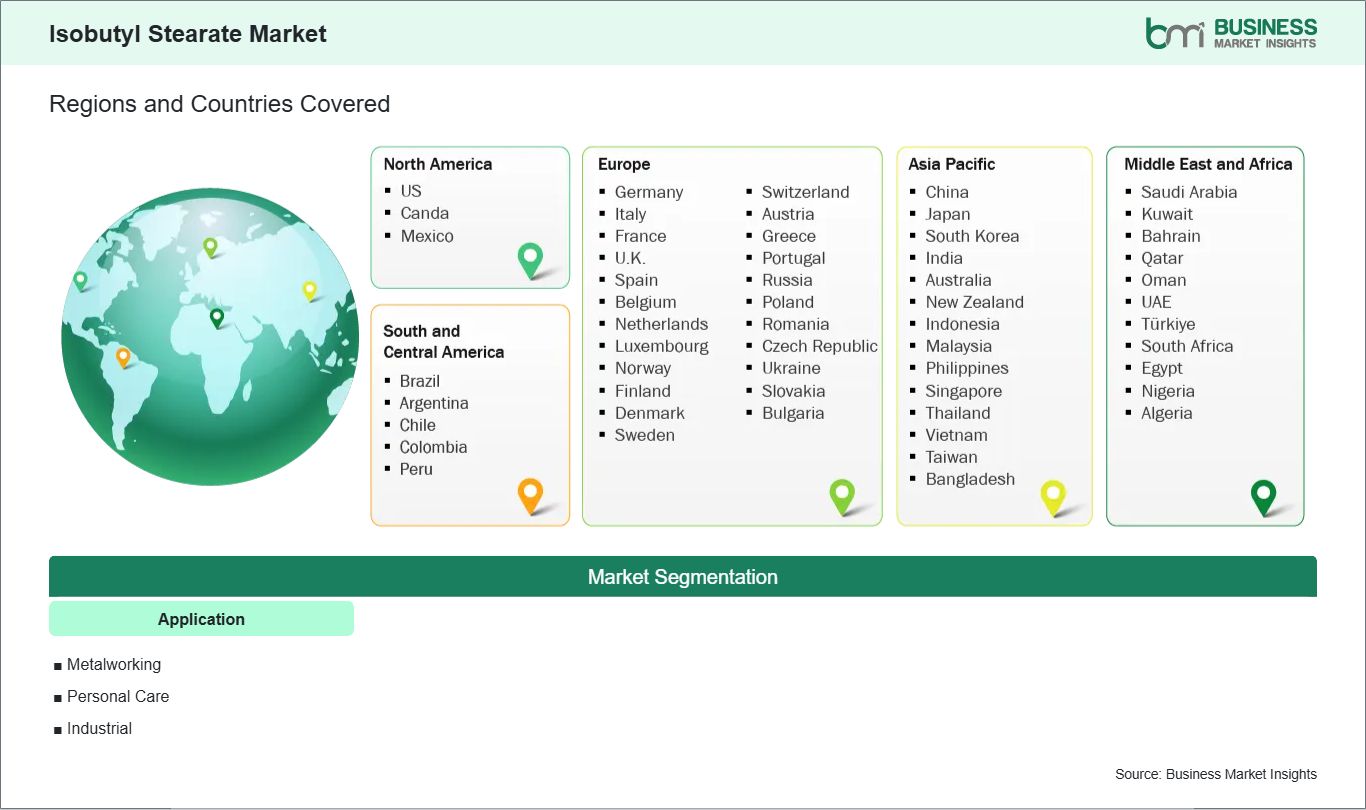
Regions and Countries Covered
| |
| North America | US, Canada, Mexico |
| Europe | Belgium, Austria, Finland, Denmark, Greece, Poland, Romania, Russia, Ukraine, Czech Republic, Slovakia, Bulgaria, Italy, Luxembourg, Germany, Switzerland, France, Netherlands, Norway, Portugal, Spain, Sweden, United Kingdom |
| Asia-Pacific | Australia, China, India, Japan, South Korea, Indonesia, Malaysia, Philippines, Singapore, Thailand, Vietnam, Bangladesh, New Zealand, Taiwan |
| South and Central America | Brazil, Argentina, Peru, Chile, Colombia |
| Middle East and Africa | Bahrain, Kuwait, Oman, Qatar, Saudi Arabia, United Arab Emirates, Turkiye, South Africa, Egypt, Algeria, Nigeria |
| Market leaders and key company profiles |
|
The "Isobutyl Stearate Market Size and Forecast (2022 - 2033)" report provides a detailed analysis of the market covering below areas:
The geographical scope of the Isobutyl Stearate market report is divided into five regions: North America, Asia Pacific, Europe, Middle East & Africa, and South & Central America. The Isobutyl Stearate market in North America is expected to grow during the forecast period.
The region of North America is the most prominent in the market for isobutyl stearate, primarily due to the advanced personal care industry, the quality requirements of the market, and the extensive use of high-performance chemical intermediates. The United States and Canadian markets are home to several personal care companies that specialize in formulating high-quality personal care products, incorporating premium-grade emollients and texture enhancers in their formulations. The sensory properties of isobutyl stearate, coupled with the versatility of the product in various formulations, have made it an integral component of the regional product development process, particularly for personal care product formulations. The presence of an advanced market for cosmetics, which places significant importance on the performance of various personal care ingredients, compels formulators to use functional esters such as isobutyl stearate to meet consumer demands for personal care products.
Apart from personal care, the strong industrial and specialty chemicals industry in North America also contributes to the dominance of the region in the market for isobutyl stearate by tapping into the lubrication, plastic processing, and specialty formulation segments. These countries in the region focus on developing better lubricant additives and processing aids, in which esters such as isobutyl stearate have better chemical and physical characteristics, thus improving the lubricating property of the product. Moreover, the regulations on product safety and environmental concerns have also contributed to the development of better quality product portfolios, which places the regional players in a strong position in the market for formulating better quality ingredients. The support provided by the strong demand from the cosmetics and industrial segments, coupled with the strong regulations, places the regional market in a strong position in the global market for isobutyl stearate.

The isobutyl stearate market is evaluated by gathering qualitative and quantitative data post primary and secondary research, which includes important corporate publications, association data, and databases. A few of the key developments in the isobutyl stearate market are:
The Isobutyl Stearate Market is valued at US$ 174.0 Million in 2025, it is projected to reach US$ 182.3 Million by 2033.
As per our report Isobutyl Stearate Market, the market size is valued at US$ 174.0 Million in 2025, projecting it to reach US$ 182.3 Million by 2033. This translates to a CAGR of approximately .58% during the forecast period.
The Isobutyl Stearate Market report typically cover these key segments-
The historic period, base year, and forecast period can vary slightly depending on the specific market research report. However, for the Isobutyl Stearate Market report:
The Isobutyl Stearate Market is populated by several key players, each contributing to its growth and innovation. Some of the major players include:
The Isobutyl Stearate Market report is valuable for diverse stakeholders, including:
Essentially, anyone involved in or considering involvement in the Isobutyl Stearate Market value chain can benefit from the information contained in a comprehensive market report.
Please tell us your area of interest
(Market Segments/ Regions and Countries/ Companies)