Market Summary
Executive Summary and Global Market Analysis
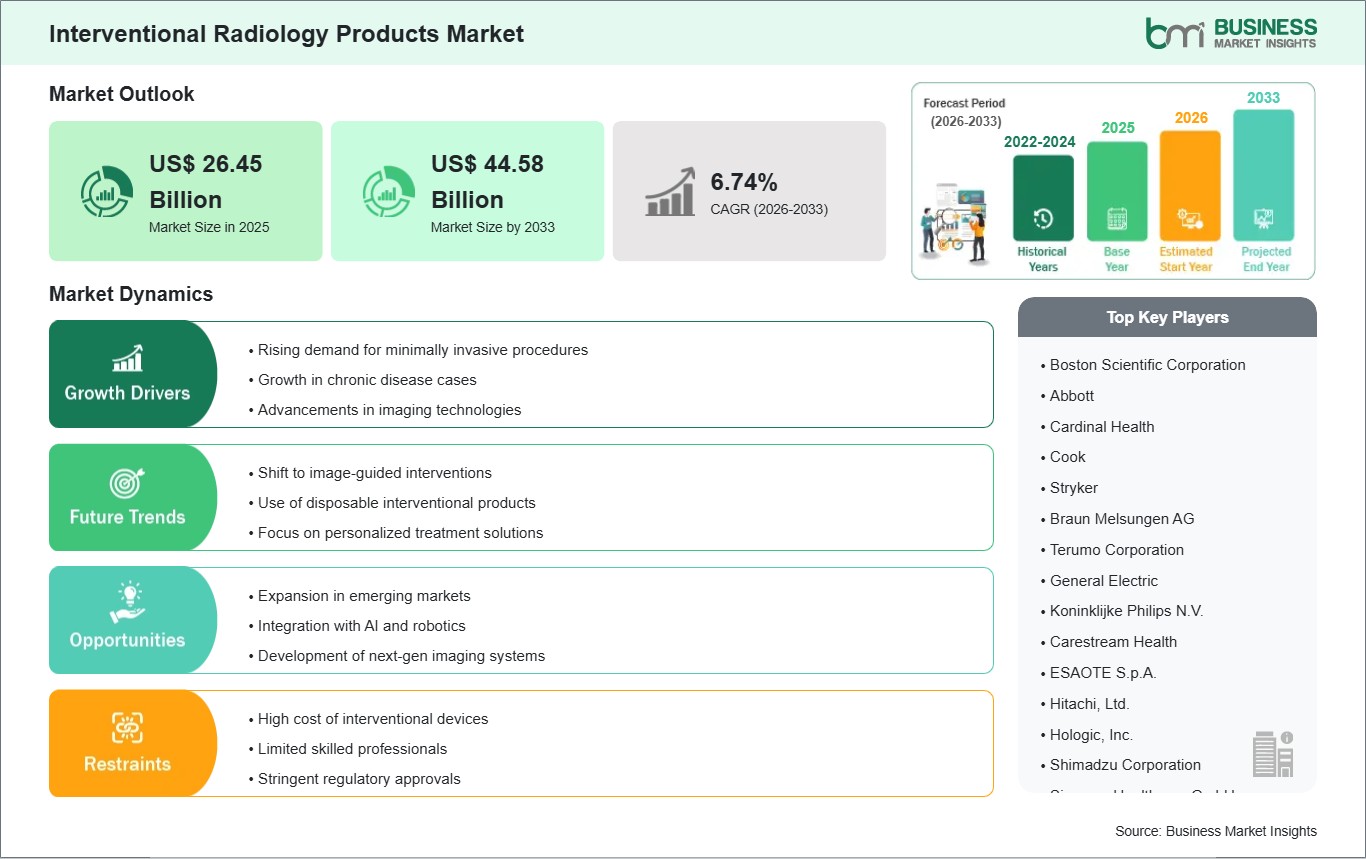
Interventional radiology (IR) represents a transformative approach in modern medicine, leveraging image-guided, minimally invasive techniques to diagnose and treat complex conditions. The market encompasses a wide range of products, including angiography systems, catheters, stents, guidewires, and biopsy devices, all designed to enable precision interventions across cardiology, oncology, neurology, and peripheral vascular domains. These procedures offer significant advantages over traditional surgery, shorter recovery times, reduced hospital stays, and lower overall costs, making IR a cornerstone of value-based healthcare delivery.
However, the market faces notable challenges. High capital expenditure for advanced imaging systems and consumables remains a barrier for smaller healthcare facilities. Regulatory compliance is another critical hurdle, as evolving frameworks such as the EU MDR and FDA guidelines demand rigorous quality assurance and documentation, increasing time-to-market for new products. Additionally, disparities in infrastructure and skilled personnel across emerging economies limit widespread adoption, creating uneven growth patterns globally.
Despite these constraints, the outlook for IR products is highly promising. The rising prevalence of chronic diseases, coupled with an aging population, is driving demand for minimally invasive solutions. Technological advancements, such as AI-powered imaging platforms, photon-counting CT, and robotic-assisted interventions, are redefining procedural accuracy and safety. Furthermore, the shift toward outpatient and ambulatory care settings opens new revenue streams for device manufacturers. Companies that integrate digital workflows, invest in training programs, and align with regulatory best practices are well-positioned to capitalize on these opportunities and secure long-term growth in this dynamic market.
Segment Analysis
Interventional Radiology Products Market Segmentation
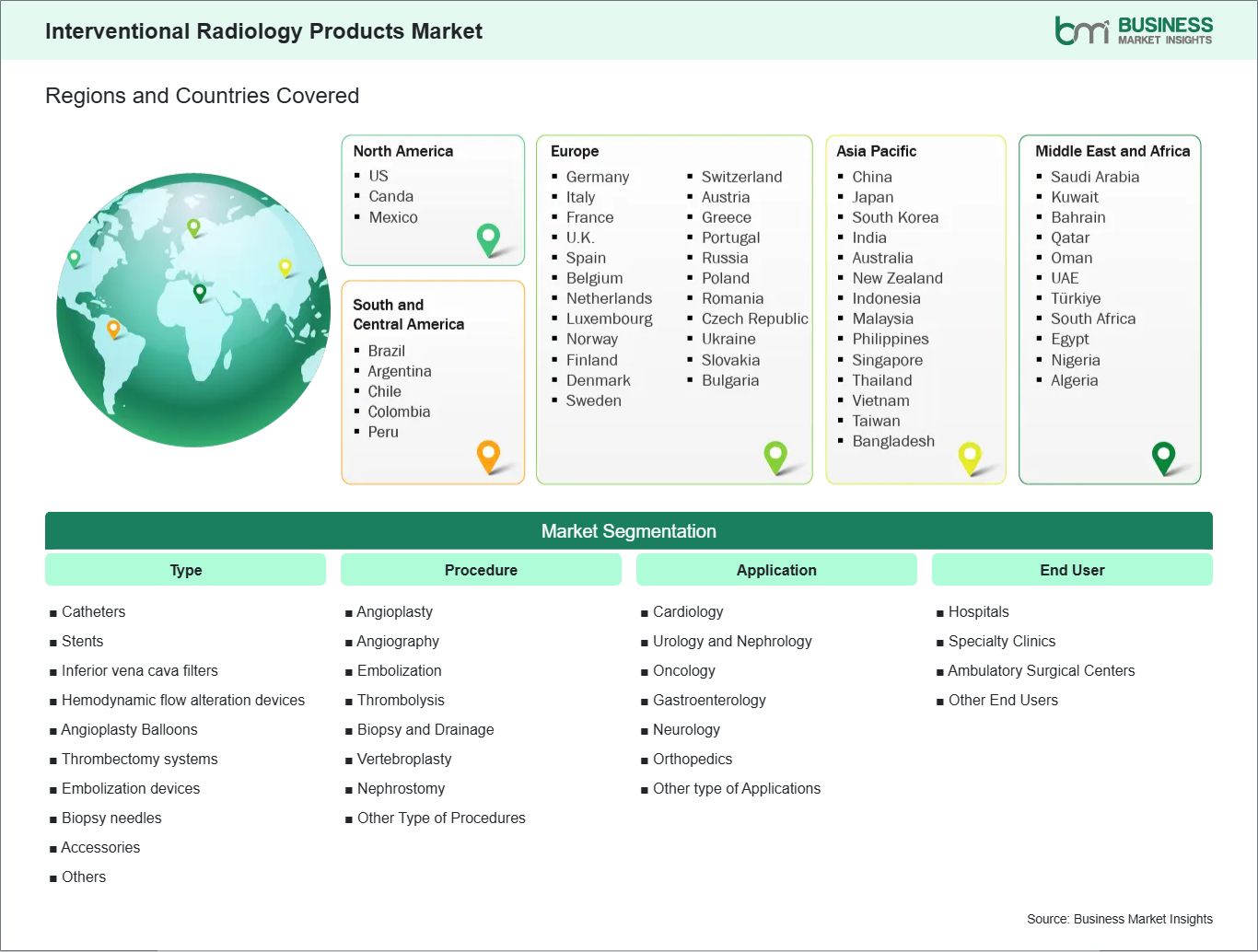
Key segments that contributed to the derivation of the Interventional Radiology Products market analysis are type, procedure, application, and end user.
- By Type, the market is segmented into Catheters, Stents, Inferior Vena Cava Filters, Hemodynamic Flow Alteration Devices, Angioplasty Balloons, Thrombectomy Systems, Embolization Devices, Biopsy Needles, Accessories, and Others.
- By Procedure, the market is segmented into Angioplasty, Angiography, Embolization, Thrombolysis, Biopsy and Drainage, Vertebroplasty, Nephrostomy, and Other Types of procedures.
- By Application, the market is segmented into Cardiology, Urology and Nephrology, Oncology, Gastroenterology, Neurology, Orthopedics, and Other types of Applications.
- By End User, the market is segmented into Hospitals, Specialty Clinics, Ambulatory Surgical Centers, and Other End Users.
Market Forces
Interventional Radiology Products Market Drivers and Opportunities
Rising Prevalence of Chronic and Cardiovascular Diseases
The global healthcare landscape is witnessing an unprecedented surge in chronic conditions, particularly cardiovascular diseases, cancer, and neurological disorders. According to WHO estimates, cardiovascular diseases remain the leading cause of mortality worldwide, accounting for millions of deaths annually. This epidemiological shift is creating immense pressure on healthcare systems to adopt cost-effective, minimally invasive solutions that reduce patient recovery time and hospital resource utilization.
Interventional radiology (IR) products, such as angioplasty balloons, stents, and embolization devices, are increasingly favored for their ability to deliver targeted treatment with fewer complications compared to open surgery. These procedures not only improve clinical outcomes but also align with the growing emphasis on outpatient care and value-based healthcare models. As payers and providers seek to optimize costs while enhancing patient experience, the demand for IR technologies accelerates in tandem across both developed and emerging markets.
Growing Importance of AI-Powered Image-Guided Systems
Artificial intelligence (AI) is redefining the future of interventional radiology by enhancing precision, safety, and workflow efficiency. Advanced AI algorithms integrated into imaging platforms, such as Siemens Healthineers' Optiq AI, enable real-time optimization of image quality, automatic dose adjustments, and predictive analytics during complex interventions. This convergence of AI and imaging hardware addresses critical challenges such as operator variability and radiation exposure, while improving procedural accuracy in high-risk cases like neurovascular and cardiac interventions.
Beyond image enhancement, AI-driven systems facilitate automated segmentation, lesion detection, and decision support, reducing cognitive load on clinicians and shortening procedure times. These innovations open new clinical applications, including robotic-assisted interventions and remote-guided procedures, positioning AI-powered imaging as a strategic differentiator for vendors. Companies that invest in AI integration and regulatory compliance will gain a competitive edge in an increasingly digital and data-driven IR ecosystem.
Size and Share Analysis
Interventional Radiology Products Market Size and Share Analysis
The Interventional Radiology Products market demonstrates steady growth, with size and share analysis revealing evolving trends and competitive positioning among key players. The report further examines subsegments categorized within type, procedure, application, and end user, offering insights into their contribution to overall market performance.
For instance, among types, catheters remain a critical component of interventional radiology procedures due to their versatility in delivering therapeutic agents and enabling vascular access. Their widespread use across angioplasty, embolization, and drainage procedures positions them as a foundational product category. Within procedures, angioplasty stands out as a key growth driver, propelled by the rising prevalence of cardiovascular diseases and the increasing adoption of minimally invasive techniques to restore blood flow in occluded vessels.
In terms of application, cardiology dominates the clinical landscape, as interventional radiology has become integral to coronary interventions, structural heart disease management, and peripheral vascular treatments. Among end users, hospitals account for the largest share, given their advanced infrastructure, skilled personnel, and ability to perform complex image-guided interventions, while ambulatory surgical centers are emerging as a cost-efficient alternative for select procedures.
Report Coverage
Interventional Radiology Products Market Report Coverage and Deliverables
The Interventional Radiology Products Market Size and Forecast (2022–2033) report provides a detailed analysis of the market covering below areas:
- Interventional Radiology Products market size and forecast at global, regional, and country levels for all the key market segments covered under the scope
- Interventional Radiology Products market trends, as well as market dynamics such as drivers, restraints, and key opportunities
- Interventional Radiology Products market analysis covering key market trends, global and regional framework, major players, regulations, and recent market developments
- Industry landscape and competition analysis covering market concentration, heat map analysis, prominent players, and recent developments for the Interventional Radiology Products market
- Detailed company profiles, including SWOT analysis
Geographic Insights
Interventional Radiology Products Market Geographic Insights
The geographical scope of the Interventional Radiology Products market report is divided into five regions: North America, Asia Pacific, Europe, the Middle East & Africa, and South & Central America.
North America remains highly advanced, with established infrastructure and reimbursement policies driving early adoption of IR innovations. Europe closely follows, encouraged by strong regulatory bodies and healthcare modernization efforts. Asia Pacific exhibits the fastest expansion, fueled by increased government healthcare spending and rising procedural volumes in China and India. Latin America, the Middle East, and Africa are gradually upgrading infrastructure, supporting modest but steady IR market growth.
Industry Activity
Recent Developments
The Interventional Radiology Products market is evaluated by gathering qualitative and quantitative data post primary and secondary research, which includes important corporate publications, association data, and databases. A few of the key developments in the Interventional Radiology Products market are:
- In November 2024, Philips launched an enhanced Azurion angiography system in India, optimized for neurovascular, vascular, cardiac, and oncology procedures with advanced C-arm rotation, table-side controls, and a head immobilizer for stroke care.
- In December 2025, Royal Philips announced its acquisition of SpectraWAVE, Inc., an innovator in Enhanced Vascular Imaging (EVI) of coronary arteries, angiography-based physiology assessments, and the use of AI in medical imaging. Philips’ next-generation platform that brings advanced interventional tools together in a single, intuitive environment supporting a wide range of procedures across interventional cardiology, interventional radiology, neuroradiology, and vascular surgery.
Trust & Transparency
Research Methodology
The market analysis combines proprietary research with secondary data from government agencies, company disclosures, regulatory filings, industry databases and expert interviews. Market estimates are validated through data triangulation, cross-market benchmarking and analyst
review.
View Full Research Methodology
Key Sources Referred:
World Bank – Global Trade IndicatorsWorld Trade Organization (WTO)International Monetary Fund (IMF)International Trade Administration (ITA)Company WebsitesCompany Annual ReportsCompany Investor Presentations