Market Summary
Executive Summary and Global Market Analysis
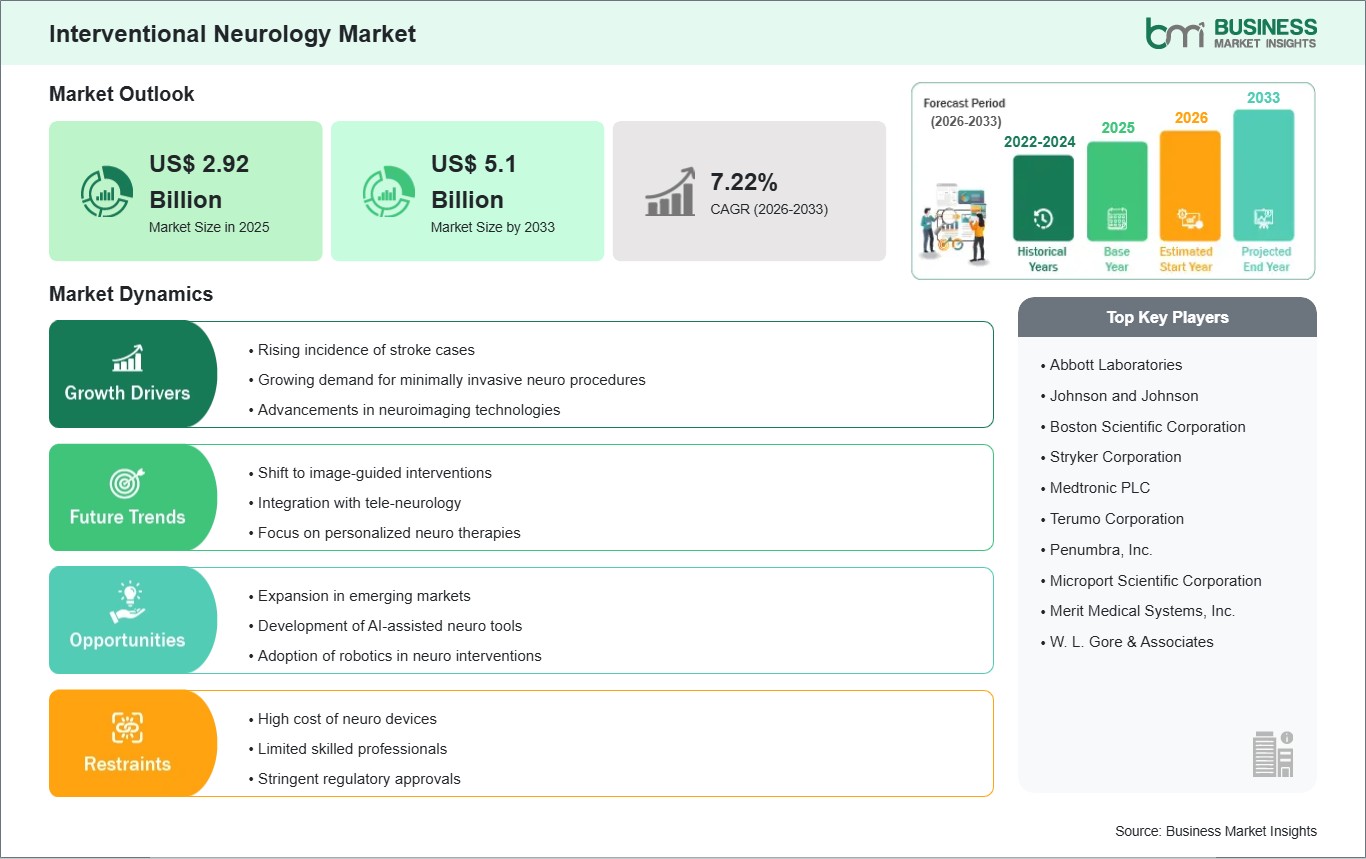
Interventional Neurology, also referred to as neuro intervention or endovascular neurosurgery, comprises minimally invasive, catheter-based procedures to diagnose and treat cerebrovascular conditions such as ischemic stroke, intracranial aneurysms, arteriovenous malformations (AVMs), and carotid artery disease. Core device classes include stent retrievers and aspiration systems for thrombectomy, flow-diverters and intrasaccular implants for aneurysm repair, microcatheters and guidewires, and carotid stents. The clinical value proposition is faster recovery, reduced procedural risk compared to open surgery, and expanding indications underpinned by advances in imaging, navigation, and materials science.
Yet, the sector navigates material and regulatory complexity. Recalls and field actions can disrupt adoption and raise scrutiny. Supply-side pressures (e.g., platinum pricing for coils) and reimbursement variability also affect economics and capital planning for hospital neuro-IR suites. Despite these restraints, enduring demand drivers, aging demographics, broader stroke system-of-care readiness, and rapid device iteration continue to open opportunities. Integration of robotics and AI-guided imaging, collaborative ecosystems between imaging and device leaders, and portfolio expansion by neurovascular pure-plays and diversified medtechs underscore a constructive outlook. Strategic partnerships (e.g., Stryker with Siemens Healthineers on neurovascular robotics) and ongoing product innovation (e.g., Penumbra access and embolization platforms; Terumo Neuro's expanded brand and pipeline) are enabling precision, speed, and workflow gains that expand patient access and sustain market growth.
Segment Analysis
Interventional Neurology Market Segmentation
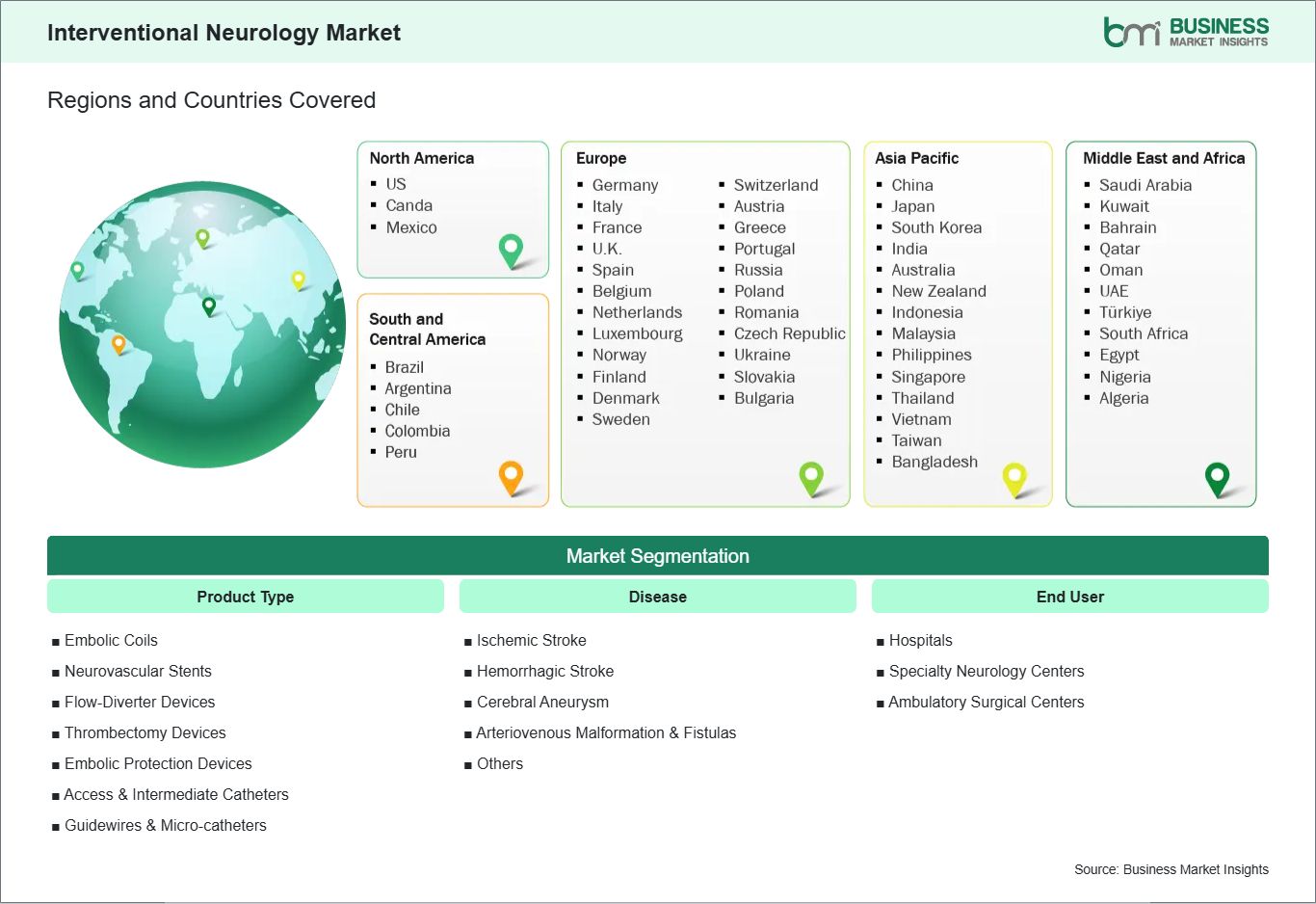
Key segments that contributed to the derivation of the Interventional Neurology market analysis are product type, disease, and end user.
- By Product Type, the market is segmented into Embolic Coils, Neurovascular Stents, Flow-Diverter Devices, Thrombectomy Devices, Embolic Protection Devices, Access & Intermediate Catheters, and Guidewires & Micro-catheters.
- By Disease, the market is segmented into Ischemic Stroke, Hemorrhagic Stroke, Cerebral Aneurysm, Arteriovenous Malformation & Fistulas, and Others.
- By End User, the market is segmented into Hospitals, Specialty Neurology Centers, and Ambulatory Surgical Centers.
Market Forces
Interventional Neurology Market Drivers and Opportunities
Expansion of Mechanical Thrombectomy in Stroke Pathways
Mechanical thrombectomy has firmly established itself as the gold standard for treating large vessel occlusion (LVO) ischemic strokes, driven by compelling clinical evidence and evolving stroke care protocols. As global stroke systems of care mature, hospitals and neuro-interventional centers are investing heavily in infrastructure and training to ensure rapid access to thrombectomy procedures.
The technology landscape continues to advance with next-generation stent retrievers and aspiration catheters designed for improved trackability, clot engagement, and faster reperfusion. These device innovations, combined with AI-powered imaging platforms and workflow optimization tools, are reducing door-to-reperfusion times and expanding treatment windows beyond traditional limits. Furthermore, integrated stroke networks and tele-neurointervention models are enabling broader patient access, even in resource-constrained geographies. This sustained momentum is reinforced by favorable reimbursement policies and strong clinical outcomes, making thrombectomy a cornerstone of neurovascular intervention and a key driver of capital investment in neuro-interventional radiology suites worldwide.
Emergence of Robotics and Image-Guided Ecosystems in Neurovascular Care
The convergence of robotic navigation systems with advanced image-guided technologies represents a transformative opportunity for neurovascular interventions. Robotics enhances procedural precision, minimizes operator fatigue, and significantly reduces radiation exposure, while image-guided platforms deliver real-time visualization and AI-driven decision support. This synergy is paving the way for remote intervention capabilities and hub-and-spoke care models, which are critical for time-sensitive conditions like acute stroke.
Strategic collaborations between leading medtech companies and imaging giants, such as the partnership between Siemens Healthineers and Stryker, signal a clear industry shift toward integrated ecosystems that combine access devices, implants, imaging modalities, and software into a unified workflow. Early adopters of these technologies stand to gain competitive advantages through improved clinical outcomes, higher throughput, and enhanced staff recruitment and retention. Additionally, these innovations open new service lines for complex aneurysm repairs and emergent stroke interventions, positioning providers at the forefront of next-generation neurovascular care.
Size and Share Analysis
Interventional Neurology Market Size and Share Analysis
The Interventional Neurology market demonstrates steady growth, with size and share analysis revealing evolving trends and competitive positioning among key players. The report further examines subsegments categorized within product type, disease, and end user, offering insights into their contribution to overall market performance.
For instance, among product types, flow-diverter devices have emerged as a critical solution for managing complex cerebral aneurysms, offering durable occlusion and reducing retreatment rates compared to traditional coil embolization. Within disease segment, ischemic stroke dominates procedural volumes due to the growing adoption of mechanical thrombectomy as a standard of care for large vessel occlusions, supported by robust clinical evidence and system-level investments in stroke networks. For end users, hospitals remain the primary setting for neurointerventional procedures, driven by their integrated imaging infrastructure, multidisciplinary teams, and ability to manage high-acuity cases, while specialty neurology centers and ASCs are gradually expanding select interventions under optimized reimbursement frameworks.
Report Coverage
Interventional Neurology Market Report Coverage and Deliverables
The Interventional Neurology Market Size and Forecast (2022–2033) report provides a detailed analysis of the market covering below areas:
- Interventional Neurology market size and forecast at global, regional, and country levels for all the key market segments covered under the scope
- Interventional Neurology market trends, as well as market dynamics such as drivers, restraints, and key opportunities
- Interventional Neurology market analysis covering key market trends, global and regional framework, major players, regulations, and recent market developments
- Industry landscape and competition analysis covering market concentration, heat map analysis, prominent players, and recent developments for the Interventional Neurology market
- Detailed company profiles, including SWOT analysis
Geographic Insights
Interventional Neurology Market Geographic Insights
The geographical scope of the Interventional Neurology market report is divided into five regions: North America, Asia Pacific, Europe, the Middle East & Africa, and South & Central America.
North America focuses on comprehensive stroke centers, robust clinical trial participation, and early integration of imaging-AI into neuro-IR workflows. Europe emphasizes evidence-led adoption and training through pan-European societies, with growing interest in robotics pilots. Asia Pacific accelerates capacity building, China, India, and Southeast Asia expand neuro-IR programs and local manufacturing, supporting cost-effective access. The Middle East & Africa prioritize capability development within tertiary hubs to reduce outbound care. South & Central America modernize neurovascular pathways and imaging infrastructure, with select centers scaling thrombectomy volumes and aneurysm programs.
Industry Activity
Recent Developments
The Interventional Neurology market is evaluated by gathering qualitative and quantitative data post primary and secondary research, which includes important corporate publications, association data, and databases. A few of the key developments in the Interventional Neurology market are:
- In February 2025, Brainomix, a pioneer in stroke AI imaging software and European market leader, announced a strategic partnership with Medtronic Neurovascular, a global leader in medical technology. The collaboration aims to enhance stroke care for patients across Western Europe by integrating cutting-edge artificial intelligence (AI) solutions into clinical practice, expanding access to life-changing treatments, and improving patient outcomes.
- In September 2025, Siemens Healthineers and Stryker announced a strategic partnership in the field of neurovascular robotics. The collaboration aims to develop a unique robotic system capable of performing a comprehensive range of elective and emergency neurovascular procedures, including treatment for strokes and aneurysms.
Trust & Transparency
Research Methodology
The market analysis combines proprietary research with secondary data from government agencies, company disclosures, regulatory filings, industry databases and expert interviews. Market estimates are validated through data triangulation, cross-market benchmarking and analyst
review.
View Full Research Methodology
Key Sources Referred:
World Bank – Global Trade IndicatorsWorld Trade Organization (WTO)International Monetary Fund (IMF)International Trade Administration (ITA)Company WebsitesCompany Annual ReportsCompany Investor Presentations