Market Summary
Executive Summary and Global Market Analysis
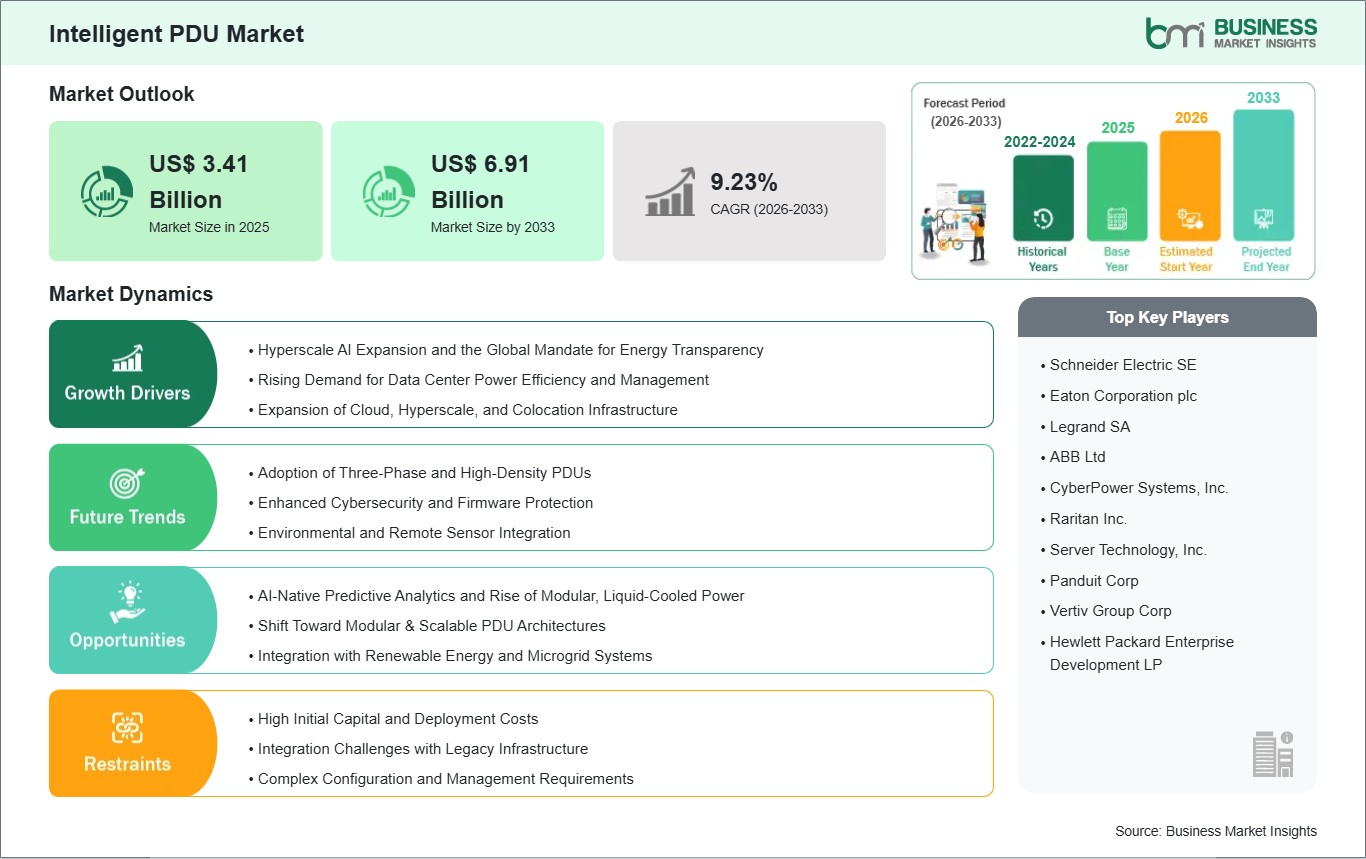
Intelligent Power Distribution Units (iPDUs) refer to networked electrical devices designed to distribute power to multiple IT or industrial assets while providing sophisticated monitoring and control capabilities. Unlike basic units, iPDUs feature integrated network interfaces that allow for real-time power metering, environmental sensing (temperature and humidity), and remote outlet-level switching. Market progression is fundamentally propelled by the exponential growth of high-density AI and GPU-intensive workloads and the rapid expansion of hyperscale data centers. Furthermore, the transition toward carbon-neutral operations, which requires high-precision energy auditing, serves as a primary catalyst for sustained demand.
However, several factors may restrain market progression. The high upfront capital expenditure associated with intelligent units, often significantly more expensive than basic models, can deter adoption in budget-sensitive enterprise environments. Technical complexity remains a hurdle, as the integration of networked PDUs into existing management software requires specialized personnel and rigorous cybersecurity protocols. Additionally, the industry faces challenges related to global supply chain constraints, particularly for the specialized semiconductors and communication modules required for smart monitoring, which can lead to extended deployment schedules for critical infrastructure projects.
Despite these hurdles, the market holds significant opportunities in the expansion of edge computing facilities, where remote management is essential for unstaffed micro-data centers. The rise of cybersecurity-hardened firmware featuring encrypted communication and the development of modular PDU designs that allow for hot-swappable monitoring components are expected to support long-term development. Manufacturers are also finding growth potential in the food and cold-chain industry, where iPDUs are increasingly utilized to monitor the critical power supply to industrial refrigeration and automated processing lines.
Segment Analysis
Intelligent PDU Market Segmentation
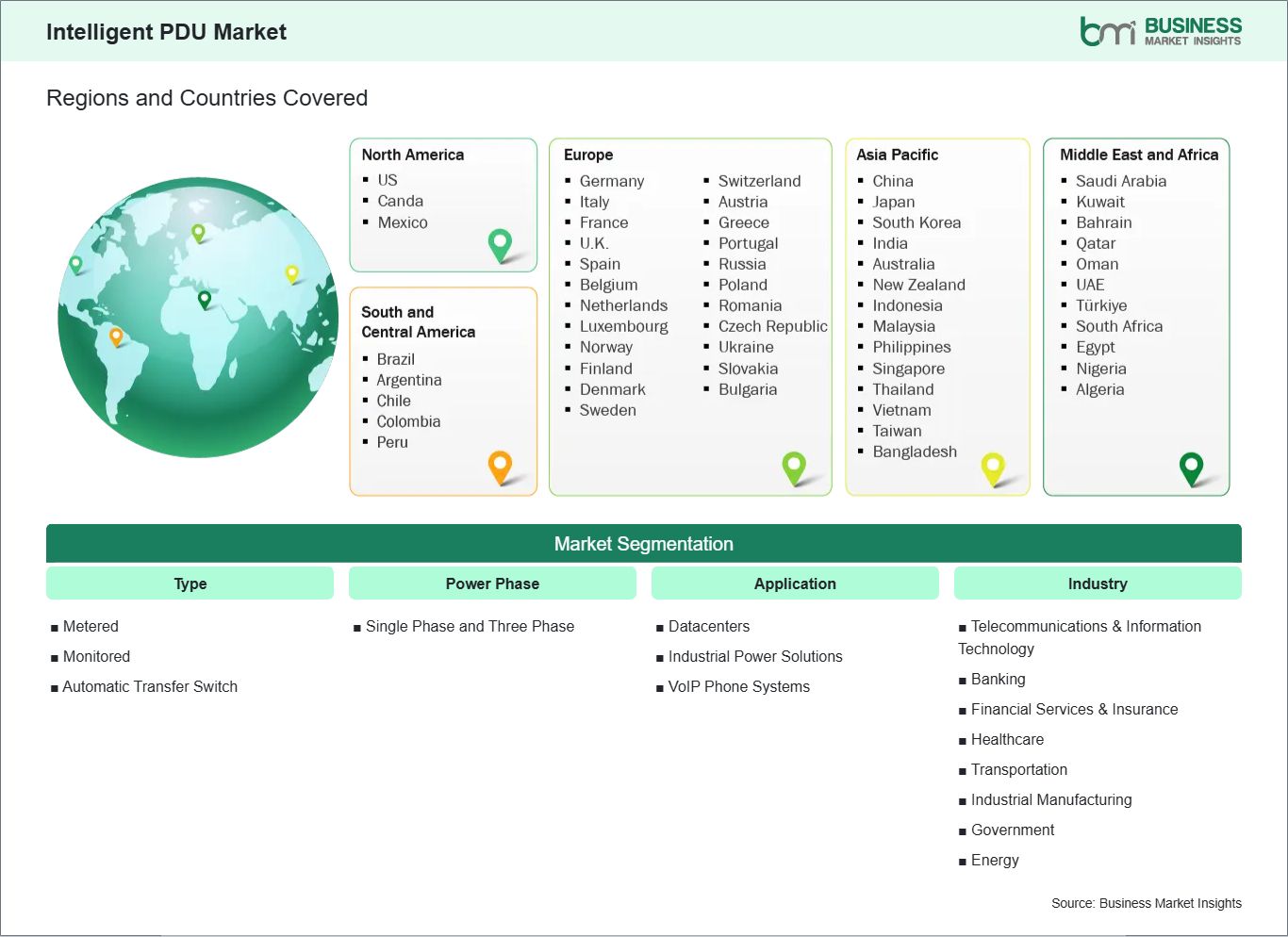
Key segments that contributed to the derivation of the Intelligent PDU market analysis are type, power phase, application, and industry.
- By Type, the market is segmented into Metered, Monitored, and Automatic Transfer Switch.
- By Power Phase, the market is divided into Single Phase and Three Phase.
- By Application, the market is categorized into Datacenters, Industrial Power Solutions, and VoIP Phone Systems.
- By Industry, the market is classified into Telecommunications & Information Technology (Telecom & IT), Banking, Financial Services & Insurance (BFSI), Healthcare, Transportation, Industrial Manufacturing, Government, and Energy.
Market Forces
Intelligent PDU Market Drivers and Opportunities
Hyperscale AI Expansion and the Global Mandate for Energy Transparency
The primary driver for the Intelligent PDU Market is the systemic global requirement to manage escalating rack power densities while adhering to strict environmental and operational efficiency standards. The Proliferation of AI-Ready and Hyperscale Data Centers acts as a foundational catalyst, as training clusters for large language models generate heat and power loads that far exceed the capabilities of basic distribution units, necessitating intelligent monitoring to prevent circuit overloads. This momentum is further propelled by Increasingly Stringent Energy Efficiency and Sustainability Mandates; global regulatory frameworks and corporate environmental, social, and governance goals are compelling facility managers to utilize intelligent PDUs to track Power Usage Effectiveness at the rack level. In the technological sphere, the Rapid Migration from Single-Phase to Three-Phase Power Architectures serves as a vital driver, as enterprises seek to deliver higher wattage to servers while minimizing cable bulk and improving airflow within high-density racks.
Furthermore, the Rising Adoption of Edge Computing and Decentralized IT is driving the demand for switched and monitored PDUs that allow for remote power cycling and environmental sensing in unmanned or geographically remote locations. Together, these factors, AI-driven density, sustainability reporting, and edge expansion, ensure a robust and non-discretionary growth path for the global Intelligent PDU Market.
AI-Native Predictive Analytics and Rise of Modular, Liquid-Cooled Power
A significant high-value opportunity lies in the convergence of Intelligent PDUs with Artificial Intelligence (AI) and Advanced Thermal Management. Next-generation Self-Healing PDUs with Integrated AI-Driven Analytics are being developed to utilize sensor data to forecast potential equipment failures and automatically balance phases, providing a major growth frontier for facilities seeking to eliminate unplanned outages through proactive maintenance. There is also a significant growth frontier in the development of Liquid-Cooling Compatible and High-Heat Tolerant PDU Architectures; as racks move toward immersion and direct-to-chip cooling, the demand for specialized power distribution that can operate reliably in high-thermal environments is accelerating.
Furthermore, the expansion of IoT-Integrated Environmental and Security Sensing presents a lucrative opportunity, as modern PDUs are increasingly serving as central hubs for monitoring rack-level humidity, temperature, and unauthorized physical access. Beyond hardware, the rise of Power-Management-as-a-Service (PMaaS) and Subscription-Based Monitoring offers a unique frontier, enabling organizations to leverage sophisticated energy analytics and remote management without significant upfront capital expenditure. Manufacturers who focus on Enhanced Cybersecurity and Encrypted Firmware, and those pioneering Sustainable, Recyclable Component Designs, are positioned to lead the global Intelligent PDU Market.
Size and Share Analysis
Intelligent PDU Market Size and Share Analysis
Based on type, the Automatic Transfer Switch subsegment is registering the fastest pace of adoption within the power distribution market. These units are becoming essential for Lights-Out Data Center Management, where the ability to remotely reboot frozen servers and shed non-critical loads during power constraints is critical. By offering outlet-level control, Automatic Transfer Switch PDUs provide operators with granular visibility and command over energy distribution, ensuring resilience in mission-critical environments. Their role extends beyond convenience, serving as a strategic enabler of automation, efficiency, and sustainability in modern data centers. As demand for remote management intensifies, this subsegment is rapidly expanding its influence.
Report Coverage
Intelligent PDU Market Report Coverage and Deliverables
The "Intelligent PDU Market Size and Forecast (2022–2033)" report provides a detailed analysis of the market covering below areas:
- Intelligent PDU market size and forecast at global, regional, and country levels for all market segments covered under the scope
- Intelligent PDU market trends, as well as drivers, restraints, and opportunities
- Intelligent PDU market analysis covering key trends, global and regional framework, major players, regulations, and recent developments
- Industry landscape and competition analysis covering market concentration, heat map analysis, prominent players, and recent developments for the Intelligent PDU market
- Detailed company profiles, including SWOT analysis
Geographic Insights
Intelligent PDU Market Geographic Insights
The geographical scope of the Intelligent PDU market report is divided into five regions: North America, Asia Pacific, Europe, Middle East & Africa, and South & Central America.
North America currently maintains the largest revenue share, supported by a dense concentration of hyperscale data centers and the presence of leading technology providers. Asia Pacific is identified as the most rapidly advancing region, propelled by massive digital transformation initiatives in China and India and a surge in edge computing deployments. Europe represents a sophisticated market where growth is sustained by rigorous energy efficiency mandates and the rapid transition toward carbon-neutral data centers.
The Asia-Pacific Intelligent PDU Market serves as a vital engine for global industry expansion, driven by the modernization of IT infrastructure and the proliferation of 5G networks. China and India are leading contributors to regional growth, characterized by significant governmental support for national data center clusters and substantial investments from global colocation providers. Japan and South Korea continue to lead in the development of high-reliability, AI-enabled power management systems, prioritizing operational resilience and predictive maintenance. The region benefits from a maturing semiconductor supply chain and an increasing transition toward High-Density Rack Architectures that require advanced monitoring and switching capabilities.
Industry Activity
Recent Developments
The Intelligent PDU market is evaluated by gathering qualitative and quantitative data post primary and secondary research, which includes important corporate publications, association data, and databases. A few of the key developments in the Intelligent PDU market are:
- In Aug 2025, Panduit launched the EL2P™ intelligent PDU, a next-generation rack power distribution unit designed for automated, secure, and scalable power management. The EL2P enhances efficiency, reliability, and control for modern data center environments. This release strengthens Panduit`s position in the intelligent PDU market, supporting advanced monitoring, automation, and operational uptime.
- In Jul 2025, Chatsworth Products launched the eConnect® PDUs with QuadLock Outlets, offering four outlet types in a single unit for enhanced flexibility, reliability, and high-power support. The intelligent PDUs enable advanced monitoring, secure connections, and scalable deployment for modern data centers. This release strengthens CPI`s position in the intelligent PDU market, supporting AI, high-density, and liquid-cooled infrastructure requirements.
Trust & Transparency
Research Methodology
The market analysis combines proprietary research with secondary data from government agencies, company disclosures, regulatory filings, industry databases and expert interviews. Market estimates are validated through data triangulation, cross-market benchmarking and analyst
review.
View Full Research Methodology
Key Sources Referred:
World Bank – Global Trade Indicators World Trade Organization (WTO) (International Monetary Fund )IMF International Trade Administration (ITA) Company website Company annual reports Company investor presentations