
Influenza Vaccine Market Outlook: Size, Share, Trends, Growth Analysis, Competitive Landscape & Forecast, 2026-2033

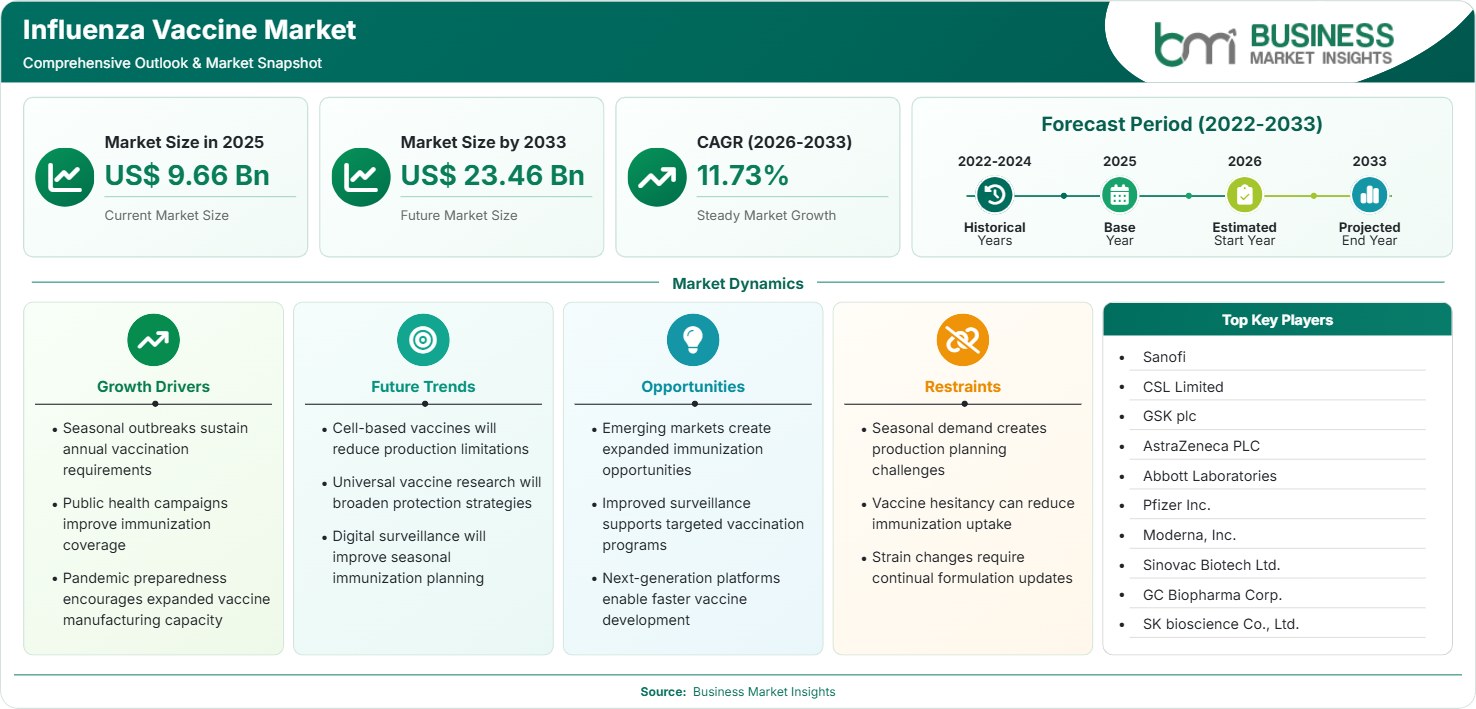
The Influenza Vaccine Market size was valued at US$ 9.66 Billion in 2025 and is projected to reach US$ 23.46 Billion by 2033, growing at a CAGR of 11.73% during 2026–2033, driven by vaccination programs, strain updates, manufacturing innovation, pediatric coverage, adult immunization, and emerging regional supply opportunities.

Report Coverage
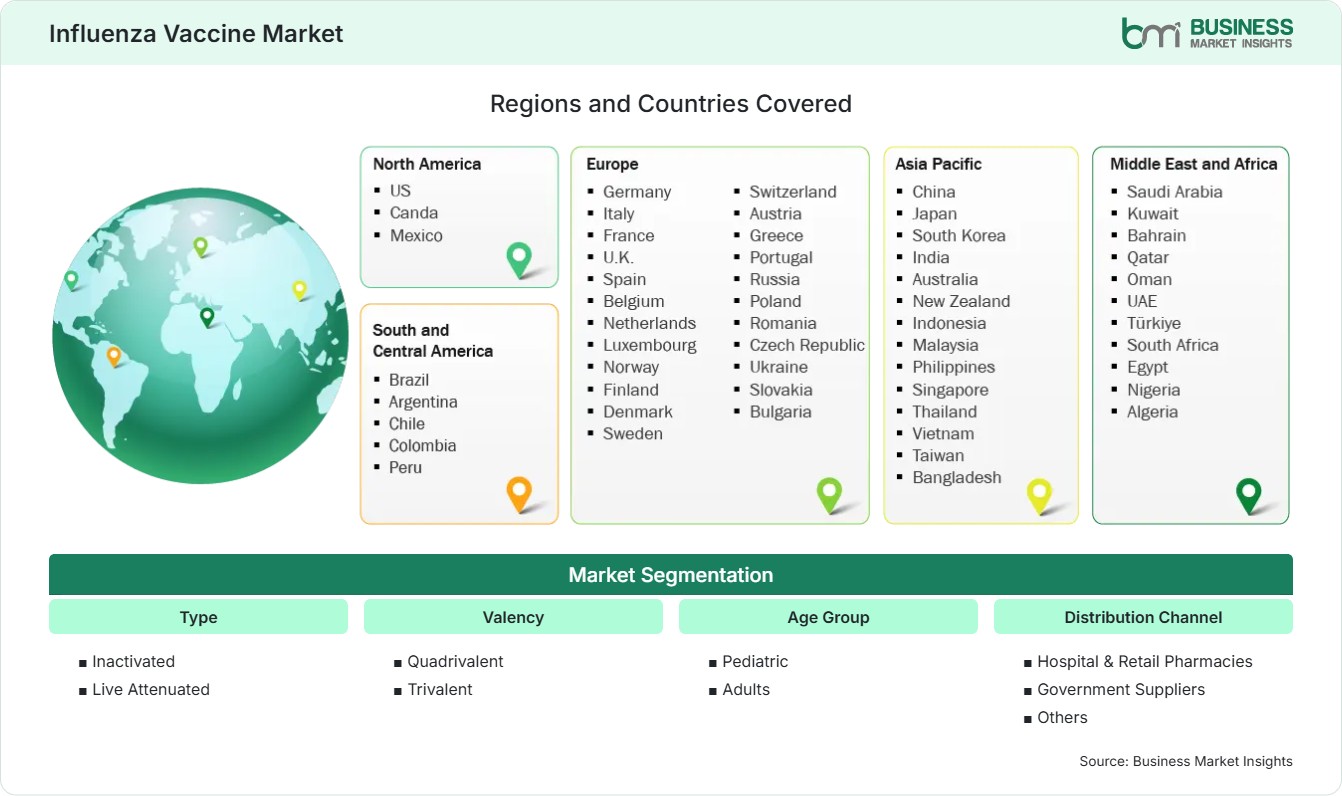
  • Type: Inactivated, Live Attenuated
  • Valency: Quadrivalent, Trivalent
  • Age Group: Pediatric, Adults
  • Distribution Channel: Hospital & Retail Pharmacies, Government Suppliers, Others
US$ 9.66 Bn Market size in 2025
US$ 23.46 Bn Market Size by 2033
11.73% CAGR, 2026 - 2033
2026-2033 Forecast Period

AI Overview

Influenza Vaccine Market Summary

  • North America Region: North America holds Influenza Vaccine Market market share of 38%–41% in 2025, growing at a CAGR of 9.8%–10.6%, influenced by mature vaccination programs, preferential adult immunization, advanced manufacturing, strong reimbursement, and pandemic preparedness investment. The US market remains highly developed, with 9.6%–10.4% CAGR supported by pharmacy access, adult vaccination, and differentiated products.
  • Fastest Growing Region: Asia Pacific holds market share of 22%–25% in 2025, expanding at a CAGR of 13.2%–14.1%, supported by expanding immunization programs, domestic manufacturing, rising healthcare spending, pediatric vaccination, improved distribution, and increasing seasonal disease awareness.
  • Leading Segment: Inactivated vaccines hold market share of 82%–86% in 2025, advancing at a CAGR of 10.9%–11.7%, supported by extensive regulatory familiarity, established manufacturing infrastructure, broad age eligibility, procurement preference, reliable distribution, and diversified formulations across public and private channels.
  • High Growth Segment: Live attenuated vaccines hold market share of 14%–18% in 2025, advancing at a CAGR of 13.0%–14.0%, supported by needle-free administration, pediatric acceptance, intranasal delivery, convenience, differentiated positioning, household vaccination demand, and expansion into markets seeking simpler immunization experiences.
  • Key Market Opportunity: Manufacturers can capture incremental demand through cell-based, recombinant, adjuvanted, intranasal, combination, and pandemic-ready platforms that improve convenience, strain responsiveness, population targeting, supply resilience, and public procurement value.
  • Major Market Players: Sanofi; CSL Limited; GSK plc; AstraZeneca PLC; Abbott Laboratories; Pfizer Inc.; Moderna, Inc.; Sinovac Biotech Ltd.; GC Biopharma Corp.; SK bioscience Co., Ltd.
Strategic Insights

Influenza Vaccine Market: Strategic Insights

Influenza Vaccine Market Strategic Framework
FREE PDF
Request your free sample
Request free sample
Stakeholder View

Key Takeaways

  • The supply chain is becoming more integrated, with manufacturers, antigen suppliers, contract producers, distributors, pharmacies, governments, and surveillance networks coordinating around shorter seasonal production cycles.
  • The strongest upside lies in differentiated products serving older adults, children, needle-averse populations, and countries expanding routine seasonal vaccination beyond narrowly defined high-risk groups.
  • Product innovation is moving toward cell-based, recombinant, adjuvanted, intranasal, mRNA-enabled, and combination approaches that can improve flexibility, convenience, immune response, or pandemic readiness.
  • Asia Pacific offers the strongest investment case because expanding immunization infrastructure is occurring alongside domestic vaccine manufacturing, urban healthcare expansion, and increasing government emphasis on supply security.
  • Investment priorities increasingly favor manufacturing localization, platform technology, strategic partnerships, and capacity expansion rather than simple volume additions, creating opportunities for targeted alliances and selective consolidation.
  • Procurement resilience is becoming a competitive differentiator as governments seek diversified suppliers, regional production capabilities, and technologies capable of responding rapidly to evolving influenza strains.
Geographic Outlook

Influenza Vaccine Market Regional Highlights

North America Influenza Vaccine Market

North America represents 38%–41% of global Influenza Vaccine Market share in 2025 and is projected to expand at a CAGR of 9.8%–10.6% through 2033. The region benefits from established adult immunization infrastructure, broad pharmacy access, government procurement, differentiated vaccines, and sophisticated seasonal surveillance. The United States remains the principal contributor, while Canada supports demand through public vaccination programs and pandemic preparedness contracts. Premium formulations for older adults provide an important value-growth pathway, while intranasal products improve convenience. Regional manufacturers are also increasing attention to cell-based production, adjuvant technologies, and scalable emergency supply.

  • Mature pharmacy vaccination networks support convenient administration while reducing pressure on physician offices and hospitals during seasonal peaks.
  • Premium, adjuvanted, high-dose, recombinant, and cell-based products create opportunities for manufacturers to differentiate beyond conventional inactivated formulations.
  • Public procurement increasingly values supply resilience, domestic capacity, pandemic preparedness, and rapid production capabilities alongside conventional seasonal pricing.
  • Employer vaccination programs and retail pharmacy campaigns can sustain adult coverage by improving access during concentrated seasonal vaccination windows.

US Influenza Vaccine Market

The US Influenza Vaccine Market accounts for 78%–82% of North American share in 2025 and is projected to grow at a CAGR of 9.6%–10.4% through 2033. Its leadership reflects extensive pharmacy distribution, established reimbursement pathways, high-risk adult vaccination priorities, and diversified product availability. Retail pharmacies provide a major access point, while pediatric and adult vaccination programs maintain recurring seasonal demand. The market also supports differentiated formulations targeting older adults, alongside intranasal delivery for eligible younger populations. Pandemic preparedness procurement is increasing the strategic relevance of cell-based and adjuvanted manufacturing capabilities.

  • Retail pharmacies remain central to seasonal vaccination because they combine broad geographic reach, established cold-chain infrastructure, and convenient administration for adults.
  • Older-adult vaccination supports premium product adoption, particularly where clinical evidence and public-health recommendations differentiate higher-dose, adjuvanted, or recombinant formulations.
  • At-home intranasal administration expands convenience and could reduce access barriers for eligible households seeking alternatives to conventional injection-based vaccination.

Europe Influenza Vaccine Market

Europe Influenza Vaccine Market holds 26%–29% share in 2025 and is projected to grow at a CAGR of 10.4%–11.2% through 2033. Western European countries provide the largest contribution through established national vaccination programs, while Central and Eastern Europe offer higher expansion potential as coverage infrastructure develops. Germany and France remain leading markets, with approximately 10.2%–11.0% and 10.0%–10.8% growth ranges, respectively. Italy, Spain, and the United Kingdom support additional demand through aging populations and broader adult immunization initiatives. Procurement standardization and manufacturing resilience remain strategic priorities.

  • Germany combines substantial older-adult demand with established physician and pharmacy distribution, supporting sustained uptake of differentiated seasonal formulations.
  • France benefits from structured vaccination campaigns and strong public-health coordination, creating predictable seasonal procurement requirements across priority populations.
  • The United Kingdom provides a mature public vaccination ecosystem, with pharmacy and primary-care delivery supporting broad seasonal access and recurring demand.
  • Southern European markets provide expansion potential as aging demographics, chronic disease prevalence, and vaccination awareness reinforce adult immunization opportunities.

Asia Pacific Influenza Vaccine Market

Asia Pacific Influenza Vaccine Market accounts for 22%–25% share in 2025 and is projected to expand at a CAGR of 13.2%–14.1%, making it the fastest-growing regional market. China, Japan, South Korea, India, and Australia form the principal demand centers, while India and Southeast Asia offer particularly strong expansion opportunities. Domestic manufacturing, government-supported immunization initiatives, rising healthcare expenditure, and improving cold-chain infrastructure are broadening access. Regional producers are also increasing cell-based and advanced platform capabilities. Population density, seasonal variability, and growing respiratory-health awareness strengthen recurring vaccination requirements.

  • China combines large population scale with expanding vaccine manufacturing capacity, creating opportunities for both domestic suppliers and international technology partnerships.
  • India offers high long-term potential as private vaccination expands, healthcare infrastructure improves, and manufacturers strengthen domestic and export-oriented seasonal vaccine production.
  • Japan maintains sophisticated adult and elderly vaccination infrastructure, supporting demand for established products while creating room for premium formulations.
  • South Korea combines advanced vaccine manufacturing with export capabilities, creating a platform for regional supply diversification and technology-led product development.

Rest of World Influenza Vaccine Market

South and Central America Influenza Vaccine Market accounts for an estimated 5%–7% share in 2025 and supports regional expansion through government procurement, seasonal vaccination, and strengthening local manufacturing. Brazil and Argentina remain important markets, while Mexico provides additional scale through public-health infrastructure. Regional production partnerships are increasingly relevant as governments seek more resilient supply and reduced dependence on distant manufacturing networks.

Middle East and Africa represent approximately 4%–5% share, with 11.0%–12.0% regional CAGR potential. Saudi Arabia, the United Arab Emirates, and South Africa are leading markets, while Gulf countries provide attractive growth opportunities through healthcare investment, mass gatherings, and preparedness programs.

  • Brazil benefits from organized public vaccination campaigns and established domestic vaccine capabilities, supporting recurring procurement and broader population coverage.
  • Argentina is emerging as a regional manufacturing hub as technology-transfer arrangements strengthen local filling, distribution, and pandemic preparedness capabilities.
  • Saudi Arabia presents differentiated demand because mass gatherings increase the value of reliable seasonal supply, local production, and rapid-response preparedness.
  • South Africa provides a strategic African entry point because healthcare infrastructure and vaccine distribution networks can support broader regional expansion.
Global Market Geography
FREE PDF
Request your free sample
Request free sample
Segment Analysis

Influenza Vaccine Market Segmentation

Type

Inactivated vaccines command 82%–86% share in 2025 and are projected to grow at a CAGR of 10.9%–11.7%, supported by regulatory familiarity, manufacturing scale, broad eligibility, and extensive procurement. Live attenuated products represent a smaller but faster-growing opportunity as intranasal delivery improves convenience and pediatric acceptance. The Influenza Vaccine Market scope therefore increasingly spans established injectable platforms and differentiated administration technologies.

  • Inactivated: Established manufacturing, broad regulatory acceptance, and extensive use across pediatric and adult populations sustain demand, while cell-based, recombinant, high-dose, and adjuvanted variants support premiumization.
  • Live Attenuated: Intranasal administration provides a needle-free alternative, supporting pediatric acceptance, convenience-focused vaccination, household immunization, and differentiated positioning where regulatory eligibility permits.

Valency

Quadrivalent and trivalent formulations are both commercially relevant as manufacturers manage the global transition toward trivalent vaccines. Trivalent adoption is strengthening as WHO recommendations remove the need for the B/Yamagata component, while quadrivalent products remain relevant in markets where the transition has not been completed. Formulation changes create recurring replacement demand and require manufacturers to synchronize production, regulatory filings, inventory, and distribution.

  • Quadrivalent: Established portfolios retain demand where regulatory transitions remain incomplete, supported by familiarity, existing procurement contracts, and inventories across selected markets and distribution systems.
  • Trivalent: Growing alignment with WHO recommendations supports transition, manufacturing simplification, and portfolio modernization while maintaining protection against the currently relevant influenza A and B lineages.

Age Group

Adults are the key demand group since seasonal vaccination programs focus on vaccinating the elderly, healthcare providers, pregnant women, and people with chronic diseases. Pediatric vaccines are expected to show strong growth potential due to government initiatives and the preference for ease of administration. Demographic aging, chronic diseases, and lifelong vaccination will continue to drive adult demand, while intranasal vaccines can encourage pediatric demand. These dynamics shape the Influenza Vaccine Market trends across developed and emerging healthcare systems.

  • Pediatric: Demand is supported by routine prevention priorities, school and community vaccination opportunities, parental awareness, and interest in needle-free delivery for eligible children.
  • Adults: Aging populations, chronic disease prevalence, occupational exposure, and established public vaccination recommendations create recurring demand, particularly for higher-value differentiated formulations.

Distribution Channel

Hospital and retail pharmacies continue to play a central role in distribution, while government supplies handle the bulk purchases required for national and regional campaigns. The growth in the number of retail pharmacies provides greater convenience, while bulk purchases through government supply ensure consistent seasonal demand. Other distribution channels include clinics, occupational healthcare providers, employer initiatives, and community vaccine clinics.

  • Hospital & Retail Pharmacies: Broad access, established cold chains, trained vaccinators, and convenient scheduling make pharmacies increasingly important for adult and seasonal vaccination delivery.
  • Government Suppliers: Public procurement aggregates demand, supports priority populations, and creates predictable volumes, particularly where national immunization programs provide centralized purchasing mechanisms.
  • Others: Clinics, employers, schools, community providers, and occupational-health programs extend vaccination access and can improve coverage among populations underserved by traditional channels.
Market Forces

Influenza Vaccine Market Dynamics

Key Market Drivers

Recurring Seasonal Disease Burden

The seasonal flu requires regular vaccinations due to waning immunity and viral evolution. The World Health Organization estimates that seasonal flu infections number 1 billion per year, including 3-5 million severe cases and respiratory deaths among 290,000-650,000 people. This recurring burden of disease keeps purchasing alive in both public and private sectors. Yearly recommendations for strains also contribute to a recurring cycle of manufacturing, ensuring that demand will not be a once-in-a-lifetime immunization event. The Influenza Vaccine Market growth, therefore, relies on a replacement-cycle structure and is not solely dependent on first-time adoption. Repetition of vaccinations is an important factor for the effective utilization of capacity, distribution relationships, and portfolios. Companies with adaptable production platforms will be able to handle changes in composition due to new surveillance information or changes in government policies.

Expansion of Adult and Pediatric Immunization

Vaccination rates among the elderly, children, pregnant women, healthcare professionals, and those with chronic illnesses have been increasing the addressable population. WHO categorizes these priority populations as needing seasonal influenza vaccination, whereas national initiatives increasingly rely on pharmacies, primary care providers, schools, and community-based settings to deliver these vaccines. The aging of populations is especially important since elderly individuals are at an increased risk of developing serious health complications and being hospitalized. Vaccinating children can enhance family awareness of the issue, since decisions about vaccines are typically made by parents or other caregivers. These changes are contributing to developments in the influenza vaccine market trends, including age-specific vaccines, administration convenience, and unique immune response considerations.

Manufacturing Technology and Supply Resilience

New developments in cell-based, recombinant, adjuvanted, and advanced manufacturing technology are redefining competitive differentiation. Despite the importance of egg-based technology given its scale and experience, alternative technologies may mitigate certain vulnerabilities and offer greater processing flexibility. Recent preparedness contracts increasingly emphasize the use of cell-based technology to respond quickly to pandemics. Innovation is also contributing to the development of premium vaccines for seniors as well as combined vaccines for influenza and other respiratory viruses. Thus, innovation not only broadens the commercial opportunity of producers beyond the supply of antigens. Producers with flexible technologies could increase their resiliency, participate in regional manufacturing collaborations, and meet requirements regarding secure supply.

Key Market Opportunities

Regional Manufacturing Localization

Asian Pacific, Middle Eastern, and Latin American governments have become more interested in producing vaccines domestically or regionally to minimize vulnerability to external disruptions in vaccine supply. Fill-finish services, technology transfer, and contract manufacturing can help minimize supply chains while providing health-security skills to a nation. This provides investment opportunities for existing companies with transferable technologies, such as cell-based, inactivated, and adjuvant technologies. Regional collaborations can also make it easier for them to secure public tenders by leveraging their global manufacturing experience alongside their local understanding of regulations and distribution channels. Influenza Vaccine Market Forecasts therefore recommend an approach that combines business growth and supply security considerations. New entrants to these markets can leverage their seasonal influenza manufacturing capabilities to develop a pandemic vaccine portfolio and manufacturing capabilities.

Combination and Next-Generation Vaccines

Flu vaccines, combined with vaccines for other respiratory infections, can make administration easier. Research that includes influenza and COVID-19 shows how useful one-time vaccination can be. However, regulatory and immunogenicity hurdles are significant. The emergence of new techniques, including mRNA, recombinant, cell-based, and adjuvant platforms, enables exploration of opportunities to accelerate development and create unique immunogenicity profiles. The key here is to focus on platforms that offer scalability, clinical trials, and regulatory support, but not novelty. The benefits of these platforms include addressing annual production challenges, improving user-friendliness, reducing acceptance rates, and protecting vulnerable segments of the population.

Convenience-Led Vaccination Delivery

Needle-free intranasal administration, pharmacy delivery, employer initiatives, community immunization, and even home-based approaches could all help overcome access barriers and increase seasonal immunization rates. An example of the former is the roll-out of the FluMist administered by AstraZeneca. Convenience will prove particularly relevant to children, adults, and those who shy away from needles. Moreover, innovations in delivery will enable producers and providers of seasonal vaccinations to take their immunization campaigns out of the conventional setting. This is particularly true where regulations allow decentralized administration and where scheduling tools enable coordination between supply and demand.

Market Restraints and Challenges

Strain Evolution and Production Timing

Factor: Influenza viruses keep changing, necessitating regular adjustments to vaccine formulations and production that must be coordinated. Recommendations by the WHO are issued semiannually for the northern and southern hemispheres, leaving companies with limited time to develop, test, regulate, produce, and deliver their products. Impact: The shortened production period increases complexity and risk for inventory and forecasting. A mismatch between the chosen strains and the existing viruses could also diminish the product's perceived value. The producers must have surveillance systems, a flexible manufacturing process, and proper inventory management strategies. These add to fixed costs and work to the detriment of smaller companies with less diversified manufacturing capacity.

Coverage Gaps and Procurement Constraints

Factor: Vaccination rates across seasons vary among nations and demographics, with public procurement prioritizing product availability at affordable prices over product differentiation. Impact: Manufacturers would have little willingness to pay for superior technologies despite their increased research and production costs. Misinformation, low health care awareness, limited access to health services, and inconsistent government programs could also be factors affecting demand in emerging markets. The concentration of procurement efforts by companies could expose them to the risks of relying on a single tender or a single government decision in national procurement.

Company Analysis

Competitive Landscape

The Influenza Vaccine Market analysis indicates a moderately concentrated competitive environment in which global vaccine manufacturers compete through portfolio breadth, manufacturing capacity, regulatory reach, distribution relationships, differentiated technologies, and pandemic preparedness capabilities.

Company Name

Overview

Products and Services relevant to this market

Sanofi

Global pharmaceutical and vaccine manufacturer with substantial seasonal influenza expertise and broad international commercial reach.

Fluzone, Fluzone High-Dose, Flublok, seasonal influenza vaccines, combination development, pandemic influenza research, and vaccine manufacturing.

CSL Limited

Australian biotechnology company with a major influenza franchise emphasizing differentiated cell-based and adjuvanted technologies.

CSL Seqirus influenza portfolio, Flucelvax, Fluad, Afluria, cell-based manufacturing, adjuvant technology, and pandemic preparedness.

GSK plc

Global biopharmaceutical company with established vaccine manufacturing and broad international distribution capabilities.

Fluarix, seasonal influenza vaccines, vaccine manufacturing, formulation development, and public-health supply programs.

AstraZeneca PLC

Science-led biopharmaceutical company distinguished by its live attenuated intranasal influenza platform.

FluMist trivalent live attenuated influenza vaccine, intranasal delivery, pediatric vaccination, and self-administration pathways.

Abbott Laboratories

Diversified healthcare company combining influenza vaccine presence in selected markets with strong respiratory diagnostics capabilities.

Influvac seasonal influenza vaccine, respiratory testing, diagnostics, and healthcare distribution across emerging markets.

Pfizer Inc.

Global pharmaceutical company investing in advanced vaccine platforms and combination respiratory immunization approaches.

Influenza vaccine research, mRNA influenza candidates, combination influenza and COVID-19 development, and vaccine research capabilities.

Moderna, Inc.

Biotechnology company applying mRNA technology to seasonal and pandemic respiratory vaccine development.

mRNA influenza candidates, respiratory vaccine platforms, clinical development, manufacturing technology, and pandemic preparedness research.

Sinovac Biotech Ltd.

China-based vaccine manufacturer with established infectious-disease vaccine production and domestic market capabilities.

Seasonal influenza vaccines, vaccine manufacturing, infectious-disease portfolio development, and distribution capabilities.

GC Biopharma Corp.

South Korean vaccine manufacturer with established seasonal influenza production and growing international reach.

GC FLU influenza vaccines, trivalent and quadrivalent products, prefilled syringes, WHO-aligned production, and export supply.

SK bioscience Co., Ltd.

South Korean vaccine specialist developing cell-based and advanced influenza technologies for domestic and international markets.

SKYCellflu trivalent and quadrivalent vaccines, cell-based manufacturing, adjuvanted influenza candidates, and international supply partnerships.

Trust & Transparency

Research Methodology

The market analysis combines proprietary research with secondary data from government agencies, company disclosures, regulatory filings, industry databases and expert interviews. Market estimates are validated through data triangulation, cross-market benchmarking and analyst review.

View Full Research Methodology

Questions Answered

Frequently Asked Questions

Why is Asia Pacific attractive for vaccine investment?

Asia Pacific combines large populations, expanding healthcare expenditure, improving immunization infrastructure, growing domestic manufacturing capabilities, and increasing government attention to health security. These factors create opportunities for both established manufacturers and regional technology partners.

How can manufacturers reduce seasonal supply risk?

Manufacturers can diversify production technologies, regionalize fill-finish operations, maintain flexible manufacturing capacity, strengthen surveillance capabilities, and establish long-term government procurement relationships. Cell-based production and regional partnerships can further reduce selected supply-chain dependencies.

Why are trivalent vaccines becoming more important?

The transition reflects the absence of detected B/Yamagata circulation and WHO recommendations that no longer require an updated B/Yamagata component. Manufacturers are consequently adapting portfolios, production processes, regulatory filings, and procurement strategies toward trivalent formulations.

What role does WHO play in seasonal vaccine development?

WHO coordinates global surveillance and recommends vaccine virus compositions for northern and southern hemisphere seasons. These recommendations guide national regulators and manufacturers, directly influencing formulation, production planning, testing, licensing, and seasonal distribution.

What is driving demand for differentiated influenza vaccines?

As per the Influenza Vaccine Market report, demand is increasingly influenced by population aging, pediatric vaccination, pharmacy access, and preference for products designed around specific immune-response needs. High-dose, adjuvanted, recombinant, cell-based, and intranasal technologies provide manufacturers with opportunities to differentiate products beyond conventional seasonal vaccines.

Access the Full Influenza Vaccine Market Report

Get segment-level forecasts, regional estimates, competitive benchmarking, company profiles and downloadable Excel datasets.

Access the full Influenza Vaccine Market Report
350 pages PDF & Excel | 2026-10-05
Similar Research

Related Market Reports