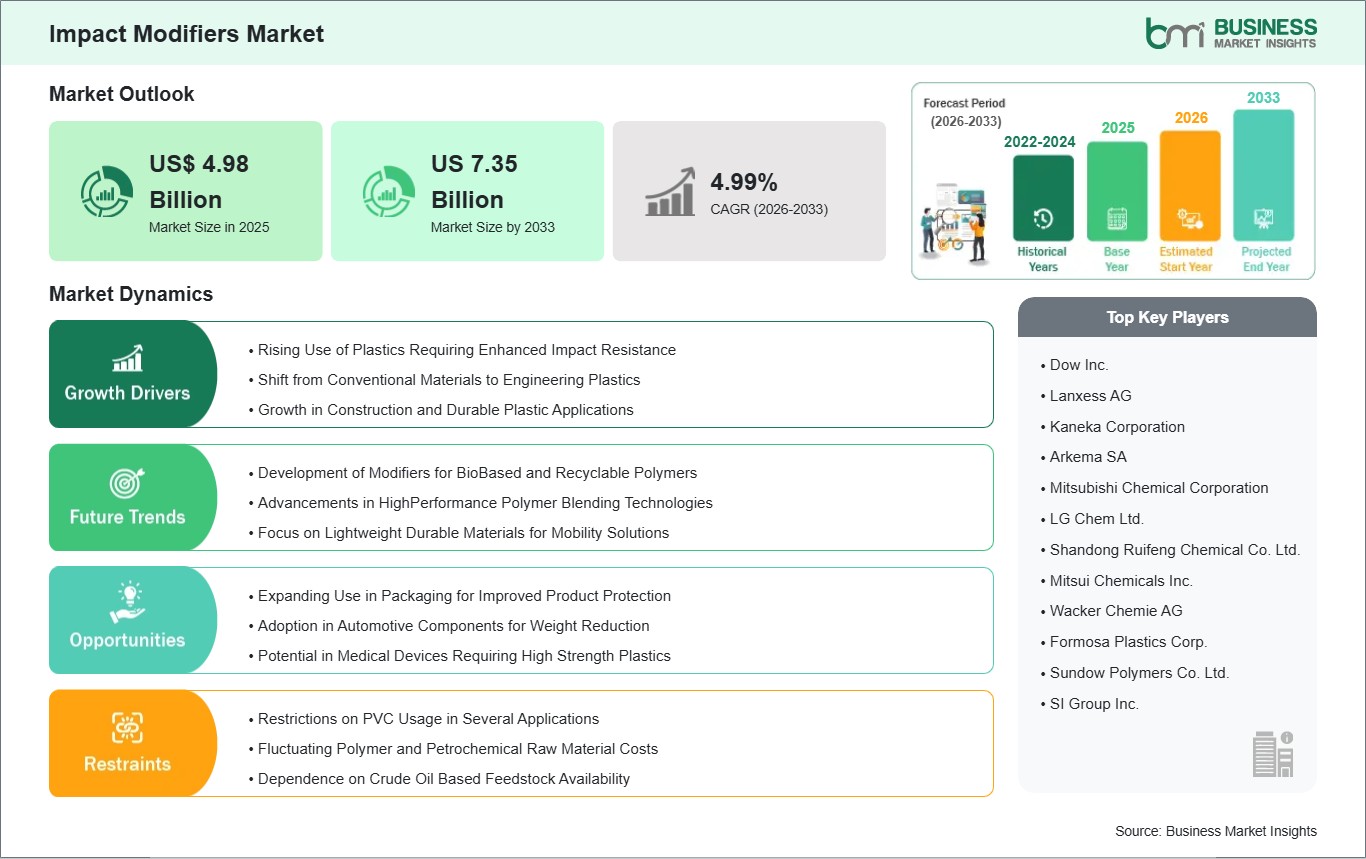
The Impact Modifiers Market size is expected to reach US$ 7.35 Billion by 2033 from US$ 4.98 Billion in 2025. The market is estimated to record a CAGR of 4.99% from 2026 to 2033.
The global impact modifiers market has emerged as a key player in the plastics and polymer additives market, with its main aim being to enhance the toughness, durability, and impact resistance of polymers. Impact modifiers are added to thermoplastics and engineering resins to increase their capacity to withstand mechanical stress, sudden force, or environmental conditions without cracking or breaking. Impact modifiers are known to work in polymers by developing a dispersed elastomeric phase in the polymers, thus enabling them to better absorb energy in conditions where they are subjected to stress. The application of impact modifiers can be seen in a variety of industries, ranging from construction to the automotive industry, packaging, consumer goods, electronic devices, and medical devices.
The market is mainly influenced by the increasing need for performance-enhanced plastics that can replace traditional materials like metals and glass in cost-effective and lightweight structures. Modern industries like automobiles and buildings are increasingly using modified polymers for parts that need strength and flexibility, especially in areas where they are exposed to temperature changes and mechanical stress. However, there are certain limitations in terms of complexity and compatibility that make it difficult to formulate polymers that can match the toughness and rigidity needed for such parts. Moreover, changes in availability and consistency in the quality of raw materials used in polymer processing can sometimes pose difficulties. Nevertheless, constant innovations in polymer science and additive technology continue to enhance the potential of impact modifiers.

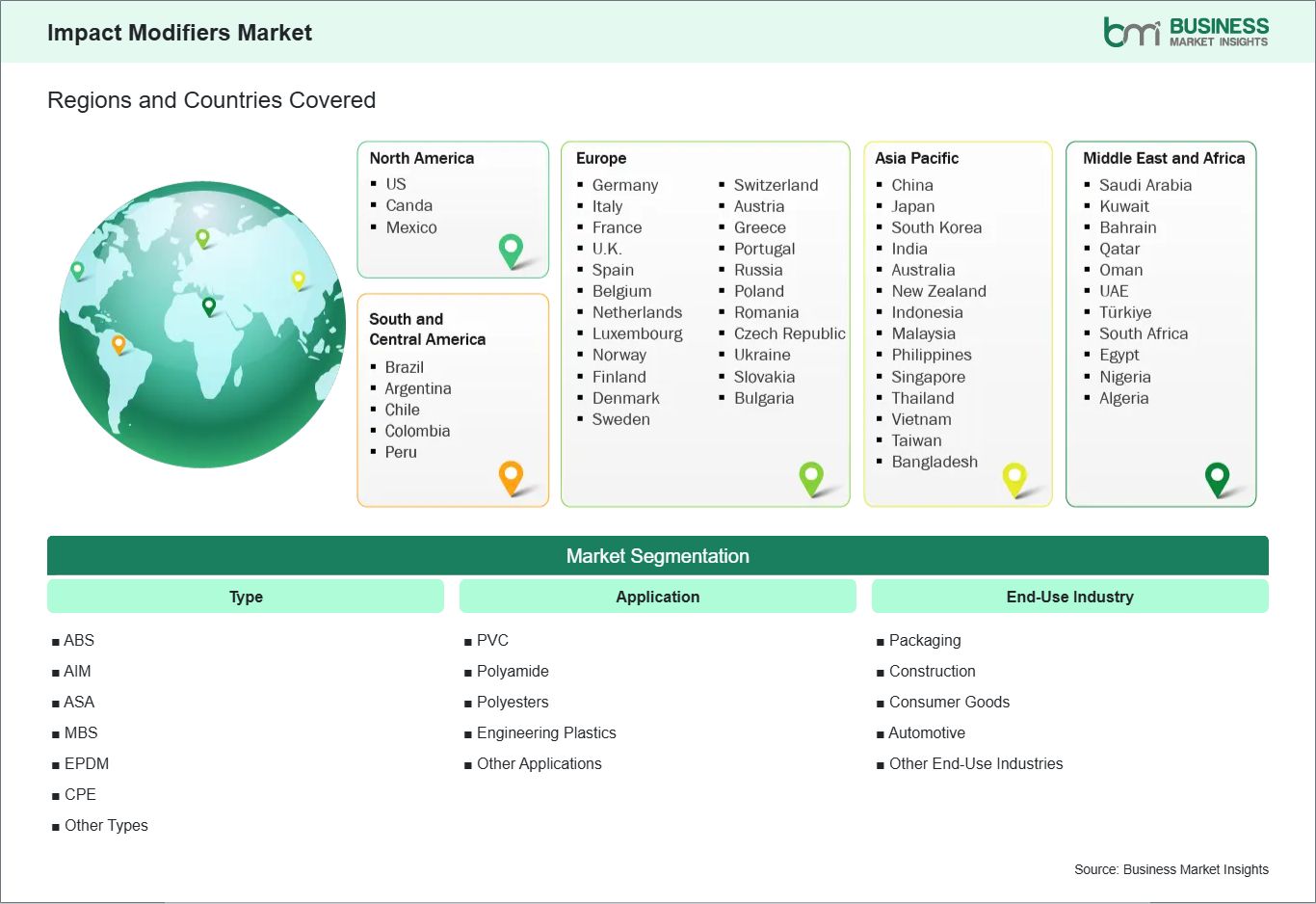
Key segments that contributed to the derivation of the impact modifiers market analysis are type, application, and end‑user industry.
The global demand for impact modifiers is being driven by the widespread use of plastics in applications that require superior toughness and durability. Modern manufacturing increasingly relies on lightweight polymer materials in automotive, construction, consumer goods, and electronics, where resistance to cracking, deformation, and brittleness under stress is critical. Impact modifiers, when blended with plastics such as polypropylene, polyethylene, polystyrene, and PVC, enhance their mechanical performance, allowing these materials to withstand repeated impact, extreme temperatures, and long-term mechanical stress. This enables manufacturers to develop products that are both lighter and more durable, meeting evolving performance expectations across industries.
Advancements in polymer chemistry have expanded the range of applications for impact modifiers, enabling plastics to maintain flexibility and toughness even in thin-walled or complex-molded parts. In automotive interiors, for example, dashboards, bumpers, and door panels benefit from plastics modified with impact modifiers, ensuring resilience against daily wear and accidental impacts. Similarly, in construction, impact-modified polymers are used in piping, window profiles, and insulation materials, where resistance to mechanical stress and temperature fluctuations is essential. Globally, this has driven material engineers and product designers to incorporate impact modifiers as a standard component for achieving an optimal balance between performance, weight reduction, and cost efficiency.
In addition to this, the demand for more durable, safe, and dependable products among consumers is driving the market for impact modifiers worldwide. Various electronic devices, household appliances, and recreational items are now being manufactured with impact-modified plastics to avoid breakage, extend the life of the product, and ensure the safety of the consumer. The flexibility offered by impact modifiers enables them to be used to make plastics suitable for different uses. With industries becoming more environmentally friendly, durable, and quality-conscious, impact modifiers have come to be regarded as an essential element in making quality plastics worldwide.
The use of impact modifiers in packaging is increasing as companies seek to ensure protection for products during transportation, storage, and handling. Packaging materials, such as films, rigid containers, and caps, need to be strengthened mechanically to ensure they do not get damaged, especially for sensitive products such as electronics, foodstuffs, and other consumer goods. The addition of impact modifiers will ensure that plastics used in packaging have enough toughness to withstand shocks, punctures, and other mechanical stress, thus ensuring products do not get damaged.
Impact modifiers are also highly beneficial in protective and lightweight packaging structures, where the interplay between strength and material efficiency is critical. Flexible or rigid packaging structures, ranging from multilayered plastic films to bottles or crates, can be made more resistant with the addition of impact modifiers. Thinner structures can be designed without sacrificing toughness, thus reducing raw material consumption, transportation, and environmental burdens. On a worldwide basis, the packaging industry increasingly relies on impact-modified plastics to address the twin requirements of product protection and sustainability, driven by both regulatory requirements and consumer needs for dependable and environmentally friendly packaging.
In addition to protecting products, impact modifiers also contribute to improved manufacturing efficiency and design flexibility in packaging. They allow for high-speed molding and extrusion processes without causing defects such as cracking or warping, ensuring consistent quality and performance. Their use also enables innovative designs, including ergonomic shapes, transparent components, and multilayer structures, without sacrificing strength. As global supply chains continue to expand and product fragility remains a concern, impact modifiers are becoming an essential material in the packaging sector, enhancing product safety, material efficiency, and overall market competitiveness.

The impact modifiers market is experiencing steady growth, with market size and share analysis reflecting evolving treatment preferences and competitive dynamics among key players. The report evaluates important subsegments categorized within fiber type, application, and end‑user industry, highlighting their respective contributions to overall market performance.
By type, the ABS subsegment dominated the Impact Modifier market in 2025. ABS impact modifiers provide excellent toughness, chemical resistance, and processability, making them highly suitable for enhancing the performance of various polymers, driving their widespread adoption.
Based on application, the PVC subsegment dominated the Impact Modifier market in 2025. PVC applications benefit from improved impact resistance and durability, supporting strong demand for ABS and other modifiers in the polymer industry.
In terms of end-use industry, the Packaging subsegment dominated the Impact Modifier market in 2025. Packaging applications require robust, durable, and lightweight materials, reinforcing the dominance of this segment in the impact modifier market.
| Report Attribute | Details |
|---|---|
| Market size in 2025 | US$ 4.98 Billion |
| Market Size by 2033 | US 7.35 Billion |
| Global CAGR (2026 - 2033) | 4.99% |
| Historical Data | 2022-2024 |
| Forecast period | 2026-2033 |
| Segments Covered | By Type
|
|
Regions and Countries Covered
| |
| North America | US, Canada, Mexico |
| Europe | Belgium, Austria, Finland, Denmark, Greece, Poland, Romania, Russia, Ukraine, Czech Republic, Slovakia, Bulgaria, Italy, Luxembourg, Germany, Switzerland, France, Netherlands, Norway, Portugal, Spain, Sweden, United Kingdom |
| Asia-Pacific | Australia, China, India, Japan, South Korea, Indonesia, Malaysia, Philippines, Singapore, Thailand, Vietnam, Bangladesh, New Zealand, Taiwan |
| South and Central America | Brazil, Argentina, Peru, Chile, Colombia |
| Middle East and Africa | Bahrain, Kuwait, Oman, Qatar, Saudi Arabia, United Arab Emirates, Turkiye, South Africa, Egypt, Algeria, Nigeria |
| Market leaders and key company profiles |
|
The "Impact Modifiers Market Size and Forecast (2022 - 2033)" report provides a detailed analysis of the market covering below areas:
The geographical scope of the Impact Modifiers market report is divided into five regions: North America, Asia Pacific, Europe, Middle East & Africa, and South & Central America. The Impact Modifiers market in North America is expected to grow during the forecast period.
North America dominates the impact modifiers market, supported by its advanced polymer processing industry and strong presence of end-use sectors that demand high-performance materials. The region’s automotive, construction, and packaging industries are major consumers of impact-modified plastics, utilizing these materials to enhance product durability, safety, and performance. In automotive applications, impact modifiers are widely used in components such as bumpers, dashboards, and interior panels, where resistance to impact and mechanical stress is essential for both safety and longevity.
Similarly, in construction, these additives improve the durability of materials like pipes, siding, and window profiles, ensuring long-term performance under environmental exposure. The region is also helped by the presence of an already established base of polymer producers and compounders who are constantly innovating in the field of additive materials. In the North American region, the focus is on the development of impact modifiers that not only provide improved impact resistance but also offer other benefits such as weatherability, thermal balance, and processing aids. This is in accordance with the region’s focus on the development of materials of superior quality for industrial applications.
Another focus is on sustainability, with the region working towards the development of impact modifiers that can be made with recyclable materials and in a sustainable way. Although the region faces issues such as cost restraints and changing materials, the technological superiority of the region and the focus on innovation ensure that the region remains the market leader in the field of impact modifiers.

The impact modifiers market is evaluated by gathering qualitative and quantitative data post primary and secondary research, which includes important corporate publications, association data, and databases. A few of the key developments in the impact modifiers market are:
The Impact Modifiers Market is valued at US$ 4.98 Billion in 2025, it is projected to reach US 7.35 Billion by 2033.
As per our report Impact Modifiers Market, the market size is valued at US$ 4.98 Billion in 2025, projecting it to reach US 7.35 Billion by 2033. This translates to a CAGR of approximately 4.99% during the forecast period.
The Impact Modifiers Market report typically cover these key segments-
The historic period, base year, and forecast period can vary slightly depending on the specific market research report. However, for the Impact Modifiers Market report:
The Impact Modifiers Market is populated by several key players, each contributing to its growth and innovation. Some of the major players include:
The Impact Modifiers Market report is valuable for diverse stakeholders, including:
Essentially, anyone involved in or considering involvement in the Impact Modifiers Market value chain can benefit from the information contained in a comprehensive market report.
Please tell us your area of interest
(Market Segments/ Regions and Countries/ Companies)