
Gibberellins Market Outlook: Size, Share, Trends, Growth Analysis, Competitive Landscape & Forecast, 2026-2033

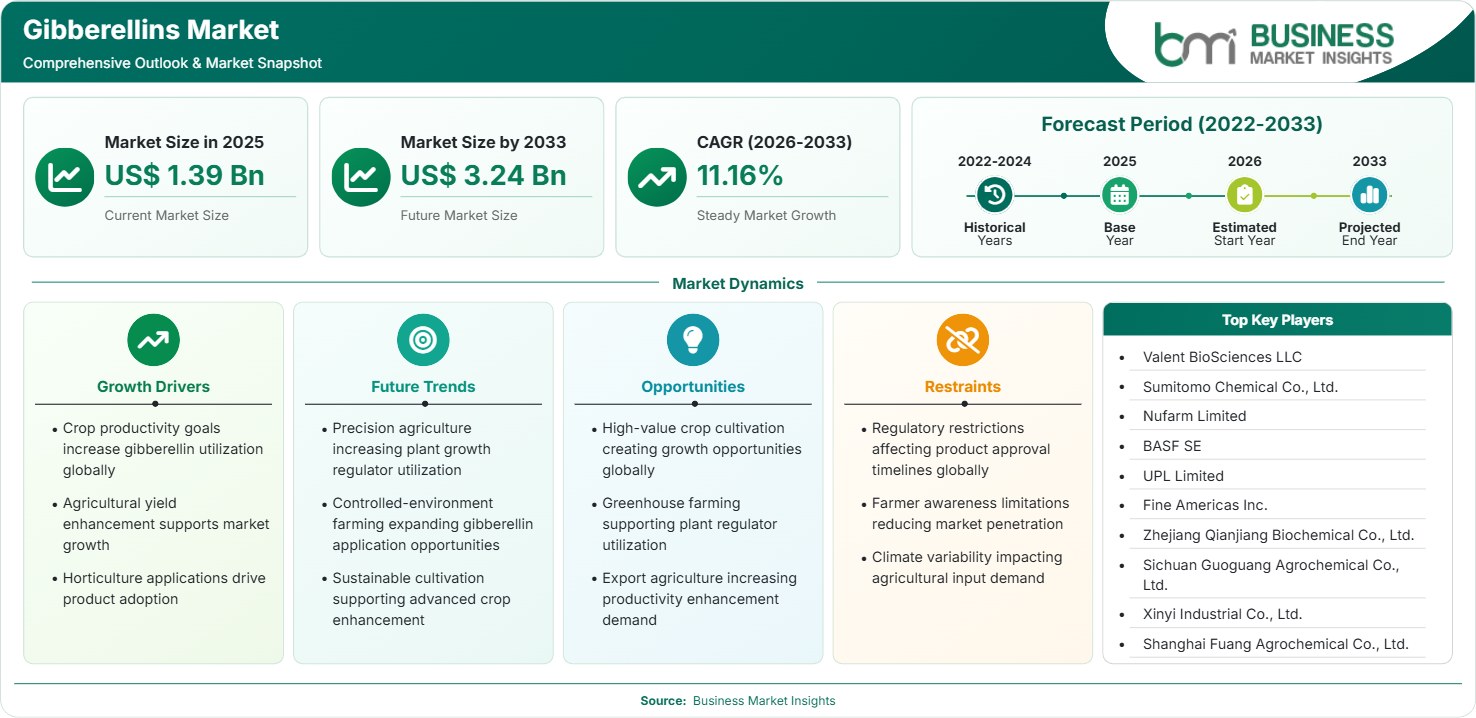
The Gibberellins Market size was valued at US$ 1.39 Billion in 2025 and is projected to reach US$ 3.24 Billion by 2033, growing at a CAGR of 11.16% during 2026–2033. Rising adoption of plant growth regulators, expanding high-value crop cultivation, precision agriculture investments, sustainable yield enhancement requirements, and increasing seed treatment applications are creating significant opportunities across global agricultural production systems.

Report Coverage
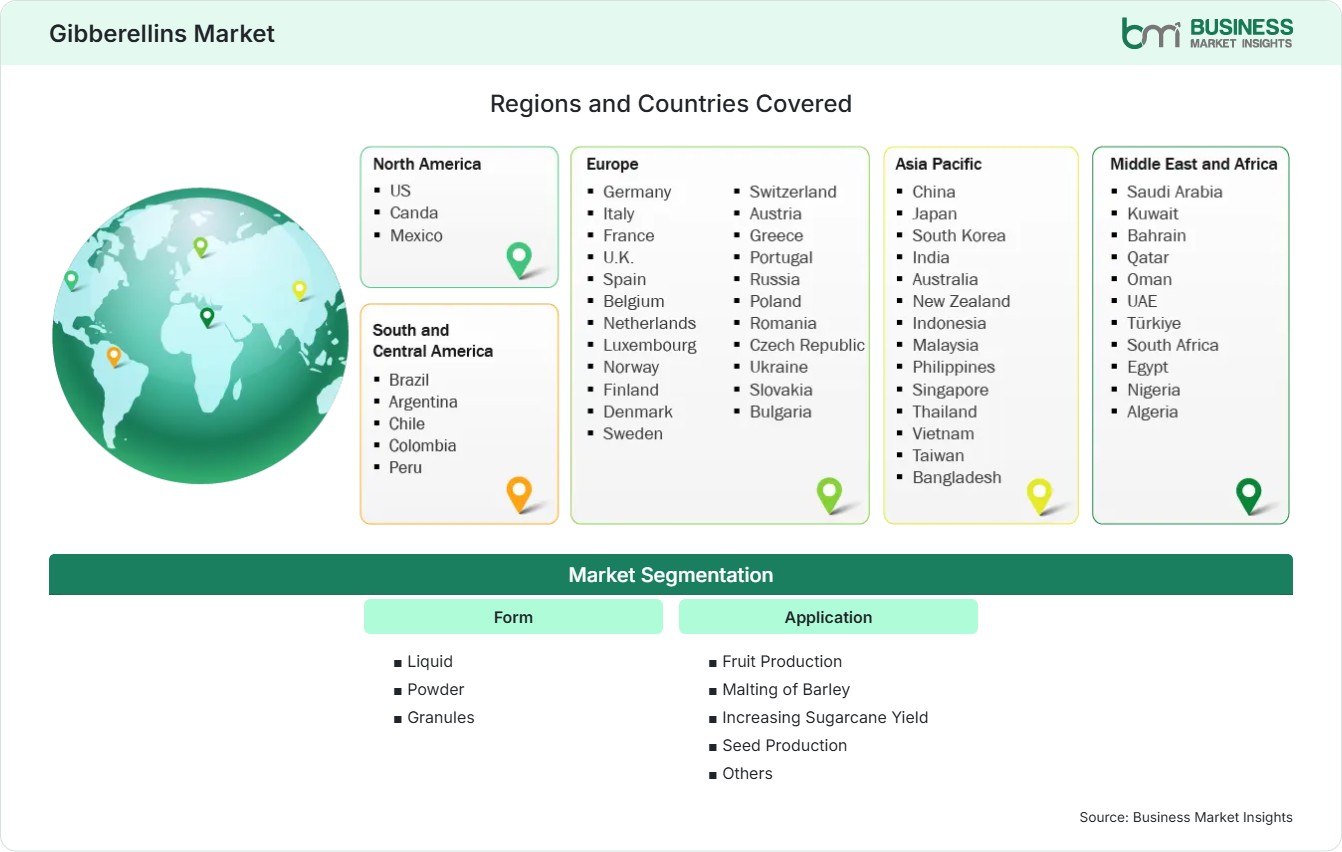
  • Form: Liquid, Powder, Granules
  • Application: Fruit Production, Malting of Barley, Increasing Sugarcane Yield, Seed Production, Others
US$ 1.39 Bn Market size in 2025
US$ 3.24 Bn Market Size by 2033
11.16% CAGR, 2026 - 2033
2026-2033 Forecast Period

AI Overview

Gibberellins Market Summary

  • North America Region: North America holds a market share of 34%–37% in 2025, growing with a CAGR of 10.2%–10.8% during 2026–2033, supported by precision farming adoption, commercial fruit cultivation, advanced crop management practices, regulatory clarity, and increasing investments in biological agricultural inputs. US demand remains strong due to intensive specialty crop production, with a CAGR of 10.4%–11.0% through 2033.
  • Fastest Growing Region: Asia Pacific accounts for 28%–31% share in 2025 and advances at 12.4%–13.1% CAGR, driven by expanding horticulture acreage, rising food security initiatives, agricultural modernization programs, export-oriented fruit production, and increasing awareness of plant growth regulator benefits.
  • Leading Segment: Fruit Production commands 39%–42% Gibberellins Market share in 2025 and expands at 11.0%–11.7% CAGR, supported by quality enhancement requirements, flowering management needs, yield optimization strategies, commercial orchard expansion, and increased cultivation of premium fruits.
  • High Growth Segment: Liquid formulations represent 44%–47% share in 2025 and progress at 11.8%–12.5% CAGR, benefiting from application convenience, improved plant absorption, compatibility with spraying systems, operational efficiency, and growing adoption among large-scale growers.
  • Key Market Opportunity: Emerging biological agriculture platforms increasingly integrate plant growth regulators with precision application technologies, creating new revenue streams through yield optimization, stress management, crop quality improvement, and sustainable cultivation practices.
  • Major Market Players: Valent BioSciences LLC, Sumitomo Chemical Co., Ltd., Nufarm Limited, BASF SE, UPL Limited, Fine Americas Inc., Zhejiang Qianjiang Biochemical Co., Ltd., Sichuan Guoguang Agrochemical Co., Ltd., Xinyi Industrial Co., Ltd., Shanghai Fuang Agrochemical Co., Ltd.
Strategic Insights

Gibberellins Market: Strategic Insights

Gibberellins Market Strategic Framework
FREE PDF
Request your free sample
Request free sample
Stakeholder View

Key Takeaways

  • The industry value chain increasingly integrates biotechnology developers, formulation specialists, distributors, precision agriculture providers, and commercial growers, creating a more sophisticated ecosystem for product development and deployment.
  • Fruit cultivation and seed production applications present attractive expansion potential because growers increasingly prioritize crop uniformity, flowering management, quality enhancement, and improved marketable yields.
  • Innovation is shifting toward crop-specific formulations, controlled-release technologies, tank-mix compatibility improvements, and biological combinations designed to maximize efficacy under variable climatic conditions.
  • Asia Pacific represents one of the strongest investment destinations due to expanding horticulture output, agricultural modernization programs, rising export competitiveness, and growing awareness regarding advanced crop management practices.
  • Strategic partnerships, distribution agreements, and portfolio expansion initiatives remain common as agricultural input companies seek broader geographic coverage and stronger positioning in specialty crop markets.
  • Sustainability objectives are encouraging integration of plant growth regulators with precision farming platforms, enabling more targeted usage and improved resource efficiency across commercial agriculture operations.
Geographic Outlook

Gibberellins Market Regional Highlights

North America Gibberellins Market

North America accounts for approximately 34%–37% of global revenue in 2025 and is projected to expand at a CAGR of 10.2%–10.8% through 2033. Mature agricultural systems, high specialty crop penetration, and extensive technology adoption support regional leadership. Strong distribution networks and established crop management practices enhance commercial utilization. The region benefits from substantial investment in biological crop inputs and precision agriculture technologies. The Gibberellins Market share remains concentrated within commercial fruit, vegetable, and seed-treatment applications supported by scientific farming approaches.

  • Commercial orchard operators increasingly utilize growth regulators to improve fruit size consistency, flowering performance, and harvest quality, strengthening demand across apple, grape, citrus, and berry cultivation systems.
  • Precision agriculture platforms enable optimized application timing and dosage management, improving return on investment and encouraging broader utilization among large-scale growers.
  • Increasing preference for sustainable production methods supports integration of plant growth regulators within crop management programs designed to enhance productivity without substantial acreage expansion.
  • Research institutions and agricultural technology providers continue collaborating on product efficacy studies, improving grower confidence and accelerating commercialization opportunities.

US Gibberellins Market

The United States represents approximately 74%–78% of the North American market and is expected to record a CAGR of 10.4%–11.0% during 2026–2033. Demand is concentrated within fruit cultivation, specialty crops, seed production, and commercial horticulture. Advanced farm management practices and high levels of mechanization support extensive adoption. Investment in agricultural innovation and biological crop enhancement products continues to strengthen market penetration across professional farming operations seeking productivity improvements and quality differentiation.

  • Specialty crop growers increasingly deploy growth regulators for flowering synchronization, yield optimization, and quality improvement initiatives supporting premium market positioning.
  • Commercial vineyards and fruit producers continue investing in advanced crop-management solutions to enhance consistency and maximize economic returns.
  • Expanding biological agriculture adoption creates favorable conditions for wider product utilization across diverse cultivation environments.
  • Agricultural extension programs and research partnerships support education efforts that increase end-user awareness and adoption rates.

Europe Gibberellins Market

Europe captures approximately 24%–27% Gibberellins Market share in 2025 and is anticipated to grow at 10.6%–11.2% CAGR through 2033. Regulatory focus on sustainable agriculture and efficient resource utilization supports adoption. Commercial horticulture, greenhouse cultivation, and fruit production remain primary demand centers. Spain leads regional consumption, while Eastern European countries exhibit stronger expansion rates due to modernization investments. The region maintains balanced demand across specialty crops and intensive agricultural production systems focused on quality enhancement.

  • Spain remains a leading consumer due to extensive fruit and vegetable cultivation, advanced irrigation infrastructure, and export-oriented agricultural practices.
  • Poland demonstrates strong growth potential with increasing modernization expenditure and expanding commercial horticulture activities.
  • Greenhouse operators increasingly utilize growth-management products to improve production efficiency and crop uniformity.
  • Sustainability-focused agricultural policies encourage adoption of technologies supporting higher productivity and resource efficiency.

Asia Pacific Gibberellins Market

Asia Pacific holds 28%–31% share in 2025 and delivers the strongest expansion with 12.4%–13.1% CAGR through 2033. Rapid agricultural modernization, rising food demand, and the horticulture segment help foster growth. The Chinese market is the largest, whereas India shows strong momentum due to increased awareness and investment in commercial cultivation. Robust government backing, export-driven production, and demand for crop quality improvement help foster growth in the region. The growth rate in the Gibberellins Market is fastest in developing countries.

  • China maintains leadership through extensive agricultural production, large specialty crop acreage, and significant domestic manufacturing capacity.
  • India benefits from expanding horticulture initiatives, growing fruit production, and increasing awareness regarding advanced crop productivity techniques.
  • Southeast Asian countries continue increasing sugarcane and fruit cultivation, supporting wider commercial application opportunities.
  • Agricultural modernization programs promote greater adoption of productivity-enhancing biological crop-input technologies.

Rest of World Gibberellins Market

Rest of World accounts for approximately 10%–13% share during 2025 and is projected to expand at 11.0%–11.6% CAGR through 2033. South and Central America benefit from strong agricultural export industries and expanding fruit cultivation. Meanwhile, Middle East and Africa markets are supported by increasing food security initiatives and adoption of advanced farming methods. Brazil leads regional consumption, while Gulf countries demonstrate increasing interest in productivity-enhancing agricultural technologies to improve domestic crop yields.

  • Brazil supports substantial demand through commercial agriculture, export-oriented fruit production, and extensive sugarcane cultivation operations.
  • Mexico continues expanding usage across horticultural crops targeting premium international export opportunities.
  • Gulf Cooperation Council countries increasingly invest in advanced agricultural technologies to improve yield performance in challenging cultivation conditions.
  • Agricultural development initiatives across Africa encourage broader adoption of productivity-enhancing crop management solutions.
Global Market Geography
FREE PDF
Request your free sample
Request free sample
Segment Analysis

Gibberellins Market Segmentation

Form

The form segment is a crucial determinant of the efficiency of product adoption. The form segment accounts for about 45%-48% of total demand and is expected to experience a CAGR of 11.4%-12.0% by 2033. The choice of the product is dependent on storage capacity, crop suitability, ease of use, and application methods. The Gibberellins Market scope continues expanding as manufacturers develop more stable, user-friendly, and crop-specific formulations.

  • Liquid: Widely preferred among commercial growers because of ease of application, rapid plant absorption, compatibility with spraying systems, and suitability for large-scale agricultural operations.
  • Powder: Maintains relevance in storage-sensitive environments where longer shelf life, transportation convenience, and flexible mixing capabilities support adoption across multiple crop applications.
  • Granules: Increasingly utilized for controlled application requirements, improved handling characteristics, and targeted delivery strategies supporting operational efficiency within professional farming systems.

Application

Application-based demand remains diverse across agricultural applications. Fruit Production ranks first in terms of market share with about 39%-42% and is expected to grow at a CAGR of 11.0%-11.7% through 2033. Growing cultivation for commercial purposes and quality agriculture drive demand. Current Gibberellins Market trends show increasing consumption for yield increase, blooming control, and optimizing crop quality.

  • Fruit Production: Extensive utilization supports fruit sizing, flowering management, quality enhancement, yield optimization, and improved commercial value across orchard and plantation crops.
  • Malting of Barley: Important for brewing-related applications where germination management and process optimization support consistent raw-material quality requirements.
  • Increasing Sugarcane Yield: Growing usage helps improve productivity, biomass development, and crop performance within commercial sugar production systems.
  • Seed Production: Adoption supports germination improvement, crop uniformity, propagation efficiency, and enhanced performance across commercial seed-development programs.
Market Forces

Gibberellins Market Dynamics

Key Market Drivers

Expansion of Global High-Value Fruit Cultivation

Rising consumption of premium fruits across developed and developing economies continues supporting adoption of plant growth regulators. According to FAO production patterns, fruit production has grown steadily as nations seek to achieve their export competitiveness and nutritional security goals. There has been an increase in efforts aimed at increasing the quality of fruits, such as size, appearance, durability, and uniformity, as these directly affect the market price. This demand trend has been instrumental in increasing the use of gibberellin-containing products in agriculture. This is due to high demand for grapes, citrus fruits, berries, and apples, among others. These factors combined make strong adoption paths and industry expansion paths.

Increasing Demand for Sustainable Yield Enhancement

It has been observed that agricultural producers are increasingly under pressure to increase productivity without having any direct relation to land expansion. Plant growth regulators are an effective way to boost productivity while being eco-friendly. Sustainability measures and the increasing use of precision agriculture are also promoting the efficient use of inputs in agricultural processes. The Gibberellins Market growth is highly dependent on maximizing productivity per hectare while preserving crop quality requirements. The better use of digital farming technologies in this regard boosts the commercial use of biological productivity enhancers. This trend strengthens commercial demand across horticulture, seed production, and specialty crop applications globally.

Advancements in Agricultural Biotechnology and Formulations

Ongoing research has further improved the stability, effectiveness, and crop-specific performance of the formulations. The companies have begun developing formulations tailored to climatic factors, modes of application, and crop needs. Better compatibility with modern sprayer systems increases the efficiency of the process and its implementation. Innovation in product development has helped enhance performance even under environmental stress. This technological advancement increases the company's competitiveness and the number of applications it can offer. Furthering research and development investment ensures new avenues for commercialization and differentiated solutions that can address changing demands for agricultural productivity across various locations.

Key Market Opportunities

Integration with Precision Agriculture Platforms

The application of precision agriculture technologies is revolutionizing crop management methods. The combination of growth regulators with sensor-driven decision systems and variable-rate application systems presents new business opportunities. The use of data-driven solutions to optimize input efficiency and farm profitability continues to grow. Through digital monitoring systems, optimal timing and dosage can be achieved, making them more effective. In light of the widespread adoption of connected farming ecosystems, companies can offer their advanced products as part of crop management systems. This trend creates long-term opportunities for value-added product offerings and stronger collaboration between agricultural technology providers and biological input manufacturers.

Expansion in Emerging Horticulture Economies

The fast-growing demand for horticultural products in Asia, Latin America, and certain areas of Africa creates favorable conditions. An increase in exports, shifts in eating habits, and investments in agricultural modernization facilitate the use of advanced technology solutions. Advanced irrigation systems and technical advice become additional triggers for faster deployment. Long-Term Gibberellins Market Forecasts driven by the growing production of fruits and vegetables that require precise control of their development. These factors make emerging economies attractive targets for capacity expansion, product localization, and distribution network development.

Growing Demand for Premium Crop Quality

Retailers and food processors increasingly prioritize consistent crop quality characteristics. Uniform size, improved appearance, and better post-harvest performance deliver measurable commercial benefits. Producers serving export markets face especially stringent quality requirements and therefore seek tools that help meet customer specifications. Growth regulators play an important role in supporting these objectives. As premium agricultural segments continue expanding, manufacturers are positioned to benefit from rising demand for quality-enhancement technologies integrated within advanced crop production systems.

Market Restraints and Challenges

Regulatory Variability Across Agricultural Markets

Factor: Different regulations across countries make approvals difficult and complex. Impact: Increased costs, longer commercialization time periods, and different market access conditions for manufacturers. Product registrations may vary greatly from one jurisdiction to another, requiring additional technical documentation and local validation. All this makes it more difficult for businesses to operate as they expand internationally. Uncertainty surrounding regulations may delay product launches. This results in businesses having to devote considerable effort to regulatory affairs, impacting profitability and slowing broader adoption across some developing agricultural markets.

Limited Farmer Awareness in Developing Regions

Factor: Awareness of application methods, crops suited for application, and economic advantages remains limited in many agricultural areas. Impact: The adoption rate could be lower than its potential, even with suitable agricultural conditions. Many growers still use conventional farming methods without adequate training. There is inadequate advisory support that lowers confidence in advanced crop management inputs. Distribution problems also contribute to awareness problems, especially on small and medium-sized farms. Addressing these issues requires greater investment in education, demonstration programs, and agronomic support services to accelerate market penetration.

Company Analysis

Competitive Landscape

The competitive environment remains moderately consolidated, with manufacturers focusing on formulation innovation, distribution expansion, regulatory approvals, and crop-specific solutions. Recent Gibberellins Market analysis indicates that product performance, geographic reach, agronomic support capabilities, and integration with advanced farming practices are the primary competitive differentiators.

Company Name

Overview

Products and Services relevant to this market

Valent BioSciences LLC

Leading provider of biorational and plant growth technologies serving agriculture, specialty crops, and commercial farming applications globally.

Gibberellic acid products, plant growth regulators, crop enhancement solutions, agronomic support services, and productivity-improvement technologies.

Sumitomo Chemical Co., Ltd.

Diversified agricultural inputs manufacturer with extensive global operations and strong biological and specialty crop portfolios.

Gibberellin formulations, crop protection products, seed technologies, agricultural chemicals, and commercial grower support solutions.

Nufarm Limited

International agricultural technology company focused on crop protection, seed technologies, and crop productivity enhancement solutions.

Plant growth regulators, agricultural formulations, crop productivity products, specialty crop solutions, and distribution services.

BASF SE

Global chemical and agricultural solutions provider investing significantly in sustainable farming and crop productivity technologies.

Agricultural biologicals, plant growth regulators, crop management systems, digital farming solutions, and agronomic services.

UPL Limited

Major agricultural solutions company with extensive offerings across crop protection, biologicals, and farm productivity products.

Growth stimulants, biological inputs, crop management products, specialty agriculture solutions, and farmer advisory services.

Fine Americas Inc.

Specialist plant growth regulator company focused on horticulture, fruit production, and specialty crop management.

Gibberellic acid formulations, fruit production solutions, crop-quality enhancement products, and technical agronomy support.

Zhejiang Qianjiang Biochemical Co., Ltd.

China-based agricultural biotechnology producer with strong capabilities in plant growth regulator manufacturing and distribution.

Gibberellins, biological crop inputs, agricultural formulations, specialty crop solutions, and agricultural chemicals.

Sichuan Guoguang Agrochemical Co., Ltd.

Established agricultural input manufacturer serving commercial farming, horticulture, and crop productivity markets.

Plant growth regulators, crop nutrition products, agricultural formulations, and commercial cultivation support solutions.

Xinyi Industrial Co., Ltd.

Agricultural product manufacturer engaged in plant growth regulator development and supply for multiple crops.

Gibberellic acid products, specialty agricultural chemicals, crop enhancement technologies, and formulation services.

Shanghai Fuang Agrochemical Co., Ltd.

Agricultural formulation company supplying plant growth regulators and specialty crop-management products to domestic and international markets.

Gibberellin products, agricultural formulations, crop productivity solutions, and customized agricultural applications.

Trust & Transparency

Research Methodology

The market analysis combines proprietary research with secondary data from government agencies, company disclosures, regulatory filings, industry databases and expert interviews. Market estimates are validated through data triangulation, cross-market benchmarking and analyst review.

View Full Research Methodology

Questions Answered

Frequently Asked Questions

Which region offers the strongest long-term investment potential?

Asia Pacific presents substantial long-term potential because of expanding horticultural production, rising food demand, modernization programs, export-driven agriculture, and increasing awareness of advanced crop productivity technologies.

What does the Gibberellins Market Report indicate about future innovation?

The report highlights increasing investment in crop-specific formulations, biological agriculture integration, precision application technologies, and digital farming compatibility as key innovation themes shaping competitive differentiation.

How does climate change affect industry demand?

Changing weather patterns increase the importance of crop management solutions that support plant development, stress management, and yield optimization. This creates opportunities for wider use in commercial farming systems.

Which agricultural applications generate the highest demand?

Fruit production currently represents the largest application area because growers use these products to improve fruit development, crop uniformity, harvest quality, and overall market value across high-value horticultural crops.

What factors are influencing adoption of gibberellin-based agricultural products?

Growing demand for higher crop quality, improved flowering performance, enhanced fruit sizing, increasing precision agriculture adoption, and the need for sustainable productivity improvements are accelerating adoption among commercial growers worldwide.

Access the Full Gibberellins Market Report

Get segment-level forecasts, regional estimates, competitive benchmarking, company profiles and downloadable Excel datasets.

Access the full Gibberellins Market Report
350 pages PDF & Excel | 2026-11-03
Similar Research

Related Market Reports