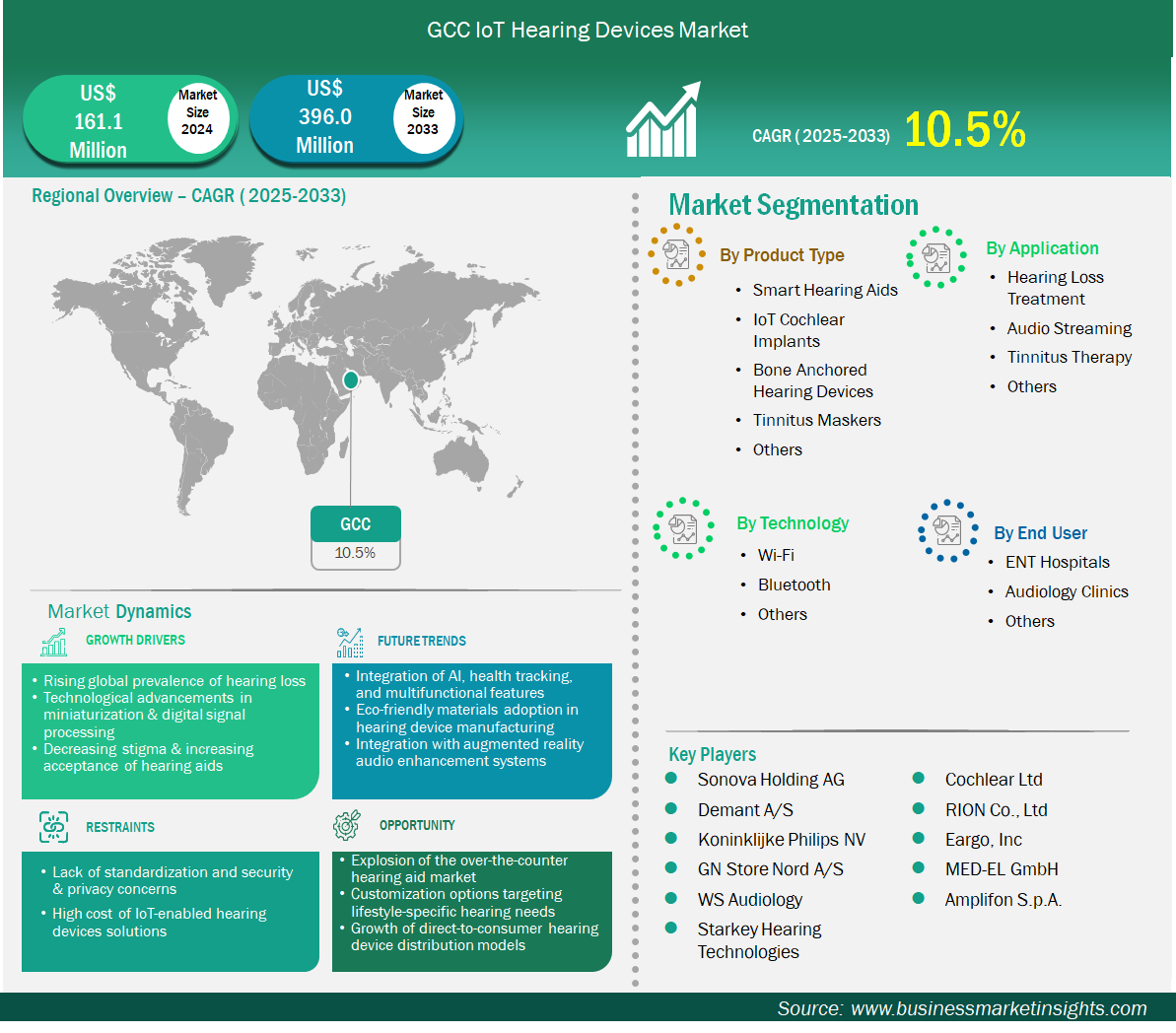
The GCC IoT hearing devices market size is expected to reach US$ 396.0 million by 2033 from US$ 161.1 million in 2024. The market is estimated to record a CAGR of 10.5% from 2025 to 2033.
Executive Summary and GCC IoT Hearing Devices Market Analysis:
The IoT hearing devices market in GCC is experiencing significant growth driven by the rising global prevalence of hearing loss, technological advancements in miniaturization & digital signal processing, decreasing stigma & increasing acceptance of hearing aids. The GCC IoT hearing devices market is expanding rapidly, driven by high healthcare spending, advanced infrastructure, and strong government initiatives to modernize audiology services. Countries such as Saudi Arabia, the UAE, and Qatar are leading adoption, supported by investments in digital health and tele‑audiology platforms. Smart hearing aids dominate the market, reflecting consumer demand for premium, connected solutions that integrate with smartphones and telehealth platforms. Market analysis highlights Saudi Arabia as a regional leader, leveraging advanced healthcare infrastructure and strong government support for IoT hearing aid adoption. The UAE emphasizes integration of IoT hearing aids into national health strategies, while Qatar benefits from public‑private partnerships expanding access to connected devices. Competitive dynamics are shaped by global players entering through partnerships with local distributors, while regional start-ups innovate with cost‑effective, mobile‑enabled hearing solutions. Multifunctional devices that combine hearing support with streaming and health monitoring are gaining traction, reflecting GCC’s appetite for integrated digital health technologies.
GCC IoT Hearing Devices Market Segmentation Analysis:
Key segments that contributed to the derivation of the IoT hearing devices market analysis are product, technology, application, and end user.
- By product, the IoT hearing devices market is segmented into smart hearing aids, IoT cochlear implants, bone anchored hearing devices, tinnitus maskers, and others. Smart hearing aids dominated the market in 2024, driven by premium healthcare spending and preference for connected consumer-medical devices.
- By technology, the IoT hearing devices market is segmented into Wi-Fi, Bluetooth, and others. Bluetooth dominated the market in 2024, driven by instant smartphone pairing and patient experience priorities.
- In terms of application, the market is segmented into hearing loss treatment, audio streaming, tinnitus therapy, and others. Hearing loss treatment dominated the market in 2024, driven by hospital-led implant programs and specialist care pathways.
- By end user, the market is segmented into ENT hospitals, audiology clinics, and others. Audiology clinics dominated the market in 2024, driven by specialized centers offering advanced diagnostics and remote follow-up.
GCC IoT Hearing Devices Market Outlook
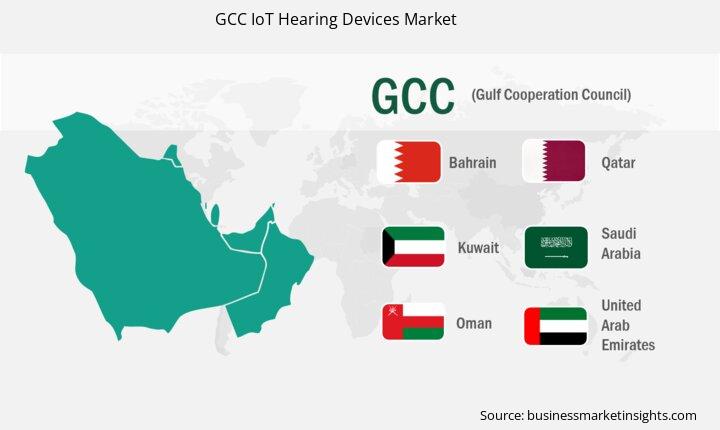
The GCC IoT hearing devices market is segmented into United Arab Emirates, Bahrain, Saudi Arabia, Oman, Qatar, and Kuwait. The outlook for GCC’s IoT hearing devices market is highly positive, supported by demographic shifts, technological innovation, and government investment in healthcare modernization. The region’s aging population and rising incidence of hearing loss create significant demand for IoT hearing aids and cochlear implants. Governments are prioritizing hearing health within broader digital health strategies, with initiatives to expand tele‑audiology services and subsidize advanced devices for vulnerable populations. Private healthcare providers and insurers recognize the economic benefits of IoT hearing devices, particularly in reducing long‑term costs and improving patient satisfaction. Strategic collaborations between device manufacturers and telecom operators are anticipated to accelerate adoption by leveraging GCC’s strong mobile connectivity infrastructure. Premium product categories will dominate in developed markets such as Saudi Arabia and the UAE, while affordable IoT hearing aids tailored for middle‑income consumers will expand access in emerging economies such as Oman and Bahrain. Overall, the outlook suggests strong momentum, with IoT hearing devices positioned as essential tools in GCC’s digital health transformation.
GCC IoT Hearing Devices Market Country Insights
Based on region, the GCC IoT hearing devices market is further segmented into United Arab Emirates, Bahrain, Saudi Arabia, Oman, Qatar, and Kuwait. Saudi Arabia held the largest share in 2024.
Country‑level insights reveal significant diversity in adoption patterns across GCC. Saudi Arabia leads the region with advanced healthcare infrastructure and strong government support for IoT hearing aid adoption. The UAE emphasizes integration of IoT hearing aids into national health strategies, while Qatar benefits from public‑private partnerships expanding access to connected devices. Oman and Bahrain are gradually scaling adoption through NGO‑led initiatives and pilot projects focused on community health. Kuwait is emerging as a high‑potential market, driven by its large population and growing investment in digital health start-ups introducing affordable IoT hearing solutions. Across these countries, the common thread is the role of mobile technology as a catalyst for IoT hearing device penetration, enabling remote monitoring, app‑based personalization, and integration with broader digital health platforms. Country insights highlight Saudi Arabia and the UAE as leaders in premium adoption, while Oman, Bahrain, and Kuwait represent the fastest‑growing opportunities, underscoring the importance of localized strategies tailored to diverse market conditions.
GCC IoT Hearing Devices Market Company Profiles
Sonova Holding AG, Demant A/S, Koninklijke Philips NV, GN Store Nord A/S, WS Audiology, Starkey Hearing Technologies, Cochlear Ltd., RION Co., Ltd., Eargo, Inc., MED-EL GmbH, Amplifon S.p.A., are among the key players operating in the market. These players adopt strategies such as expansion, product innovation, and mergers and acquisitions to stay competitive in the market and offer innovative products to their consumers.
GCC IoT Hearing Devices Market Research Methodology:
The following methodology has been followed for the collection and analysis of data presented in this report:
-
Secondary Research
The research process begins with comprehensive secondary research, utilizing both internal and external sources to gather qualitative and quantitative data for each market. Commonly referenced secondary research sources include, but are not limited to:
- Company websites, annual reports, financial statements, broker analyses, and investor presentations
- Industry trade journals and other relevant publications
- Government documents, statistical databases, and market reports
- News articles, press releases, and webcasts specific to companies operating in the market
Note: All financial data included in the Company Profiles section has been standardized to US$. For companies reporting in other currencies, figures have been converted to US$ using the relevant exchange rates for the corresponding year.
-
Primary Research
Business Market Insights conducts a significant number of primary interviews each year with industry stakeholders and experts to validate and analyze the data and gain valuable insights. These research interviews are designed to:
- Refine findings from secondary research
- Enhance the expertise and market understanding of the analysis team
- Gain insights into market size, trends, growth patterns, competitive dynamics, and future prospects
Primary research is conducted via email interactions and telephone interviews with industry experts across various markets, categories, segments, and sub-segments in different regions. Participants typically include:
- Industry stakeholders: Vice Presidents, business development managers, market intelligence managers, and national sales managers
- External experts: Valuation specialists, research analysts, and key opinion leaders with industry-specific expertise
Key Sources Referred:
- World Health Organization (WHO)
- Organisation for Economic Cooperation and Development (OECD)
- The World Bank Group
- Worldometer
- The Lancet
- International Bar Association
- International Trade Administration
- Eurostat
- United Nations Department of Economic and Social Affairs
GCC IoT Hearing Devices Market Strategic Insights
GCC IoT Hearing DevicesMarket Report Highlights
| Report Attribute | Details |
| Market size in 2024 | US$ 161.1 Million |
| Market Size by 2033 | US$ 396.0 Million |
| CAGR (2025 - 2033) | 10.5% |
| Historical Data | 2022-2023 |
| Forecast period | 2025-2033 |
| Segments Covered |
By Product
|
|
Regions and Countries Covered
|
|
| GCC | United Arab Emirates, Bahrain, Saudi Arabia, Oman, Qatar, Kuwait |
| Market leaders and key company profiles |
|
GCC IoT Hearing Devices Market Country and Regional Insights