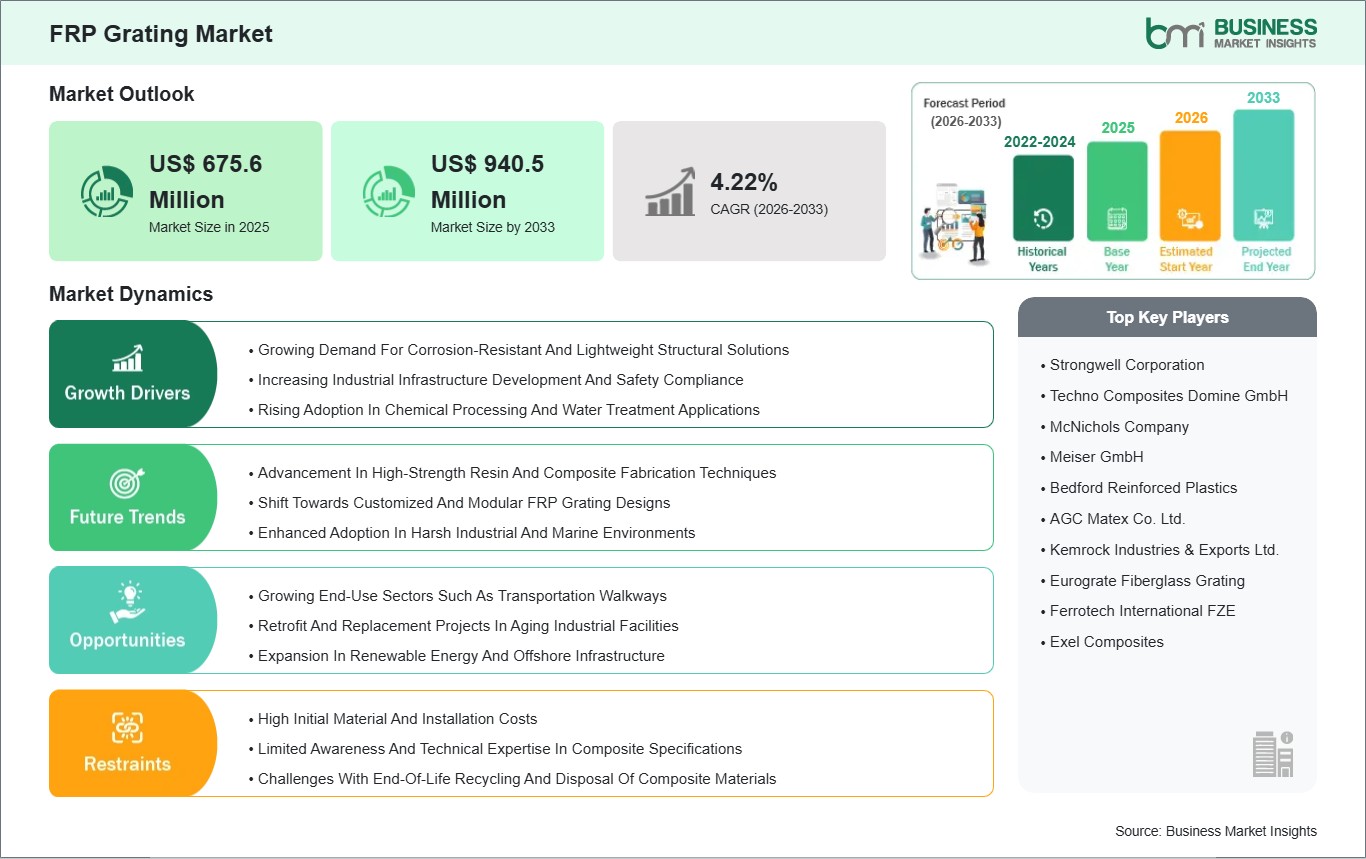
The FRP Grating Market size is expected to reach US$ 940.5 Million by 2033 from US$ 675.6 Million in 2025. The market is estimated to record a CAGR of 4.22% from 2026 to 2033.
The global FRP (Fiber Reinforced Plastic) grating market consists of light-weight, resistant, and durable grating products that find widespread use in industrial, commercial, and infrastructure applications. FRP grating is known for its high strength-to-weight ratio, resistance to chemicals, and non-conductivity, making it an ideal product for use in applications that otherwise involve the use of steel or aluminum grating that may corrode and become a hazard for users. The applications of FRP grating cover the oil and gas industry, wastewater treatment plants, chemical plants, marine and offshore applications, and flooring applications in the commercial sector. The major factor that drives the FRP grating market is the increasing rate of industrialization and the need for long-lasting and maintenance-free products, along with the increasing trend of the use of FRP grating in safety-critical applications.
Moreover, the increasing regulatory focus on workplace safety, resistance to corrosion, and fire retardancy also fuels the FRP grating market by encouraging the use of such high-performance products. The higher initial cost of FRP gratings in comparison to other materials may be a potential barrier for the growth of this market. The process of manufacturing and installation demands expertise in the field, which might be a barrier for small construction companies in areas that lack adequate expertise in the field.
The performance of these gratings might be influenced by environmental factors as well; for example, extreme exposure to UV radiation or mechanical stress might demand specific solutions for each case. Nevertheless, the constant evolution of technology and awareness about the benefits of using this material in the long term, along with the growth of industrial facilities, is expected to ensure the growth of the global FRP grating market in the future.

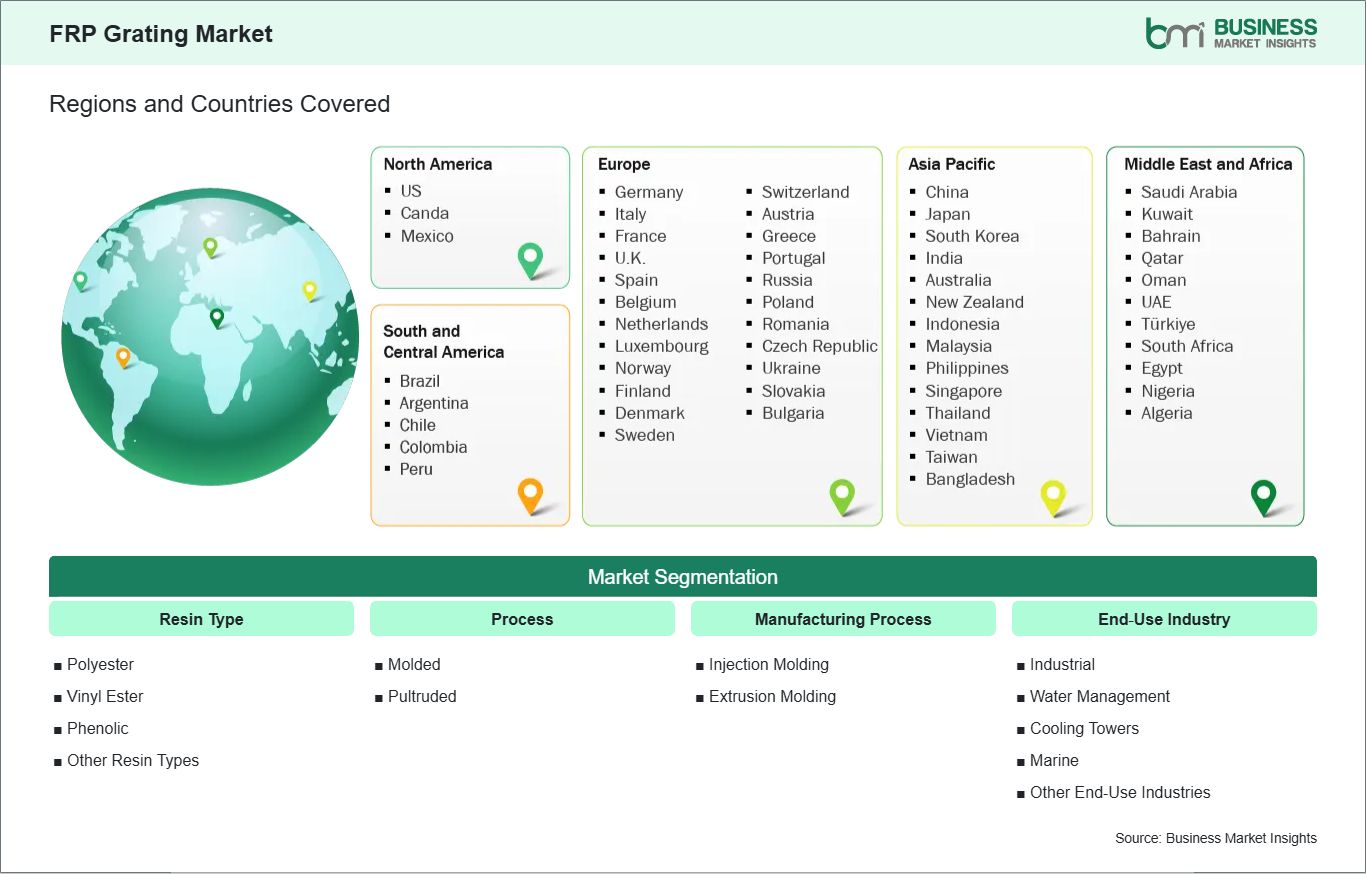
Key segments that contributed to the derivation of the FRP grating market analysis are resin type, process, application, and end‑use industry.
The global market for FRP grating materials is currently exhibiting a growth trend owing to an increased need for lightweight materials that are strong enough to withstand unfavorable environmental conditions. This is particularly true in cases where conventional metals such as steel or aluminum may be subject to corrosion or require frequent replacement owing to unfavorable environmental factors. Industries such as chemical plants, waste treatment plants, and even marine platforms are utilizing FRP grating materials owing to their ability to withstand unfavorable environmental conditions. This includes situations where moisture, acids, or salts may be present. FRP gratings are therefore suitable materials for walkways, platforms, mezzanines, etc.
Regional adoption trends are also influenced by specific environmental and industrial challenges. In regions with high industrial and chemical activities, FRP gratings have been widely adopted due to their resistance to corrosive liquids and chemical spills. This has reduced downtime and maintenance costs. In regions with high humidity and coastal environments, FRP gratings have been widely adopted in marine environments and offshore structures. In these environments, metallic materials would have to be replaced frequently or coated to prevent corrosion. In regions with emerging industrial activities, FRP gratings have also been adopted due to their light weight and ease of assembly.
Manufacturers are designing and developing FRP gratings that are more fire-resistant, UV-stable, and have higher load-carrying capacities, enabling them to satisfy higher safety and design requirements. The combination and integration of various resin types and reinforcement fibers have made it possible to produce gratings that are capable of withstanding extreme temperature changes and heavy-duty industrial requirements. As industries strive to achieve higher efficiency, safety, and performance, FRP gratings are being viewed as a key opportunity to replace traditional building materials, and their market is expected to continue to rise.
The FRP grating market is also growing due to the increasing use of FRP gratings in transportation and access applications. Railways, airports, pedestrian bridges, and walkways are utilizing FRP gratings for their lightweight, slip-resistance, and long lifespan. FRP gratings are better compared to metal gratings in that they offer better safety characteristics, such as non-conductivity and low thermal expansion. This makes FRP gratings better for applications in harsh weather and high pedestrian traffic. This enables FRP gratings to be more cost-effective in terms of maintenance and operational safety.
The regional needs for infrastructure also dictate the market for FRP gratings. In regions with highly developed transportation systems, railway platforms with high traffic volumes, pedestrian bridges, and urban overpasses are utilizing FRP gratings as replacements for traditional walkway systems made from steel. In developing regions, FRP gratings are also being considered for walkway systems in construction sites, industrial facilities, and emergency access roads, especially in situations where portability and efficiency in maintenance are critical. Their ability to withstand environmental elements while maintaining a lightweight makes FRP gratings suitable for flexible applications.
The use of advanced technology has also encouraged the use of this product in the transportation and industrial sectors. Advances in production technology have made it possible to produce larger panels with anti-slip surfaces and greater load-carrying capacities without increasing weight. This has made it possible to use FRP gratings in multi-level transportation corridors, airport tarmac surfaces, and industrial walkways. With the rise of urbanization and industrialization projects around the world, this product has been identified as a viable solution in meeting requirements in terms of functionality and safety.

The FRP grating market is experiencing steady growth, with market size and share analysis reflecting evolving treatment preferences and competitive dynamics among key players. The report evaluates important subsegments categorized within resin type, process, application, and end‑use industry, highlighting their respective contributions to overall market performance.
By resin type, the polyester subsegment dominated the FRP Grating market in 2025. Polyester resins offer high strength, corrosion resistance, and durability, making them highly suitable for a wide range of structural applications, which drives their widespread adoption.
Based on process, the pultruded subsegment dominated the FRP Grating market in 2025. Pultruded gratings provide consistent quality, dimensional stability, and high load-bearing capacity, making them highly suitable for industrial and commercial applications, which drives their widespread adoption.
In terms of application, the walkways subsegment dominated the FRP Grating market in 2025. Walkway applications demand safe, durable, and corrosion-resistant materials, making this segment highly suitable for pedestrian and industrial access, which drives its widespread adoption.
On the basis of end‑use industry, the industrial subsegment dominated the FRP Grating market in 2025. Industrial applications require high-strength, long-lasting, and low-maintenance materials, making this segment highly suitable for factories, plants, and manufacturing facilities, which drives its widespread adoption.
| Report Attribute | Details |
|---|---|
| Market size in 2025 | US$ 675.6 Million |
| Market Size by 2033 | US$ 940.5 Million |
| Global CAGR (2026 - 2033) | 4.22% |
| Historical Data | 2022-2024 |
| Forecast period | 2026-2033 |
| Segments Covered | By Resin Type
|
|
Regions and Countries Covered
| |
| North America | US, Canada, Mexico |
| Europe | Belgium, Austria, Finland, Denmark, Greece, Poland, Romania, Russia, Ukraine, Czech Republic, Slovakia, Bulgaria, Italy, Luxembourg, Germany, Switzerland, France, Netherlands, Norway, Portugal, Spain, Sweden, United Kingdom |
| Asia-Pacific | Australia, China, India, Japan, South Korea, Indonesia, Malaysia, Philippines, Singapore, Thailand, Vietnam, Bangladesh, New Zealand, Taiwan |
| South and Central America | Brazil, Argentina, Peru, Chile, Colombia |
| Middle East and Africa | Bahrain, Kuwait, Oman, Qatar, Saudi Arabia, United Arab Emirates, Turkiye, South Africa, Egypt, Algeria, Nigeria |
| Market leaders and key company profiles |
|
The "FRP Grating Market Size and Forecast (2022 - 2033)" report provides a detailed analysis of the market covering below areas:
The geographical scope of the FRP Grating market report is divided into five regions: North America, Asia Pacific, Europe, Middle East & Africa, and South & Central America. The FRP Grating market in North America is expected to grow during the forecast period.
North America holds the highest market share in the global FRP grating market, thanks to the already established industrial and infrastructural sectors in the region. The region also requires very high safety standards in industries such as oil and gas, chemicals, water treatment, and marine, which are met by FRP gratings. The preference for long-lasting and easy-to-maintain materials in harsh environments or safety-critical applications has led to the increased adoption of FRP gratings over traditional steel, aluminum, or wood gratings.
Technological advancements are also a major factor in North America, as manufacturers are creating high-strength, fire-retardant, and UV-stable FRP products to satisfy industry-specific needs. Strategic alliances between industry suppliers, engineers, and contractors are helping to provide customized solutions and efficient construction practices. Environmental and sustainability concerns are also helping to promote FRP gratings, as these materials can reduce the frequency of replacements and the overall consumption of resources.
Although initial costs and construction requirements are still concerns, the strength and stability of North America`s industry, compliance with regulations, and emphasis on safety and efficiency in operations make it a dominant force in the global FRP grating market. The emphasis on innovation and long-term performance in North America ensures a growing market and continued leadership in the FRP grating market.

The FRP grating market is evaluated by gathering qualitative and quantitative data post primary and secondary research, which includes important corporate publications, association data, and databases. A few of the key developments in the FRP grating market are:
The FRP Grating Market is valued at US$ 675.6 Million in 2025, it is projected to reach US$ 940.5 Million by 2033.
As per our report FRP Grating Market, the market size is valued at US$ 675.6 Million in 2025, projecting it to reach US$ 940.5 Million by 2033. This translates to a CAGR of approximately 4.22% during the forecast period.
The FRP Grating Market report typically cover these key segments-
The historic period, base year, and forecast period can vary slightly depending on the specific market research report. However, for the FRP Grating Market report:
The FRP Grating Market is populated by several key players, each contributing to its growth and innovation. Some of the major players include:
The FRP Grating Market report is valuable for diverse stakeholders, including:
Essentially, anyone involved in or considering involvement in the FRP Grating Market value chain can benefit from the information contained in a comprehensive market report.
Please tell us your area of interest
(Market Segments/ Regions and Countries/ Companies)