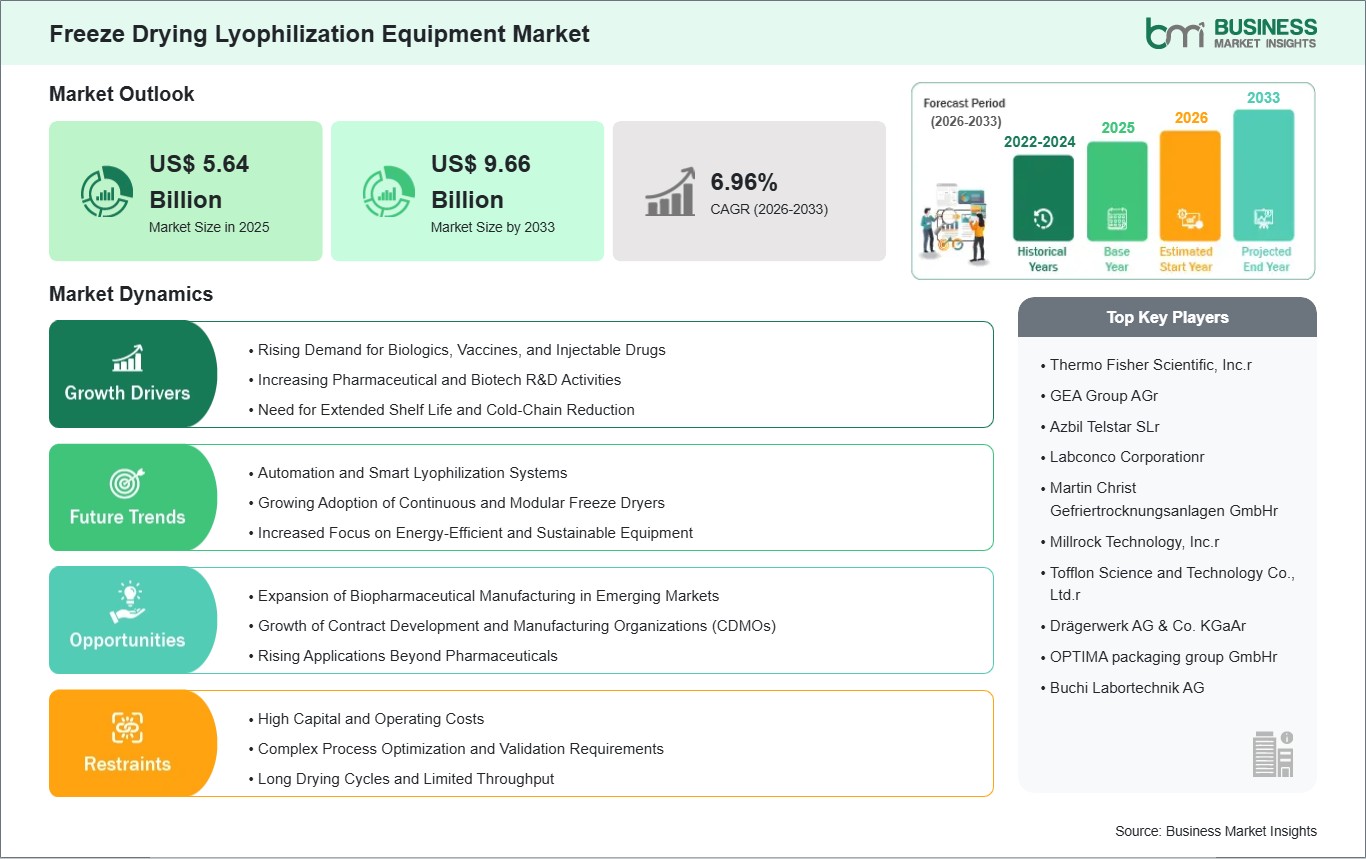
The Freeze Drying Lyophilization Equipment Market size is expected to reach US$ 9.66 Billion by 2033 from US$ 5.64 Billion in 2025. The market is estimated to record a CAGR of 6.96% from 2026 to 2033.
The global lyophilization (freeze drying) equipment market is showing a continuous growth because of the growing need for biologics, vaccines, and injectable pharmaceuticals that require longer shelf-life and extra stability. The lyophilization process is an essential step in the manufacture of biotechnological and pharmaceutical items, and the primary reason this process is important is because it allows the stabilization of active ingredients that are sensitive to temperature while at the same time maintaining both efficacy and quality throughout the complete distribution cycle of these same products. Since the length of the biopharmaceutical pipeline continues to grow due to the development of biologics such as monoclonal antibodies, biosimilar medicines, and therapeutic proteins, this growth in product offerings is resulting in increased use of freeze dryers at all orders of magnitude including laboratory, pilot, and industrial-scale. Additionally, some of the improvements that are being achieved in cycle optimisation, regulatory compliance, and operational efficiencies are due in large part to the advances in technology. Examples of such advancements are automation technologies, enhanced process control methods and energy-efficient design principles.
North America has the largest share of the global freeze drying lyophilization equipment market due to their exceptionally strong pharmaceutical manufacturing sector, large amounts of research and development investment, and the presence of many of the industry's largest freeze dryer manufacturers. However, Europe is also a major contributor to this market, primarily through its many biopharmaceutical manufacturers who are required to purchase only the highest quality lyophilization equipment because of the stringent regulations. The Asia Pacific region will experience the greatest growth in lyophilization equipment in the forecast period due to the current growth in pharmaceutical production across the region as well as the increased production of vaccines and growth of biotech-related investments in China and India. But CDMO (Contract Development & Manufacturing Organizations), modular/scalable equipment, and an expanding market for using FD equipment in nutraceuticals/diagnostics are creating further growth opportunities. The global freeze drying equipment industry will continue to see strong demand, technological advancement, and an increasing penetration rate into both developed and emerging markets.

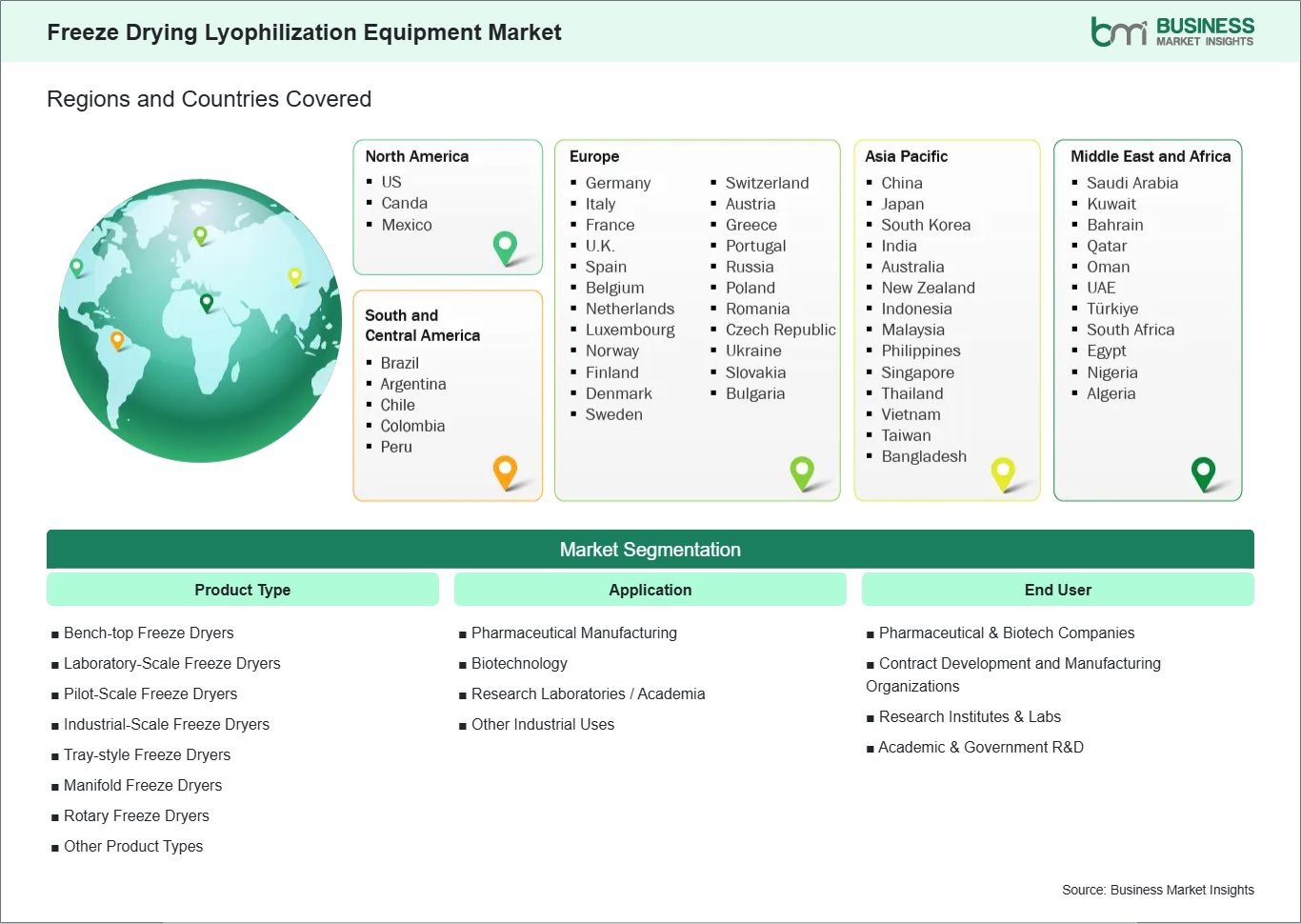
Key segments that contributed to the derivation of the Freeze Drying Lyophilization Equipment market analysis are product type, application and end user.
Growth in the freeze drying lyophilization equipment market growth is driven by the growing demand for biologics such as vaccines and injectable drugs or pharmaceuticals. Monoclonal antibodies, protein-based medications, peptides, and vaccines are among the biopharmaceutical products that are most affected by heat and moisture. As a result, lyophilization is critical to ensure that these products are stable, safe to transport, and have extended shelf life. Pharmaceutical companies are continuously extending their biologic (biopharmaceutical) product pipelines in response to the need to treat complex diseases, including cancer, autoimmune diseases, and infectious diseases, and have made the use of advanced lyophilization systems an even greater priority. The preservation of drug potency throughout the supply chain by using freeze drying significantly reduces dependency on cold-chain logistics for products shipped globally. In recent years, regulatory authorities have laid more emphasis on product quality, consistency, and long-term storage stability, therefore supporting further implementation of proven lyophilization processes.
Additionally, with more injectable drug approvals and extensive production of vaccines occurring every year, the demand for pilot production and commercial production freeze drying equipment has never been greater. Continuing investment by pharmaceutical organizations in research and development activities and ongoing construction of new biologics manufacturing facilities throughout the globe will continue to drive demand for high-quality freeze drying equipment. Therefore, as modern pharmaceutical manufacturing increasingly relies on freeze drying for the production of biologics and injectable drugs, biologics and injectable drugs will represent a significant opportunity for future growth for the freeze drying equipment market.
Due to the rapid rise of contract development and manufacturing organisations (CDMOs) and biopharma manufacturing in increasingly prominent markets, the freeze drying equipment industry has experienced substantial growth opportunities. As pharmaceutical and biotechnology firms (pharma/biotechs) come under increasing pressure to outsource their drug development and manufacturing to CDMOs to reduce costs, increase operational flexibility, and accelerate time-to-market, demand for advanced, scalable, and multi-product lyophilisation systems that can support a wider variety of formulations and batch sizes has increased dramatically. Emerging regions such as Asia Pacific and Latin America have been establishing themselves as important pharmaceutical manufacturing locations because of the cost-effective nature of production, ever-growing amounts of skilled workforce labour, and supportive government policies and guidelines that promote the establishment of new manufacturing facilities. Countries such as China and India are also making large investments in bioproduction infrastructure, including vaccine production and biosimilar manufacturing, both of which rely heavily on freeze-drying technology.
Furthermore, due to a rapid increase in healthcare demand and an improvement in the regulatory framework within each of these international locations, several leading global pharma companies are establishing partnerships with CDMOs to produce at the local level, thereby creating a new revenue stream opportunity for their partners. Those equipment manufacturers that supply modular and energy-efficient lyophilisation equipment that complies with the current requirements of the CDMO marketplace are ideally positioned to obtain new revenue opportunities. In conclusion, the convergence of the outsourcing trend, infrastructure development, and increasing biopharmaceutical production create a very strong and sustainable opportunity for global freeze drying equipment suppliers.

By product type, the freeze drying lyophilization equipment market is segmented into bench-top freeze dryers, laboratory-scale freeze dryers, pilot-scale freeze dryers, industrial-scale freeze dryers, tray-style freeze dryers, manifold freeze dryers, rotary freeze dryers, others. The industrial-scale freeze dryers segment dominated the market in 2025. The growth is attributed to large-scale production of biologics, vaccines, and injectable drugs requiring high throughput and validated processes.
By application, the market is segmented into pharmaceutical manufacturing, biotechnology, research laboratories / academia, other industrial uses. The pharmaceutical manufacturing segment held the largest share of the market in 2025. Segmental growth is driven by High reliance on lyophilization for stability, shelf-life extension, and regulatory compliance of injectable and biologic drugs.
By end user, the market is segmented into pharmaceutical & biotech companies, contract development and manufacturing organizations (CDMOs), research institutes & labs, academic & government R&D. The pharmaceutical & biotech companies segment held the largest share of the market in 2025. The segmental growth is driven by expanding biologics pipelines, vaccine production, and in-house manufacturing capacity.
| Report Attribute | Details |
|---|---|
| Market size in 2025 | US$ 5.64 Billion |
| Market Size by 2033 | US$ 9.66 Billion |
| Global CAGR (2026 - 2033) | 6.96% |
| Historical Data | 2022-2024 |
| Forecast period | 2026-2033 |
| Segments Covered | By Product Type
|
|
Regions and Countries Covered
| |
| North America | US, Canada, Mexico |
| Europe | Belgium, Austria, Finland, Denmark, Greece, Poland, Romania, Russia, Ukraine, Czech Republic, Slovakia, Bulgaria, Italy, Luxembourg, Germany, Switzerland, France, Netherlands, Norway, Portugal, Spain, Sweden, United Kingdom |
| Asia-Pacific | Australia, China, India, Japan, South Korea, Indonesia, Malaysia, Philippines, Singapore, Thailand, Vietnam, Bangladesh, New Zealand, Taiwan |
| South and Central America | Brazil, Argentina, Peru, Chile, Colombia |
| Middle East and Africa | Bahrain, Kuwait, Oman, Qatar, Saudi Arabia, United Arab Emirates, Turkiye, South Africa, Egypt, Algeria, Nigeria |
| Market leaders and key company profiles |
|
The "Freeze Drying Lyophilization Equipment Market Size and Forecast (2022-2033)" report provides a detailed analysis of the market covering below areas:
The geographical scope of the Freeze Drying Lyophilization Equipment market report is divided into five regions: North America, Asia Pacific, Europe, Middle East & Africa, and South & Central America. The Freeze Drying Lyophilization Equipment market in Asia Pacific is expected to grow significantly during the forecast period.
The Asia-Pacific Freeze Drying Lyophilization Equipment market is segmented into China, Japan, South Korea, India, Australia, New Zealand, Indonesia, Malaysia, the Philippines, Singapore, Thailand, Vietnam, Taiwan, Bangladesh, and the Rest of Asia. The Asia Pacific freeze drying lyophilization equipment market is experiencing strong growth, fueled by the expansion of pharmaceuticals and biotechnology manufacturing, growing demand for healthcare, and investments in research and development in the region. The demand for freeze-dried products will continue to increase in countries such as China, India, Japan, South Korea, and Australia; these countries have well-developed biopharmaceutical pipelines, vaccine production, and increased activity in manufacturing biosimilars.
The population of Asia-Pacific is large, and an increasing number of people suffering from chronic diseases and infectious diseases is increasing the number of customers looking for injectable drugs and biologicals that require lyophilization to preserve their stability and shelf-life. The increasing efforts of many governments to strengthen their domestic pharmaceutical industries will help support more use of advanced freeze-drying equipment, particularly in China and India. In addition, Asia Pacific has become an attractive alternative to other regions for contract development and manufacturing outsourcing due to its lower costs, a large number of people who can work in skilled manufacturing positions, and better government regulations. As this trend continues, there will be a growing demand for pilot-scale and industrial freeze-drying equipment for the production of multiple products and large volumes. The increase in the use of technologies, such as automation, energy-efficient designs and modular systems, will also help improve the efficiency of operations and meet the regulatory requirements of those involved on the production side of the industry.

The Freeze Drying Lyophilization Equipment market is evaluated by gathering qualitative and quantitative data post primary and secondary research, which includes important corporate publications, association data, and databases. A few of the key developments in the freeze drying lyophilization equipment market are:
The Freeze Drying Lyophilization Equipment Market is valued at US$ 5.64 Billion in 2025, it is projected to reach US$ 9.66 Billion by 2033.
As per our report Freeze Drying Lyophilization Equipment Market, the market size is valued at US$ 5.64 Billion in 2025, projecting it to reach US$ 9.66 Billion by 2033. This translates to a CAGR of approximately 6.96% during the forecast period.
The Freeze Drying Lyophilization Equipment Market report typically cover these key segments-
The historic period, base year, and forecast period can vary slightly depending on the specific market research report. However, for the Freeze Drying Lyophilization Equipment Market report:
The Freeze Drying Lyophilization Equipment Market is populated by several key players, each contributing to its growth and innovation. Some of the major players include:
The Freeze Drying Lyophilization Equipment Market report is valuable for diverse stakeholders, including:
Essentially, anyone involved in or considering involvement in the Freeze Drying Lyophilization Equipment Market value chain can benefit from the information contained in a comprehensive market report.
Please tell us your area of interest
(Market Segments/ Regions and Countries/ Companies)