
Formaldehyde Market Outlook: Size, Share, Trends, Growth Analysis, Competitive Landscape & Forecast, 2026-2033

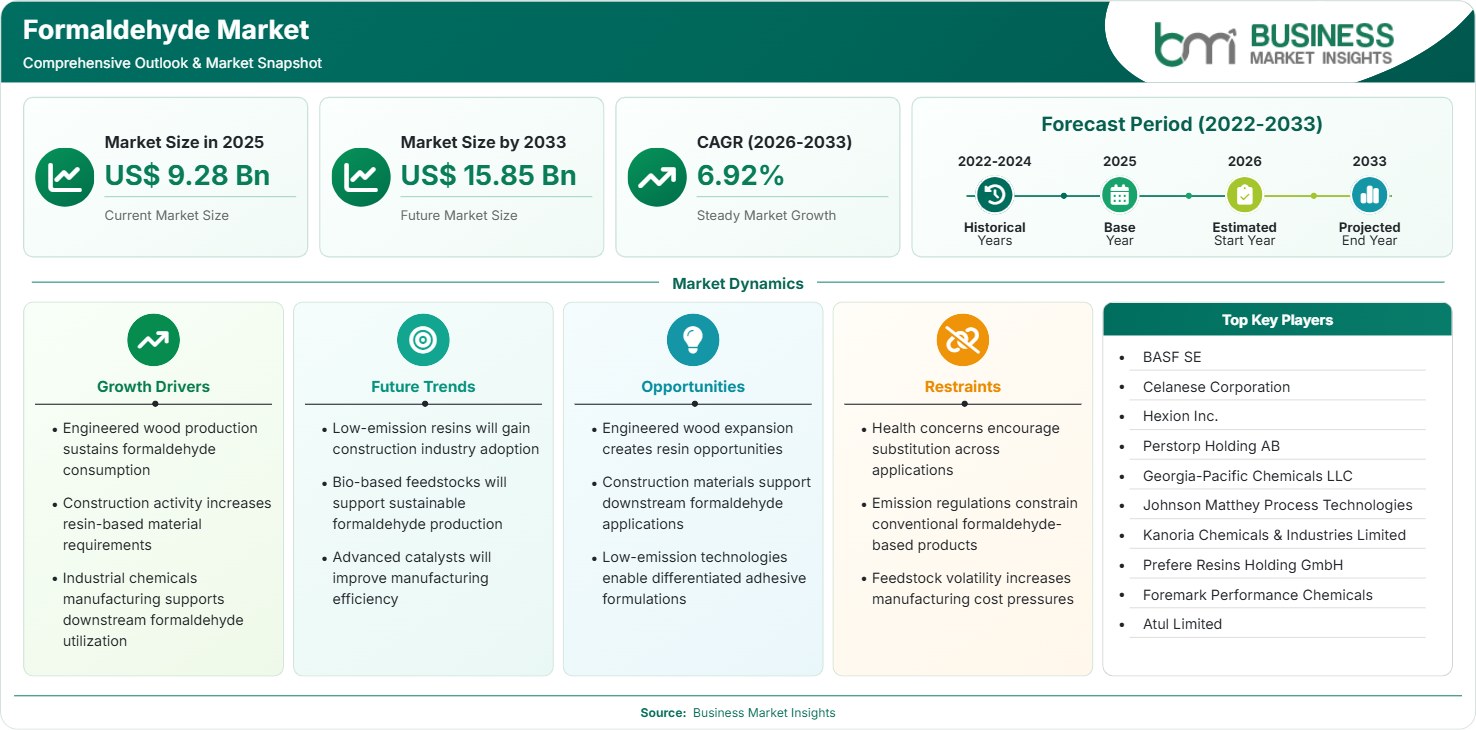
The Formaldehyde Market size was valued at US$ 9.28 Billion in 2025 and is projected to reach US$ 15.85 Billion by 2033, growing at a CAGR of 6.92% during 2026–2033, driven by engineered wood, construction, automotive polymers, resin demand, capacity expansion, and lower-emission technologies.

Report Coverage
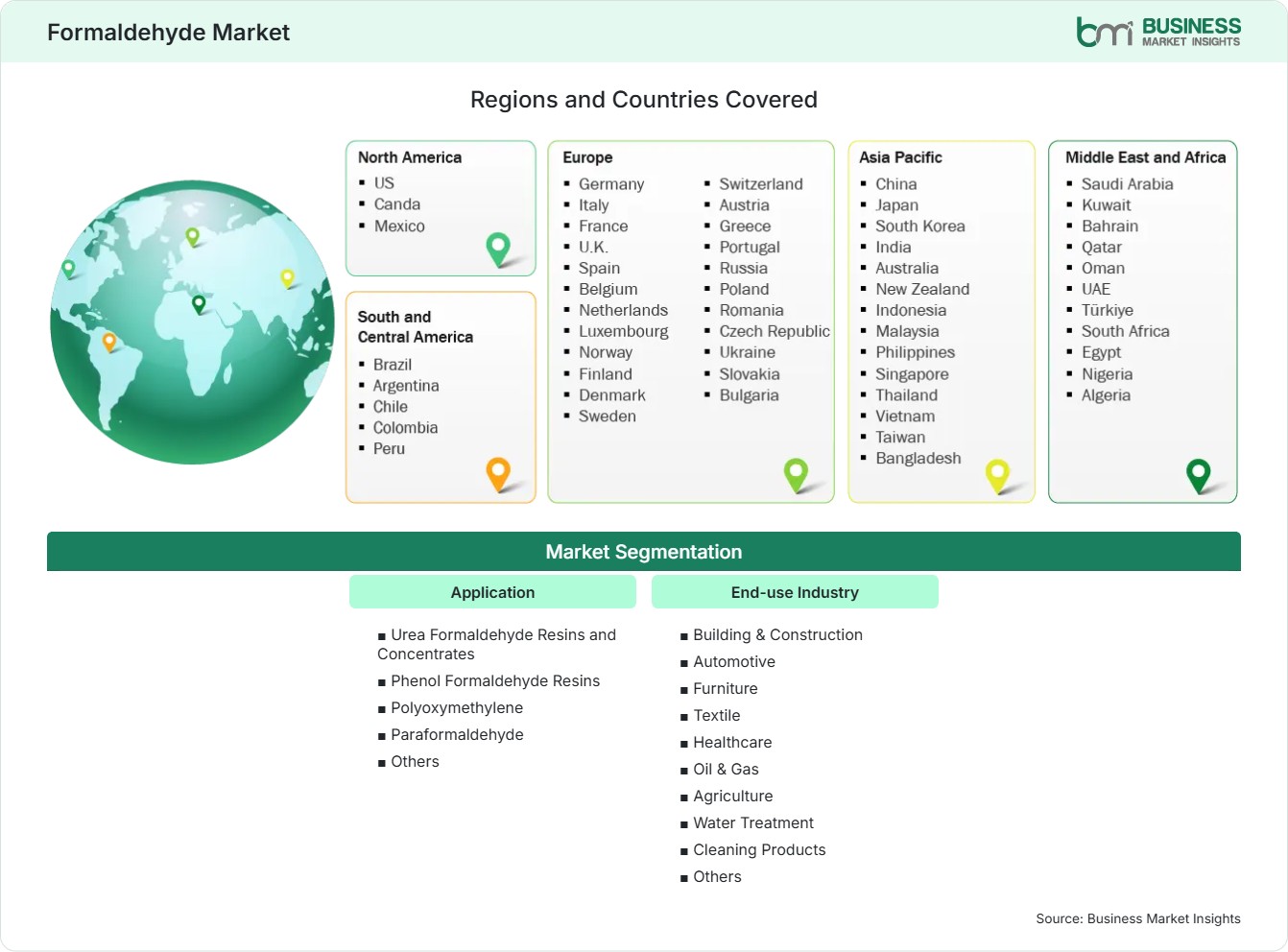
  • Application: Urea Formaldehyde Resins and Concentrates, Phenol Formaldehyde Resins, Polyoxymethylene, Paraformaldehyde, Others
  • End-use Industry: Building & Construction, Automotive, Furniture, Textile, Healthcare, Oil & Gas, Agriculture, Water Treatment, Cleaning Products, Others
US$ 9.28 Bn Market size in 2025
US$ 15.85 Bn Market Size by 2033
6.92% CAGR, 2026 - 2033
2026-2033 Forecast Period

AI Overview

Formaldehyde Market Summary

  • North America Region: holds an 18%–22% share in 2025 and grows at a 5.8%–6.4% CAGR, supported by engineered wood, renovation, furniture, automotive components, specialty resins, lower-emission formulations, domestic supply chains, infrastructure investment, and technical-grade demand. The US market expands at a 5.7%–6.3% CAGR during 2026–2033, supported by construction materials, furniture, automotive components, engineered wood, and specialty chemical applications.
  • Fastest Growing Region: Asia Pacific holds a 52%–56% share in 2025 and expands at a 7.4%–8.0% CAGR, driven by panel production, urbanization, furniture, automotive manufacturing, electronics, chemical integration, localized capacity, catalyst modernization, and growing demand across China, India, and Southeast Asia.
  • Leading Segment: Urea Formaldehyde (UF) Resins and Concentrates hold a 40%–44% share in 2025 and grow at a 7.0%–7.6% CAGR, supported by engineered wood, furniture, laminates, insulation, cost efficiency, rapid curing, lower-emission formulations, scavengers, and manufacturing optimization.
  • High Growth Segment: Polyoxymethylene (POM) holds a 10%–14% share in 2025 and expands at an 8.2%–8.8% CAGR, supported by automotive lightweighting, electrification, medical devices, electronics, precision engineering, dimensional stability, wear resistance, and higher-performance polymer applications.
  • Key Market Opportunity: Opportunities are emerging in integrated methanol-to-formaldehyde plants, downstream resins, POM, paraformaldehyde, low-emission chemistry, sustainable feedstocks, catalyst upgrades, localized capacity, and specialty formulations serving automotive, construction, healthcare, and electronics.
  • Major Market Players: BASF SE; Celanese Corporation; Hexion Inc.; Perstorp Holding AB; Georgia-Pacific Chemicals LLC; Johnson Matthey Process Technologies; Kanoria Chemicals & Industries Limited; Prefere Resins Holding GmbH; Foremark Performance Chemicals; Atul Limited.
Strategic Insights

Formaldehyde Market: Strategic Insights

Formaldehyde Market Strategic Framework
FREE PDF
Request your free sample
Request free sample
Stakeholder View

Key Takeaways

  • Supply-chain integration is becoming more important as producers connect methanol sourcing, formaldehyde conversion, derivatives, storage, and downstream customers to improve reliability and reduce logistics exposure.
  • Engineered wood remains the largest commercial demand base, while POM, paraformaldehyde, specialty resins, automotive components, and medical applications provide opportunities for higher-value product expansion.
  • Product innovation is increasingly focused on lower emissions, catalyst efficiency, improved curing, sustainable feedstocks, captured-carbon chemistry, and formulations that preserve performance while meeting tighter specifications.
  • India and Southeast Asia provide attractive capacity-development opportunities because chemical infrastructure, engineered wood, furniture, automotive, pharmaceutical, and agrochemical manufacturing are expanding simultaneously.
  • Investment is increasingly directed toward downstream integration, specialty materials, plant modernization, technology licensing, and regional capacity rather than undifferentiated commodity expansion.
Geographic Outlook

Formaldehyde Market Regional Highlights

North America Formaldehyde Market

North America Formaldehyde Market holds an 18%–22% share in 2025 and grows at a 5.8%–6.4% CAGR through 2033. Demand is concentrated in engineered wood, furniture, construction, automotive, and specialty chemicals. The United States dominates regional consumption, while Canada provides additional demand through wood products and construction materials. Producers increasingly prioritize supply reliability, emission performance, consistent formalin concentration, and proximity to large downstream customers. The Formaldehyde Market share reflects established industrial infrastructure and mature resin manufacturing.

  • Engineered wood remains a principal demand channel for UF and PF systems used in panels, flooring, cabinetry, furniture, and construction materials.
  • Automotive applications are increasing demand for engineering polymers with improved emissions performance, durability, dimensional stability, and lightweighting characteristics.
  • Regulatory requirements are encouraging investment in emission monitoring, lower-release formulations, analytical testing, and process-control technologies.
  • Integrated supply networks provide advantages by reducing freight exposure and improving response times for resin and formalin customers.

US Formaldehyde Market

The US Formaldehyde Market represents 70%–74% of North American demand and grows at a 5.7%–6.3% CAGR during 2026–2033. Construction renovation, engineered wood, furniture, automotive, and industrial chemicals form the principal demand base. Buyers increasingly emphasize consistent concentration, delivery reliability, emissions documentation, and formulation performance. Domestic production benefits from established chemical infrastructure, although methanol costs, freight, plant utilization, and customer concentration continue influencing procurement economics and supplier competitiveness across regional markets.

  • Housing renovation and engineered wood consumption support recurring UF and PF resin demand across cabinetry, flooring, panels, and composite materials.
  • Automotive manufacturers increasingly use engineered polymers where dimensional precision, durability, chemical resistance, and lower emissions are required.
  • Domestic producers benefit from established infrastructure, while feedstock volatility encourages customers to diversify suppliers and secure dependable contracts.

Europe Formaldehyde Market

Europe Formaldehyde Market holds a 16%–20% share in 2025 and grows at a 5.5%–6.1% CAGR through 2033. Germany is a leading market, while Poland, Italy, France, and Spain provide substantial downstream demand. Germany grows at approximately 5.6%–6.2%, while Poland reaches 6.2%–6.8% as furniture and engineered wood production expand. Regulatory requirements increasingly favor lower-emission products, encouraging formulation upgrades, emissions testing, supplier qualification, and improved manufacturing controls throughout the regional value chain.

  • Germany benefits from a strong chemical and materials ecosystem supporting formaldehyde, resin, polymer, and specialty derivative production.
  • Poland's furniture and engineered wood industries create additional demand for resin intermediates and production technologies.
  • European emissions requirements are encouraging lower-release formulations and investment in monitoring, testing, process control, and product redesign.
  • Specialty resin producers can differentiate through technical support, compliance documentation, and customized formulations for demanding industrial customers.

Asia Pacific Formaldehyde Market

The Asia Pacific Formaldehyde Market holds 52% - 56% market share in 2025, grows at a 7.4% - 8.0% CAGR until 2033, and is the largest regional market. China is the leading consumer, while India and Southeast Asia offer growth in incremental consumption. Growth rates in China stand at 7.2% - 7.8%, in India at 8.0% - 8.6%, and in Vietnam at 8.3%- 8.9%. Engineered wood, furniture, automotive, construction, textiles, pharmaceuticals, electronics, and agricultural chemicals support broad-based regional consumption.

  • China combines large furniture, panel, automotive, chemical, and electronics industries, creating substantial internal formaldehyde and derivative demand.
  • India is expanding chemical capacity around industrial clusters serving engineered wood, textiles, pharmaceuticals, agrochemicals, and automotive applications.
  • Southeast Asia is attracting manufacturing investment as companies diversify production footprints and develop regional supply chains.
  • Catalyst modernization and plant integration can improve production efficiency while supporting lower emissions and more consistent product quality.

Rest of World Formaldehyde Market

Rest of World Formaldehyde Market holds 8%–12% share in 2025 and grows at 6.8%–7.4% through 2033. South and Central America benefit from construction, furniture, agriculture, and chemical manufacturing. Brazil and Mexico provide important demand centers, while the Middle East benefits from petrochemical integration and industrial diversification. Saudi Arabia, the UAE, and Egypt provide expanding opportunities as construction, agriculture, industrial chemicals, and regional manufacturing capacity develop.

Latin America's demand is increasingly being backed up by local manufacturing, furniture, engineered timber products, automotive manufacturing, and agricultural chemistry. The diversified industry clientele in Brazil contrasts with that in Mexico, which is more reliant on its automotive and manufacturing hubs in North America.

Middle Eastern countries present growth prospects for the development of an integrated formaldehyde plant and methanol production. Other industries, such as oilfield chemicals, building materials, agriculture, and water treatment, could generate additional downstream demand for the company’s products. African countries have smaller markets but growing infrastructural and chemical manufacturing capacity.

  • Brazil provides diversified demand through wood products, furniture, construction, automotive manufacturing, and agricultural applications.
  • Mexico's automotive and furniture manufacturing clusters support demand for resins, adhesives, polymers, and specialty chemical intermediates.
  • Saudi Arabia and the UAE can leverage petrochemical infrastructure, feedstock availability, and industrial investment to expand downstream chemical production.
  • Egypt's construction and industrial development supports formaldehyde-derived materials, resins, and chemical intermediates.
Global Market Geography
FREE PDF
Request your free sample
Request free sample
Segment Analysis

Formaldehyde Market Segmentation

Application

Application requirements depend on the type of resin chemistry used and have been diversified through the use of engineered polymers and derivatives. The market is expected to have a 40%–44% share in 2025 and will grow at 7.0%–7.6% from 2025 to 2033. These applications include construction, furniture, automotive, healthcare, agriculture, textiles, and processing industries. The Formaldehyde Market scope is broadening to meet downstream manufacturing requirements.

  • Urea Formaldehyde (UF) Resins and Concentrates: Widely used in engineered wood and furniture because of rapid curing, cost efficiency, and strong bonding; lower-emission formulations support continued adoption.
  • Phenol Formaldehyde (PF) Resins: Thermal resistance supports structural wood, laminates, insulation, abrasives, and demanding industrial applications requiring durable bonding.
  • Polyoxymethylene (POM): High stiffness, dimensional stability, low friction, and chemical resistance support automotive, medical, electronics, and precision engineering applications.
  • Paraformaldehyde: A concentrated solid derivative supporting agriculture, resins, coatings, pharmaceuticals, textiles, and specialty chemical synthesis where controlled formaldehyde dosing is required.

End-use Industry

The end-user demand base is skewed towards the construction and furniture sectors but is becoming increasingly diverse across automotive, healthcare, agriculture, textiles, oil and gas, water treatment, and cleaning applications. The industry segment has a market share of 35%-39% in 2025 and is expected to grow at a CAGR of 6.7%-7.3% until 2033. The Formaldehyde Market trends reflect rising demand for lower-emission materials, reliable supply, application-specific formulations, and efficient downstream manufacturing.

  • Building & Construction: Engineered wood, insulation, laminates, adhesives, and composite panels remain major applications, with lower-emission resin systems gaining importance.
  • Automotive: POM and specialty polymers support lightweight, durable components requiring dimensional stability, chemical resistance, and reliable processing.
  • Furniture: MDF, particleboard, laminates, and decorative surfaces sustain resin demand while manufacturers increasingly prioritize lower formaldehyde release.
  • Textile: Textile finishing and durable-press chemistry create demand for controlled formaldehyde derivatives and compliant formulations.
  • Healthcare: Formaldehyde derivatives support selected medical, laboratory, sterilization, and pharmaceutical applications requiring controlled chemical performance.
  • Oil & Gas: Specialty formaldehyde chemistry supports selected drilling, production, and oilfield chemical applications.
  • Agriculture: Paraformaldehyde and related derivatives are used in selected agricultural chemicals, formulations, and treatment processes.
  • Water Treatment: Formaldehyde-derived chemistry participates in selected polymer and treatment-material applications linked to industrial water management.
  • Cleaning Products: Selected industrial cleaning and preservation formulations use formaldehyde-related chemistry subject to regulatory and formulation requirements.
Market Forces

Formaldehyde Market Dynamics

Key Market Drivers

Engineered Wood Sustains Resin Consumption

Engineered wood is a major driver of demand due to the combination of fast curing, processability, good adhesion, and competitiveness offered by UF and PF systems. Furniture, flooring, cabinet making, decorative panels, and structural panels rely on dependable resins. Therefore, the Formaldehyde Market growth path remains closely tied to building and refurbishment, furniture manufacturing, and panel fabrication. Companies have been able to reduce free formaldehyde content and maintain the resin system through the use of scavengers, proper stoichiometry, improved catalysts, and process control. This results in a greater need for technology in formulation and emissions control than in a simple commodity. Suppliers that can enhance resin performance without reducing manufacturing efficiency are well-positioned to assist customers who must meet stricter product release specifications.

Automotive Electrification Supports Engineering Polymer Demand

Automotive electrification is increasing the use of engineering polymers requiring dimensional stability, low friction, chemical resistance, durability, and low weight. POM is gaining relevance in precision components, fluid-management systems, technical assemblies, and selected vehicle interior applications. Materials manufacturers must thus manage their mechanical performance with low emissions. Formaldehyde market forecasts opportunity is not limited to traditional vehicles, as electric vehicle platform design requires new considerations, such as component compactness and durability. Materials manufacturers that can consistently produce materials with emissions data will be able to forge strong relations with OEMs and Tier manufacturers. Qualification in the automotive industry also makes customer relations long-lasting, since requirements related to safety and durability do not allow a supplier to switch quickly.

Integrated Production Improves Cost Control

There may be significant benefits in integrating methanol acquisition, formaldehyde transformation, resin formation, and derivative production to reduce logistics risk and optimize feedstock utilization. Companies that operate downstream facilities can switch their production between commercial formalin and high-value derivatives based on prevailing market conditions. The use of modern catalysts, energy recycling, automation, and process control is an additional means of enhancing the economics of a facility. Kanoria Chemicals & Industries Limited is one such company that has increased formaldehyde production in India for use by its diverse downstream users in engineering wood, textile, agrochemical, pharmaceutical, and export markets.

Key Market Opportunities

Low-Emission Formulations Create Premium Applications

More stringent emissions regulations present an opportunity to develop low-emission UF and PF systems, scavengers, hybrid binders, curing systems, and process control. There is demand for systems that enable emission reductions without compromising bonding effectiveness, process speeds, or final product quality. This creates an opportunity to offer customers technical support in addition to chemicals. Companies with sound technical know-how can help customers meet their product specifications without requiring expensive redesigns of manufacturing processes. European regulations have become especially important because companies manufacturing furniture, engineered wood, and construction materials must demonstrate their emissions performance. Such standards are becoming widespread across international supply chains due to the uniformity of specifications in the manufacturing processes of multinational corporations.

Sustainable Feedstocks Expand Downstream Innovation

Bio-sourced and captured-carbon feedstocks offer new avenues for development of formaldehyde-based polymers and derivatives. The examples of mass-balance paraformaldehyde and captured-carbon POM demonstrate how existing chemistry can enable a new manufacturing paradigm. And the trick is that when end-users in the automotive, electronics, construction, and industrial industries have carbon-reduction goals without compromising material characteristics, there should be a certification process, life-cycle accounting, qualified customers, and a scalable supply chain. Product differentiation through low-carbon products can be achieved by manufacturers and can help switch end-users to those materials.

Localized Capacity Reduces Supply-Chain Risk

A capacity boost in the region will help to decrease freight risk and increase supply reliability in regions where formaldehyde requirements are growing. India, Southeast Asia, the Middle East, and selected Latin American countries offer opportunities to integrate plants with customers such as resin producers, panel manufacturers, automotive companies, pharmaceutical companies, agricultural companies, and industrial companies. Investors need to pay attention to locations with stable sources of methanol and chemical facilities, and diversified customers and opportunities for export and downstream integration. The modern plant can integrate energy-saving measures and other features at the design stage.

Market Restraints and Challenges

Emission Regulations Increase Compliance Costs

Factor: Stringent indoor aiindoor air emissions, labeling, and documentation regulations necessitate increased testing and process control. Impact: Reformulations, monitoring, supplier qualifications, and emissions tests might be necessary for manufacturers, particularly those producing furniture, engineered wood, insulation, and consumer goods. There is an established indoor air quality guideline of 0.1 mg/m³, which is averaged over 30 minutes. It becomes evident how important it is to control exposure to emissions. Such compliance will direct attention to the use of low-emission grades and the prolongation of the qualification period. In this way, producers need analytical methods, regulatory information, emission control technology, and customer services.

Methanol and Logistics Volatility Pressures Margins

Factor: The prices of methanol, energy costs, transportation rates, exchange rates, and methanol availability affect the economics of formaldehyde production. Impact: Manufacturers face risks of margin pressure, inventory volatility, and loss of competitiveness due to contracts' inability to pass through changes in feedstock costs. Integrated producers could hedge some of the risks through captive methanol supplies, efficient plants, higher capacity utilization, and internal demand. Merchant producers are more price-sensitive since they rely on external feedstocks and logistics. Buyers could mitigate this risk by using diversified suppliers, increasing inventory, or contract indexing. Hence, cost control depends on several factors.

Company Analysis

Competitive Landscape

The Formaldehyde Market analysis shows competition across integrated chemical producers, resin specialists, engineering-material companies, process technology providers, and regional manufacturers. Differentiation increasingly depends on downstream integration, low-emission capabilities, catalyst efficiency, geographic coverage, product consistency, technical support, sustainability, and supply reliability.

Company Name

Overview

Products and Services relevant to this market

BASF SE

Global chemical producer serving construction, furniture, automotive, industrial, and specialty material markets.

Resin systems, POM, binders, additives, engineered materials, and formaldehyde-related technologies.

Celanese Corporation

Specialty materials producer with strong engineering polymer capabilities across automotive, medical, and industrial applications.

POM, paraformaldehyde, engineered materials, and specialty polymer technologies.

Hexion Inc.

Specialty chemical company focused on resins, wood products, and performance materials.

Formalin, thermoset resins, wood-panel binders, and process chemistry.

Perstorp Holding AB

Specialty chemicals producer supplying formaldehyde solutions and downstream intermediates.

Formalin, specialty chemicals, intermediates, and derivative chemistry.

Georgia-Pacific Chemicals LLC

Resin and chemical supplier serving wood products and industrial applications.

Formaldehyde, resins, adhesives, binders, and performance additives.

Johnson Matthey Process Technologies

Process technology provider with expertise in chemical catalysts and manufacturing systems.

Catalyst technologies, reactor solutions, process engineering, and formaldehyde technology.

Kanoria Chemicals & Industries Limited

Indian chemical manufacturer with integrated formaldehyde and derivative operations.

Formaldehyde, phenolic resins, hexamine, pentaerythritol, and specialty intermediates.

Prefere Resins Holding GmbH

European resin specialist serving industrial and wood-based applications.

Formaldehyde, paraformaldehyde, amino resins, phenolic resins, and specialty products.

Foremark Performance Chemicals

North American specialty chemical producer serving construction and industrial customers.

Formalin, resins, intermediates, and tailored chemical solutions.

Atul Limited

Diversified Indian chemical manufacturer serving specialty and industrial markets.

Formaldehyde-related intermediates, resins, specialty chemicals, and industrial materials.

Trust & Transparency

Research Methodology

The market analysis combines proprietary research with secondary data from government agencies, company disclosures, regulatory filings, industry databases and expert interviews. Market estimates are validated through data triangulation, cross-market benchmarking and analyst review.

View Full Research Methodology

Questions Answered

Frequently Asked Questions

What should buyers evaluate when selecting suppliers?

Buyers should assess product consistency, capacity reliability, methanol exposure, geographic proximity, emissions performance, technical support, downstream integration, regulatory documentation, sustainability credentials, and ability to provide application-specific formulations.

What is driving lower-emission resin development?

Regulatory requirements, indoor-air concerns, customer specifications, and furniture and construction standards are encouraging manufacturers to reduce free formaldehyde and product emissions. Scavengers, formulation changes, process controls, and alternative binder systems are being developed to meet these requirements.

How is automotive demand changing?

Automotive customers increasingly require engineering polymers that combine mechanical performance with lower emissions. POM benefits from applications requiring dimensional stability, durability, low friction, chemical resistance, and lightweight construction, particularly in electrified vehicle platforms.

How important is paraformaldehyde?

As per the Formaldehyde Market report, Paraformaldehyde provides a solid, concentrated formaldehyde source for agriculture, resins, pharmaceuticals, coatings, textiles, and specialty chemical synthesis. Its physical form can simplify handling and controlled dosing for selected industrial customers.

What determines formaldehyde production economics?

Methanol cost, energy consumption, catalyst efficiency, plant utilization, logistics, concentration, downstream integration, and customer location are the principal economic variables. Integrated facilities generally have greater flexibility in managing feedstock and product allocation.

Access the Full Formaldehyde Market Report

Get segment-level forecasts, regional estimates, competitive benchmarking, company profiles and downloadable Excel datasets.

Access the full Formaldehyde Market Report
350 pages PDF & Excel | 2026-10-05
Similar Research

Related Market Reports