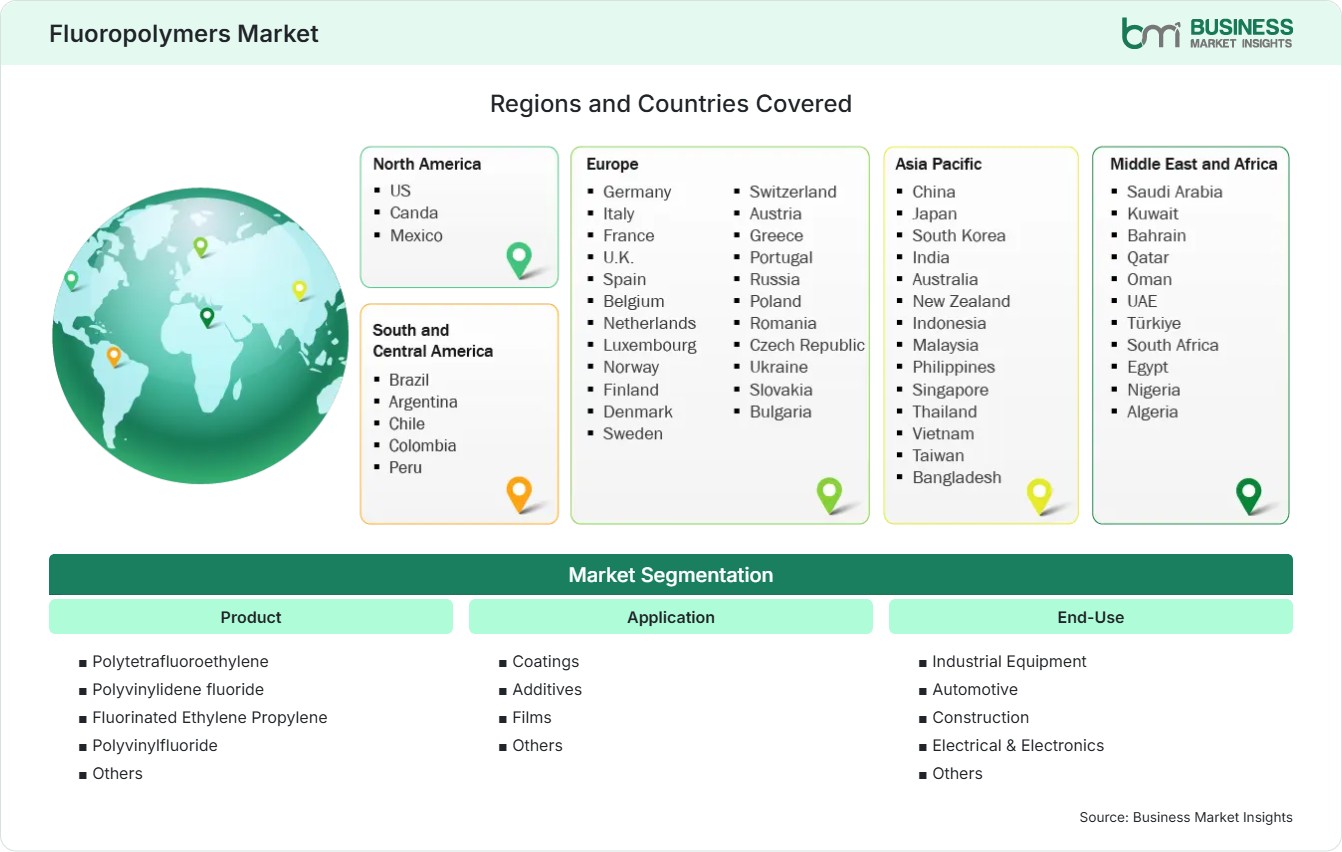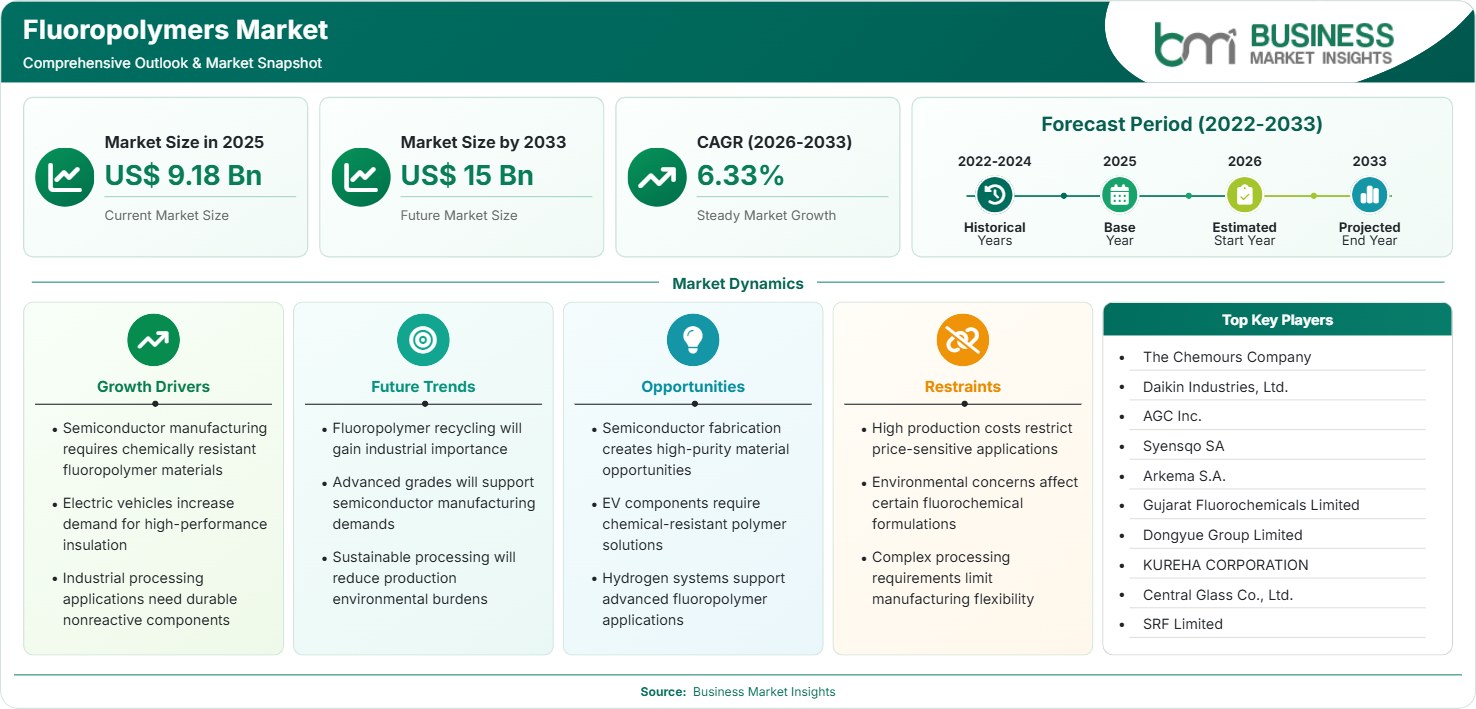
Fluoropolymers Market Regional Highlights
North America Fluoropolymers Market
North America Fluoropolymers Market holds 22%–26% share in 2025 and records a 5.8%–6.4% CAGR through 2033. The regional mix is supported by semiconductor fabrication, aerospace, automotive electrification, chemical processing, and high-purity fluid handling. The US represents the dominant national market, while Canada and Mexico support selected industrial, automotive, and energy applications. Published market benchmarks place North America among the largest regional markets; the range here reflects triangulation and adjustment to the supplied global base.
- Semiconductor reshoring is increasing requirements for high-purity PTFE, PFA, FEP, and related components capable of resisting aggressive process chemicals and elevated temperatures.
- Battery localization is expanding demand for PVDF binders, separator materials, and fluoropolymer components used in thermal management, sealing, insulation, and electrolyte-resistant systems.
- Aerospace and defense procurement favors lightweight, chemically stable, low-friction materials for tubing, seals, wire insulation, bearings, and fluid-management components.
- Domestic supply-chain strategies are encouraging qualification of alternative suppliers, creating opportunities for regional manufacturing, compounding, and specialty-grade production.
US Fluoropolymers Market
The US Fluoropolymers Market represents approximately 64%–68% of North American demand in 2025 and is projected to grow at a 5.7%–6.3% CAGR through 2033. Demand is concentrated in semiconductor equipment, aerospace, automotive, chemical processing, medical technologies, and electrical systems. High-value applications increasingly require traceability, low extractables, controlled processing, and documented compliance. The country's large installed industrial base also supports recurring replacement demand for seals, linings, tubing, bearings, insulation, and engineered components across multiple sectors.
- Semiconductor equipment expansion is strengthening demand for high-purity polymer components as advanced-node processing increases chemical exposure and cleanliness requirements.
- Automotive electrification is creating demand for fluoropolymer insulation, seals, coatings, battery components, and thermal-management systems that tolerate aggressive operating environments.
- Domestic qualification programs favor suppliers able to provide technical documentation, consistent grades, application engineering, and dependable delivery for safety-critical uses.
Europe Fluoropolymers Market
Europe Fluoropolymers Market accounts for 19%–23% share in 2025 and advances at a 5.9%–6.5% CAGR through 2033. Germany and France remain important manufacturing centers, while Italy and the United Kingdom support specialized automotive, industrial, electronics, and construction applications. Germany is estimated at a 5.8%–6.4% CAGR and France at a 5.6%–6.2% CAGR. Regulatory pressure is accelerating process modernization, traceability, recycling initiatives, and non-fluorinated manufacturing aids.
- Germany's automotive and industrial equipment base supports continued PTFE, PVDF, FEP, and specialty polymer demand for seals, insulation, bearings, and chemical-resistant components.
- France combines specialty chemical production with aerospace, energy, and automotive demand, supporting higher-value fluoropolymer formulations and engineered components.
- European regulation is encouraging suppliers to distinguish durable fluoropolymers from processing aids and lower-molecular-weight PFAS while strengthening emissions controls.
- Semiconductor, battery, and renewable-energy investments create opportunities for high-purity grades and materials engineered around circularity requirements.
Asia Pacific Fluoropolymers Market
Asia-Pacific fluoropolymers market holds a 43% - 47% share in 2025 and experiences a CAGR of 7.0% - 7.8%, making it the most rapidly growing region. China is the largest source of demand and production, and Japan and South Korea hold stable positions in electronics and advanced materials. India is a rapidly growing region with a CAGR of 6.0%-6.8%, driven by electronics, the automotive industry, chemicals, and domestic production.
- China combines extensive fluorochemical production with battery, electronics, chemical-processing, and automotive ecosystems, creating integrated demand for multiple fluoropolymer grades.
- Japan's semiconductor, automotive, precision-equipment, and chemical industries support technically demanding PTFE, FEP, PFA, and PVDF applications.
- South Korea's battery and electronics manufacturing base creates opportunities for PVDF binders, high-purity components, insulation, and chemically resistant processing materials.
- India is developing local fluorochemical capacity while expanding electronics, EV, renewable-energy, and industrial manufacturing, supporting new qualification opportunities for domestic suppliers.
Rest of World Fluoropolymers Market
The Rest of World Fluoropolymers market accounts for an 8% - 12% share in 2025, with 5.0% - 5.8% CAGR over 2033. South and Central America find support in the automotive, food processing, chemicals, mining, and energy industries, whereas MEA markets are important in oil and gas, water treatment, construction, and industrial processes. Brazil's CAGR is projected at 5.2% to 5.9%, while Saudi Arabia and the UAE benefit from industrial diversification and infrastructure programs.
- Brazil offers demand across automotive, chemicals, food processing, energy, and industrial equipment, with local conversion and distribution networks supporting imported specialty grades.
- Gulf economies are increasing investment in chemicals, water infrastructure, energy, and industrial manufacturing, expanding requirements for corrosion-resistant linings, seals, membranes, and coatings.
- South Africa provides specialized demand from mining, chemicals, water treatment, and industrial processing where chemical resistance and long service life reduce maintenance requirements.
- Regional growth is increasingly linked to infrastructure modernization rather than broad commodity polymer consumption, favoring application engineering and distributor capabilities.