Market Summary
Executive Summary and Global Market Analysis
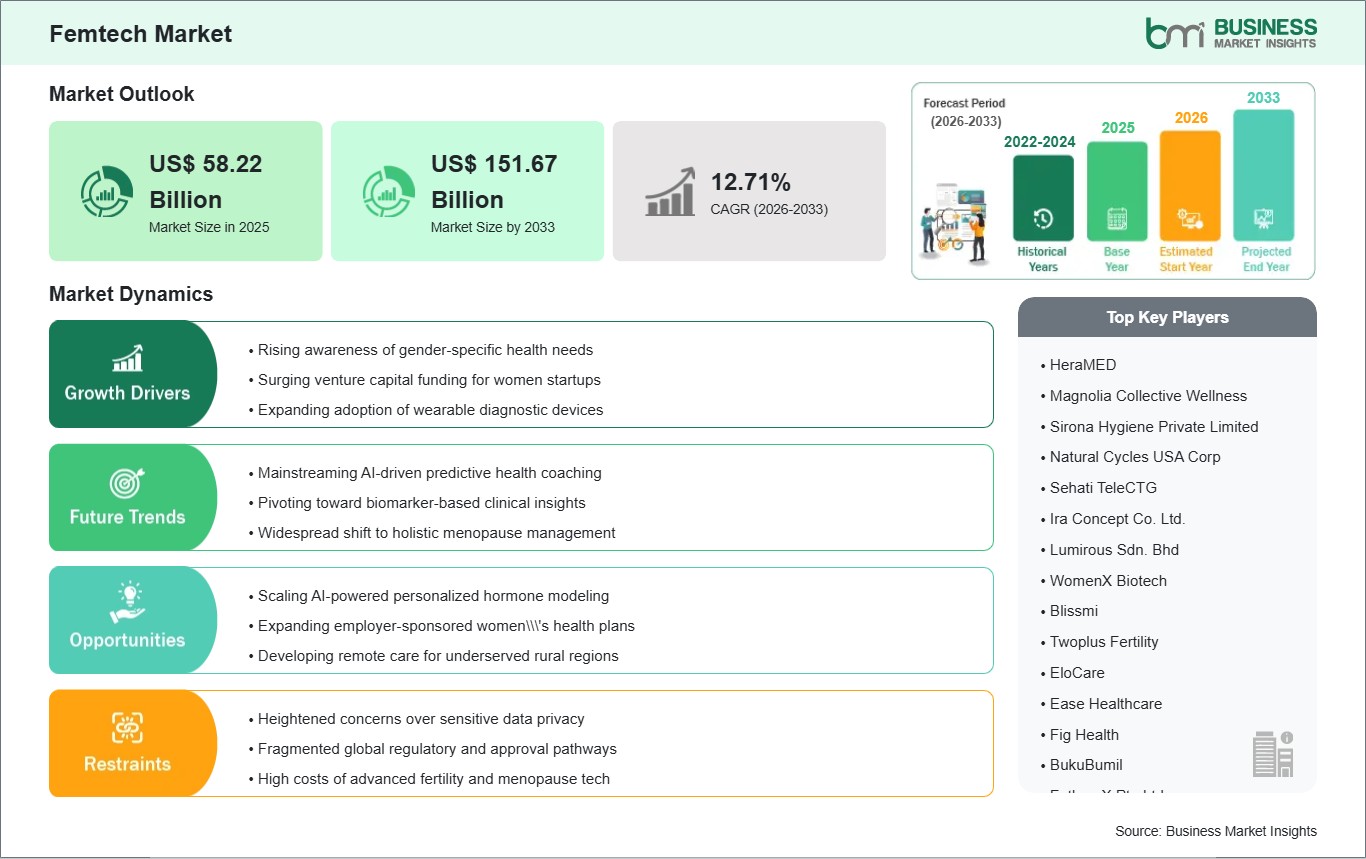
Femtech, or Female Technology, is a category of digital health tools, diagnostic devices, and wearables made to address health issues that mainly or only affect women. These products support women throughout their lives, offering data-driven help for menstrual health, fertility, pregnancy, menopause, and other gynecological or autoimmune conditions. The femtech market is pivotal for providing personalized, technology-based healthcare and diagnostics that help close the gender health gap. It includes mobile health apps like cycle and pregnancy trackers, wearable monitors such as fertility bracelets, smart medical devices such as breast pumps and pelvic trainers, and telehealth platforms. Femtech offers advantages, including the destigmatization of women's health issues, real-time biometric monitoring, and increased autonomy over reproductive and hormonal wellness. The market is being fueled by surging investor interest in women-centric startups, the rapid expansion of direct-to-consumer (DTC) healthcare models, and the global push for personalized medicine. Additionally, the shift toward menopause-focused technologies and postpartum support is fundamentally enhancing the comprehensive care continuum for aging female populations.
However, several challenges can restrain market growth: High upfront costs and the complexity of obtaining medical-grade regulatory approval for new diagnostic devices remain significant barriers. Concerns about data privacy are growing, especially regarding sensitive reproductive and menstrual information, as laws change. The industry still struggles with gaps in clinical research and limited insurance coverage for many wellness products. Despite these challenges, the market has strong potential. Health equity is becoming more important, AI-powered tools for diagnosing conditions such as endometriosis are more common, and more people are using IoT wearables to track hormones. Additionally, more employers are offering fertility and wellness benefits, which is likely to further drive market growth. The shift toward employer-sponsored fertility and wellness benefits is expected to create significant opportunities for market growth.
Segment Analysis
Femtech Market Segmentation
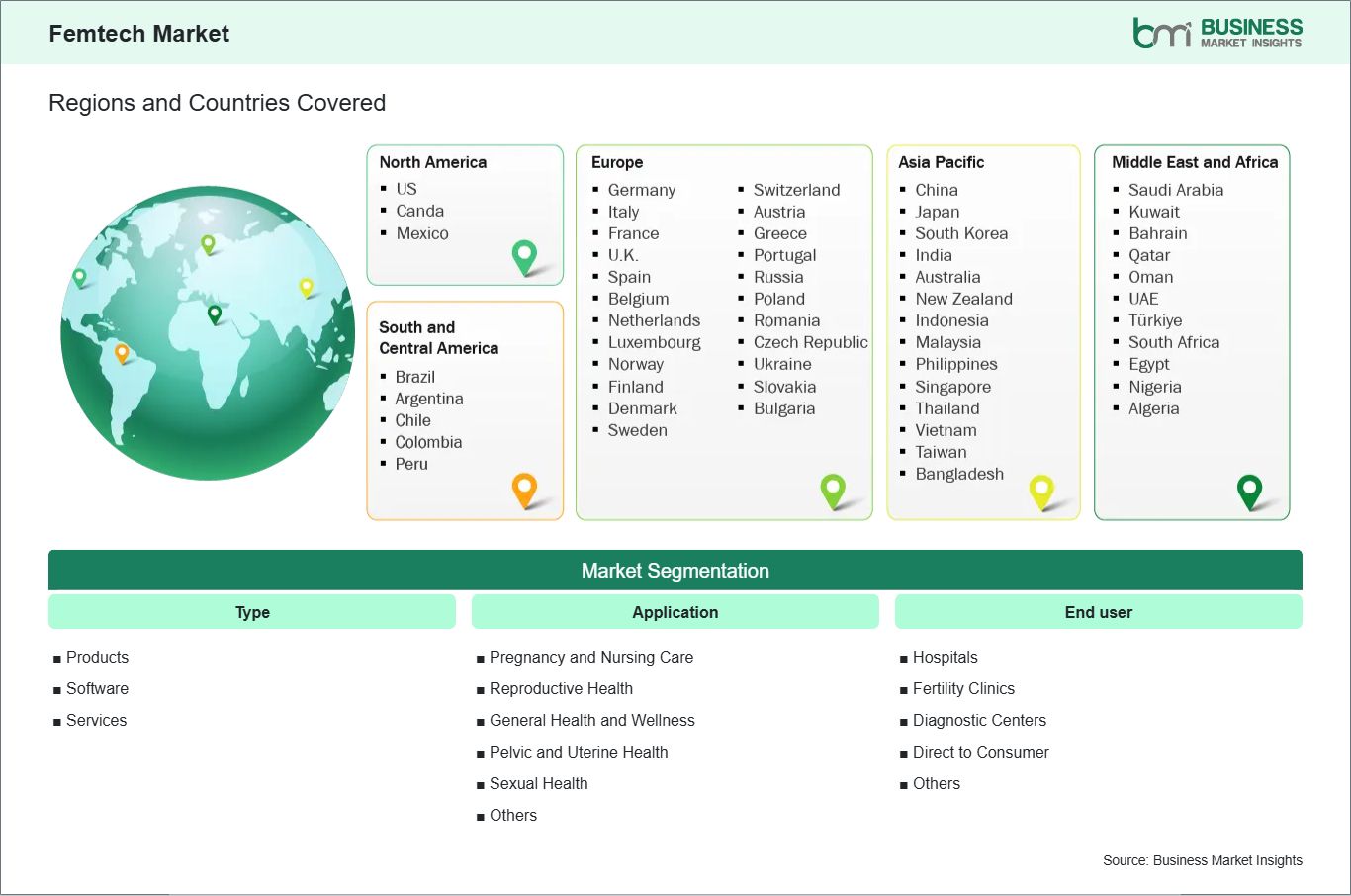
Key segments that contributed to the derivation of the Femtech market analysis are type, application, and end user.
- By Type, the market is segmented into Products (Wearables, Fertility and Hormone Monitoring Kits, Sexual Wellness Devices, and Others), Software (Reproductive and Fertility Apps, Pregnancy and Postnatal Apps, Sexual and Hormonal Health Apps, and General Wellness and Lifestyle Apps), and Services (Telehealth and Teleconsultations, Subscription-based Wellness Programs, and Others).
- By Application, the market is segmented into Pregnancy and Nursing Care, Reproductive Health, General Health and Wellness, Pelvic and Uterine Health, Sexual Health, and Others.
- By End user, the market is segmented into Hospitals, Fertility Clinics, Diagnostic Centers, Direct to Consumer, and Others.
Market Forces
Femtech Market Drivers and Opportunities
Widespread Adoption of Digital Health
Historically stigmatized or closely guarded subjects such as menstrual health, fertility, and pelvic wellness are increasingly entering mainstream conversations, driven by a more proactive and informed consumer base. This cultural shift is largely fueled by a tech-savvy generation of women who expect personalized, data-rich insights into their biological cycles rather than generalized or opaque information. As awareness grows, so does the demand for mobile health applications and wearable devices that provide real-time tracking, predictive analytics, and clinically validated metrics. These digital tools not only empower users with greater control over their reproductive and hormonal health but also facilitate earlier detection of irregularities and more confident decision-making. Ultimately, this widespread “democratization” of health information is transforming what was once considered a niche segment into a vital pillar of the modern digital healthcare ecosystem, reshaping consumer expectations and setting new standards for accessibility and transparency in women’s health technology.
Expansion into Underserved Life Stages
While much of the early market focused on fertility and pregnancy, the "menopause transition" represents a massive, untapped demographic requiring specialized symptom-tracking tools, non-invasive cooling wearables, and tailored telehealth services. Furthermore, there is a significant opportunity for the development of at-home diagnostic kits and AI-powered screening tools for conditions that disproportionately affect women, such as polycystic ovary syndrome (PCOS), endometriosis, and certain oncological conditions. By integrating machine learning to analyze complex hormonal and physiological data, Femtech companies can offer highly customized care plans, positioning themselves as essential partners for both healthcare providers and employers seeking to offer holistic women's health benefits.
Size and Share Analysis
Femtech Market Size and Share Analysis
The Femtech market demonstrates steady growth, with size and share analysis revealing evolving trends and competitive positioning among key players. The report further examines subsegments categorized within type, application, and end user, offering insights into their contribution to overall market performance.
For instance, the Products segment, which includes Wearables and Fertility Monitoring Kits, accounts for a significant portion of the market as women increasingly seek tangible, data-driven tools for health tracking. These products are predominantly utilized in Reproductive Health and Pregnancy and Nursing Care to provide real-time biological feedback. The integration of advanced sensors and AI in these devices is a growing trend, allowing for more accurate ovulation prediction and fetal health monitoring, particularly in the direct-to-consumer segment.
Report Coverage
Femtech Market Report Coverage and Deliverables
The "Femtech Market Size and Forecast (2022 - 2033)" report provides a detailed analysis of the market covering below areas:
- Femtech market size and forecast at global, regional, and country levels for all the key market segments covered under the scope
- Femtech market trends, as well as market dynamics such as drivers, restraints, and key opportunities
- Femtech market analysis covering key market trends, global and regional framework, major players, regulations, and recent market developments
- Industry landscape and competition analysis covering market concentration, heat map analysis, prominent players, and recent developments for the Femtech market
- Detailed company profiles, including SWOT analysis
Geographic Insights
Femtech Market Geographic Insights
The geographical scope of the Femtech market report is divided into five regions: North America, Asia Pacific, Europe, Middle East & Africa, and South & Central America.
The Asia-Pacific Femtech Market is segmented into China, Japan, South Korea, India, Australia, New Zealand, Indonesia, Malaysia, the Philippines, Singapore, Thailand, Vietnam, Taiwan, Bangladesh, and the Rest of Asia. The market is primarily driven by the region's massive female population and the rapid de-stigmatization of women's health issues.
Growth is further bolstered by the rising demand for menstrual health trackers, fertility solutions, and menopause management tools among urban women. The integration of AI-driven personalization in wearable devices and the expansion of direct-to-consumer (DTC) healthcare platforms secures Asia-Pacific’s position as the hub for future Femtech innovation and adoption.
Industry Activity
Recent Developments
The Femtech market is evaluated by gathering qualitative and quantitative data post primary and secondary research, which includes important corporate publications, association data, and databases. A few of the key developments in the Femtech market are:
- In March 2025, Willow Innovations, Inc. (Willow), the FemTech leader that revolutionized the breast pumping experience by inventing the first fully in-bra wearable breast pump, announced its acquisition of Elvie, the leading U.K. FemTech innovator in women’s health and well-being. The transaction unites Willow’s award-winning product portfolio and invention leadership in medical device technology with Elvie's broad portfolio of trusted products, including breast pumps, smart pelvic tools, and sleep solutions. Together, Willow and Elvie create a scaled maternal health platform with two iconic brands, a diversified product portfolio, global distribution, and efficient operations.
- In August 2025, Spark Biomedical, the parent company of OhmBody, a women’s wellness division focused on wearable neurostimulation technology, was selected as one of 13 organizations worldwide to receive funding from Wellcome Leap’s renowned women’s health initiative, The Missed Vital Sign. This recognition highlights Spark Biomedical’s innovative approach and continued scientific pursuit to advancing women’s healthcare. This award supports Spark Biomedical’s work in heavy menstrual bleeding (HMB), particularly its cutting-edge transcutaneous auricular neurostimulation (tAN) platform. tAN therapy represents a non-invasive, non-pharmaceutical approach that engages the nervous system to enhance platelet function and improve hemostasis (i.e., reduced bleeding), addressing a critical unmet need during menstruation.
Trust & Transparency
Research Methodology
The market analysis combines proprietary research with secondary data from government agencies, company disclosures, regulatory filings, industry databases and expert interviews. Market estimates are validated through data triangulation, cross-market benchmarking and analyst
review.
View Full Research Methodology
Key Sources Referred:
World Bank - Global Trade IndicatorsWorld Trade Organization (WTO)International Monetary Fund (IMF)International Trade Administration (ITA)Company WebsitesCompany Annual ReportsCompany Investor Presentations