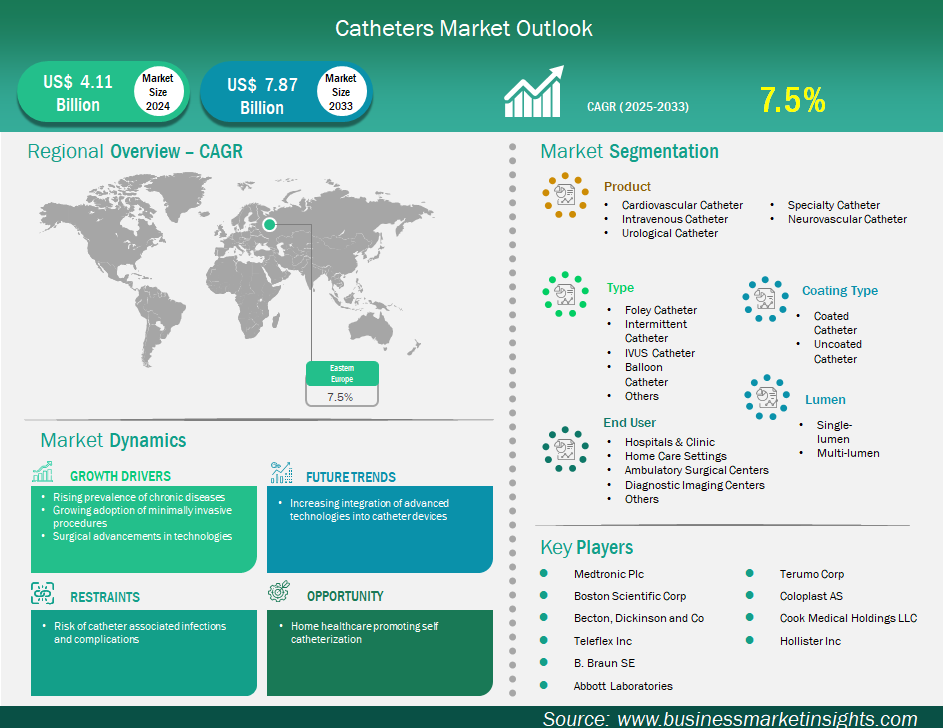
Eastern Europe Catheters market size is expected to reach US$ 7,872.9 million by 2033 from US$ 4,107.2 million in 2024. The market is estimated to record a CAGR of 7.5% from 2025 to 2033.
Executive Summary and Eastern Europe Catheters Market Analysis:
The catheters market in Eastern Europe is experiencing significant growth driven by rising prevalence of chronic diseases, growing adoption of minimally invasive procedures, and technological advancements. The Eastern Europe region, which includes Poland, Czechia, Romania, Bulgaria, and Slovakia, among others is one of the fastest emerging markets for catheters. The Eastern European catheters market is seeing a significant rise due to multiple factors, including aging population, a significant burden of chronic disease, and steadily growing healthcare investment in infrastructure and modernization. Projections indicate that Eastern and Southern EU countries will see the largest decreases in population totals and increases in old-age dependence ratios by 2050, with the number of people aged 85 and older more than doubling by 2050. This demographic shift directly affects catheter utilization since the aging process leads to a greater prevalence of age-dependent or age-related conditions. This leads to a greater need for catheters. There is also a steady upward trend in healthcare spending in many Eastern European countries, indicating a strong commitment to improving healthcare services. Governments in Eastern Europe are actively upgrading public hospitals and promoting connected medical devices. The continuous evolution of the catheter market is happening, with exciting innovative changes that signal more market growth.
Eastern Europe Catheters Market Segmentation Analysis:
Key segments that contributed to the derivation of the Catheters market analysis are product, type, coating type, lumen, and end user.
- By product, catheters market is segmented into cardiovascular catheters, intravenous catheters, urological catheters, specialty catheters, and neurovascular catheters. The cardiovascular catheters segment dominated the market in 2024. The dominance of cardiovascular catheters is driven by the high prevalence of cardiovascular diseases (CVDs) in Eastern Europe.
- By type, catheters market is segmented into Foley catheter, intermittent catheter, IVUS catheter, balloon catheter, and others. The balloon catheter segment dominated the market in 2024. Balloon catheters are favored due to their wide application in angioplasty and other interventional procedures to treat blocked arteries.
- By coating type, catheters market is segmented into coated catheters and uncoated catheters. The coated catheters segment dominated the market in 2024. Coated catheters are preferred for their ability to enhance patient safety and comfort by reducing friction and the risk of infection.
- By lumen, catheters market is segmented into single-lumen and multi-lumen. The multi-lumen segment dominated the market in 2024. Multi-lumen catheters are dominant because they allow for the simultaneous administration of multiple fluids or medications without requiring additional insertion sites.
- By end user, the market is segmented into hospitals & clinics, home care settings, ambulatory surgical centers, diagnostic imaging centers, and others. The hospitals & clinics segment held the largest share of the market in 2024. The hospitals & clinics is the primary end-user due to the high volume of catheter-based procedures performed in these settings.
Eastern Europe Catheters Market Outlook
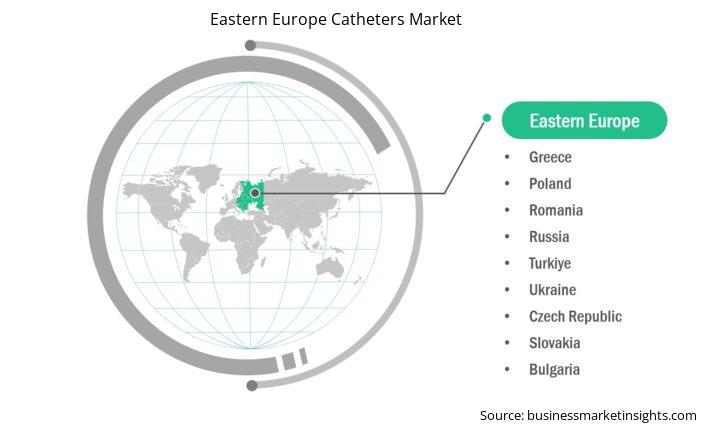
The Eastern Europe catheters market is segmented into Russia, Poland, Ukraine, Romania, Czech Republic, Slovakia, Bulgaria, and Greece. The European catheter market is growing rapidly due to ongoing technological advances and an increasing preference for catheters that focus on patient comfort. Leading medical device companies such as Coloplast, Convatec, and Becton Dickinson are expanding their product offerings to meet the diverse needs of patients. For instance, Coloplast recently launched its Luja line of intermittent catheters, which uses innovative micro-hole technology to lower the risk of urinary tract infections and improve bladder emptying. Similarly, Convatec introduced the GentleCath Air catheter for women, designed with a hydrophilic coating for extra comfort and ease of use.
At the same time, competition in the market is increasing. Smaller companies are creating niche products by focusing on eco-friendly and single-use catheters. This response addresses the growing environmental concerns in Europe. Regulatory trends are promoting sustainability and safety in products, prompting manufacturers to explore biodegradable materials and reduce plastic in catheter design.
Another exciting trend is the rising interest in smart catheters equipped with integrated sensors. These devices can monitor bladder pressure and urine flow, allowing real-time data sharing with healthcare providers, which ultimately improves patient outcomes. The growth of digital health and telemedicine is boosting demand for these connected devices.
Eastern Europe Catheters Market Country Insights
Based on country, the Eastern Europe catheters market is segmented into Russia, Poland, Ukraine, Romania, Czech Republic, Slovakia, Bulgaria, and Greece. Russia held the largest share in 2024.
The Eastern Europe catheters market demonstrates diverse trends and growth drivers across individual countries, reflecting variations in healthcare access, infrastructure, and policy support. In Poland, strong government spending on hospital modernization and a well-developed public healthcare system have led to robust demand for cardiovascular and urological catheters. The country is also an attractive destination for medical tourism, further supporting high procedure volumes. The Czech Republic stands out for its advanced tertiary care infrastructure and emphasis on precision medicine, which is fueling the uptake of neurovascular and interventional catheters. Hungary is witnessing growth in both public and private sectors, driven by rising chronic disease burdens and expanding private hospital chains that favor high-end catheter solutions. Romania, while still working to improve its healthcare delivery model, is seeing increased demand for basic catheter types as part of broader hospital equipment upgrades. Slovakia and Bulgaria are emerging markets where EU-funded healthcare reforms are creating momentum for improved diagnostics and surgical interventions using catheters. However, across the region, rural-urban healthcare disparities remain a concern, often limiting access to specialized catheter procedures in remote areas. National reimbursement systems and procurement policies also vary, influencing product accessibility and physician choice. Despite these variances, the overall trajectory points to greater standardization, improved access, and higher penetration of advanced catheter technologies.
Eastern Europe Catheters Market Company Profiles
Medtronic Plc, Boston Scientific Corporation, Becton, Dickinson and Co., Teleflex Incorporated, B. Braun SE, Abbott Laboratories, Terumo Corporation, Coloplast Group, Cook Medical, and Hollister Incorporated, are among the key players operating in the market. These players adopt strategies such as expansion, product innovation, and mergers and acquisitions to stay competitive in the market and offer innovative products to their consumers.
Eastern Europe Catheters Market Research Methodology:
The following methodology has been followed for the collection and analysis of data presented in this report:
- Secondary Research
The research process begins with comprehensive secondary research, utilizing both internal and external sources to gather qualitative and quantitative data for each market. Commonly referenced secondary research sources include, but are not limited to:
- Company websites, annual reports, financial statements, broker analyses, and investor presentations
- Industry trade journals and other relevant publications
- Government documents, statistical databases, and market reports
- News articles, press releases, and webcasts specific to companies operating in the market
Note: All financial data included in the Company Profiles section has been standardized to US$. For companies reporting in other currencies, figures have been converted to US$ using the relevant exchange rates for the corresponding year.
- Primary Research
Business Market Insights conducts a significant number of primary interviews each year with industry stakeholders and experts to validate and analyze the data and gain valuable insights. These research interviews are designed to:
- Refine findings from secondary research
- Enhance the expertise and market understanding of the analysis team
- Gain insights into market size, trends, growth patterns, competitive dynamics, and future prospects
Primary research is conducted via email interactions and telephone interviews with industry experts across various markets, categories, segments, and sub-segments in different regions. Participants typically include:
- Industry stakeholders: Vice Presidents, business development managers, market intelligence managers, and national sales managers
- External experts: Valuation specialists, research analysts, and key opinion leaders with industry-specific expertise
Key Sources Referred:
- World Health Organization (WHO)
- The World Bank Group
- Eurostat
- World Heart Federation (WHF)
- Centers for Disease Control and Prevention
- Worldometer
- The Lancet
- International Trade Administration
Eastern Europe Catheters Market Strategic Insights
Eastern Europe CathetersMarket Report Highlights
| Report Attribute | Details |
| Market size in 2024 | US$ 4,107.2 Million |
| Market Size by 2033 | US$ 7,872.9 Million |
| CAGR (2025 - 2033) | 7.5% |
| Historical Data | 2022-2023 |
| Forecast period | 2025-2033 |
| Segments Covered |
By Product
|
|
Regions and Countries Covered
|
|
| Eastern Europe | Russia, Poland, Ukraine, Romania, Czech Republic, Slovakia, Bulgaria, Greece |
| Market leaders and key company profiles |
|
Eastern Europe Catheters Market Country and Regional Insights