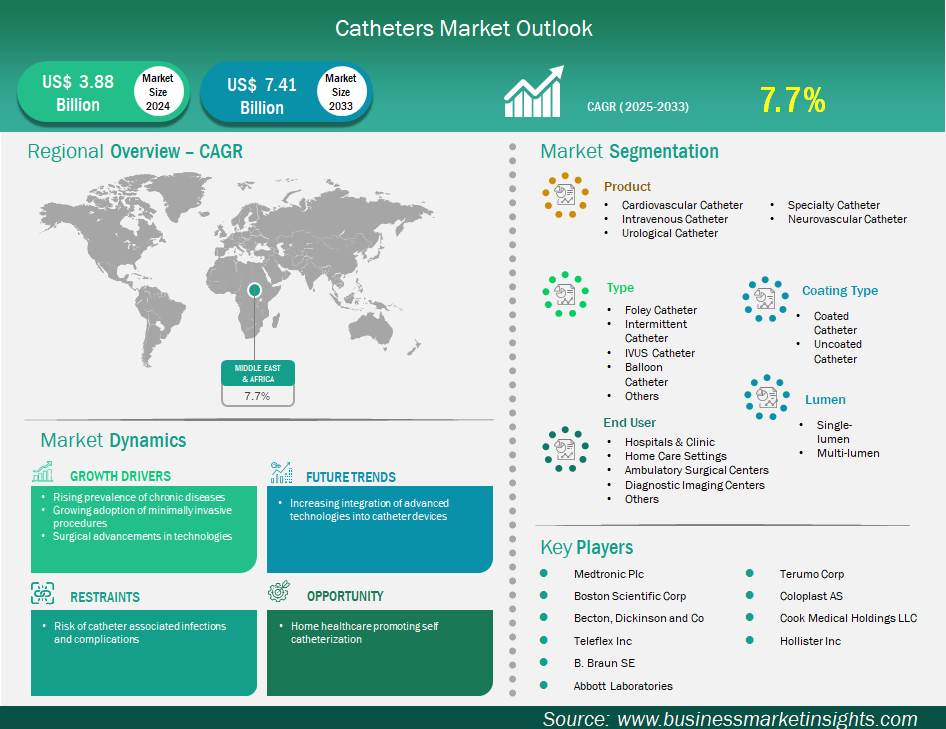
Middle East & Africa catheters market size is expected to reach US$ 7,409.1 million by 2033 from US$ 3,883.7 million in 2024. The market is estimated to record a CAGR of 7.7% from 2025 to 2033.
Executive Summary and Middle East & Africa Catheters Market Analysis:
The catheters market in Middle East & Africa is experiencing significant growth driven by rising prevalence of chronic diseases, growing adoption of minimally invasive procedures, and technological advancements. The catheters market growth is further driven by developing healthcare infrastructure. The catheters market in the Middle East & Africa (MEA) is fragmented. The dynamic nature of the market is readily illustrated by the most recent approvals and regulatory changes. Cardiovascular disease continues to rank as the top cause of non-communicable disease in the United Arab Emirates. In response to the burden of disease, a company, ZvIox-Tonbridge Medical Technology Co., launched its balloon catheter products used for angioplasty and stent products in February 2024, after acquiring marketing approvals from the United Arab Emirates Ministry of Health and Prevention. This example illustrates how the region is primed for the reception of advanced catheter technologies for addressing significant health issues.
Middle East & Africa Catheters Market Segmentation Analysis:
Key segments that contributed to the derivation of the Catheters market analysis are product, type, coating type, lumen, and end user.
- By product, catheters market is segmented into cardiovascular catheters, intravenous catheters, urological catheters, specialty catheters, and neurovascular catheters. The cardiovascular catheters segment dominated the market in 2024. Cardiovascular catheters are dominating due to a rising incidence of cardiovascular diseases (CVDs) often linked to the high prevalence of diabetes and hypertension in the region.
- By type, catheters market is segmented into Foley catheter, intermittent catheter, IVUS catheter, balloon catheter, and others. The balloon catheter segment dominated the market in 2024. Balloon catheters are the leading choice due to the increasing demand for effective and less-invasive procedures for treating vascular diseases.
- By coating type, catheters market is segmented into coated catheters and uncoated catheters. The coated catheters segment dominated the market in 2024. Coated catheters are a dominant force as a result of a strong regional emphasis on infection control and patient safety, especially within newly built, state-of-the-art hospitals.
- By lumen, catheters market is segmented into single-lumen and multi-lumen. The multi-lumen segment dominated the market in 2024. Multi-lumen catheters are dominating because of their essential role in managing critically ill patients who often require multiple interventions simultaneously.
- By end user, the market is segmented into hospitals & clinics, home care settings, ambulatory surgical centers, diagnostic imaging centers, and others. The hospitals & clinics segment held the largest share of the market in 2024. The hospitals & clinics hold the largest market share due to the ongoing large-scale healthcare infrastructure projects funded by governments and private investors.
Middle East & Africa Catheters Market Outlook
The outlook for the Middle East & Africa catheters market is defined by a developing healthcare landscape. The market is experiencing a surge in non-communicable diseases and diagnostic & therapeutic catheter demand is likely to continue. In addition, the market is being driven by a significant modernization of healthcare facilities, including government and private sector investments to build new hospitals and specialized physician care centers. Modernization of facilities will provide more demand for advanced, high-value catheters with the ability to improve patient outcomes. The market will also be impacted by an increasing focus on public health education and sanitation, which will indirectly increase catheter demand through infection control. The market will see an increase in telemedicine use connecting specialists in urban areas to patients in remote areas, including home-based catheter products.
Middle East & Africa Catheters Market Country Insights
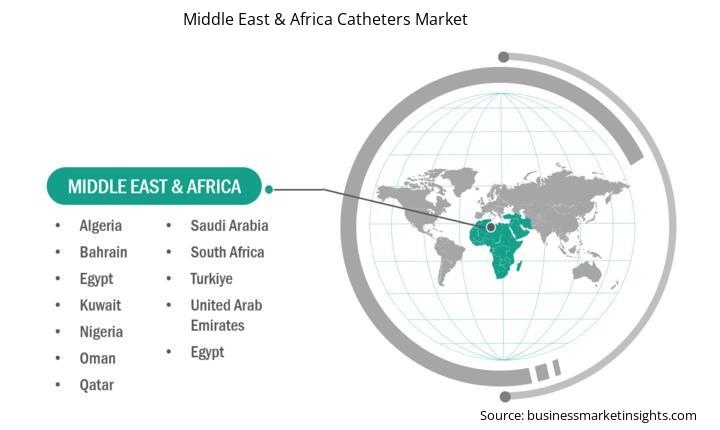
Based on country, the Middle East & Africa catheters market is further segmented into Turkiye, the United Arab Emirates, Saudi Arabia, Bahrain, Oman, Egypt, South Africa, Algeria, Nigeria, Kuwait, and Qatar. Saudi Arabia held the largest share in 2024.
The catheters market across Saudi Arabia, Turkiye, United Arab Emirates, and Nigeria is evolving due to a set of factors that are unique to each country but also following a pattern across the region. Saudi Arabia has a large footprint in this area due to its large public sector investment in healthcare, along with its medical tourism market. Saudi healthcare is currently undergoing a massive regime change under Vision 2030, which is aimed at constructing world-class hospitals with leading medical talent and a demand for premium, technologically advanced catheters. The UAE is another important market with regards to general catheter usage, with its high per capita healthcare expenditure and luxury focus on patient-centered care. Catheter demand in the UAE stems from the demand for advanced devices for complex procedures. Moreover, cardiology and oncology are two areas that require advanced catheter technology to meet the demand of the local population as well as medical tourists. In Africa, South Africa's more developed private healthcare sector also drives high demand for a full variety of catheter product needs, from simple devices to highly specialized devices in advanced settings. South Africa also faces the challenge of addressing the disregard of unmet need in its public healthcare sector.
Middle East & Africa Catheters Market Company Profiles
Medtronic Plc, Boston Scientific Corporation, Becton, Dickinson and Co., Teleflex Incorporated, B. Braun SE, Abbott Laboratories, Terumo Corporation, Coloplast Group, Cook Medical, and Hollister Incorporated, are among the key players operating in the market. These players adopt strategies such as expansion, product innovation, and mergers and acquisitions to stay competitive in the market and offer innovative products to their consumers.
Middle East & Africa Catheters Market Research Methodology:
The following methodology has been followed for the collection and analysis of data presented in this report:
- Secondary Research
The research process begins with comprehensive secondary research, utilizing both internal and external sources to gather qualitative and quantitative data for each market. Commonly referenced secondary research sources include, but are not limited to:
- Company websites, annual reports, financial statements, broker analyses, and investor presentations
- Industry trade journals and other relevant publications
- Government documents, statistical databases, and market reports
- News articles, press releases, and webcasts specific to companies operating in the market
Note: All financial data included in the Company Profiles section has been standardized to US$. For companies reporting in other currencies, figures have been converted to US$ using the relevant exchange rates for the corresponding year.
- Primary Research
Business Market Insights conducts a significant number of primary interviews each year with industry stakeholders and experts to validate and analyze the data and gain valuable insights. These research interviews are designed to:
- Refine findings from secondary research
- Enhance the expertise and market understanding of the analysis team
- Gain insights into market size, trends, growth patterns, competitive dynamics, and future prospects
Primary research is conducted via email interactions and telephone interviews with industry experts across various markets, categories, segments, and sub-segments in different regions. Participants typically include:
- Industry stakeholders: Vice Presidents, business development managers, market intelligence managers, and national sales managers
- External experts: Valuation specialists, research analysts, and key opinion leaders with industry-specific expertise
Key Sources Referred:
- World Health Organization (WHO)
- The World Bank Group
- World Heart Federation (WHF)
- Centers for Disease Control and Prevention
- Worldometer
- The Lancet
- International Trade Administration
Middle East & Africa Catheters Market Strategic Insights
Middle East & Africa CathetersMarket Report Highlights
| Report Attribute | Details |
| Market size in 2024 | US$ 3,883.7 Million |
| Market Size by 2033 | US$ 7,409.1 Million |
| CAGR (2025 - 2033) | 7.7% |
| Historical Data | 2022-2023 |
| Forecast period | 2025-2033 |
| Segments Covered |
By Product
|
|
Regions and Countries Covered
|
|
| Middle East and Africa | Saudi Arabia, United Arab Emirates, Kuwait, Bahrain, Qatar, Oman, Turkiye, South Africa, Egypt, Nigeria, Algeria |
| Market leaders and key company profiles |
|
Middle East & Africa Catheters Market Country and Regional Insights