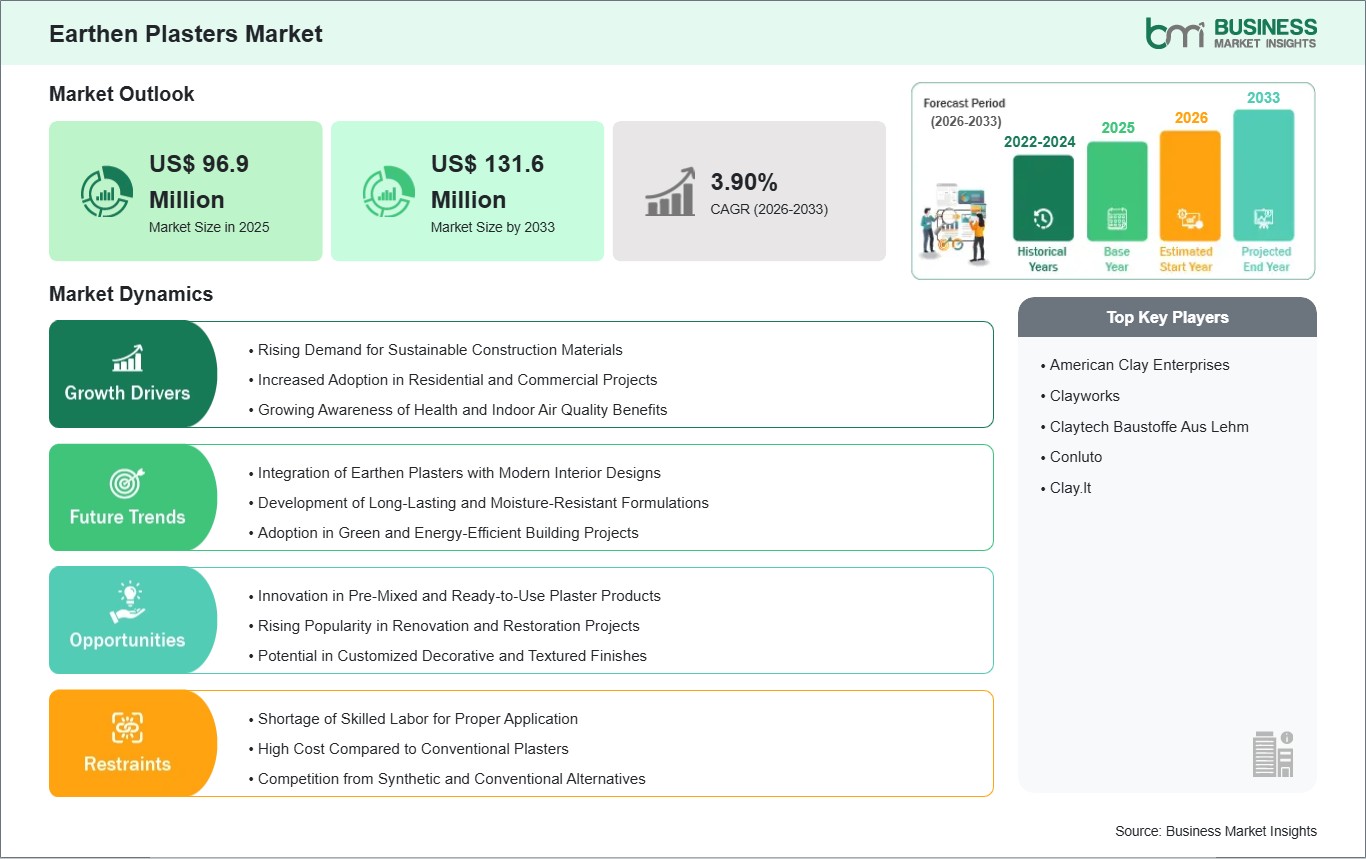
The Earthen Plasters Market size is expected to reach US$ 131.6 Million by 2033 from US$ 96.9 Million in 2025. The market is estimated to record a CAGR of 3.90% from 2026 to 2033.
The earthen plasters market, as a segment of the sustainable building materials industry, is witnessing increasing importance as a building material, driven largely by the renewed interest in green building practices. Earthen plasters, as a natural coating material made from clay, sand, and other fibers, have come into the spotlight as a building material due to their potential benefits, including improved indoor air quality, control of humidity levels, and reduced carbon footprint. The increasing awareness of healthy living, coupled with the implementation of green building regulations, has propelled the demand for earthen plasters as a building material, particularly in the construction of residential, commercial, and heritage buildings. The market also enjoys the advantage of increasing traction in geographies where the focus is on natural and indigenous construction materials. Modern and conventional structures are incorporating earthen plaster materials due to the aesthetic appeal of the material and its ability to adapt to various environmental conditions. The market is also witnessing challenges with regards to its scalability and standardization. Differences in the quality of raw materials, lack of processing facilities, and perceptions about the longevity of the material vis-à-vis modern materials like gypsum and cement may act as a roadblock for the wider acceptance of the material. However, the advocacy for green architecture and the inclusion of earthen materials in the conventional construction curriculum are giving the market a positive outlook for the future.

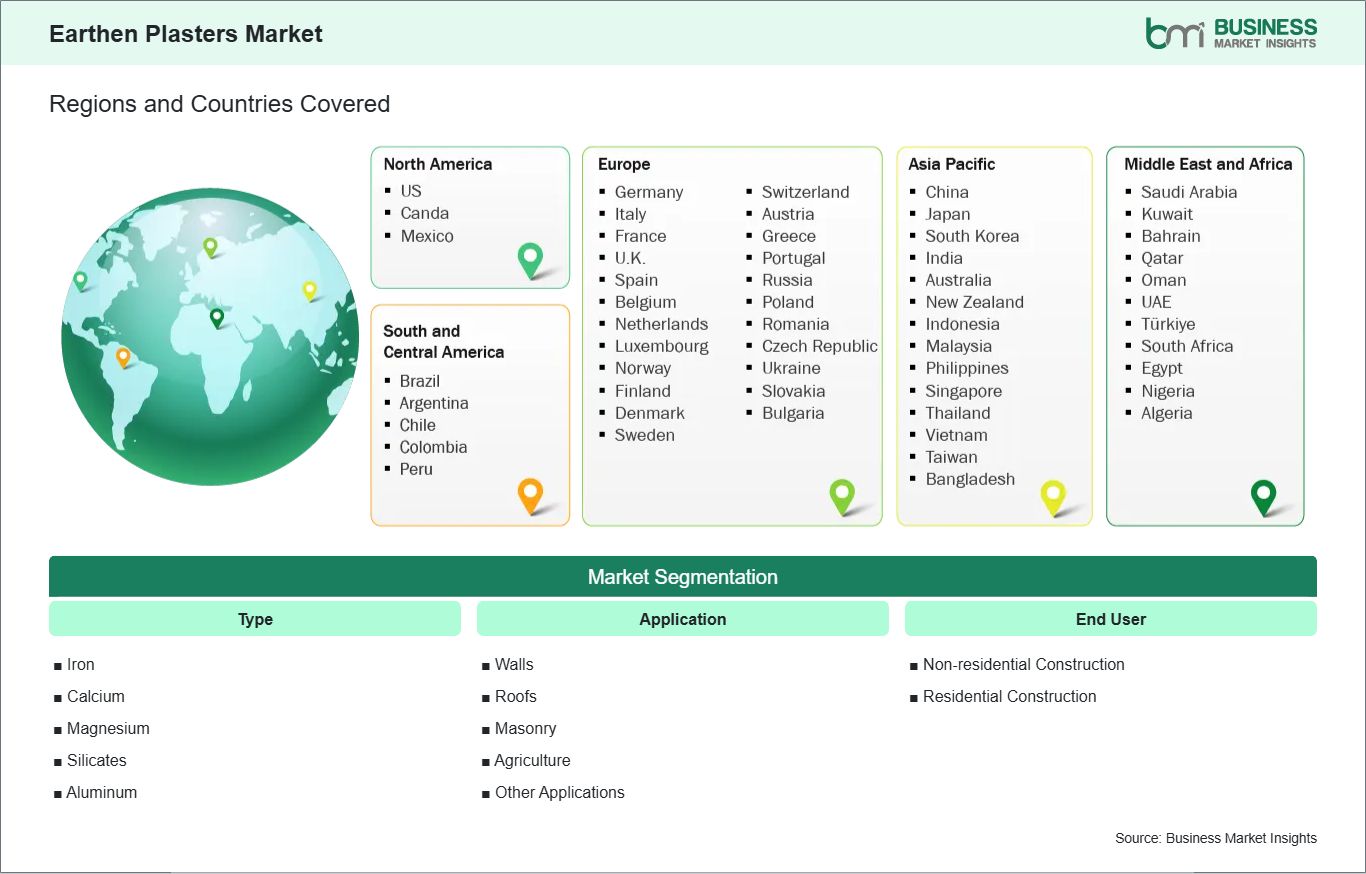
Key segments that contributed to the derivation of the earthen plasters market analysis are type and application.
The increase in environmental awareness and the need for sustainable living are fueling the need for earthen plaster. Builders, designers, and individuals are looking for materials that are renewable, non-toxic, and have a low embodied energy. Earthen plaster, consisting of natural clay, sand, and fibers, is a material that fits the bill and is becoming increasingly popular as a green option to conventional plaster. It also provides a healthier indoor air quality, which is becoming a major concern for both residential and commercial spaces.
Sustainability trends are further amplified by the focus on energy efficiency. Earthen plasters naturally regulate humidity and temperature, reducing the need for additional heating or cooling in buildings. This makes them attractive for construction projects that aim to minimize energy consumption and carbon footprints. Architects and developers are promoting these materials as part of broader eco-friendly building strategies, highlighting both environmental and functional benefits.
The appeal of earthen plasters is not just ecological—it also offers a timeless aesthetic. The natural textures, warm tones, and customizable finishes allow builders to create visually striking spaces while maintaining sustainability standards. As environmental consciousness becomes mainstream, the preference for materials like earthen plaster is expanding beyond niche markets into more mainstream construction and interior design applications.
The market for earthen plasters is being reshaped by innovation in pre-mixed and ready-to-use formulations. Traditional plastering requires skilled labor and careful on-site mixing, which can be time-consuming and limit adoption. Pre-mixed products simplify the application process, reduce errors, and ensure consistent quality, making earthen plasters more accessible to a broader audience, including DIY enthusiasts and modern construction teams.
Manufacturers are taking this opportunity to introduce new product lines that offer natural ingredients along with better workability and durability. New additives are also available in the market, which provide better adhesion, reduced shrinkage, and better resistance to cracking. These pre-mixed plasters are able to meet the requirements of contemporary construction techniques without compromising sustainability.
Furthermore, pre-mixed plasters are also opening new markets for renovation and retrofitting activities, where ease of application and quicker completion are critical factors. Homeowners and contractors are increasingly showing interest in using these pre-mixed plasters for renovation and interior finishes, thus taking earthen plasters beyond new construction activities. As more and more innovation is seen in this field, pre-mixed and ready-to-use plasters are likely to take this construction material beyond traditional techniques and make it more popular in the global construction market.

The earthen plasters market is experiencing steady growth, with market size and share analysis reflecting evolving treatment preferences and competitive dynamics among key players. The report evaluates important subsegments categorized within type and application, highlighting their respective contributions to overall market performance.
By type, the Aluminum subsegment dominated the Earthen Plasters market in 2025. Aluminum-based plasters offer superior durability, workability, and resistance to environmental stress, making them highly suitable for modern construction and decorative applications, which drives their widespread adoption.
Based on application, the Walls subsegment dominated the Earthen Plasters market in 2025. Walls benefit from earthen plasters’ excellent thermal insulation, breathability, and aesthetic appeal, making them ideal for both residential and commercial buildings, thereby supporting strong market demand.
| Report Attribute | Details |
|---|---|
| Market size in 2025 | US$ 96.9 Million |
| Market Size by 2033 | US$ 131.6 Million |
| Global CAGR (2026 - 2033) | 3.90% |
| Historical Data | 2022-2024 |
| Forecast period | 2026-2033 |
| Segments Covered | By Type
|
|
Regions and Countries Covered
| |
| North America | US, Canada, Mexico |
| Europe | Belgium, Austria, Finland, Denmark, Greece, Poland, Romania, Russia, Ukraine, Czech Republic, Slovakia, Bulgaria, Italy, Luxembourg, Germany, Switzerland, France, Netherlands, Norway, Portugal, Spain, Sweden, United Kingdom |
| Asia-Pacific | Australia, China, India, Japan, South Korea, Indonesia, Malaysia, Philippines, Singapore, Thailand, Vietnam, Bangladesh, New Zealand, Taiwan |
| South and Central America | Brazil, Argentina, Peru, Chile, Colombia |
| Middle East and Africa | Bahrain, Kuwait, Oman, Qatar, Saudi Arabia, United Arab Emirates, Turkiye, South Africa, Egypt, Algeria, Nigeria |
| Market leaders and key company profiles |
|
The "Earthen Plasters Market Size and Forecast (2022 - 2033)" report provides a detailed analysis of the market covering below areas:
The geographical scope of the Earthen Plasters market report is divided into five regions: North America, Asia Pacific, Europe, Middle East & Africa, and South & Central America. The Earthen Plasters market in North America is expected to grow during the forecast period.
North America stands out as the leading region in the global earthen plasters market, driven by the strong cultural shift towards more sustainable and wellness-based building practices. In this region, the need for environmentally friendly building materials is closely linked to the general public's demand for non-toxic interior finishes. Earthen plasters have been gaining popularity as design statements in high-end residential projects and boutique commercial renovations. The region's strong green building movement is also helping to promote the use of earthen plasters. The green building movement is well established in North America, and building codes are increasingly acknowledging the advantages of earthen materials. The region's architects and builders are experimenting with earthen plasters as part of a broader range of sustainable building solutions. They are combining earthen materials with other natural materials such as straw bale, timber framing, and even rammed earth. The region is also benefiting from the availability of training programs and workshops that have helped to develop a skilled workforce capable of applying the material correctly. The need for healthier homes is also contributing to the popularity of earthen plasters in North America. Although there are still challenges in terms of consistency in supply chains and mainstream acceptance, North America stands out as a leader in the earthen plaster field due to its emphasis on innovation, sustainability policy, and lifestyle. There is a continued push in terms of collaboration between material suppliers, designers, and sustainability advocates to increase visibility in terms of opportunities.

The earthen plasters market is evaluated by gathering qualitative and quantitative data post primary and secondary research, which includes important corporate publications, association data, and databases. A few of the key developments in the earthen plasters market are:
The Earthen Plasters Market is valued at US$ 96.9 Million in 2025, it is projected to reach US$ 131.6 Million by 2033.
As per our report Earthen Plasters Market, the market size is valued at US$ 96.9 Million in 2025, projecting it to reach US$ 131.6 Million by 2033. This translates to a CAGR of approximately 3.90% during the forecast period.
The Earthen Plasters Market report typically cover these key segments-
The historic period, base year, and forecast period can vary slightly depending on the specific market research report. However, for the Earthen Plasters Market report:
The Earthen Plasters Market is populated by several key players, each contributing to its growth and innovation. Some of the major players include:
The Earthen Plasters Market report is valuable for diverse stakeholders, including:
Essentially, anyone involved in or considering involvement in the Earthen Plasters Market value chain can benefit from the information contained in a comprehensive market report.
Please tell us your area of interest
(Market Segments/ Regions and Countries/ Companies)