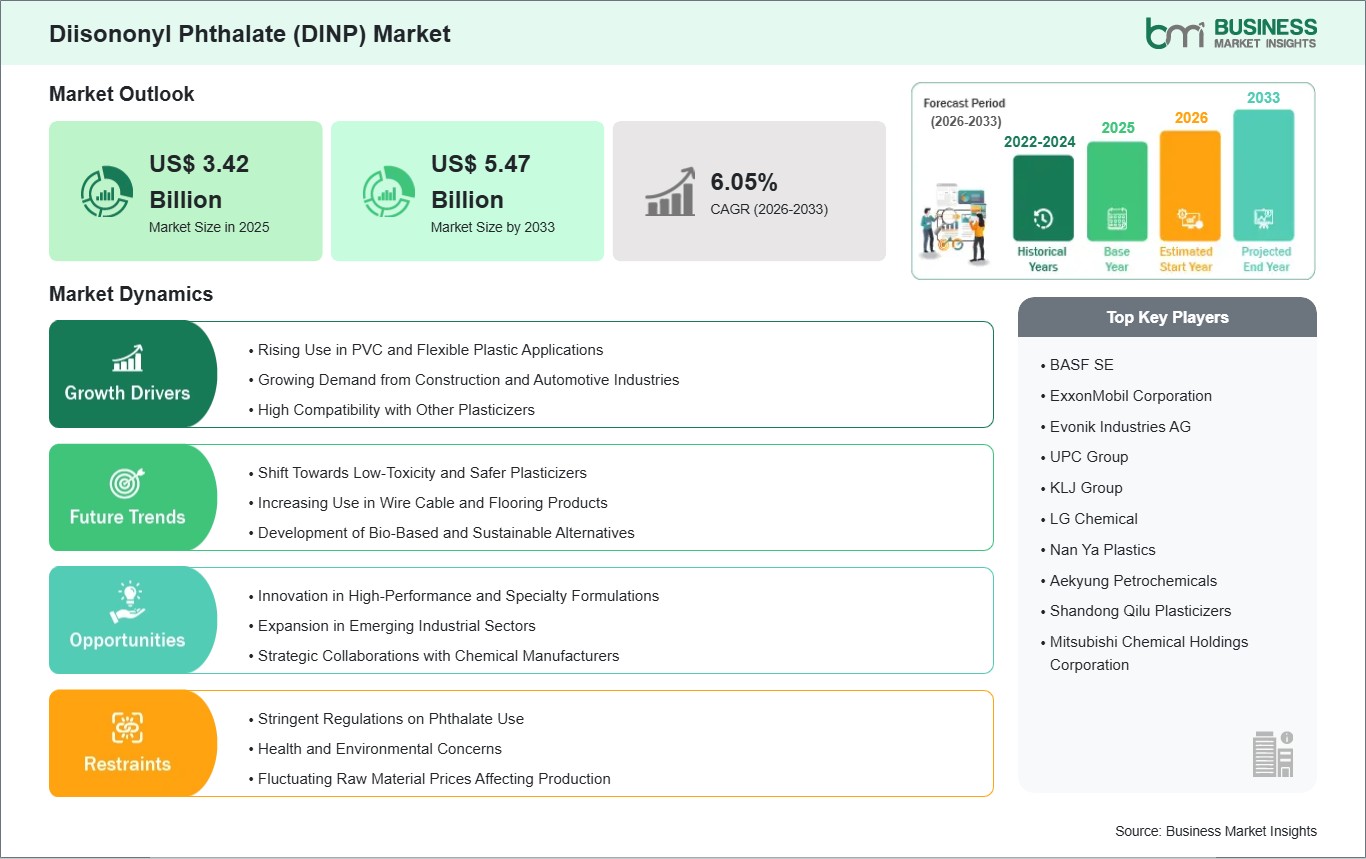
The Diisononyl Phthalate (DINP) Market size is expected to reach US$ 5.47 Billion by 2033 from US$ 3.42 Billion in 2025. The market is estimated to record a CAGR of 6.05% from 2026 to 2033.
The global market for diisononyl phthalate (DINP) is centered around the production and use of DINP as a plasticizer, mainly in polyvinyl chloride (PVC) resins, as well as other polymers. DINP is used as a plasticizer that improves flexibility, durability, and resistance to aging, making it the preferred plasticizer in various applications, including flooring, cables, car interiors, synthetic leather, and coated fabrics. The ability of DINP to retain mechanical properties under various environmental conditions makes it an important plasticizer in industries that demand long-lasting as well as reliable polymer products. Some of the key factors that are contributing to the growth of the market include the rise in construction and automotive activities, which in turn increase the need for flexible PVC products, as well as the growth in the electronics industry, where the product would be suitable in the form of durable plastic components. The compatibility of the product with various polymers, as well as the enhancement of material properties in indoor and outdoor environments, also adds to the importance of the product in the industry. Furthermore, the focus on the development of environment-friendly phthalate substitutes through research activities has also contributed to the incremental development of the product, thereby enhancing its usability in the industry while addressing the concerns of newly evolving regulations in the industry. The concerns over the health and environmental impacts of the product, as well as the regulations that prohibit the use of the product in the production of children`s items, also add to the constraints in the industry, as the focus on the development of alternative non-phthalate plasticizers also adds to the challenges that need to be addressed in order to justify the advantages of the product in the industry.

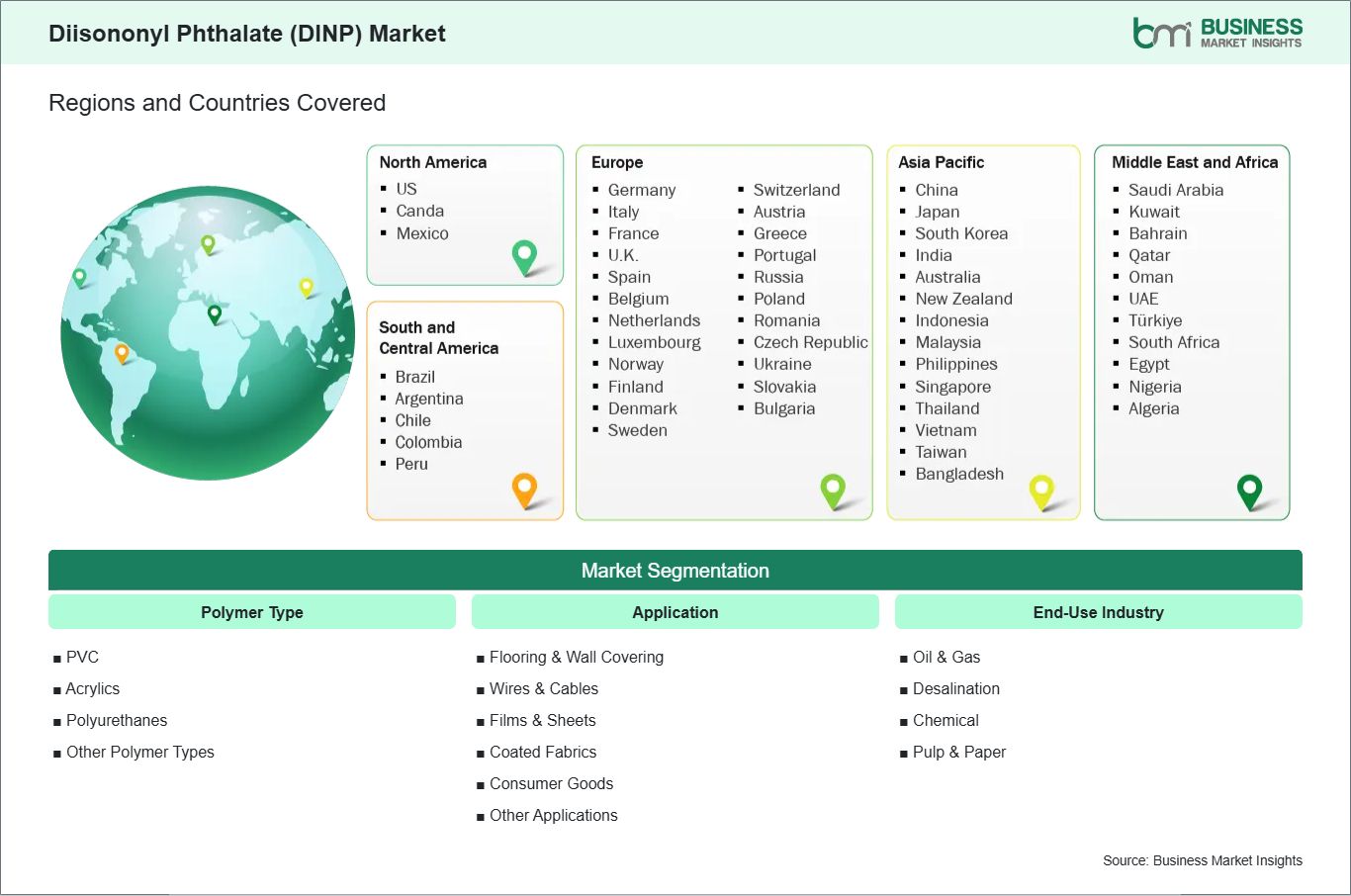
Key segments that contributed to the derivation of the diisononyl phthalate (DINP) market analysis are polymer type, application, and end-user.
The demand for diisononyl phthalate (DINP) continues to grow as manufacturers seek reliable solutions for flexible plastic applications. DINP is widely used as a plasticizer in polyvinyl chloride (PVC) products where elasticity, durability, and long-term stability are critical. Its ability to impart softness while maintaining structural integrity makes it a key material in applications such as flooring, wiring insulation, medical tubing, and synthetic leather, enabling products to meet both functional and aesthetic requirements.
Beyond traditional applications, DINP supports innovation in product design by enhancing flexibility and resilience in items that undergo frequent mechanical stress. Its chemical compatibility with PVC ensures that materials maintain performance over extended periods, which is essential for applications that require repeated use or exposure to varying environmental conditions. This combination of performance and reliability drives its continued adoption across industrial and consumer segments alike.
The growing emphasis on sustainable and long-lasting products further reinforces DINP`s role in the market. By enabling flexible materials to achieve extended lifespans without compromising performance, DINP contributes to reducing material waste and enhancing the durability of everyday products. Its versatility allows manufacturers to address evolving market demands while delivering consistent quality in a wide range of applications.
Innovation in DINP formulations is expanding opportunities in high-performance and specialty applications. Advances in chemical design have improved thermal stability, UV resistance, and migration control, allowing DINP-based products to perform reliably under extreme conditions. This is particularly valuable for applications where precision, longevity, and safety are critical, such as medical devices, electronic components, and automotive interiors.
Specialty DINP formulations also support the development of environmentally conscious and safer products. Modern formulations can offer low emissions, improved compatibility with other materials, and enhanced resistance to environmental stress, making them suitable for premium applications that require a balance of performance and sustainability. Manufacturers increasingly leverage these properties to create differentiated products that meet higher industry standards.
The focus on high-performance DINP is driving its integration into novel applications beyond traditional flexible PVC. From complex industrial materials to sophisticated consumer goods, advanced formulations enable designers and engineers to push the boundaries of what flexible plastics can achieve. By combining durability, safety, and adaptability, DINP continues to be a critical enabler of innovation in the plastics industry.

The diisononyl phthalate (DINP) market is experiencing steady growth, with market size and share analysis reflecting evolving treatment preferences and competitive dynamics among key players. The report evaluates important subsegments categorized within polymer type, application, and end-user, highlighting their respective contributions to overall market performance.
By polymer type, the PVC subsegment dominated the Diisononyl Phthalate (DINP) market in 2025. PVC offers excellent flexibility, durability, and chemical resistance, making it the preferred choice for various plastic applications and driving its widespread adoption.
Based on application, the Flooring & Wall Covering subsegment dominated the Diisononyl Phthalate (DINP) market in 2025. DINP enhances the flexibility and longevity of flooring and wall covering materials, ensuring performance and aesthetic appeal, supporting strong demand.
In terms of end‑user, the Construction & Infrastructure subsegment dominated the Diisononyl Phthalate (DINP) market in 2025. Construction and infrastructure projects require durable, flexible, and cost-effective materials, reinforcing the leading position of this segment.
| Report Attribute | Details |
|---|---|
| Market size in 2025 | US$ 3.42 Billion |
| Market Size by 2033 | US$ 5.47 Billion |
| Global CAGR (2026 - 2033) | 6.05% |
| Historical Data | 2022-2024 |
| Forecast period | 2026-2033 |
| Segments Covered | By Polymer Type
|
|
Regions and Countries Covered
| |
| North America | US, Canada, Mexico |
| Europe | Belgium, Austria, Finland, Denmark, Greece, Poland, Romania, Russia, Ukraine, Czech Republic, Slovakia, Bulgaria, Italy, Luxembourg, Germany, Switzerland, France, Netherlands, Norway, Portugal, Spain, Sweden, United Kingdom |
| Asia-Pacific | Australia, China, India, Japan, South Korea, Indonesia, Malaysia, Philippines, Singapore, Thailand, Vietnam, Bangladesh, New Zealand, Taiwan |
| South and Central America | Brazil, Argentina, Peru, Chile, Colombia |
| Middle East and Africa | Bahrain, Kuwait, Oman, Qatar, Saudi Arabia, United Arab Emirates, Turkiye, South Africa, Egypt, Algeria, Nigeria |
| Market leaders and key company profiles |
|
The "Diisononyl Phthalate (DINP) Market Size and Forecast (2022 - 2033)" report provides a detailed analysis of the market covering below areas:
The geographical scope of the Diisononyl Phthalate (DINP) market report is divided into five regions: North America, Asia Pacific, Europe, Middle East & Africa, and South & Central America. The Diisononyl Phthalate (DINP) market in North America is expected to grow during the forecast period.
North America is the major market for DINP, followed by Europe, due to the well-developed base of polymer production, industrial applications, and quality requirements. The construction, automotive, and electronic industries of North America are major consumers of flexible PVC products, along with plasticized products, as they have a continuous demand for DINP. DINP is used in various applications, including wiring, cabling, flooring, synthetic leather, and car upholstery, where flexibility, durability, and resistance to chemicals are of utmost importance. The well-developed base of polymer production in North America is suitable for the production of high-quality DINP, as well as the production of various polymer blends with DINP as an additive. Manufacturers are more focused on creating formulations with DINP that adhere to strict regulations on the environment and health, especially when it comes to consumer products. The industry has invested in various technologies that ensure energy efficiency, product consistency, and safety standards. The implementation of sustainable practices, such as monitoring and controlling phthalates, has also helped to improve market acceptability. The dominance of North America is also a result of cooperation between chemical producers, polymer producers, and users, ensuring that DINP is a widely used plasticizer with versatility. The challenges that may come with regulatory changes and environmental concerns are balanced by technological advancements and product demand in high-performance products. North America is leading the way in terms of setting trends in product development, regulatory compliance, and product diversification with DINP.

The diisononyl phthalate (DINP) market is evaluated by gathering qualitative and quantitative data post primary and secondary research, which includes important corporate publications, association data, and databases. A few of the key developments in the diisononyl phthalate (DINP) market are:
The Diisononyl Phthalate (DINP) Market is valued at US$ 3.42 Billion in 2025, it is projected to reach US$ 5.47 Billion by 2033.
As per our report Diisononyl Phthalate (DINP) Market, the market size is valued at US$ 3.42 Billion in 2025, projecting it to reach US$ 5.47 Billion by 2033. This translates to a CAGR of approximately 6.05% during the forecast period.
The Diisononyl Phthalate (DINP) Market report typically cover these key segments-
The historic period, base year, and forecast period can vary slightly depending on the specific market research report. However, for the Diisononyl Phthalate (DINP) Market report:
The Diisononyl Phthalate (DINP) Market is populated by several key players, each contributing to its growth and innovation. Some of the major players include:
The Diisononyl Phthalate (DINP) Market report is valuable for diverse stakeholders, including:
Essentially, anyone involved in or considering involvement in the Diisononyl Phthalate (DINP) Market value chain can benefit from the information contained in a comprehensive market report.
Please tell us your area of interest
(Market Segments/ Regions and Countries/ Companies)