Market Summary
Executive Summary and Global Market Analysis
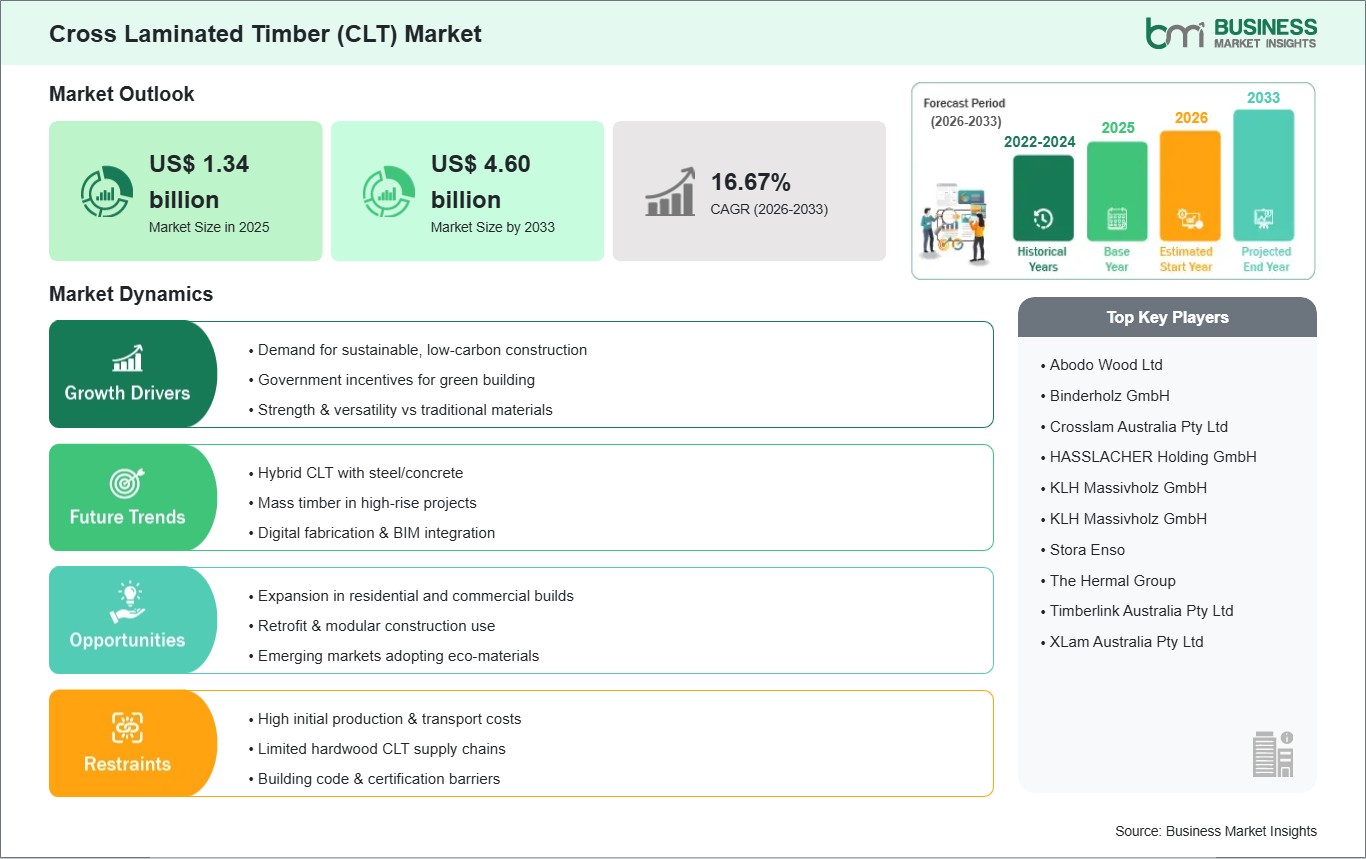
Cross-laminated timber (CLT) is a type of engineered wood made by gluing layers of solid-sawn lumber at right angles to create large structural panels. This setup offers high strength, stability, and fire resistance, which makes it suitable for various construction uses. CLT panels are commonly found in residential, commercial, and industrial buildings for walls, floors, roofs, and modular construction. The product comes in different grades, thicknesses, and finishes, allowing for customization based on architectural, structural, and aesthetic needs. The market is expanding steadily because of the growing demand for sustainable building materials, urban growth, and green building practices worldwide.
The construction industry's move toward lightweight, prefabricated, and renewable materials supports this trend. There is also an increasing emphasis on reducing carbon footprints in building projects. Improvements in manufacturing, adhesives, and panel production methods boost performance, accuracy, and scalability. Additionally, building codes and environmental certifications are increasingly supporting timber-based construction, which promotes the global use of CLT panels in both low-rise and mid-rise buildings.
Segment Analysis
Cross Laminated Timber (CLT) Market Segmentation
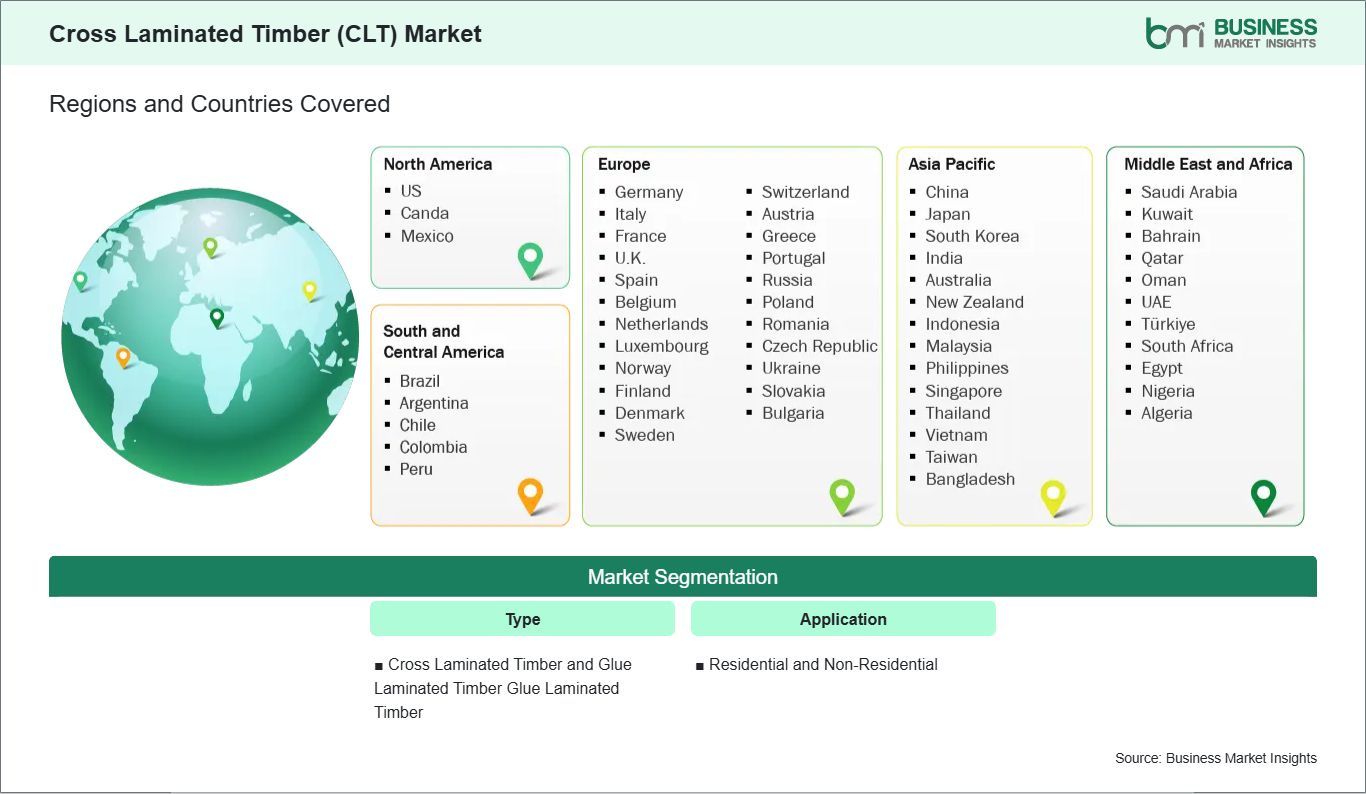
Key segments that contributed to the derivation of the cross laminated timber (CLT) market analysis are type and application.
- By type, the cross laminated timber market is segmented into cross laminated timber and glue laminated timber. The cross laminated timber segment held the largest market share in 2025.
- By application, the market is segmented into residential and non-residential applications. The residential segment held the largest market share in 2025.
Market Forces
Cross Laminated Timber (CLT) Market Drivers and Opportunities
Rising Demand for Sustainable Construction Materials
The growing demand for sustainable and eco-friendly construction materials is a major factor boosting the cross laminated timber (CLT) market. CLT is made from renewable timber resources and provides significant benefits for carbon capture. This aligns with global efforts to lower greenhouse gas emissions in the construction industry. Architects and developers are increasingly using CLT because of its low environmental impact, lightweight nature, and quicker construction times compared to traditional concrete and steel structures.
The material also helps with energy efficiency and reduces waste during manufacturing and assembly. Supportive actions from governments, green building certifications, and tougher rules on conventional construction emissions further encourage the use of CLT. Moreover, urban development projects looking for modular and prefabricated solutions find CLT suitable for high-performance, sustainable, and visually appealing designs. These elements together fuel the demand for CLT panels in residential, commercial, and institutional construction projects globally.
Expansion in Modular and High-Rise Construction
The growth of modular and high-rise timber construction presents a significant opportunity for the cross laminated timber (CLT) market. Advances in engineering and fire-resistant designs allow CLT to be used for mid-rise and tall buildings. This opens new segments for large-scale urban construction. Prefabricated CLT panels enable rapid assembly on-site, which reduces labor costs, construction time, and disruption in crowded areas. Increased awareness of the environmental and logistical benefits of mass timber, along with wider acceptance in building codes, drives architects and developers to explore new applications.
Markets in North America, Europe, and Asia are actively using CLT in modular housing, office complexes, and mixed-use developments. Technological improvements in panel manufacturing, structural optimization, and digital design integration further boost performance, safety, and cost-effectiveness. These trends create opportunities for manufacturers and construction firms to expand their product lines, enter new urban markets, and meet the rising demand for sustainable, high-performance timber construction solutions across the globe.
Size and Share Analysis
Cross Laminated Timber (CLT) Market Size and Share Analysis
The cross laminated timber (CLT) market demonstrates steady growth, with size and share analysis revealing evolving trends and competitive positioning among key players. The report examines subsegments categorized within type and application, offering insights into their contribution to overall market performance. By application, the residential segment has the largest market share. Cross laminated timber is widely used in single-family homes, multi-family buildings, apartments, and low- to mid-rise housing projects. Builders and developers prefer CLT for residential construction because it offers high structural strength while being lightweight. This allows for faster construction and lower foundation costs. The material also provides excellent thermal insulation, fire resistance, and sound performance, which improves the comfort and safety of living spaces. CLT is valued for its design flexibility, enabling architects to create modern, open-plan layouts with large spans and exposed timber aesthetics. Growth in this segment is driven by rising demand for sustainable and eco-friendly building materials, increasing urbanization, government incentives for green housing, and consumer preference for energy-efficient, low-carbon residential structures worldwide.
Report Coverage
Cross Laminated Timber (CLT) Market Report Coverage and Deliverables
The " Cross Laminated Timber (CLT) Market Size and Forecast (2022 - 2033)" report provides a detailed analysis of the market covering below areas:
- Cross laminated timber (CLT) market size and forecast at global, regional, and country levels for all the key market segments covered under the scope
- Cross laminated timber (CLT) market trends, as well as market dynamics such as drivers, restraints, and key opportunities
- Cross laminated timber (CLT) market analysis covering key market trends, global and regional framework, major players, regulations, and recent market developments
- Industry landscape and competition analysis covering market concentration, heat map analysis, prominent players, and recent developments for the cross laminated timber (CLT) market
- Detailed company profiles, including SWOT analysis
Geographic Insights
Cross Laminated Timber (CLT) Market Geographic Insights
The geographical scope of the cross laminated timber (CLT) market report is divided into five regions: North America, Asia Pacific, Europe, the Middle East & Africa, and South & Central America. Europe holds a significant share of the cross laminated timber (CLT) market. This is due to strong government backing for sustainable construction and established mass timber industries in countries like Germany, Austria, and Switzerland. The region enjoys a long history of timber construction, extensive research and development, and building codes that promote the use of engineered wood products.
High urbanization rates, green building efforts, and a focus on carbon-neutral construction have increased the demand for CLT panels in residential, commercial, and public infrastructure projects. Europe also has strong production capabilities, a well-developed supply chain, and broad recognition of the environmental and aesthetic benefits of CLT, making it a popular choice for architects and developers. Growing interest in modular and multi-story timber buildings further strengthens Europe's leadership. With ongoing policy support, sustainability efforts, and technological progress, Europe is likely to keep its dominant position in the global cross laminated timber (CLT) market during the forecast period.
Industry Activity
Recent Developments
The cross laminated timber (CLT) market is evaluated by gathering qualitative and quantitative data post-primary and secondary research, which includes important corporate publications, association data, and databases. A few of the key developments in the cross laminated timber (CLT) market are:
- In April 2024, researchers at Michigan Technological University developed cross-laminated timber (CLT) from hardwood species. They tested new resins to expand mass timber use beyond softwoods, reduce carbon in construction, and increase options for sustainable building materials.
- In February 2024, researchers at Washington State University received a two-year grant to explore making cross-laminated timber more resilient and durable. This includes thermally modified CLT and recycled carbon fiber composites. Their goal is to strengthen housing materials and improve research on sustainable wood construction.
Trust & Transparency
Research Methodology
The market analysis combines proprietary research with secondary data from government agencies, company disclosures, regulatory filings, industry databases and expert interviews. Market estimates are validated through data triangulation, cross-market benchmarking and analyst
review.
View Full Research Methodology
Key Sources Referred:
World Bank - Global Trade IndicatorsWorld Trade Organization (WTO)International Monetary Fund (IMF)International Trade Administration (ITA)Company WebsitesCompany Annual ReportsCompany Investor PresentationsInternational Wood Products Association (IWPA)European Woodworking Federation (FECOF)American Wood Council (AWC)Canadian Wood Council (CWC)