Market Summary
Executive Summary and Global Market Analysis
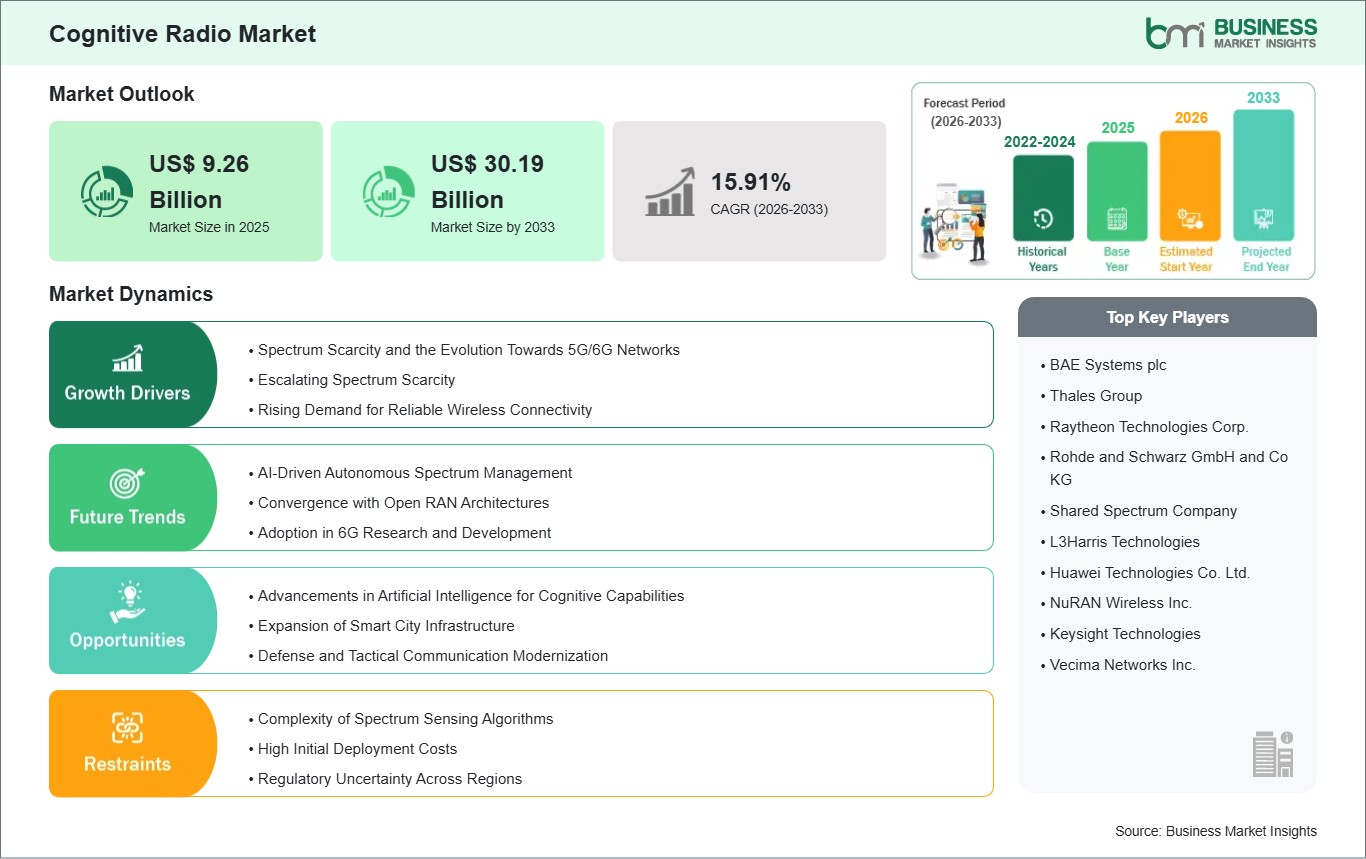
The global cognitive radio market represents a transformative segment in wireless communications, focused on intelligent spectrum management. Cognitive radio systems are designed to dynamically access underutilized portions of the radio frequency (RF) spectrum, improving overall spectral efficiency. This technology addresses the critical challenge of spectrum scarcity by enabling devices to sense their operational environment and adapt transmission parameters in real-time, thereby operating as secondary users in licensed bands without causing harmful interference to primary users. Market growth is propelled by the exponential increase in wireless data traffic, the rollout of 5G and upcoming 6G networks requiring efficient spectrum use, and growing governmental initiatives for spectrum sharing and dynamic spectrum access (DSA). Applications in military and defense for secure, jamming-resistant communications further bolster demand.
However, the market faces significant challenges including complex regulatory frameworks governing spectrum sharing, high initial development and deployment costs for intelligent hardware, and the technical difficulty of ensuring reliable interference avoidance. Despite these hurdles, substantial opportunities are emerging with advancements in artificial intelligence (AI) and machine learning (ML) for enhanced spectrum prediction, the integration of cognitive capabilities into Internet of Things (IoT) and smart city networks, and the push for next-generation public safety and mission-critical communication systems that require resilient and adaptive connectivity.
Segment Analysis
Cognitive Radio Market Segmentation
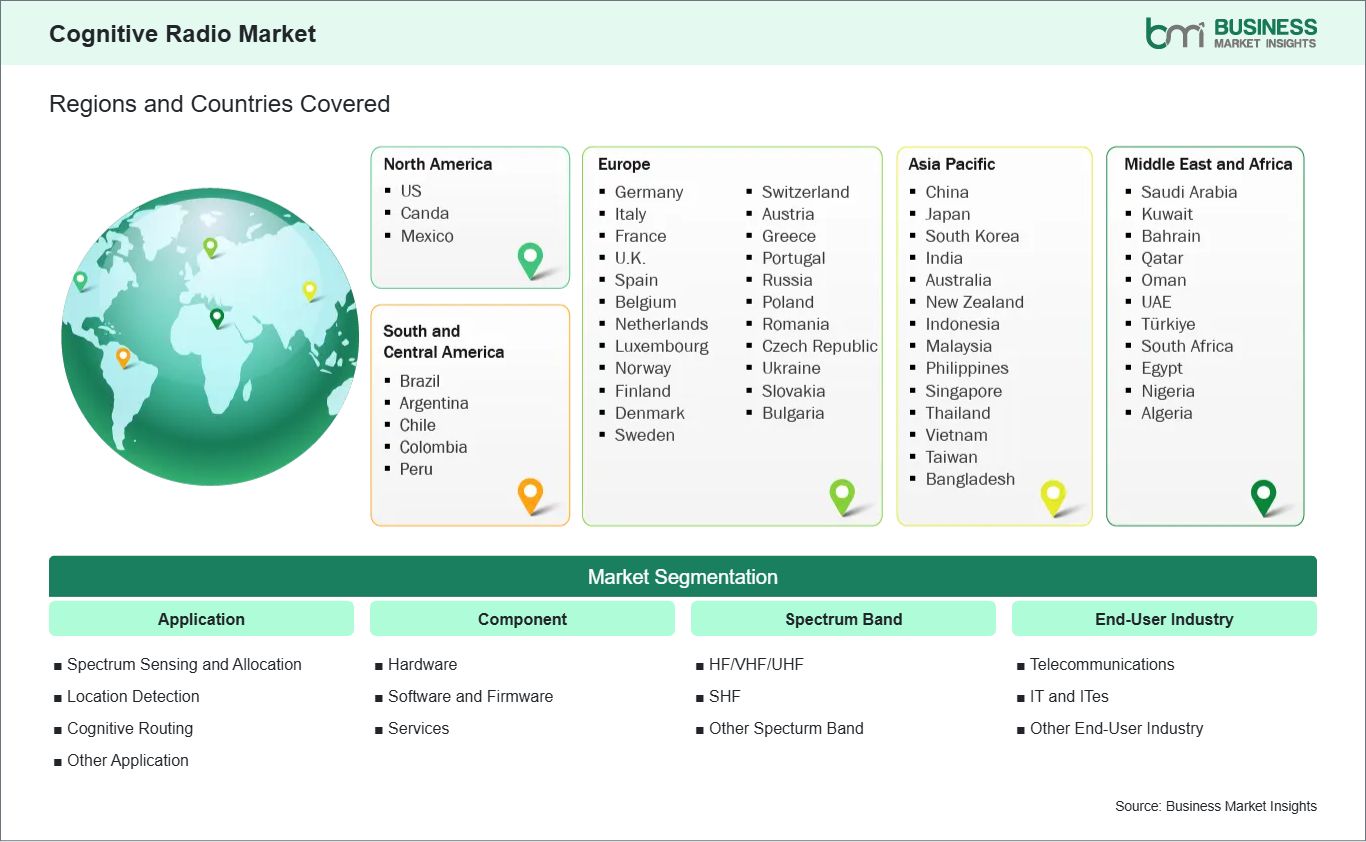
Key segments that contributed to the derivation of the cognitive radio market analysis are application, component, spectrum band, and end-user industry.
- By application, the market is segmented into spectrum sensing and allocation, location detection, cognitive routing, and others. The spectrum sensing and allocation segment dominated the market in 2025, as it forms the core functional foundation of any cognitive radio system.
- By component, the market is categorized into hardware, software and firmware, and services. The hardware segment, encompassing specialized radios, sensors, and antennas, held the largest share of the market in 2025.
- By spectrum band, the market is divided into HF/VHF/UHF (Less Than 1 GHz), SHF (1-6 GHz), and others. The SHF (1-6 GHz) segment, which includes prime bands for 4G/5G and Wi-Fi, accounted for the largest share in 2025, driven by commercial cellular and broadband applications.
- By end-user industry, the market is segmented into telecommunications, IT and ITes, and others (including defense, public safety). The telecommunications segment held the leading share, fueled by carrier investments in spectrum efficiency for network capacity enhancement.
Market Forces
Cognitive Radio Market Drivers and Opportunities
Spectrum Scarcity and the Evolution Towards 5G/6G Networks
The relentless growth in mobile data consumption and the dense deployment of connected devices have created an acute scarcity of available RF spectrum. This is the primary driver for cognitive radio technology. Regulatory bodies worldwide are promoting spectrum-sharing models to unlock underutilized bands. Cognitive radio is a key enabling technology for this shift, allowing 5G and future 6G networks to dynamically access shared spectrum (e.g., Citizens Broadband Radio Service - CBRS in the US), thereby increasing capacity and reducing infrastructure costs for network operators. This creates a sustained, long-term driver as mobile network evolution continues.
Advancements in Artificial Intelligence for Cognitive Capabilities
The integration of sophisticated AI and machine learning algorithms represents a monumental opportunity for the cognitive radio market. AI enhances core cognitive functions like spectrum sensing, prediction, and decision-making, moving systems from simple rule-based adaptation to intelligent, predictive spectrum access. This enables more efficient, reliable, and complex operations in dense, heterogeneous wireless environments. The opportunity lies in developing advanced software-defined radio (SDR) platforms and cloud-native cognitive engines that can be deployed across commercial, defense, and IoT networks, creating high-value software and service revenue streams.
Size and Share Analysis
Cognitive Radio Market Size and Share Analysis
By application, the spectrum sensing and allocation function holds the dominant share, as it is the indispensable first step in the cognitive cycle. However, cognitive routing is a high-growth segment, particularly for military mesh networks and resilient IoT, where dynamic path selection is critical.
By component, hardware (SDR platforms, RF front-ends) constitutes the major revenue share due to its specialized nature. The software and firmware segment is growing rapidly, driven by the increasing value of intelligent algorithms, cognitive engines, and network management software. Services related to testing, integration, and managed spectrum access are also expanding.
By spectrum band, the commercially vital SHF band (1-6 GHz) is the largest market, encompassing most cellular and WLAN traffic. The HF/VHF/UHF bands (<1 GHz) hold significant importance for long-range, non-line-of-sight applications in military, maritime, and public safety.
By end-user industry, telecommunications is the largest adopter, seeking commercial efficiency. The "Others" category, which includes defense, homeland security, and public safety, represents a high-value segment willing to invest in advanced, secure, and jam-resistant cognitive communication systems.
Report Coverage
Cognitive Radio Market Report Coverage and Deliverables
The "Cognitive Radio Market Size and Forecast (2022–2033)" report provides a detailed analysis of the market covering below areas:
- Cognitive Radio Market size and forecast at global, regional, and country levels for all the key market segments covered under the scope
- Cognitive Radio Market trends, as well as market dynamics such as drivers, restraints, and key opportunities
- Cognitive Radio Market analysis covering key market trends, global and regional framework, major players, regulations, and recent market developments
- Industry landscape and competition analysis covering market concentration, heat map analysis, prominent players, and recent developments for the cognitive radio market
- Detailed company profiles, including SWOT analysis
Geographic Insights
Cognitive Radio Market Geographic Insights
The geographical scope of the cognitive radio market report is divided into five regions: North America, Asia Pacific, Europe, Middle East & Africa, and South & Central America. The market in North America is expected to hold a leading revenue share during the forecast period, driven by early regulatory leadership and defense spending, while Asia Pacific is anticipated to exhibit the highest growth rate.
North America, led by the United States, is the most advanced market. Pioneering regulatory frameworks like the FCC's CBRS band have created a commercial ecosystem for spectrum sharing. Furthermore, substantial defense R&D and procurement budgets in the U.S. for advanced tactical communications systems fuel significant market demand in the military sector.
The Asia Pacific region, with key markets in China, Japan, South Korea, and India, is poised for the fastest growth. This is driven by massive investments in 5G infrastructure, government-led smart city initiatives requiring efficient spectrum use, and growing defense modernization programs. National efforts to develop indigenous wireless technologies further stimulate the regional market.
Europe maintains a strong market presence through coordinated spectrum policy via the European Commission, significant defense collaborations, and leading research in wireless communications. Countries like the UK, Germany, and France are key contributors to both commercial and defense applications of cognitive radio.
Industry Activity
Recent Developments
The cognitive radio market is evaluated by gathering qualitative and quantitative data post primary and secondary research, which includes important corporate publications, association data, and databases. A few of the key developments in the cognitive radio market are:
- In April 2025, the U.S. Department of Defense conducted its first large-scale spectrum-sharing demonstration, successfully showcasing the ability of cognitive radio technologies to enable seamless multiband coexistence between defense and commercial wireless systems across wide geographic areas.
- In March 2025, Thales announced an order intake of EUR 25.3 billion for 2024 and unveiled plans to invest EUR 4 billion in research and development through 2028, with a strong strategic focus on advancing software-defined radio capabilities for aerospace and defense applications.
- In March 2025, NVIDIA entered a strategic collaboration with T-Mobile, MITRE, and Cisco to develop AI-native wireless network architectures, aiming to significantly enhance spectral efficiency and intelligence in next-generation 6G communications.
Trust & Transparency
Research Methodology
The market analysis combines proprietary research with secondary data from government agencies, company disclosures, regulatory filings, industry databases and expert interviews. Market estimates are validated through data triangulation, cross-market benchmarking and analyst
review.
View Full Research Methodology
Key Sources Referred:
World Bank – Global Trade Indicators World Trade Organization (WTO) International Monetary Fund (IMF) International Trade Administration (ITA) Company website Company annual reports Company investor presentations