Market Summary
Executive Summary and Global Market Analysis
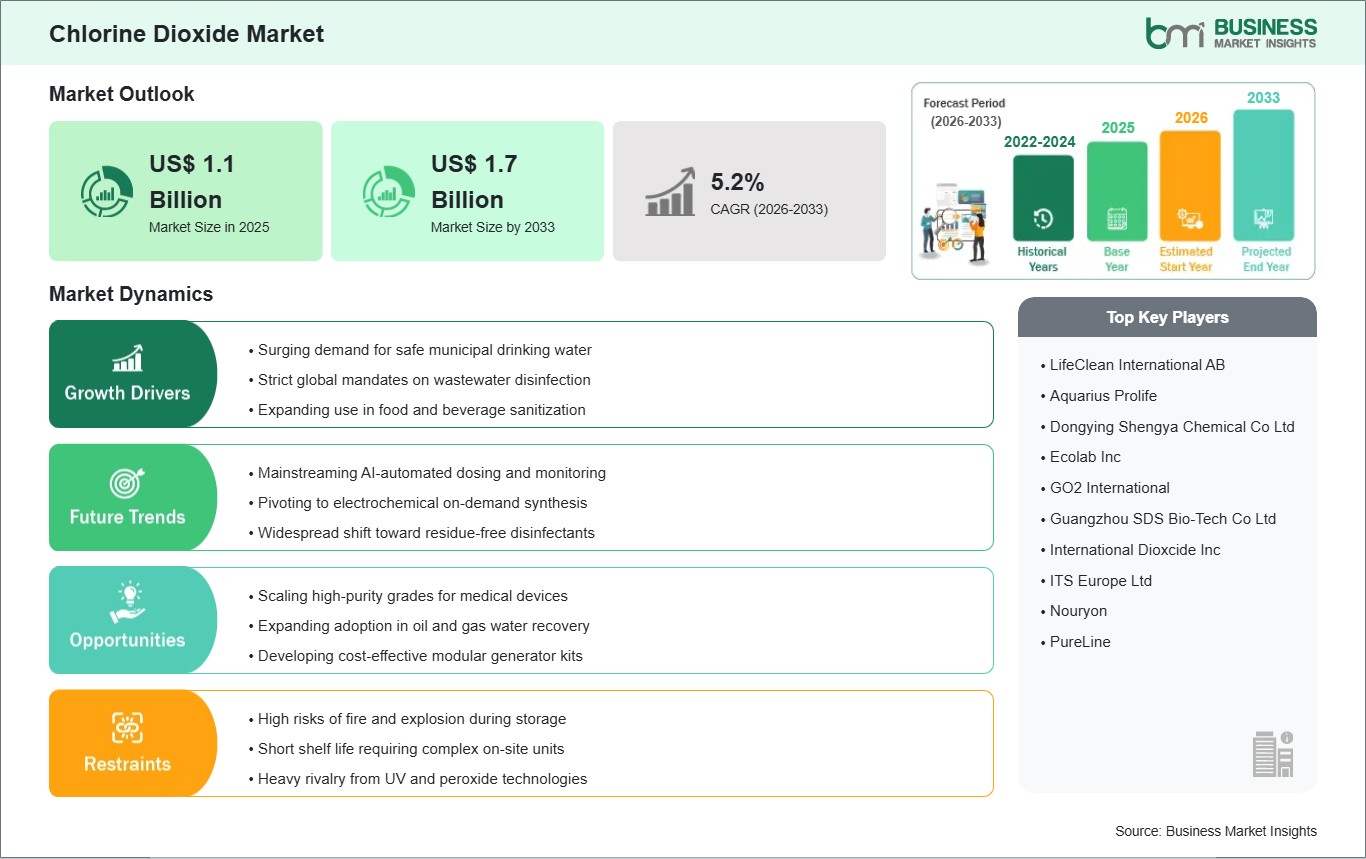
Chlorine Dioxide (ClO2) is a powerful, broad-spectrum disinfectant and oxidizing agent, increasingly favored over traditional chlorine due to its superior performance and environmental profile. This compound is vital for core sectors: Water and Wastewater Treatment, Pulp & Paper, Food & Beverages, and Healthcare. Chlorine Dioxide offers advantages including high efficacy against pathogens (including viruses and protozoa), its ability to eliminate biofilm in piping systems, and its key benefit of producing minimal harmful halogenated disinfection by-products (DBPs) such as Trihalomethanes (THMs). The market is fueled by stringent global regulations aimed at improving drinking water quality and curbing industrial pollution, rising urbanization necessitating advanced wastewater infrastructure, and the massive shift in the pulp industry toward Elemental Chlorine-Free (ECF) bleaching processes.
However, several challenges restrain market growth: the inherent instability and reactive nature of ClO2, which means it generally cannot be stored or shipped in bulk and must be generated safely on-site, which increases capital expenditure and operational complexity for end users. High flammability and explosion hazards associated with concentrated forms necessitate extremely strict safety protocols and specialized generating equipment. Furthermore, the industry faces constraints due to competition from established disinfectants (e.g., Sodium Hypochlorite, UV), which may have lower initial setup costs. Despite these hurdles, opportunities arise driven by the accelerating adoption of advanced, automated on-site generation systems that enhance safety and efficiency, the growing use of ClO2 for surface and process water disinfection in the food and beverage industry (minimal residue), and substantial market growth in the Asia-Pacific region due to rapidly expanding municipal and industrial water treatment needs. Continuous innovation in safe, stabilized chemical precursors is expected to open new avenues for market expansion.
Segment Analysis
Chlorine Dioxide Market Segmentation
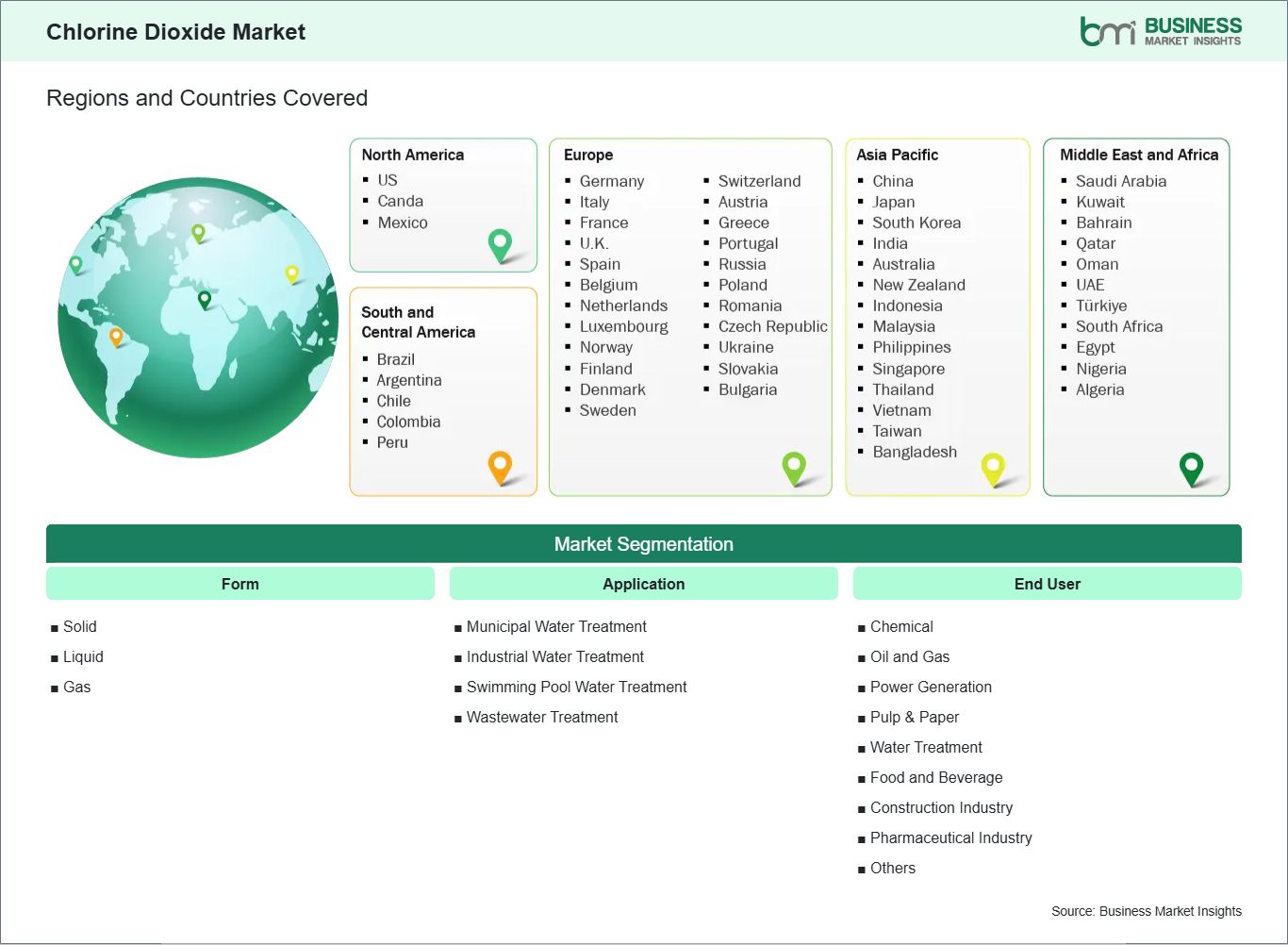
Key segments that contributed to the derivation of the Chlorine Dioxide Market analysis are form, application, and end user.
- By Form, the market is segmented into Solid, Liquid, and Gas.
- By Application, the market is segmented into Municipal Water Treatment, Industrial Water Treatment, Swimming Pool Water Treatment, and Wastewater Treatment.
- By End User, the market is segmented into Chemical, Oil and Gas, Power Generation, Pulp & Paper, Water Treatment, Food and Beverage, Construction Industry, Pharmaceutical Industry, and Others.
Market Forces
Chlorine Dioxide Market Drivers and Opportunities
Regulated Wastewater Treatment
The primary driver for the Chlorine Dioxide Market is the ever-increasing global need for efficient, safe, and regulated water and wastewater treatment. Chlorine dioxide is a highly effective biocide and disinfectant, significantly surpassing traditional chlorine in many applications, particularly in its ability to manage biofilms and kill chlorine-resistant pathogens like Giardia and Cryptosporidium. The growing population and rapid industrialization worldwide place immense pressure on existing water resources, necessitating advanced and reliable purification methods. Furthermore, stringent public health and environmental regulations, particularly in developed regions, mandate the use of superior disinfectants that minimize the formation of carcinogenic disinfection byproducts (DBPs) like trihalomethanes (THMs). Chlorine Dioxide's proven efficacy and environmental safety profile in producing safe drinking water and treating industrial process water underpin its sustained market growth.
Food Safety and On-Site Generation Systems
A significant and high-growth opportunity lies in the expanded application of chlorine dioxide for food and beverage safety and the industry's shift toward advanced, on-site generation technologies.
The demand for high-quality sanitization is escalating across the food and beverage industry, where ClO2 is used for disinfecting processing water, washing produce, and sanitizing equipment surfaces due to its ability to kill bacteria without imparting undesirable tastes or odors. Furthermore, due to the difficulty and hazard associated with transporting and storing large quantities of ClO2, the market is rapidly adopting sophisticated on-site generation systems. These modular units produce ClO2 safely and reliably only as needed, using precursor chemicals like sodium chlorite. This technology reduces logistics costs, enhances safety, and makes the disinfectant accessible to a wider range of industrial and municipal end users, driving market penetration.
Size and Share Analysis
Chlorine Dioxide Market Size and Share Analysis
The Chlorine Dioxide Market demonstrates steady growth, with size and share analysis revealing evolving trends and competitive positioning among key players. The report further examines subsegments categorized within form, application, and end user, offering insights into their contribution to overall market performance.
The gas of Chlorine Dioxide is typically generated on-site for Municipal Water Treatment. The gas subsegment is driven by ClO2 's superior disinfection power, low formation of harmful disinfection byproducts (DBPs), and efficacy against pathogens, including Cryptosporidium.
Liquid or stabilized Chlorine Dioxide is widely utilized in Industrial Water Treatment application. This application is valued for its ability to control microbial growth, remove sulfides, and prevent biofouling in cooling towers and process water systems.
Report Coverage
Chlorine Dioxide Market Report Coverage and Deliverables
The "Chlorine Dioxide Market Size and Forecast (2022 - 2033)" report provides a detailed analysis of the market covering below areas:
- Chlorine Dioxide Market size and forecast at global, regional, and country levels for all the key market segments covered under the scope
- Chlorine Dioxide Market trends, as well as market dynamics such as drivers, restraints, and key opportunities
- Chlorine Dioxide Market analysis covering key market trends, global and regional framework, major players, regulations, and recent market developments
- Industry landscape and competition analysis covering market concentration, heat map analysis, prominent players, and recent developments for the Chlorine Dioxide Market
- Detailed company profiles, including SWOT analysis
Geographic Insights
Chlorine Dioxide Market Geographic Insights
The geographical scope of the Chlorine Dioxide Market report is divided into five regions: North America, Asia Pacific, Europe, the Middle East & Africa, and South & Central America.
The Asia-Pacific Chlorine Dioxide Market is segmented into China, Japan, South Korea, India, Australia, New Zealand, Indonesia, Malaysia, the Philippines, Singapore, Thailand, Vietnam, Taiwan, Bangladesh, and the Rest of Asia. The Asia-Pacific market is driven by increasing industrialization and stringent regulations on water and wastewater treatment.
Growth is further supported by the expanding pulp and paper industry, where chlorine dioxide is widely used as a superior bleaching agent, replacing elemental chlorine. The rising concern over public health and the increasing adoption of ClO2 in the food and beverage and healthcare sectors solidify Asia-Pacific as a critical growth center for the market.
Industry Activity
Recent Developments
The Chlorine Dioxide Market is evaluated by gathering qualitative and quantitative data post-primary and secondary research, which includes important corporate publications, association data, and databases. A few of the key developments in the Chlorine Dioxide Market are:
- In August 2025, LifeClean International AB announced that the Company has developed LifeClean Insitu, a two-component solution for the in situ generation of the Company's patented chlorine dioxide formulation. The active biocidal substance is produced by the user at the time of use, which significantly extends the product's shelf life in its inactive form. The product is particularly relevant for the Agriculture business area and strengthens the Company's competitiveness in international markets outside the EU.
- In April 2025, Arxada introduced NUGEN HLD-CD, a ready-to-use disinfectant based on stabilized chlorine dioxide designed for critical healthcare environments due to its broad-spectrum efficacy.
Trust & Transparency
Research Methodology
The market analysis combines proprietary research with secondary data from government agencies, company disclosures, regulatory filings, industry databases and expert interviews. Market estimates are validated through data triangulation, cross-market benchmarking and analyst
review.
View Full Research Methodology
Key Sources Referred:
World Bank - Global Trade IndicatorsWorld Trade Organization (WTO)International Monetary Fund (IMF)International Trade Administration (ITA)Company WebsitesCompany Annual ReportsCompany Investor Presentations