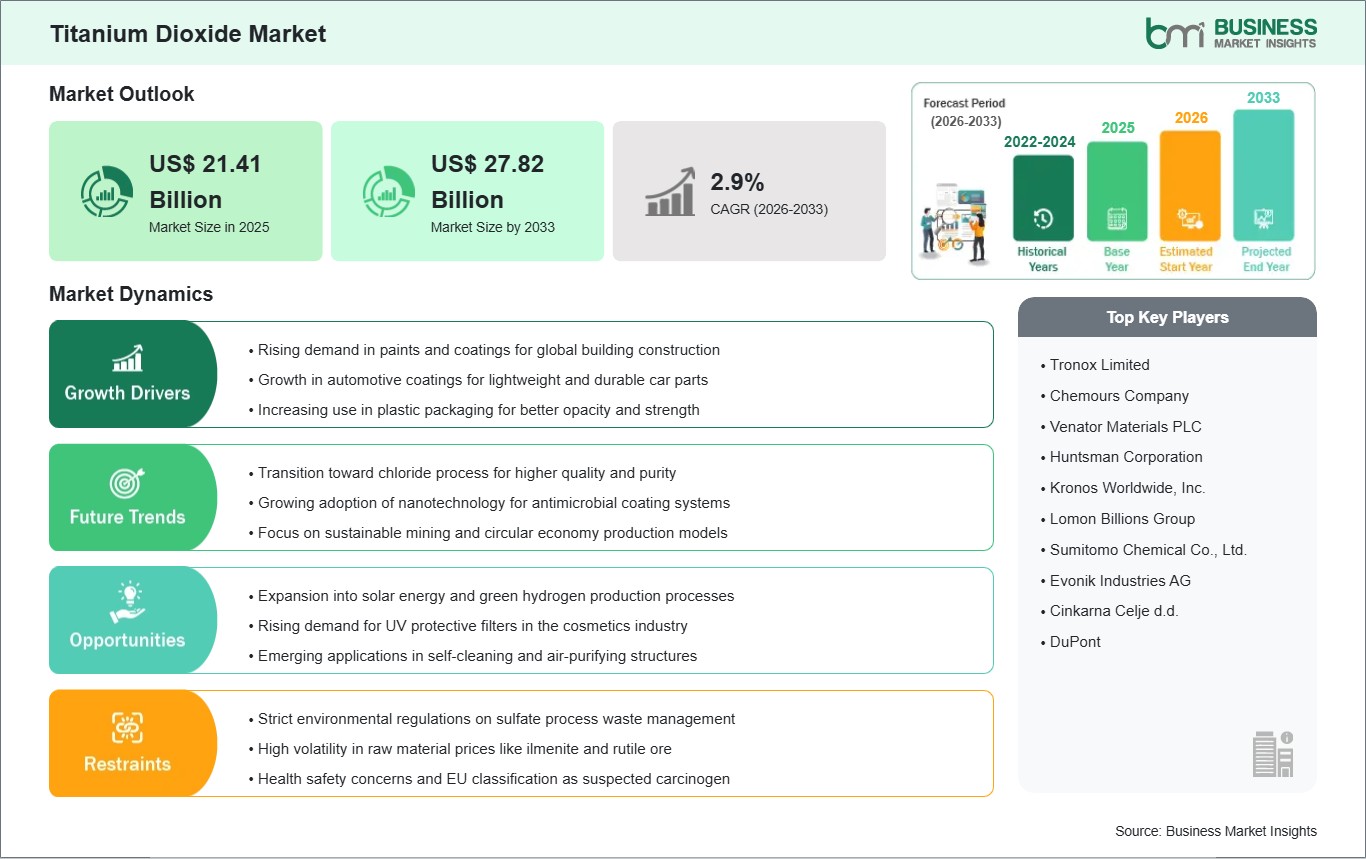
The Titanium Dioxide market size is expected to reach US$ 27.82 billion by 2033 from US$ 21.41 billion in 2025. The market is estimated to record a CAGR of 2.91% from 2026 to 2033.
Titanium Dioxide (TiO₂) is a white, inorganic compound prized for its high refractive index, opacity, brightness, and UV‑blocking capabilities. Produced primarily in two crystallographic grades, anatase and rutile, TiO₂ is manufactured via sulfate or chloride processes and is indispensable across paints &coatings, plastics, paper, inks, food colorants, adhesives, and cosmetics. Its role as a premium white pigment and functional additive extends from architectural and industrial coatings to packaging, automotive, and personal care, where it delivers hiding power, tinting strength, durability, and weatherability. Recent industry dynamics show producers optimizing portfolios and footprints, strengthening financial resilience, and advancing sustainability and specialty grades, while customers emphasize cost‑to‑performance value and reliable supply.
However, the sector faces several headwinds. Cyclical demand patterns in downstream construction, consumer durables, and packaging continue to influence volume visibility; energy and feedstock cost volatility challenge margins; and environmental compliance requirements, especially for sulfate waste streams, necessitate capital and process upgrades. Capacity rationalizations and site restructurings in Europe underscore the imperative to align output with market conditions. At the same time, selective divestments from joint ventures and assets reflect a focus on core operations and specialty value creation.
Despite these constraints, opportunities remain compelling. Producers are investing in differentiated TiO₂ technologies for high-performance coatings, UV protection, and functional plastics, while pricing initiatives and portfolio mix upgrades are evident in Asia and other growth regions. Innovation in micro and specialty TiO₂ for cosmetics, photocatalysis, and conductive applications is expanding end-use optionality; concurrently, operational excellence programs, cost‑improvement plans, and sustainability reporting indicate a disciplined path to profitable growth. These trends position the market to benefit as construction cycles normalize, packaging demand stabilizes, and specialty applications scale.

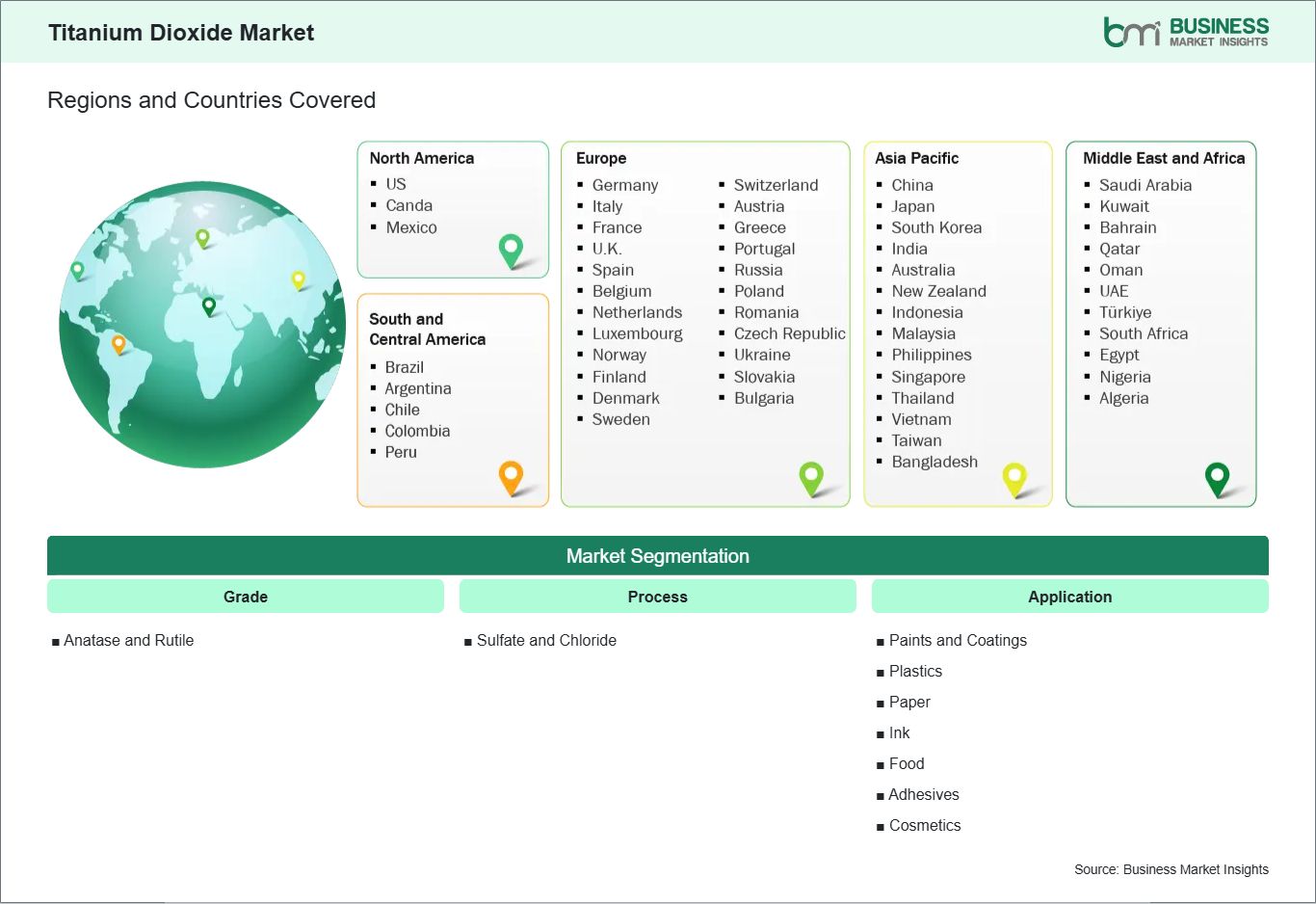
Key segments that contributed to the derivation of the Titanium Dioxide market analysis are grade, process, and application.
The Titanium Dioxide (TiO₂) market is fundamentally driven by the escalating performance demands placed on modern coatings and engineered plastics. As global construction, industrial maintenance, automotive refinish, and infrastructure sectors evolve, end‑users seek materials that can withstand increasingly aggressive environmental conditions, UV radiation, humidity fluctuations, chemical exposure, and long outdoor service intervals. TiO₂ plays a critical role in meeting these requirements due to its unparalleled refractive index, which delivers high opacity, superior whiteness, and exceptional light‑scattering efficiency. These attributes enable coatings to achieve optimal hiding power in fewer layers, improving productivity and reducing material costs. Additionally, TiO₂ contributes to long-term color retention, gloss stability, and resistance to photo‑degradation. These features are essential for premium architectural coatings, coil coatings, marine paints, and next-generation automotive finishes.
In engineered plastics, TiO₂ enhances weatherability, UV resistance, and mechanical strength, supporting applications ranging from outdoor PVC profiles and polyolefin films to high-performance packaging and consumer goods. As regulatory bodies push for longer-lasting materials that reduce lifecycle environmental impact, manufacturers emphasize durability, making TiO₂ indispensable. The broader shift toward high-performance, specification-driven markets ensures that TiO₂ remains central to formulation science, reinforcing stable structural demand over the long term.
The emergence and rapid expansion of specialty TiO₂ grades represent one of the most lucrative opportunities for producers seeking margin enhancement and portfolio differentiation. Beyond its traditional role as a white pigment, TiO₂ has become integral to advanced functional applications that demand precise particle engineering, specialized surface treatments, and controlled reactivity. In the cosmetics sector, micro‑ and nano-sized TiO₂ grades enable transparent yet highly effective UVA/UVB protection in sunscreens, delivering smoother sensory profiles and reduced whitening, key performance features for premium personal care brands. These tailored grades often command significantly higher pricing due to their stringent quality, consistency, and safety requirements.
In photocatalysis, TiO₂'s ability to promote energy-efficient degradation of pollutants under light exposure enables applications such as self-cleaning surfaces, antimicrobial coatings, and air‑purifying tiles. Similarly, conductive and electro-functional TiO₂ variants are gaining attention in electronics, antistatic packaging, and specialty printing. High-purity, chloride‑route TiO₂ grades are increasingly critical for demanding polymer systems where brightness, dispersion, and low impurity levels are essential for performance.
As end‑markets prioritize sustainability, energy efficiency, and multifunctional materials, these specialty applications present an opportunity for TiO₂ manufacturers to move up the value chain, reducing dependency on cyclical commodity segments and building long-term competitive resilience through innovation-led growth.

The Titanium Dioxide market demonstrates steady growth, with size and share analysis revealing evolving trends and competitive positioning among key players. The report further examines subsegments categorized within grade, process, and application, offering insights into their contribution to overall market performance.
For instance, within the grade segment, rutile is widely selected in premium coatings and outdoor applications for its higher refractive index and weathering performance versus anatase, supporting film durability in industrial and architectural systems.
In terms of process, chloride‑route material is frequently specified in high-purity formulations given its typically narrower impurity profile and consistent brightness, aiding premium coatings and engineered plastics.
| Report Attribute | Details |
|---|---|
| Market size in 2025 | US$ 21.41 Billion |
| Market Size by 2033 | US$ 27.82 Billion |
| Global CAGR (2026 - 2033) | 2.9% |
| Historical Data | 2022-2024 |
| Forecast period | 2026-2033 |
| Segments Covered | By Grade
|
|
Regions and Countries Covered
| |
| North America | US, Canada, Mexico |
| Europe | Belgium, Austria, Finland, Denmark, Greece, Poland, Romania, Russia, Ukraine, Czech Republic, Slovakia, Bulgaria, Italy, Luxembourg, Germany, Switzerland, France, Netherlands, Norway, Portugal, Spain, Sweden, United Kingdom |
| Asia-Pacific | Australia, China, India, Japan, South Korea, Indonesia, Malaysia, Philippines, Singapore, Thailand, Vietnam, Bangladesh, New Zealand, Taiwan |
| South and Central America | Brazil, Argentina, Peru, Chile, Colombia |
| Middle East and Africa | Bahrain, Kuwait, Oman, Qatar, Saudi Arabia, United Arab Emirates, Turkiye, South Africa, Egypt, Algeria, Nigeria |
| Market leaders and key company profiles |
|
The "Titanium Dioxide Market Size and Forecast (2022 - 2033)" report provides a detailed analysis of the market covering below areas:
The geographical scope of the Titanium Dioxide market report is divided into five regions: North America, Asia Pacific, Europe, the Middle East &Africa, and South &Central America.
In North America, the market is primarily characterized by a robust focus on high-performance chloride-route pigments, driven by the specialized needs of the aerospace, medical, and premium architectural sectors. This region emphasizes technological innovation and the integration of Titanium Dioxide into high-durability coatings that meet stringent performance and environmental standards. Meanwhile, Europe remains a pivotal region for regulatory leadership and sustainable manufacturing. A transition toward low-emission production technologies and the growing utilization of specialized pigments in advanced automotive plastics and energy-efficient building materials increasingly shape the market here.
The Asia-Pacific region functions as the core engine of global production and consumption, underpinned by a massive electronics manufacturing base and expansive infrastructure development. Market activity in this region is propelled by rapid urbanization and large-scale government housing initiatives, which necessitate vast quantities of architectural and decorative coatings. In the Middle East &Africa, the market is expanding through the modernization of telecommunications and transport infrastructure, alongside significant investments in smart city projects that utilize UV-resistant and heat-reflective coatings. Similarly, South &Central America are witnessing a steady digital and industrial transformation, where the expansion of regional manufacturing hubs for packaging and consumer goods is bolstering the consistent demand for high-opacity pigments. This diversified regional participation ensures market resilience as global economies continue to modernize their digital and industrial frameworks.

The Titanium Dioxide market is evaluated by gathering qualitative and quantitative data post primary and secondary research, which includes important corporate publications, association data, and databases. A few of the key developments in the Titanium Dioxide market are:
The Titanium Dioxide Market is valued at US$ 21.41 Billion in 2025, it is projected to reach US$ 27.82 Billion by 2033.
As per our report Titanium Dioxide Market, the market size is valued at US$ 21.41 Billion in 2025, projecting it to reach US$ 27.82 Billion by 2033. This translates to a CAGR of approximately 2.9% during the forecast period.
The Titanium Dioxide Market report typically cover these key segments-
The historic period, base year, and forecast period can vary slightly depending on the specific market research report. However, for the Titanium Dioxide Market report:
The Titanium Dioxide Market is populated by several key players, each contributing to its growth and innovation. Some of the major players include:
The Titanium Dioxide Market report is valuable for diverse stakeholders, including:
Essentially, anyone involved in or considering involvement in the Titanium Dioxide Market value chain can benefit from the information contained in a comprehensive market report.
Please tell us your area of interest
(Market Segments/ Regions and Countries/ Companies)