Market Summary
Executive Summary and Global Market Analysis
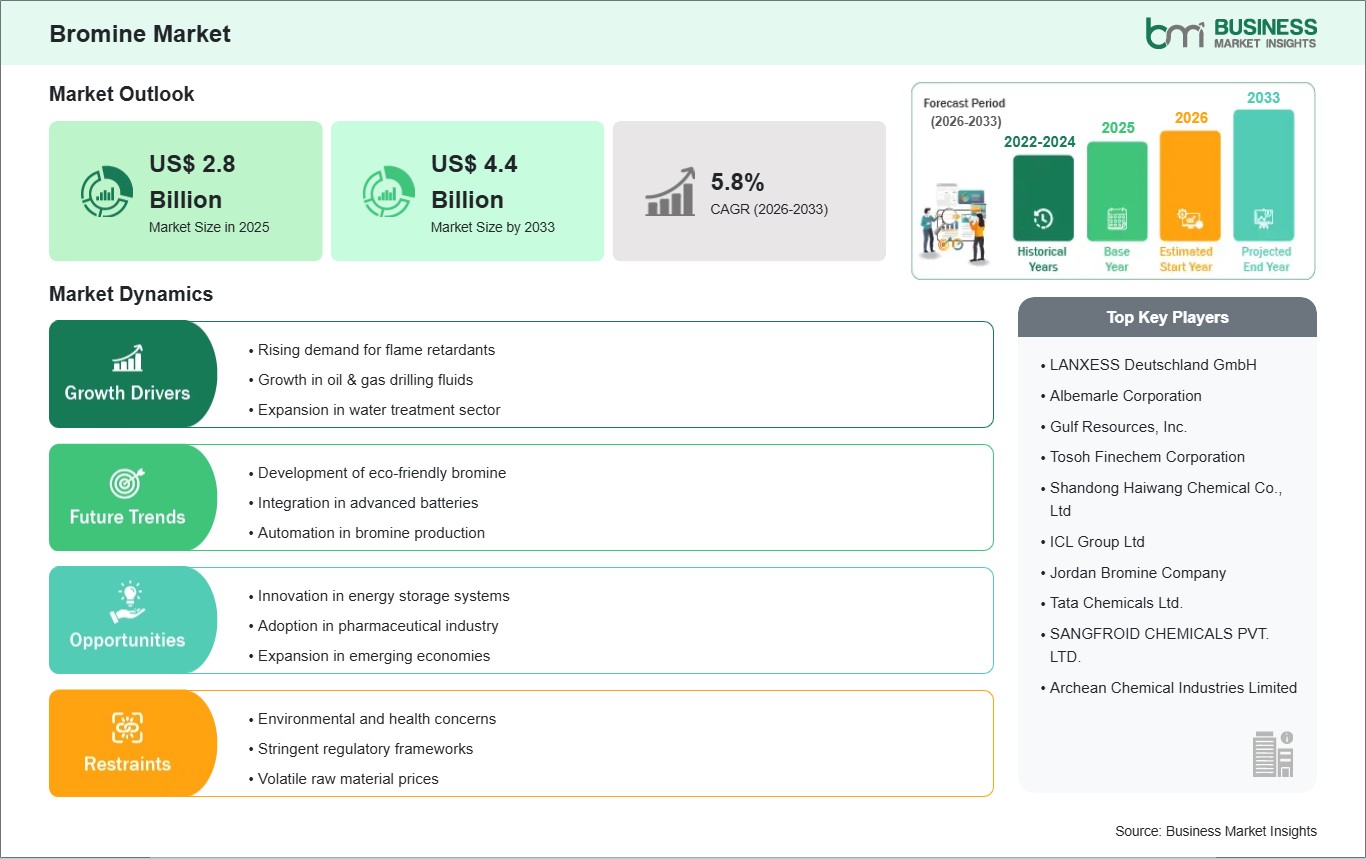
Bromine and its derivatives are predominantly sourced from natural brine reserves, with production concentrated in key regions such as the Dead Sea (Israel and Jordan), China, and the United States—particularly Arkansas. The market is anchored by sustained demand for flame retardants used in critical safety applications, as well as bromine?based fluids essential to oil and gas drilling operations. Core brominated products, including bromide salts (such as sodium and calcium bromide) and organobromines like tetrabromobisphenol A (TBBPA), serve as vital intermediates and end-use materials across a wide range of industries. The competitive landscape remains highly consolidated, with a limited number of major global players controlling a substantial portion of supply.
Despite strong demand, several structural challenges may constrain market growth. Heightened environmental and health concerns associated with certain brominated compounds have triggered stringent regulatory scrutiny, particularly across developed markets. Additionally, rising adoption of non?halogenated alternatives, commodity price volatility, and the geographic concentration of bromine resources introduce notable risks to long?term market stability.
Nevertheless, the bromine industry continues to present robust growth opportunities. Demand for safer, more environmentally compliant flame retardants is increasing, especially within the electronics and automotive sectors. Expanding oil and gas exploration is also driving higher consumption of bromine?based drilling fluids. Furthermore, the transition toward advanced energy storage solutions, most notably zinc?bromine flow batteries for renewable energy integration, offers a growing high?value application segment.
Bromine-based water treatment solutions are also gaining momentum as global hygiene and disinfection standards tighten. Emerging markets in Asia?Pacific and the Middle East, supported by strong infrastructure investment and industrial expansion, provide significant untapped potential for bromine derivatives. In parallel, strategic investments in closed?loop recycling systems and green chemistry technologies are enabling producers to enhance sustainability credentials and capture new value streams.
Segment Analysis
Bromine Market Segmentation
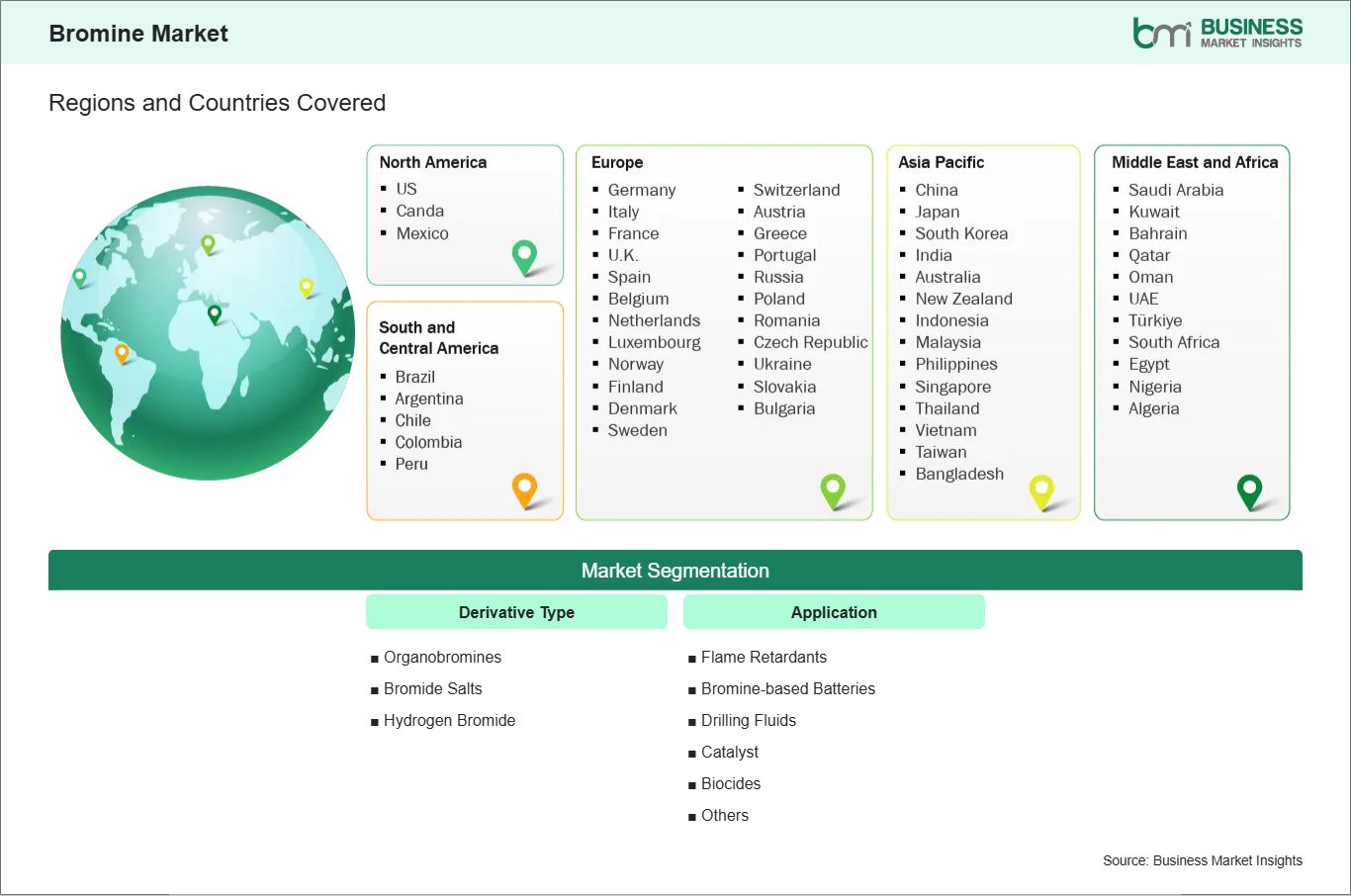
Key segments that contributed to the derivation of the CF &CFRP market analysis are the derivative type and application.
- By Derivative Type, the market is segmented into Organobromines, Bromide Salts, and Hydrogen Bromide.
- By Application, the market is segmented into Flame Retardants, Bromine-based Batteries, Drilling Fluids, Catalysts, Biocides, and Others.
Market Forces
Bromine Market Drivers and Opportunities
Stringent Fire Safety Regulations Drive Flame Retardant Demand
Increasingly strict fire safety regulations across the globe are a primary driver for bromine demand, particularly in flame-retardant applications. In electronics and construction, regulatory standards mandate the use of effective flame-retardant materials in circuit boards, cables, insulation, and plastic housings. Brominated flame retardants, such as TBBPA, are widely used to meet international fire safety certifications, especially in high-growth electronics manufacturing regions in Asia Pacific and in the highly regulated European market.
In the automotive sector, bromine-based flame retardants help manufacturers comply with fire safety requirements for interior components while supporting lightweight material design, which is increasingly important for electric vehicles.
Expansion of Oil & Gas Exploration and Production
The growth of deepwater, high-pressure, and high-temperature drilling, along with unconventional oil and gas exploration, is a major driver for bromine-based clear brine fluids. Bromide salts such as calcium bromide, sodium bromide, and zinc bromide are essential for maintaining wellbore stability, controlling formation pressure, and preventing formation damage during drilling and completion operations. Their use directly enhances operational efficiency and hydrocarbon recovery.
Continued offshore drilling and shale gas development in the United States, Brazil, the Middle East, and parts of the Asia Pacific significantly boost demand for high-density bromine-based drilling fluids.
Size and Share Analysis
Bromine Market Size and Share Analysis
The Bromine Market demonstrates steady growth, with size and share analysis revealing evolving trends and competitive positioning among key players. The report further examines subsegments categorized within derivative type and application, offering insights into their contribution to overall market performance.
For instance, the Organobromines subsegment dominates the market by derivative type. Bromide Salts are another critical subsegment, driven by their irreplaceable function in high-density drilling fluids used in oil and gas exploration and production. Hydrogen Bromide is an important chemical feedstock in the synthesis of pharma active ingredients, plasma etching, specialty chemicals, and new energy storage applications exemplified by bromine-based flow batteries. In terms of application, flame retardants hold a significant share of the bromine market owing to strict fire safety requirements globally.
Report Coverage
Bromine Market Report Coverage and Deliverables
The "Bromine Market Size and Forecast (2022 - 2033)" report provides a detailed analysis of the market covering below areas:
- Bromine Market size and forecast at global, regional, and country levels for all the key market segments covered under the scope.
- Bromine Market trends, as well as market dynamics such as drivers, restraints, and key opportunities.
- Bromine Market analysis covering key market trends, global and regional framework, major players, regulations, and recent market developments
- Industry landscape and competition analysis covering market concentration, heat map analysis, prominent players, and recent developments for the Bromine Market
- Detailed company profiles, including SWOT analysis
Geographic Insights
Bromine Market Geographic Insights
The geographical scope of the Bromine Market report is divided into five regions: North America, Europe, Asia Pacific, the Middle East & Africa, and South & Central America.
Asia Pacific dominates the market due to rapid industrialization, large-scale electronics manufacturing, and infrastructure development in countries such as China and India. These factors are driving strong demand for flame retardants and chemical intermediates. North America represents a mature, resource-rich market supported by bromine reserves in Arkansas and sustained demand from the oil and gas industry for clear brine fluids, alongside strict enforcement of fire safety standards.
The Middle East and Africa region plays a critical role in global bromine supply, with the Dead Sea representing the world's largest natural bromine source. High oil and gas exploration activity in GCC countries drives strong consumption of bromine-based drilling fluids. Europe is characterized by stringent environmental regulations such as REACH, which restrict certain legacy brominated compounds while encouraging innovation toward safer, low-persistence alternatives. South and Central America are emerging markets, with growth driven by expanding oil and gas activities, agriculture, and industrial development.
Industry Activity
Recent Developments
The Bromine Materials Market is evaluated by gathering qualitative and quantitative data post-primary and secondary research, which includes important corporate publications, association data, and databases. A few of the key developments in the Bromine market are:
- In September 2025, Tetra Technologies, Inc. announced a resource upgrade for the Arkansas Bromine project and additional critical minerals. According to the updated resource report, the measured and indicated bromine resources increased from 158 ktons to 3.57 million tons across all TETRA acreage.
- In March 2024, Acume Chemicals Private Limited commissioned Phase 1 of the production facility of Bromine derivative products at its manufacturing factory situated in the state of Gujarat.
Trust & Transparency
Research Methodology
The market analysis combines proprietary research with secondary data from government agencies, company disclosures, regulatory filings, industry databases and expert interviews. Market estimates are validated through data triangulation, cross-market benchmarking and analyst
review.
View Full Research Methodology
Key Sources Referred:
World Bank - Global Trade Indicators
World Trade Organization (WTO)
International Monetary Fund (IMF)
International Trade Administration (ITA)
Company Websites
Company Annual Reports
Company Investor Presentations