Biosurfactants Market Regional Highlights
North America Biosurfactants Market
The North America Biosurfactants Market accounted for 27%-30% of the market in 2025 and is expected to grow at a 5.8%-6.3% CAGR through 2033. The region is positively impacted by the advanced distribution of specialty chemicals, biotechnology know-how, oilfield needs, industrial cleaning applications, and growing interest in bio-sources for formulation. The US continues to be the major market, driven by commercial fermentation and downstream formulation activities. Canada participates through resource-based applications, environmental cleanup, and specialty chemicals.
- Industrial cleaning remains an important adoption route because biosurfactants can improve wetting, soil penetration, dispersion, and suspension under demanding operating conditions.
- Oilfield chemistry provides a differentiated application pathway, with biosurfactants being evaluated for enhanced recovery, production optimization, and lower-impact treatment programs.
- Domestic manufacturing capacity and regulatory credentials can shorten qualification cycles for institutional and industrial buyers seeking traceable bio-based ingredients.
- Personal-care formulators increasingly evaluate sophorolipids where mildness, biodegradability, and multifunctionality can justify premium ingredient economics.
US Biosurfactants Market
The US accounted for 20% - 23% of the world market and around 72% - 78% of the North American market demand, recording a CAGR of 5.9% - 6.4% by 2033. The application areas include household and institutional cleaners, personal care, agriculture, oilfield chemicals, and specialty formulations for industry. Domestic manufacturers are ramping up production, but consumers require products with verified biobased composition, regulations, and performance.
- US oilfield applications remain commercially relevant because biosurfactant treatments can target interfacial behavior, production rates, and treatment economics while supporting lower-impact chemical strategies.
- Industrial formulators are adopting multifunctional glycolipids where one ingredient can support wetting, dispersion, separation, and cleaning performance.
- Agricultural adjuvant applications offer a route to higher-value formulations through improved spreading, deposition, and active-ingredient delivery.
Europe Biosurfactants Market
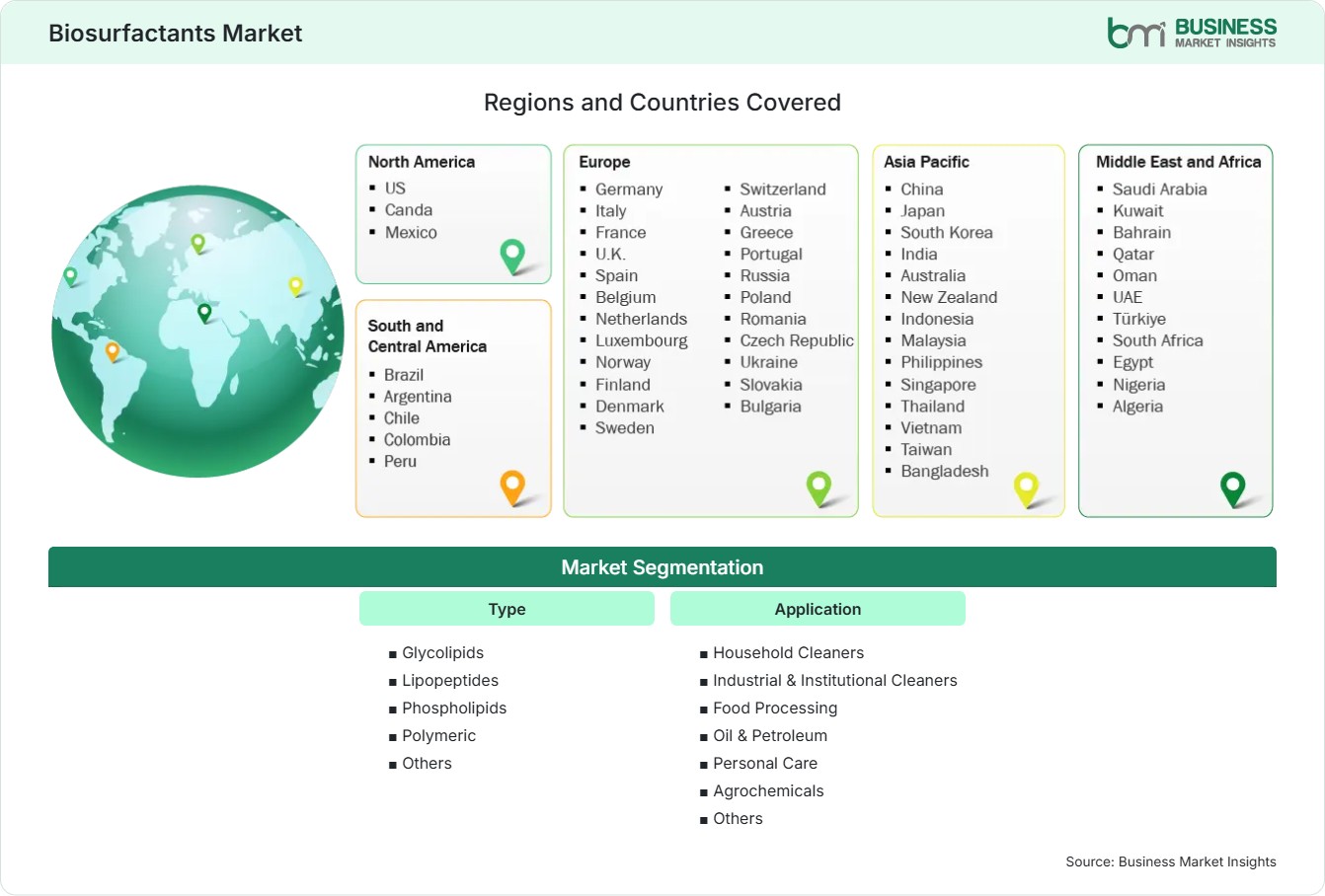
The Europe Biosurfactants Market holds 23%-26% market share in 2025 and is expected to grow at a 5.8%-6.5% CAGR by 2033. Some important countries for business in the region include Germany, France, the United Kingdom, Italy, and Spain. Germany and the United Kingdom are important in biotech and formulation capabilities. Spain is an important market for sustainable biosurfactants. The regulatory focus on environmental performance provides opportunities for substitution.
- Germany combines specialty-chemical expertise with strong demand for lower-impact ingredients in cleaning, personal care, coatings, and industrial formulations.
- The United Kingdom is strengthening biotechnology commercialization, with Holiferm pursuing international partnerships and broader biosurfactant commercialization.
- Spain offers a developing distribution pathway, highlighted by Holiferm's partnership with Adiego Hermanos to expand sustainable biosurfactants in the Spanish market.
- France and Italy provide established cosmetics, food, and household-product manufacturing ecosystems where formulation performance can support bio-based ingredient adoption.
Asia Pacific Biosurfactants Market
Asia Pacific region had a market share ranging from 30% - 34% in 2025 and is expected to register a CAGR of 7.0% - 7.8% through 2033. The region’s key drivers include China, Japan, South Korea, and India, where India and Southeast Asia are expected to deliver strong growth potential. Several avenues for adoption exist in large industries such as personal care, food processing, agriculture, detergents, and chemical manufacturing.
- Japan maintains a distinctive commercialization position through Saraya's long-running SOFORO sophorolipid platform and its expanding applications in cleaning, cosmetics, food, and healthcare.
- China offers scale advantages across fermentation, chemicals, agriculture, and consumer products, supporting both domestic consumption and regional supply opportunities.
- India provides strong biotechnology capabilities and expanding research into biosurfactant-enabled enhanced oil recovery and industrial applications.
- South Korea combines advanced cosmetics manufacturing with sophisticated specialty-ingredient demand, creating opportunities for high-purity biosurfactants.
Rest of World Biosurfactants Market
Rest of World accounted for a 12%–16% Biosurfactants Market share in 2025 and is projected to grow at a 5.5%–6.3% CAGR through 2033. South and Central America offer opportunities through agriculture, food processing, cosmetics, and oilfield applications, with Brazil providing the broadest industrial base. Middle Eastern demand is linked to oilfield chemistry and industrial cleaning, while Africa offers developing opportunities in agriculture, mining, consumer products, and environmental applications.
Latin American growth will come about through the processing of agriculture and the use of the resources sector, whereas Brazil may take advantage of the presence of renewables and expertise in energy and fermentation technology. In the Middle East, the performance of oilfield chemicals should be emphasized, as biosurfactants possess unique functionality.
- Brazil provides the strongest regional platform through its large agricultural, food, cosmetics, and energy-related industrial base.
- Saudi Arabia and the United Arab Emirates provide oilfield-oriented opportunities where enhanced recovery and production chemistry remain strategically important.
- South Africa offers opportunities across mining, agriculture, industrial cleaning, and environmental remediation where biodegradable surface-active ingredients can address specialized process requirements.
- Argentina, Chile, and Colombia provide additional agricultural and industrial formulation opportunities as sustainable ingredient portfolios broaden.