
Biofungicide Market Outlook: Size, Share, Trends, Growth Analysis, Competitive Landscape & Forecast, 2026-2033

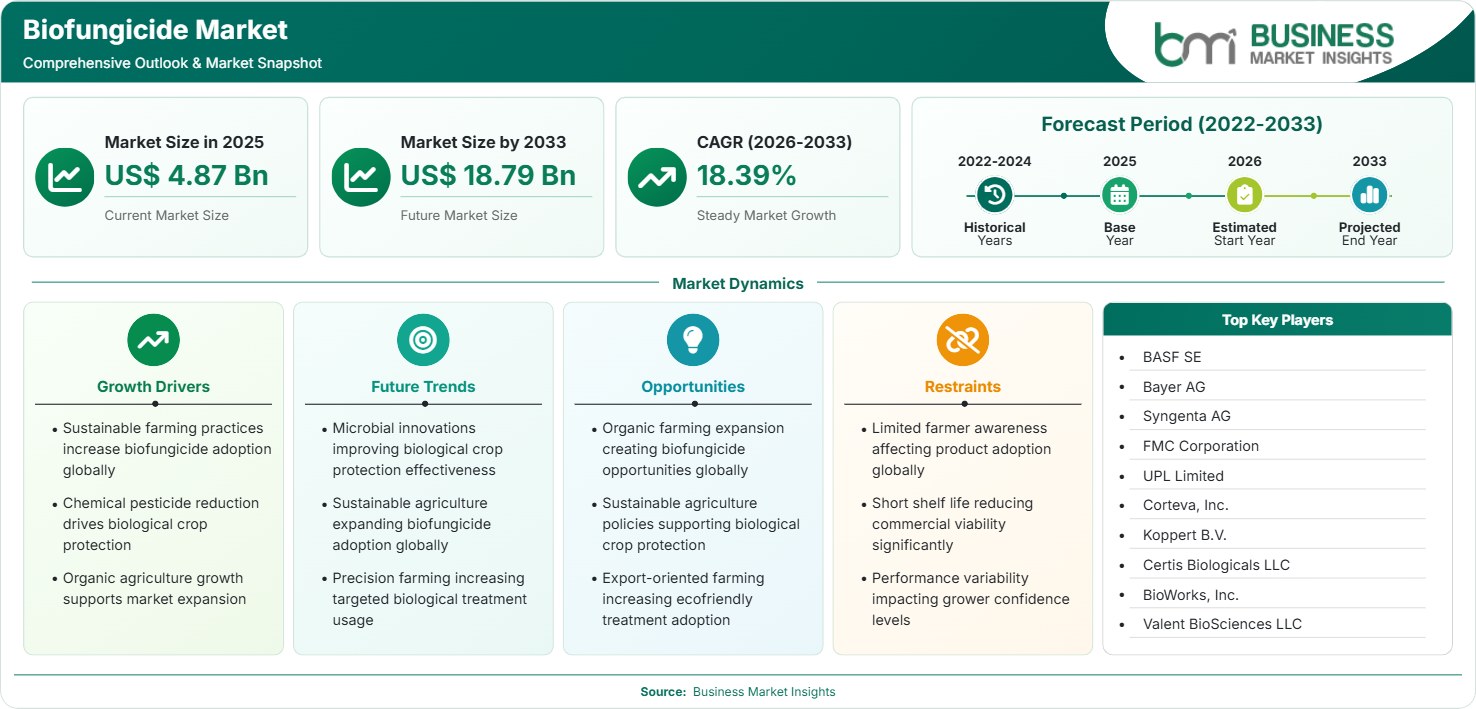
The Biofungicide Market size was valued at US$ 4.87 Billion in 2025 and is projected to reach US$ 18.79 Billion by 2033, growing at a CAGR of 18.39% during 2026–2033, driven by microbial innovation, resistance management, sustainable farming, residue reduction, and biological crop protection adoption.

Report Coverage
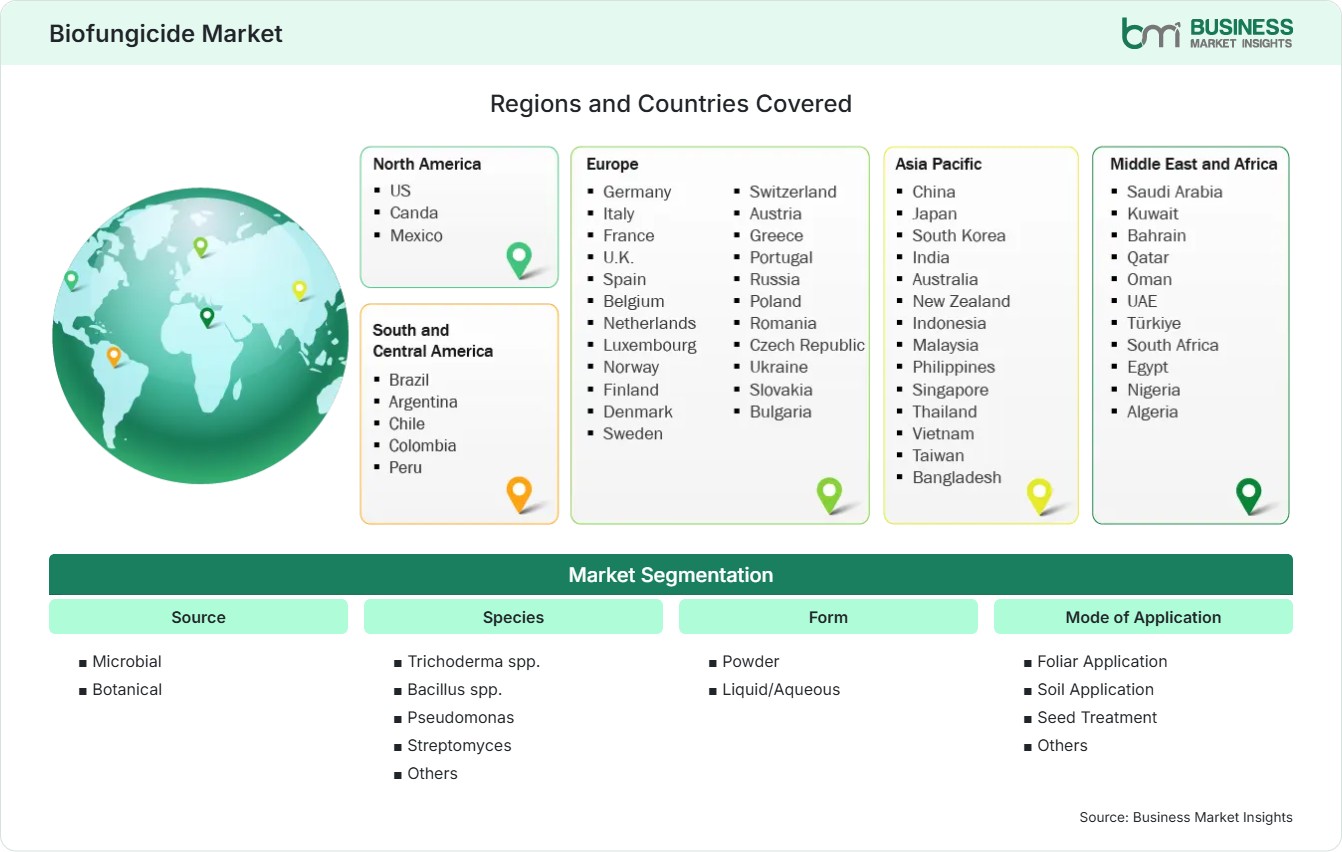
  • Source: Microbial, Botanical
  • Species: Trichoderma spp., Bacillus spp., Pseudomonas, Streptomyces, Others
  • Form: Powder, Liquid/Aqueous
  • Mode of Application: Foliar Application, Soil Application, Seed Treatment, Others
  • Crop Type: Cereals, Oilseeds, Fruits & Vegetables, Others
US$ 4.87 Bn Market size in 2025
US$ 18.79 Bn Market Size by 2033
18.39% CAGR, 2026 - 2033
2026-2033 Forecast Period

AI Overview

Biofungicide Market Summary

  • North America Region: North America holds a Biofungicide Market share of 34%–38% in 2025, growing at a 17%–19% CAGR during 2026–2033, supported by integrated pest management, biological registration activity, specialty crops, microbial formulation advances, and retailer-led sustainable agriculture programs. The US market benefits from established biological crop protection distribution, expanding biological portfolios, resistance-management requirements, and increasing adoption of microbial products across row crops and specialty agriculture, supporting a 17%–19% CAGR during 2026–2033.
  • Fastest Growing Region: Asia Pacific accounts for a 20%–24% share in 2025, with a 20%–22% CAGR during 2026–2033, supported by expanding protected cultivation, biological input adoption, residue-conscious exports, government sustainability programs, local fermentation capacity, and increasing farmer awareness.
  • Leading Segment: The Microbial source segment holds a 66%–70% share in 2025, with a 18%–20% CAGR during 2026–2033, supported by scalable fermentation, established Bacillus and Trichoderma platforms, biological compatibility, repeatable formulations, integrated disease management, and expanding registration pipelines.
  • High Growth Segment: Bacillus spp. represents a 20%–24% share in 2025, expanding at a 20%–22% CAGR during 2026–2033, supported by formulation stability, broad disease-management applications, spore resilience, seed-treatment compatibility, foliar use, soil colonization, and commercial scalability.
  • Key Market Opportunity: The strongest opportunity lies in combining microbial fungicides with precision application, seed treatment, resistant varieties, biostimulants, and digital agronomy to improve consistency, reduce chemical dependence, and expand biological adoption.
  • Major Market Players: BASF SE; Bayer AG; Syngenta AG; FMC Corporation; UPL Limited; Corteva, Inc.; Koppert B.V.; Certis Biologicals LLC; BioWorks, Inc.; Valent BioSciences LLC.
Strategic Insights

Biofungicide Market: Strategic Insights

Biofungicide Market Strategic Framework
FREE PDF
Request your free sample
Request free sample
Stakeholder View

Key Takeaways

  • Now more than ever, the way companies position themselves competitively relies on their ability to control the processes involving strain discovery, fermentation, formulation, registration, distribution, and technical support, which is why integrated biological value chains are of strategic importance.
  • Seed treatment, soil application, and foliar applications provide different ways of introducing the treatments, and products based on Bacillus are especially well suited to scalable formulations and their integration into standard disease-management programs.
  • Fermentation optimization, the use of microbial consortia, protein-based biologicals, better formulation stability, and the use of data to enable applications are all contributing to biological crop protection, moving away from being a niche offering and towards more predictable performance in the field.
  • There are considerable opportunities for expansion in India, China, Brazil, and some of the agricultural markets in Southeast Asia since intensive cropping, horticulture, the need to export, and awareness of the use of biological inputs are all increasing at the same time.
  • More money is now being invested in microbial discovery, in new modes of action, in fermentation facilities, and in distribution. In July 2025, Koppert made a strategic investment of €800,000 in Amoéba after entering into a five-year exclusive global distribution agreement for its biofungicide solution.
  • Whether or not promising biological technologies reach a commercial scale is more determined by registration evidence, shelf stability, compatibility with present crop programs, proven yield protection, and farmer education.
Geographic Outlook

Biofungicide Market Regional Highlights

North America Biofungicide Market

North America represented a 34%–38% Biofungicide Market share in 2025 and is projected to expand at a 17%–19% CAGR from 2026–2033. The region benefits from mature crop-protection distribution, strong biological research, specialty-crop demand, and resistance-management requirements. The US remains the principal market, while Canada contributes through controlled-environment agriculture and sustainable crop programs.

  • Familiarity with the regulations on microbial products lessens the difficulties involved in bringing such products to market for existing biological manufacturers, since the evidence required for registration now places greater emphasis on efficacy, safety, and practical performance in the field.
  • Specialty crops are attractive to adopt since residue management, the need to meet export requirements, and disease pressure all provide a valid reason for carrying out higher-value biological disease-management programs.
  • Retailers and crop consultants are now having an increasing influence on adoption by showing that their products are biologically compatible with ordinary fungicides, nutrition programs, and integrated disease-management programs.
  • The improvements in fermentation and formulation spending are helping to ensure a more consistent product, thus dealing with the past worries about its shelf life, the storage conditions required, and the varying performance in the field.

US Biofungicide Market

The US accounted for approximately 82%–86% of the North American Biofungicide Market revenue in 2025 and is projected to grow at a 17%–19% CAGR during 2026–2033. Adoption is supported by biological product registration, specialty agriculture, integrated pest management, and demand for resistance-management tools. Commercial development increasingly emphasizes performance validation under field conditions rather than sustainability claims alone.

  • Instead of completely replacing them, biologicals are now increasingly used in conjunction with synthetic fungicides, which allows farmers to develop rotation and resistance-management programs over the course of disease cycles.
  • The sale of specialty crops, products from greenhouses, and high-value horticulture is very profitable since damage from disease can have a material impact on the quality of the crops, their marketability, and the margins of the farm.
  • It is still important to carry out trials at the university level, make use of the extension networks, conduct independent agronomic tests, and hold demonstrations for retailers if confidence is to be built up regarding the biological performance under varying environmental conditions.

Europe Biofungicide Market

Europe held a 25%–29% Biofungicide Market share in 2025 and is projected to grow at an 18%–20% CAGR during 2026–2033. Germany, France, Italy, Spain, and the Netherlands represent important commercial markets, while Spain and the Netherlands provide strong opportunities in horticulture and protected cultivation. France and Germany benefit from established agricultural biotechnology capabilities.

  • Germany and France are still important markets for agricultural technology, with biological crop protection becoming an integral part of wider sustainable farming and resistance-management strategies.
  • Spain represents a high-value opportunity since intensive horticulture, the use of greenhouses, export-oriented production, and the presence of disease problems all lead to a demand for biological foliar and soil treatments.
  • The Netherlands has a highly innovative environment when it comes to biological crop protection since controlled-environment agriculture calls for precise disease-management solutions and a high level of application reliability.
  • As developers look for alternatives that act in different ways against resistant fungal pathogens and complicated diseases, novel biological platforms are becoming more noteworthy.

Asia Pacific Biofungicide Market

Asia Pacific represented a 20%–24% Biofungicide Market share in 2025 and is forecast to register a 20%–22% CAGR through 2033. China, India, Japan, Australia, and South Korea form major commercial markets, while India and China offer high-growth opportunities because of extensive cultivated areas, horticultural expansion, biological input adoption, and local manufacturing.

  • India is a market exhibiting high growth and in which microbial products are being used more in crop protection, soil health, horticulture, and integrated disease-management programs.
  • China carries out large-scale agricultural production while at the same time expanding its research into biological inputs, which provides opportunities for the development of locally adapted strains and for cost-effective microbial formulations.
  • In Japan and South Korea, there are technologically advanced markets which allow controlled cultivation, strict food quality requirements, and the use of precision agriculture to support high-end biological products.
  • Australia offers opportunities for the management of biological diseases in both horticulture and broadacre farming, especially in cases where resistance management and the aim of sustainable production affect the choice of inputs.

Rest of World Biofungicide Market

South and Central America together represented an estimated 8%–11% Biofungicide Market share in 2025, with a 19%–22% CAGR during 2026–2033. Brazil is the leading commercial market, supported by large-scale soybean, corn, cotton, sugarcane, and specialty-crop production. Argentina and Mexico provide additional opportunities as biological inputs become more integrated into commercial crop programs.

  • Brazil represents a foremost opportunity since biological agriculture is becoming more integrated into large-scale row-crop production, due to local manufacturing, technical networks, and the vast areas that are under planting.
  • Argentina has growth potential in the production of soybeans and cereals, since biological inputs can supplement conventional methods of managing disease and thus help to achieve more integrated crop programs.
  • In South Africa, there are opportunities in the production of fruits, vegetables, vineyards, and field crops, particularly because export requirements and the use of integrated pest-management practices affect the decisions taken regarding disease control.
  • Specialized opportunities are available in the Israeli and Gulf markets via protected cultivation, precision irrigation, the use of controlled environments, and technology-intensive horticulture, all of which require targeted biological disease-management tools.
Global Market Geography
FREE PDF
Request your free sample
Request free sample
Segment Analysis

Biofungicide Market Segmentation

Source

The Source segment is led by microbial solutions, representing 66%–70% Biofungicide Market share in 2025 and a 18%–20% CAGR during 2026–2034. Adoption is supported by established fermentation platforms, scalable production, biological compatibility, and expanding disease-management applications across commercial crops.

  • Microbial: Microbial formulations dominate commercial deployment because Bacillus, Trichoderma, Pseudomonas, and Streptomyces strains offer scalable production, diverse disease-control mechanisms, and compatibility with integrated crop-protection programs.
  • Botanical: Botanical products use plant-derived compounds and extracts to address fungal diseases, with adoption supported by natural-input demand, specialty crops, residue considerations, and formulation innovation.

Species

The Species segment is increasingly influenced by Bacillus and Trichoderma platforms, with the leading species category maintaining broad commercial adoption and a 20%–22% Biofungicide Market CAGR during 2026–2034. Strain selection and formulation determine performance.

  • Trichoderma spp: Trichoderma products support soil and root-zone disease management through antagonism, competition, enzyme activity, and plant-response mechanisms, making them relevant to horticulture and soil applications.
  • Bacillus spp.: Bacillus strains benefit from spore-forming stability, broad formulation compatibility, and multiple biological mechanisms, supporting rapid expansion across foliar sprays, seed treatments, and soil applications.
  • Pseudomonas: Pseudomonas solutions leverage rhizosphere colonization and antimicrobial activity, with opportunities in root disease management, seed treatment, and integrated soil-health programs.
  • Streptomyces: Streptomyces products provide antibiotic-producing microbial activity and disease suppression potential, creating applications in soil disease management and specialized crop-protection programs.

Form

Formulation selection affects storage, transport, application accuracy, and farmer convenience. Liquid and aqueous products remain important for foliar delivery, while powder formats offer logistical advantages. Both forms are projected to expand as manufacturers improve stability and application consistency.

  • Powder: Powder formulations offer transportation, storage, and concentration advantages while supporting seed treatment, soil incorporation, and preparation flexibility across different farm operating conditions.
  • Liquid/Aqueous: Liquid products simplify dilution and application, making them suitable for foliar sprays, fertigation-compatible programs, and commercial operations seeking consistent microbial distribution.

Mode of Application

Application method determines biological exposure, disease timing, and compatibility with existing crop practices. The category is expanding as manufacturers develop products specifically optimized for foliar, soil, and seed delivery systems.

  • Foliar Application: Foliar programs provide direct contact with disease-prone plant surfaces and enable integration with scheduled crop-protection passes, especially in fruits, vegetables, cereals, and high-value specialty crops.
  • Soil Application: Soil applications target root-zone pathogens and beneficial microbial establishment, with demand supported by soil-health programs, transplant production, and integrated disease-management systems.
  • Seed Treatment: Seed treatment provides early-stage protection and efficient microbial placement, creating opportunities for biological products that improve emergence, root-zone colonization, and early disease suppression.

Crop Type

Crop demand varies according to disease pressure, crop value, application frequency, and residue requirements. Fruits and vegetables provide high-value opportunities, while cereals and oilseeds support larger-volume commercial deployment.

  • Cereals: Cereal crops provide broad-volume opportunities for microbial disease-management products, particularly where biologicals complement seed treatment, foliar protection, and resistance-management programs.
  • Oilseeds: Oilseed production creates opportunities for biological products targeting soilborne and foliar diseases, with seed treatment offering efficient deployment across large cultivated areas.
  • Fruits & Vegetables: Fruits and vegetables support premium biological adoption because residue requirements, quality standards, intensive cultivation, and disease sensitivity can justify integrated biological protection.
Market Forces

Biofungicide Market Dynamics

Key Market Drivers

Expansion of microbial fermentation and formulation capabilities

By enhancing consistency of production, concentration of strains, and scalability of formulations, industrial fermentation is helping remove one of the biggest restrictions of biological crop protection. In May 2026, BASF will open the BioHub fermentation facility in Ludwigshafen, Germany, to produce biologically active substances, such as Bacillus amyloliquefaciens, for Serifel. This investment reflects the trend of biological manufacture transitioning from specialty to industrial facilities. The Biofungicide Market growth trajectory is increasingly connected to manufacturing quality because growers require stable products that can survive storage, transport, tank mixing, and variable field conditions.

Rising resistance-management requirements in crop protection

The rising problem of fungal resistance has increased the need for differentiation in modes of action as well as disease management programs. Biologicals can add to the repertoire of methods available through rotation, decreasing dependence on the repeated use of the same classes of chemicals. The launch of BASF’s Adapzo Active in 2026 highlights the industry's growing concern about new fungicidal modes of action and resistance management, even though the product itself falls under the category of conventional fungicides. These developments are strengthening Biofungicide Market trends around combination programs rather than simple chemical replacement.

Expansion of sustainable and integrated crop protection

There is a growing demand for inputs for integrated disease management systems as a result of sustainable agriculture programs. The Indian Agricultural Research Institute has noted a rising level of adoption of biological inputs, microbial products making up a major part of India's bio-input sector. In its 2025 analysis, microbial inputs were found to be the leading source category, showing that their use is increasing for both plant protection and soil-health purposes. This trend is supported by the demand for residue-conscious production, the need to comply with export requirements, and better soil management. Biological fungicides are especially important in cases where farmers need a variety of disease-control measures throughout the crop cycle.

Key Market Opportunities

Protein-based and engineered biological disease-control platforms

Because of protein-based and genetically engineered microbial technologies, developers now have the opportunity to deal with pathogens that are hard to control with conventional biological products. Biotalys has advanced its BioFun-6 product against Botrytis and powdery mildew and is also developing other programs targeting Phytophthora and Alternaria. In 2025 and 2026, field trials were carried out in both Europe and the United States, and the collaboration models have been extended to include various academic and agricultural research organizations. These technologies might offer more specific activity and lower application rates compared to conventional microbial products, although regulatory validation and manufacturing economics are still important.

Digital agriculture and precision biological application

The precision agriculture model can enhance biological efficiency through synchronized delivery with respect to time, dosage, environment, disease susceptibility, and growth stage. Disease risk windows when biologicals are most likely to provide value can be identified through sensors, satellite imagery, field scouting, weather modeling, and agronomic software. In doing so, it will be possible for biological products to be sold as part of a crop program enabled by technology. Biofungicide Market Forecasts increasingly need to account for this convergence between biological chemistry and digital decision support because adoption depends on reliable field execution.

High-value horticulture and export-oriented agriculture

Fruits, vegetables, grapes, berries, and crops grown in greenhouses and other high-value agricultural systems offer a commercially appealing setting for the use of biological methods to control diseases, since crop quality and residue requirements have a direct impact on the farm's economic situation. This potential is demonstrated by Koppert's partnership with Amoéba, which involves the two companies creating an amoeba-based biofungicide for fungal diseases such as downy mildew and powdery mildew in grapes and vegetables. These types of applications can help establish a premium position, as farmers can address residue management, market access, and disease protection simultaneously.

Market Restraints and Challenges

Variable field performance and environmental sensitivity

The effectiveness of microorganisms can depend on temperature, humidity, ultraviolet exposure, soil conditions, pathogen pressure, crop stage, and the timing of application. This variability in performance may delay farmers' willingness to adopt the product and lead to a greater requirement for additional chemical protection. While similar to many synthetic fungicides, live microbial products might need carefully controlled methods for both storage and application to keep them viable. Although formulation technologies are helping to improve stability, manufacturers still have to show that the product performs consistently in a wide range of agricultural environments.

Registration complexity and commercialization costs

The need for biological products to be accompanied by regulatory documentation relating to strain identity, safety, efficacy, environmental behavior, manufacturing quality, and their intended agricultural use has the effect of leading to long registration procedures, which can delay market launch and raise development costs, especially in the case of new organisms and engineered biological platforms. Moreover, regulatory requirements differ from one jurisdiction to another, resulting in extra costs for companies that wish to commercialize their products on a global scale.

Company Analysis

Competitive Landscape

The competitive structure combines diversified agricultural companies with specialist biological developers. Biofungicide Market analysis indicates that differentiation increasingly depends on microbial discovery, fermentation capacity, formulation quality, registration expertise, field validation, distribution reach, and integration with broader crop-protection portfolios.

Company Name

Overview

Products and Services relevant to this market

BASF SE

Global agricultural science company with substantial crop-protection R&D, formulation, manufacturing, and distribution capabilities across major farming regions.

Biological fungicides, microbial active ingredients, seed treatment technologies, crop-protection formulations, disease-management programs, and agricultural technical services.

Bayer AG

Diversified life-science company with a major Crop Science business covering seeds, crop protection, biological research, and digital agriculture.

Biological crop protection, fungicide solutions, seed technologies, integrated disease management, digital agronomy, and biological R&D platforms.

Syngenta AG

Global agricultural technology company serving row crops and specialty agriculture through crop protection, seeds, and biological innovation.

Biological crop protection, fungicides, microbial research, integrated disease management, seed solutions, and agricultural technology services.

FMC Corporation

Agricultural sciences company developing crop protection technologies and expanding its biological solutions portfolio across international markets.

Biofungicides, biological crop protection, microbial formulations, integrated disease-management products, crop protection technologies, and agronomic support.

UPL Limited

Global agricultural input company with broad biological, crop protection, seed, and sustainable agriculture capabilities across emerging and developed markets.

Biological fungicides, biocontrol products, crop protection formulations, integrated farming solutions, and sustainable agriculture technologies.

Corteva, Inc.

Agricultural technology company combining seeds, crop protection, biological research, and farmer-focused agricultural solutions across major crop markets.

Biological crop protection, fungicides, seed treatment, microbial technologies, crop protection products, and agronomic solutions.

Koppert B.V.

Biological crop protection specialist with strong expertise in biocontrol, beneficial organisms, microbial products, and protected cultivation.

Biological fungicides, microbial disease management, biocontrol systems, integrated pest management, greenhouse solutions, and technical services.

Certis Biologicals LLC

Specialist biological crop protection company focused on microbial and biological products for commercial agriculture and specialty crops.

Microbial fungicides, biopesticides, integrated disease management, formulation technologies, and biological crop protection programs.

BioWorks, Inc.

Biological crop protection specialist supplying microbial solutions for horticulture, agriculture, greenhouse, nursery, and turf applications.

Microbial fungicides, biological disease management, soil and foliar products, integrated programs, and technical crop-support services.

Valent BioSciences LLC

Biologicals specialist with expertise in microbial technologies and biological agricultural products serving growers across global markets.

Microbial crop protection, biological fungicides, fermentation-derived technologies, plant health products, and integrated agricultural solutions.

Trust & Transparency

Research Methodology

The market analysis combines proprietary research with secondary data from government agencies, company disclosures, regulatory filings, industry databases and expert interviews. Market estimates are validated through data triangulation, cross-market benchmarking and analyst review.

View Full Research Methodology

Questions Answered

Frequently Asked Questions

Which applications provide opportunities beyond conventional foliar spraying?

Seed treatment and soil application provide important expansion pathways because they place beneficial microorganisms near emerging roots or within the rhizosphere. These applications can support early disease management and improve integration with crop establishment, soil-health, and precision agriculture programs.

What role does fermentation play in biological fungicide production?

Fermentation determines microbial biomass, concentration, consistency, and production scalability. Dedicated fermentation infrastructure allows manufacturers to improve supply reliability and control critical production parameters. Recent investment in industrial biological manufacturing demonstrates the growing importance of fermentation as a strategic capability.

How are biological fungicides being integrated with conventional fungicides?

Many commercial programs use biological products alongside conventional fungicides rather than treating them as direct substitutes. Biologicals can contribute to rotation strategies, disease prevention, resistance management, and residue-conscious production while conventional products provide additional curative or broad-spectrum control when required.

Why are Bacillus-based products gaining commercial attention?

Bacillus species offer spore-forming characteristics that can support formulation stability and storage. Their biological activity can involve antimicrobial metabolites, competition, colonization, and plant-response mechanisms, enabling use across seed treatment, soil application, and foliar disease-management programs.

What factors determine the commercial success of microbial fungicides?

The Biofungicide Market Report highlights that Commercial success depends on strain efficacy, formulation stability, shelf life, compatibility with farm practices, registration status, application convenience, field consistency, distribution coverage, and technical support. Products that demonstrate reliable disease suppression across multiple environmental conditions have stronger potential for repeat adoption.

Access the Full Biofungicide Market Report

Get segment-level forecasts, regional estimates, competitive benchmarking, company profiles and downloadable Excel datasets.

Access the full Biofungicide Market Report
350 pages PDF & Excel | 2026-11-03
Similar Research

Related Market Reports