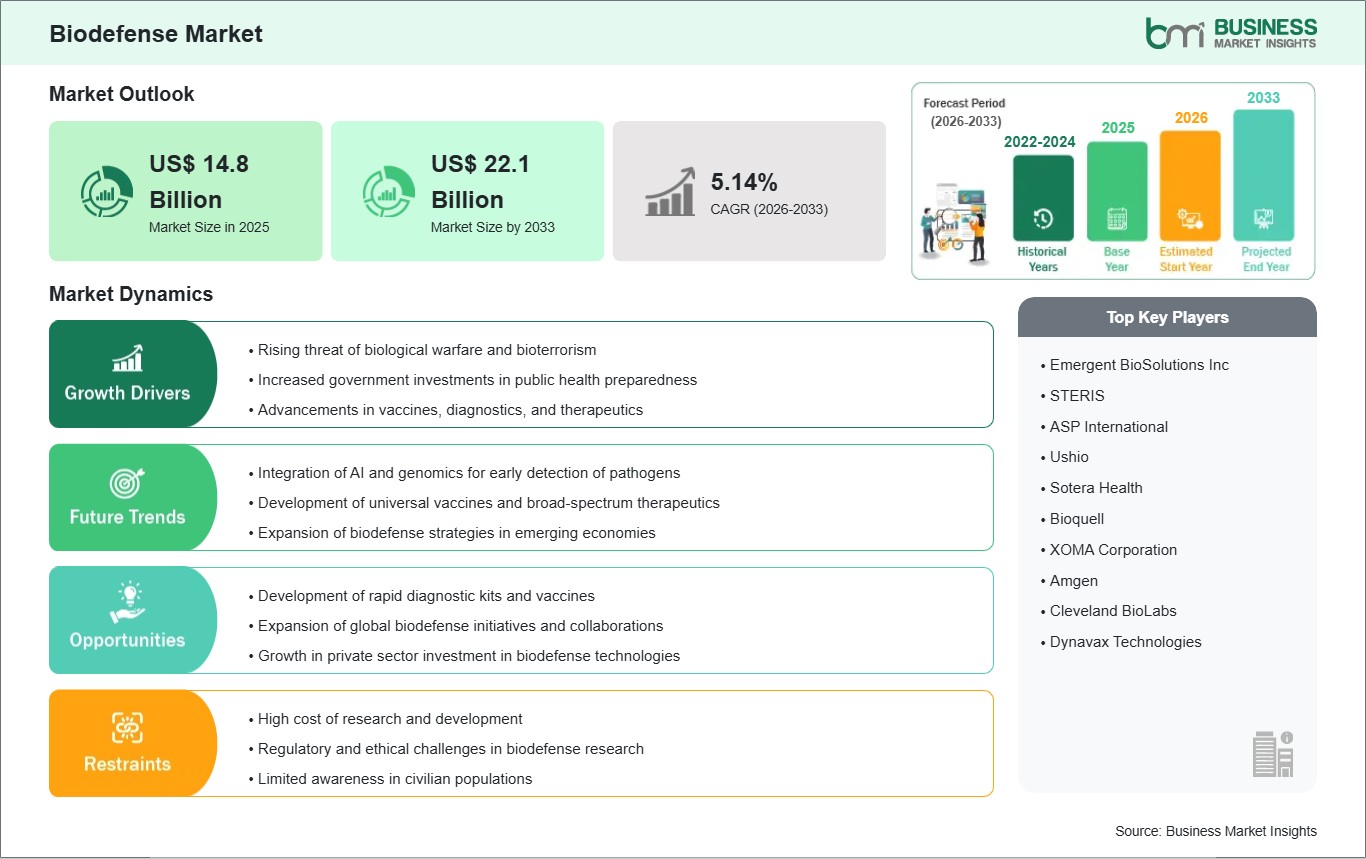
The Biodefense Market size is expected to reach US$ 22.1 Billion by 2033 from US$ 14.8 Billion in 2025. The market is estimated to record a CAGR of 5.14% from 2026 to 2033.
Biodefense is a term for the different ways, measures, and technologies that are used to protect the human race, infrastructure, and economy from living things of biological origin that threaten them directly or indirectly. These biological threats may include infectious diseases that occur naturally, the use of biological agents in warfare, and the accidental release of pathogens. The main activities involved in biodefense are surveillance, early detection, diagnostics, vaccines, therapeutics, and emergency response systems.
The global biodefense market has been heightened due to the rise in the number of infectious disease outbreaks, political disputes, and daily concerns about bioterrorism. The use of genomics, synthetic biology, and rapid diagnostic tools is among the technological advances that have greatly reduced the time and increased the accuracy of threat detection. Also, the use of innovative vaccine platforms and therapeutics is already improving the capability of preparedness and response. Cooperation between governments and private organizations for building public health infrastructure and developing strong biodefense strategies is becoming more frequent. North America is the geographical leader in biodefense activities because of its large government funding and sophisticated research capabilities, while Europe and the Asia-Pacific are quickly increasing investments due to health security concerns. Emerging economies are realizing the necessity of biodefense as well by concentrating on disease surveillance, capacity building, and regional collaboration. In a nutshell, the global market for biodefense has been witnessing the factors of increasing awareness, technological innovation, and strategic initiatives that are aimed at mitigating the biological risks and at the same time protecting public health across the world.

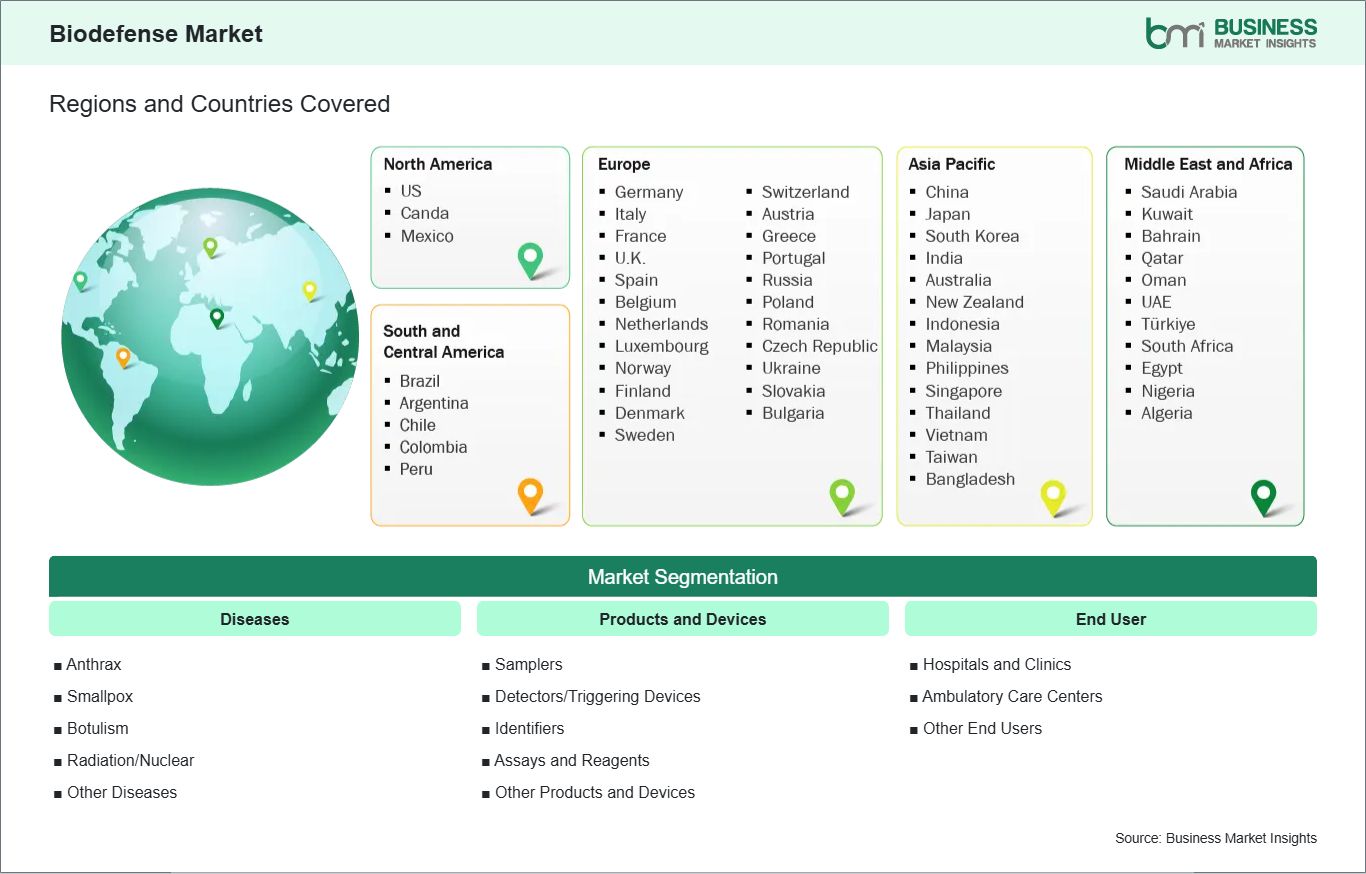
Key segments that contributed to the derivation of the biodefense market analysis are diseases, products and devices, and end user.
One of the main factors driving the biodefense market is the global public awareness of biological threats, which are also supported by the governments' enormous investments aimed at making their preparedness and response systems better. In recent studies or analyses, the big fears of pandemics, bioterrorism, and rising infectious diseases have led governments and defense organizations to place biodefense funding as one of their priorities, particularly in the case of bio-surveillance, diagnostics, and vaccine platforms.- Besides that, the investments in AI-powered detection and real-time threat monitoring systems by both tech giants and defense entities are making the early warning capabilities and the rapid response actions across the whole sector stronger. The public-private partnerships and the strategic initiatives like Project BioShield and BARDA (Biomedical Advanced Research and Development Authority) are also the factors that continuously push the development of medical countermeasures through innovation, thus keeping biodefense as a sustained policy and funding priority for national security and public health readiness.
The biodefense market offers a great chance for the development of AI-based bio-surveillance and function-based biosecurity screening technologies. These technologies will be able to fill the gaps in threat detection and response, which are just opening up. Traditional DNA screening methods based on homology have so far missed some of the novel AI-designed protein threats, and this has led to the demand for the new-generation function-oriented screening standards that will allow more robust biosecurity measures. Furthermore, research conducted by the industry points to the opening of new avenues in the areas of AI-powered predictive health analytics, nanotech biosensors, and integrated bio-surveillance networks that can operate in almost real-time by monitoring genomic and epidemiological data simultaneously. The mentioned new technologies will allow the quick discovery of unknown agents and also the more accurate prediction of the areas where the disease might spread, which is a crucial advantage in the fight against or control of biological events. Besides, the collaborations among the tech companies, biotechnology firms, and government sectors are one of the major factors that speed up the research, development, and introduction of these cutting-edge tools into the market, thus creating new areas of biodefense innovation.
By diseases, the biodefense market is categorized into anthrax, smallpox, botulism, radiation/nuclear, other diseases. The anthrax segment held the largest share of the market in 2025. Anthrax remains the leading segment due to its high-profile use in bioterrorism and the ease with which spores can be stored and disseminated. Governments prioritize research, vaccines, and emergency response systems for anthrax, making it a focal point in biodefense programs. Its potential for rapid infection and high fatality rates drives continuous funding, surveillance, and stockpiling of medical countermeasures, ensuring anthrax-related solutions dominate the disease-focused biodefense market.
By products and devices, the market is segmented into samplers, detectors/triggering devices, identifiers, assays and reagents, other products and devices. The detectors/triggering devices segment held the largest share of the market in 2025. Detectors and triggering devices lead this segment because rapid identification of biological threats is critical for timely response. These devices enable early warning systems in public spaces, hospitals, and military settings, minimizing casualties and spread. Continuous technological improvements, including portable and automated detectors, have enhanced sensitivity and reliability. Governments and organizations heavily invest in these systems to ensure national security, making detectors indispensable components of biodefense infrastructure.
By end user, the biodefense market is segmented into hospitals and clinics, ambulatory care centers, other end users. The hospitals and clinics segment dominated the market in 2025. Hospitals and clinics are the primary end users as they serve as the first line of defense in managing biological incidents. They require rapid diagnostic tools, vaccines, and treatment protocols to address sudden outbreaks or exposure events. Investment in infrastructure, staff training, and emergency preparedness ensures hospitals can respond effectively, making them the dominant end-user segment in the biodefense market globally.
| Report Attribute | Details |
|---|---|
| Market size in 2025 | US$ 14.8 Billion |
| Market Size by 2033 | US$ 22.1 Billion |
| Global CAGR (2026 - 2033) | 5.14% |
| Historical Data | 2022-2024 |
| Forecast period | 2026-2033 |
| Segments Covered | By Diseases
|
|
Regions and Countries Covered
| |
| North America | US, Canada, Mexico |
| Europe | Belgium, Austria, Finland, Denmark, Greece, Poland, Romania, Russia, Ukraine, Czech Republic, Slovakia, Bulgaria, Italy, Luxembourg, Germany, Switzerland, France, Netherlands, Norway, Portugal, Spain, Sweden, United Kingdom |
| Asia-Pacific | Australia, China, India, Japan, South Korea, Indonesia, Malaysia, Philippines, Singapore, Thailand, Vietnam, Bangladesh, New Zealand, Taiwan |
| South and Central America | Brazil, Argentina, Peru, Chile, Colombia |
| Middle East and Africa | Bahrain, Kuwait, Oman, Qatar, Saudi Arabia, United Arab Emirates, Turkiye, South Africa, Egypt, Algeria, Nigeria |
| Market leaders and key company profiles |
|
The " Biodefense Market Size and Forecast (2022–2033)" report provides a detailed analysis of the market covering below areas:
The geographical scope of the biodefense market report is divided into five regions: North America, Asia Pacific, Europe, Middle East & Africa, and South & Central America. The biodefense market in Asia Pacific is expected to grow significantly during the forecast period.
The Asia-Pacific biodefense market is segmented into China, Japan, South Korea, India, Australia, New Zealand, Indonesia, Malaysia, the Philippines, Singapore, Thailand, Vietnam, Taiwan, Bangladesh, and the Rest of Asia. The Asia-Pacific biodefense market is experiencing robust growth, driven by increased public health preparedness, government investments, and the expansion of healthcare infrastructure. Disease outbreaks and biosecurity issues have been the primary drivers of this trend. The countries of China, India, Japan, and South Korea are making significant investments in bio-surveillance systems, rapid diagnostics, and pandemic response capabilities, which are clear indications of their proactive approach toward future biological emergencies. Governments in the region are not only establishing disease detection networks but also improving laboratory capacity, mostly by utilizing the funding and policy support that resulted from COVID-19 preparedness gap exposure. They are also the beneficiaries of the increased global focus on biodefense, which includes collaborative programs like multi-country initiatives, backed by the WHO and partners, to strengthen surveillance and diagnostic readiness in South-East Asia.
The large and densely populated region is not only home to various pathogens but also one of the places where the transmission of infectious diseases takes place easily. This has caused the public and private sectors to resort to the use of advanced technologies, which include genomics, AI-enabled detection tools, and rapid vaccine development platforms, among others. The region's rise in healthcare spending and biosecurity policies not only contribute but also elevate the growth prospect of the market for your business, since such policies are increasingly looking at integrating and cross-disciplinary approaches to public health and national security.

The biodefense market is evaluated by gathering qualitative and quantitative data post primary and secondary research, which includes important corporate publications, association data, and databases. A few of the key developments in the biodefense market are:
The Biodefense Market is valued at US$ 14.8 Billion in 2025, it is projected to reach US$ 22.1 Billion by 2033.
As per our report Biodefense Market, the market size is valued at US$ 14.8 Billion in 2025, projecting it to reach US$ 22.1 Billion by 2033. This translates to a CAGR of approximately 5.14% during the forecast period.
The Biodefense Market report typically cover these key segments-
The historic period, base year, and forecast period can vary slightly depending on the specific market research report. However, for the Biodefense Market report:
The Biodefense Market is populated by several key players, each contributing to its growth and innovation. Some of the major players include:
The Biodefense Market report is valuable for diverse stakeholders, including:
Essentially, anyone involved in or considering involvement in the Biodefense Market value chain can benefit from the information contained in a comprehensive market report.
Please tell us your area of interest
(Market Segments/ Regions and Countries/ Companies)